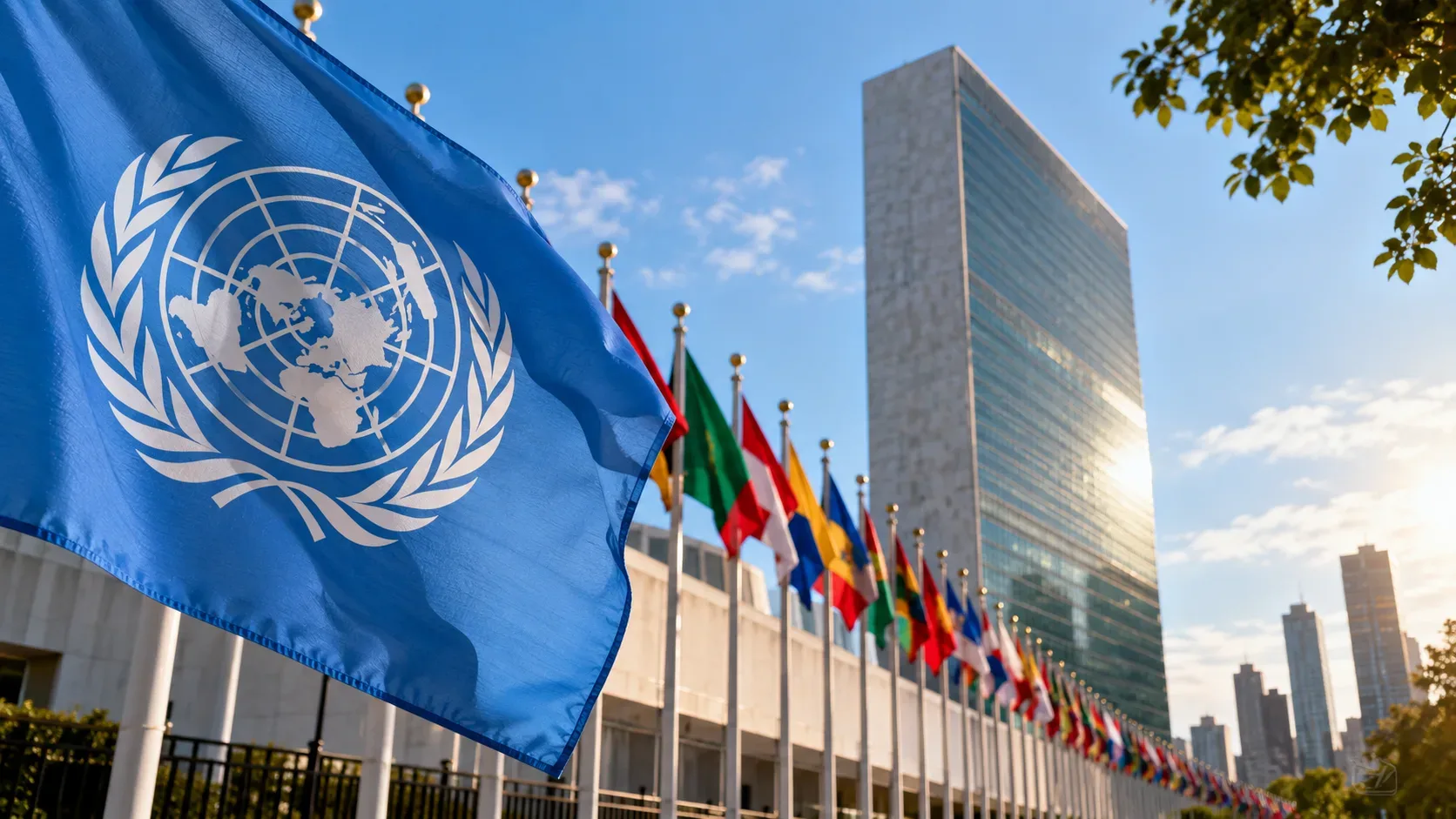
The 81st session of the United Nations General Assembly opened on 8 September 2026, but the main concentration of high-level events comes later in the month. The UN's official page defines High-level Week as running from 18 to 28 September, beginning with the SDG Moment and culminating in the final day of the General Debate and the meeting marking the 25th anniversary of the Durban Declaration and Programme of Action.
For coverage planning, the key distinction is this: the General Debate is primarily a sequence of national speeches, while some thematic high-level meetings have their own mandates and may approve or forward negotiated political declarations. Not every high-level event therefore produces a collective decision.
When is the 2026 UN General Assembly General Debate?
The General Debate of the 81st session begins on Tuesday, 22 September, continues through Saturday, 26 September, and concludes on Monday, 28 September 2026. Sunday, 27 September, is not part of the sequence of General Debate sessions. This is confirmed both by the official schedule for the 81st session and the High-level Week 2026 page.
The General Debate will be presided over by Khalilur Rahman of Bangladesh, President of the 81st session, under the theme “Restoring trust, managing transformation: A United Nations that delivers for all”. In practice, Heads of State and Government use this forum to set out priorities, positions and assessments of global crises and issues.
What the General Debate is not: a single vote on the world's agenda. A speech may announce a national position, initiative or pledge, but it does not automatically become a General Assembly decision. To determine whether there was an institutional outcome, check whether a resolution, decision, political declaration or other document was adopted through a separate process.
Timeline: what to watch from 18 to 29 September
The times below are the UN's published New York times. The schedule is official, but some operational details and outcome documents may still be updated before the meetings.
| Date | Main event | What to watch in coverage |
|---|---|---|
| 18 Sep | SDG Moment, 10 a.m.–1 p.m. | A mobilization event on the Sustainable Development Goals. It highlights progress, gaps, partnerships and commitments; the UN does not present it as a session designed to approve a negotiated declaration. |
| 21 Sep | SDG Media Zone begins | An interview and discussion platform running through 25 September. It can generate news and announcements, but it is not a decision-making meeting of the General Assembly. |
| 22 Sep | Day 1 of the General Debate | Leaders' speeches begin. Editorially, the task is to identify national priorities, shifts in position and concrete announcements without treating them as collective UN decisions. |
| 23 Sep | General Debate; 40th anniversary of the Declaration on the Right to Development; Climate Action and Just Transition event | The most crowded day. The right-to-development meeting runs 10 a.m.–1 p.m. and 3–6 p.m.; the Secretary-General's climate event runs 3–6 p.m. Alongside national speeches, watch for commitments, finance, energy-transition signals and development messages. |
| 24 Sep | General Debate; High-level Meeting on Sea Level Rise, 10 a.m.–1 p.m. and 3–6 p.m. | There is an intergovernmental process for a concise, action-oriented declaration on sea-level rise. The final text and its adoption are the decision point to monitor, alongside resilience, finance, continuity of states and protection of coastal populations. |
| 25 Sep | General Debate; High-level Meeting on Pandemic Prevention, Preparedness and Response, 10 a.m.–6 p.m. | The UN explicitly says the meeting is expected to approve a concise, action-oriented political declaration negotiated in advance by consensus, for subsequent adoption by the Assembly. |
| 26 Sep | General Debate continues | A day of speeches. The main 81st-session schedule does not list another major thematic high-level meeting for this date. |
| 27 Sep | General Debate break | There is no General Debate session. It is a useful day to consolidate positions, documents and announcements made from 22 to 26 September. |
| 28 Sep | Final day of the General Debate; 25th anniversary of the Durban Declaration and Programme of Action, 10 a.m.–1 p.m. and 3–6 p.m. | In addition to the final speeches, coverage should follow the political process on racism, racial discrimination, xenophobia and related intolerance. A dedicated political-declaration process has taken place; the formal result should be checked against the adopted text. |
| 29 Sep | High-level meeting on the total elimination of nuclear weapons, 10 a.m.–1 p.m. and 3–6 p.m. | This falls outside the 18–28 September range highlighted at the top of High-level Week, but it is part of the official sequence of high-level meetings for the 81st session. The focus is political signalling on nuclear disarmament; the schedule itself does not announce a new negotiated declaration as a mandatory outcome. |
18 September: the SDG Moment opens the high-level programme
The 2026 SDG Moment is scheduled for 18 September, from 10 a.m. to 1 p.m., in the General Assembly Hall. Convened by the Secretary-General under resolution 74/4, it is designed to showcase progress, identify gaps and mobilize support to accelerate the Sustainable Development Goals through 2030.
For coverage, the useful distinction is between political commitment and mobilization and formal decision-making. The programme includes messages from leaders, multi-stakeholder dialogues and calls to action, but the official page does not present the SDG Moment as a negotiation of a resolution or political declaration.
23 September brings together the right to development and climate
40th anniversary of the Declaration on the Right to Development
The commemorative high-level meeting is scheduled in two blocks, from 10 a.m. to 1 p.m. and from 3 to 6 p.m. The resolution organizing the cycle also requests a Secretary-General report on efforts to promote and realize the right to development and provides for participation by relevant UN mechanisms.
That gives coverage a review-and-implementation angle. As of the official schedule consulted on 9 September, the UN does not highlight a mandatory negotiated political declaration for this meeting comparable to the pandemic or sea-level-rise meetings. It is therefore safer to treat speeches and reports as the meeting's political and substantive outputs without pre-announcing a final document that has not been formally listed.
Climate Action and Just Transition
On the same day, from 3 to 6 p.m., the Secretary-General convenes a high-level event on climate action and the just transition. The official agenda emphasizes three tracks: accelerating a just and orderly energy transition to renewables, scaling up affordable finance and investment for developing countries, and strengthening adaptation and resilience.
This format can produce voluntary announcements, government commitments, financing signals and coalition-building. It should not automatically be treated as a General Assembly plenary designed to vote on a resolution.
24 September: sea-level rise can produce its own political outcome
The High-level Meeting on Sea Level Rise will take place in two blocks, from 10 a.m. to 1 p.m. and from 3 to 6 p.m. The UN describes it as an effort to build common understanding, mobilize political leadership and expand cooperation in response to the existential threats associated with rising seas, with particular attention to small island developing states and low-lying coastal areas.
The key point for coverage is that there is a specific intergovernmental process to negotiate a concise, action-oriented declaration. Unlike a speech in the General Debate, the meeting can therefore produce a collective political text. Until formal adoption, however, the final content should be treated as pending and subject to negotiation.
25 September: a political declaration on pandemics is planned
The High-level Meeting on Pandemic Prevention, Preparedness and Response will run from 10 a.m. to 6 p.m. and includes a plenary, two multi-stakeholder panels and a closing segment. Its theme is a multilateral and intergenerational approach to preventing, preparing for and responding to pandemics and public-health emergencies based on equity and solidarity.
The institutional difference is explicit: the UN says the meeting will approve a concise, action-oriented political declaration agreed in advance by consensus through intergovernmental negotiations, to be submitted by the President of the General Assembly for adoption by the Assembly. For journalists and analysts, that document matters more than any single speech when measuring the meeting's collective outcome.
28 September: Durban shares the day with the close of the General Debate
28 September combines the final round of General Debate speeches with the high-level meeting marking the 25th anniversary of the Durban Declaration and Programme of Action, a central international framework against racism, racial discrimination, xenophobia and related intolerance.
The Assembly set specific modalities for the meeting and an intergovernmental process has been devoted to a political declaration. Coverage should therefore look for the final adopted text and any divergent state positions, rather than treating the event as purely commemorative.
How to separate “speech” from “decision” when covering UNGA 81
- General Debate speech: expresses a country's position or announces a national commitment; it is not, by itself, a UN decision.
- Secretary-General-convened event: may generate commitments, coalitions and announcements, but there is an institutional decision only if a formal mechanism exists.
- General Assembly high-level meeting: may have a mandate to approve a political declaration or other document, depending on the resolution or decision that convened it.
- Political declaration: is a negotiated collective outcome with political weight, but it should not automatically be confused with a legally binding treaty.
- General Assembly resolution or decision: should be verified by document number, adopted text and the official record of the meeting.
Where to follow the official schedule and outcomes
For planning, the most useful reference is the General Assembly High-level Week 2026 page, which brings together dates, times and event descriptions. The 81st-session meeting schedule lists the high-level meetings and their mandates. Live broadcasts are available on UN Web TV.
During the week, these pages should be checked daily. The basic schedule is already set, but speaker order, final documents, negotiated drafts and operational details can change. For factual coverage, the right moment to say a declaration was adopted is after the official decision is recorded, not merely because the meeting was scheduled to produce one.