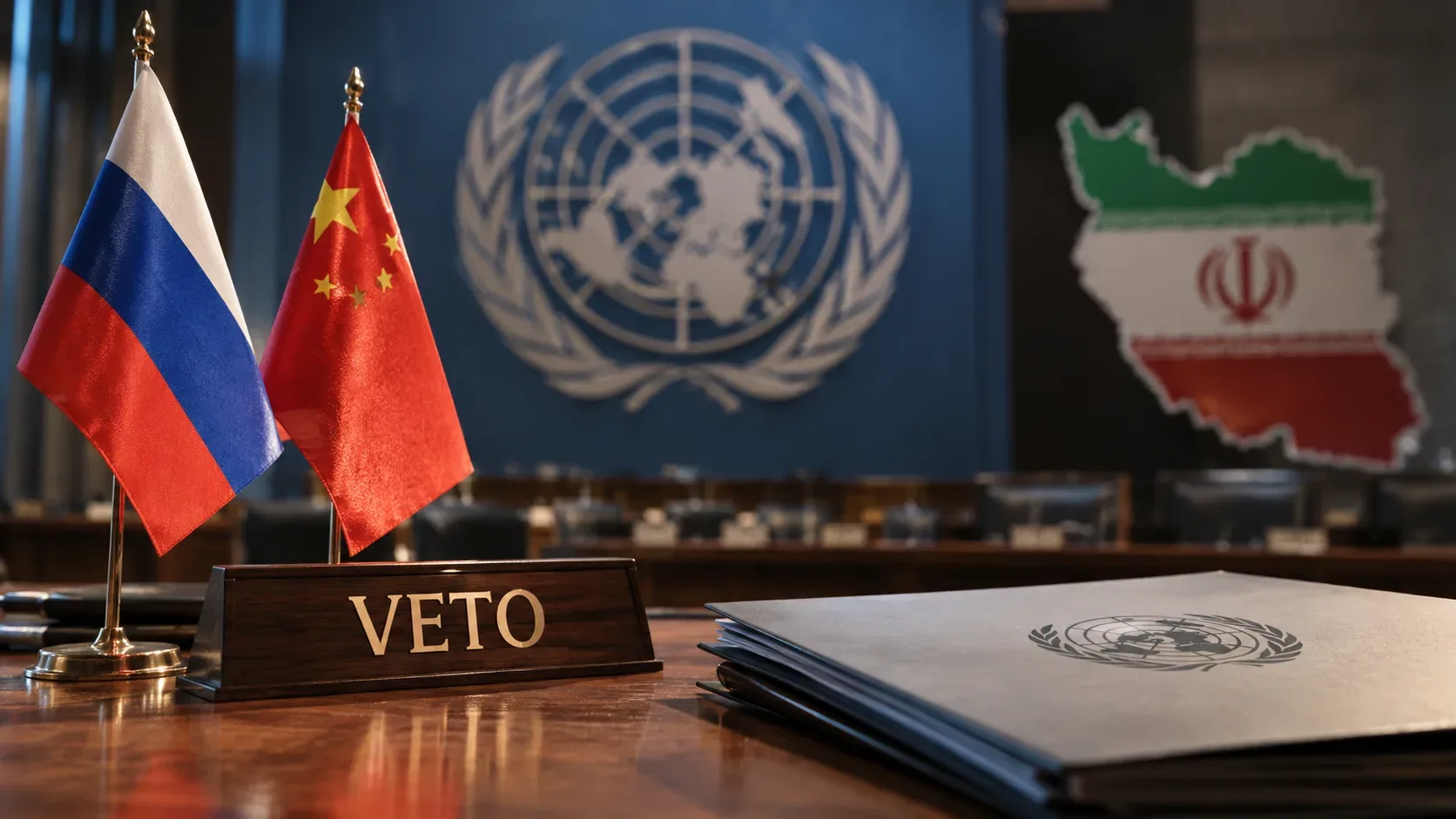
Russia and China vetoed a draft resolution on September 17, 2026 that would have extended the mandate of the Panel of Experts linked to the UN sanctions regime on Iran. The text received 11 votes in favor, while Pakistan and Somalia abstained. The panel's current mandate expires on September 26, 2026. The vote, however, was not a decision to cancel the sanctions themselves. It blocked the continuation of the independent expert mechanism intended to investigate implementation of the measures, gather evidence on possible violations, and make recommendations to the Security Council.
There is an important qualification. According to Reuters, the Council had already been operating for about a year without a functioning panel of experts because members could not reach consensus on appointments. The immediate effect of the veto is therefore not the shutdown of a normally operating team. Its main effect is to close the path, once the current mandate expires, to reconstituting that independent mechanism and to prolong a monitoring gap that already existed in practice.
What exactly was vetoed
The vote concerned renewal of the Panel of Experts created to support the Security Council's 1737 Committee. According to the UN's official page on the panel, it may include up to eight experts and is tasked with gathering, examining, and analyzing information supplied by states, UN bodies, and other parties about implementation of the sanctions, especially possible cases of non-compliance.
The panel can also recommend steps to improve implementation and submit reports to the Council. In other words, it is a technical layer of investigation and analysis. It is not the sanctions regime itself, and it does not replace the 15 members of the Security Council in decision-making.
The US-sponsored draft sought to keep that mandate in place for another year. Russia and China, both permanent members of the Council, voted against it. Because substantive Security Council decisions can be blocked by a negative vote from a permanent member, the draft was not adopted.
Did the veto remove the UN sanctions?
Not according to the institutional framework currently maintained by the United Nations. The official 1737 Committee page states that the pre-2015 measures were re-applied on September 27, 2025 through the process set out in Resolution 2231. That is the operational basis the UN uses to maintain the sanctions regime and the related list again.
Russia and China, however, dispute the legal validity of that return. In its September 17 explanation of vote, the Russian mission argued that the snapback mechanism had not been validly triggered and therefore that neither the 1737 Committee nor its panel had a legal basis. Reuters reported that China and Russia advanced a similar position at the meeting and accused Western countries of politicizing the Council.
Two statements therefore need to be kept separate. In the institutional operation published by the UN, the sanctions have been re-applied and continue to be treated as in force. Russia and China reject that interpretation and contest the legitimacy of the snapback. The September 17 veto did not resolve that legal dispute. It only prevented renewal of the panel.
What remains in the sanctions regime listed by the UN
The Security Council's current documentation continues to list measures related to nuclear proliferation and systems capable of delivering nuclear weapons. Elements of the regime include:
- restrictions on transfers to Iran of items, materials, and technology connected to enrichment, reprocessing, heavy water, and other proliferation-sensitive activities;
- restrictions related to technology and assistance for activities involving missiles capable of delivering nuclear weapons;
- measures concerning conventional arms under the re-applied resolutions;
- asset freezes and travel restrictions applying to designated individuals and entities under the regime's criteria and lists;
- financial vigilance and prevention measures intended to keep services, assets, or resources from contributing to proliferation-sensitive nuclear activities or nuclear weapon delivery systems.
The sanctions list materials page currently reports 43 individuals and 78 entities on the re-established 1737 list. That illustrates why ending the panel and ending the sanctions are different matters: the list and the measures remain published as part of the UN regime, even though Russia and China challenge its legal foundation.
What the monitoring gap means in practice
Without the Panel of Experts, the Council loses a team dedicated to cross-checking information, investigating incidents, analyzing evasion networks, and producing independent reports with recommendations. That work differs from receiving diplomatic positions from governments because the panel was designed to bring together technical expertise in non-proliferation, conventional arms, nuclear technology, missiles, export controls, customs, finance, and maritime transport.
The 1737 Committee itself does not disappear within the framework currently maintained by the UN. The official description of its mandate says it consists of all 15 Security Council members and can seek information from states, handle exemption requests, examine implementation reports, deal with designations, and report to the Council. Its decisions are made by consensus.
This means a political and administrative channel for the sanctions regime remains, but without the same independent technical investigative capacity that a fully staffed panel could provide. Because the panel had already gone without appointed experts, the veto turns what had been a staffing deadlock into a loss of mandate after September 26.
The veto does not end IAEA nuclear inspections
The UN Panel of Experts and the International Atomic Energy Agency, or IAEA, perform different functions. The panel tracks implementation and possible violations of Security Council sanctions. The IAEA conducts nuclear safeguards and verification under its own legal instruments.
The IAEA's legal database records Iran's safeguards agreement connected to the Nuclear Non-Proliferation Treaty as in force since 1974. The agency also maintains a dedicated section on verification and monitoring in Iran. The sanctions panel veto therefore does not automatically terminate the IAEA's role, nor does the panel serve as a substitute for nuclear inspections.
How the United States, United Kingdom, Russia, and China describe the result
The United States and United Kingdom described the failed renewal as a loss of monitoring capacity. Reuters quoted US representative Jennifer Locetta as saying that without the panel the Council loses its principal source of independent, evidence-based reporting on sanctions violations. In an official statement after the vote, the United Kingdom said the veto reduces the Council's understanding of how the sanctions are being implemented, while maintaining that measures against Iranian proliferation remain in force.
Russia and China offered the opposite reading of the regime's legal basis. Moscow said Resolution 2231 expired on October 18, 2025 and that the snapback was not validly triggered, which is why it regards both the 1737 Committee and the panel as illegitimate. Reuters reported that both countries also argued that the Iranian nuclear issue should be addressed through political and diplomatic means.
Those positions are not the same as a new Council decision on the validity of the sanctions. They reflect a continuing division among permanent members over what legally happened in 2025. For readers, the central distinction is that the September 17, 2026 vote ended the prospect of renewing the independent expert mechanism, not through a resolution repealing the measures that the UN currently publishes as re-applied.
What changes from here
The clearest change is institutional. After September 26 there will be no renewed mandate for the Panel of Experts. That reduces the Council's ability to obtain investigations and technical reports produced by an independent team dedicated to the Iran regime. Since experts had already not been appointed during the previous year, the immediate operational impact is smaller than it would have been if an active panel had been shut down overnight, but the gap is no longer only an appointments deadlock. It now also involves the absence of a mandate.
What does not automatically change is the sanctions architecture that the UN has again published since September 2025, or the IAEA's nuclear safeguards work. The snapback's legality remains contested: the UN maintains the regime on its official pages and lists, while Russia and China reject that legal basis. Any accurate reading of the issue has to preserve the distinction between the operational status of the UN system and the political and legal challenge raised by two permanent members of the Council.