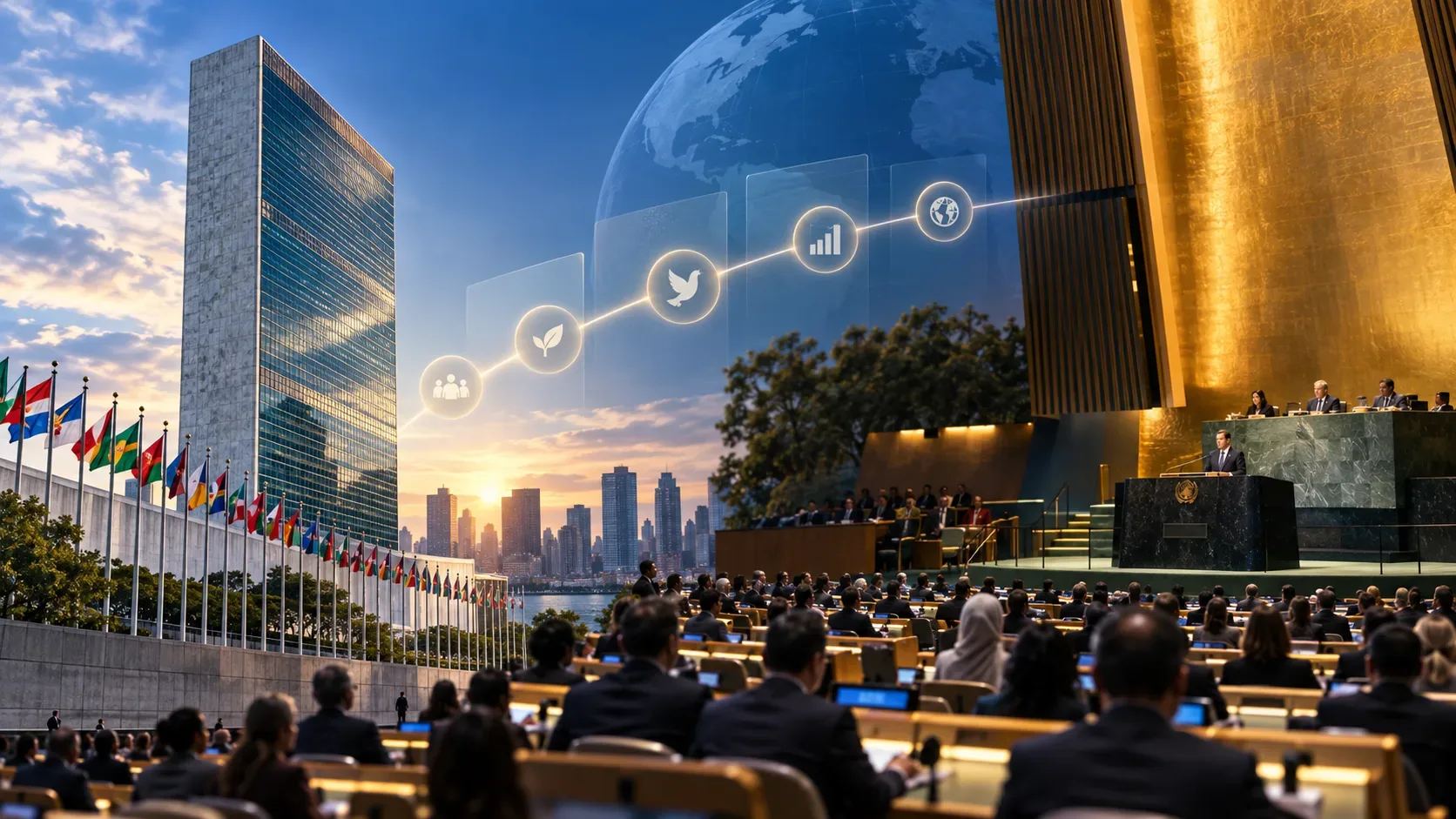
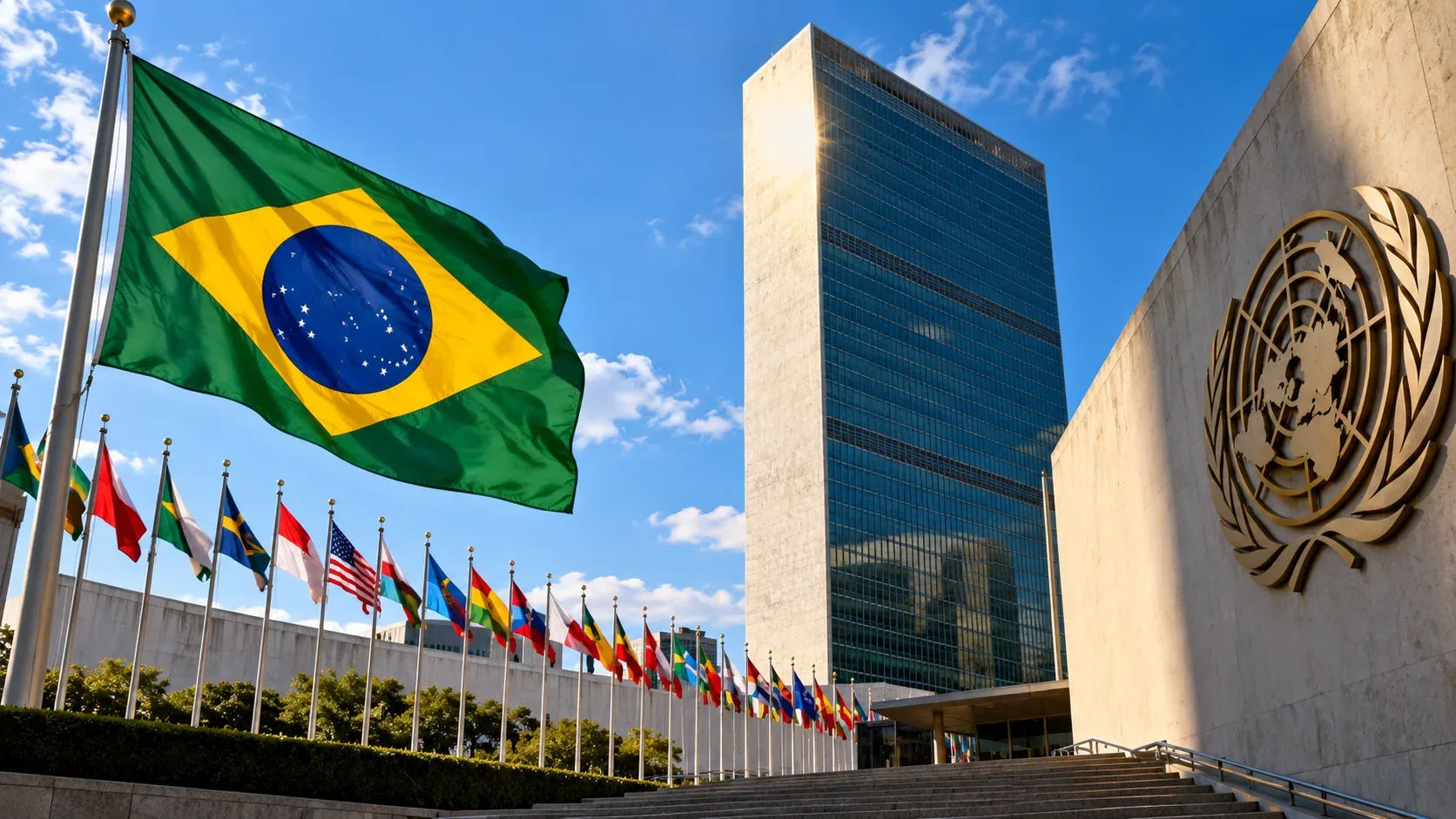
When the United Nations General Assembly’s General Debate begins, Brazil traditionally takes the first speaking slot among Member States. In 2026, that practice applies again at the 81st session, whose General Debate will run from 22 to 26 September and conclude on 28 September. Brazil’s position, however, does not result from alphabetical order, the country’s size, voting power or a written rule granting Brazil a permanent privilege.
The UN’s official explanation is historical: in the Organization’s early years, countries were reluctant to open the General Debate, and Brazil volunteered to speak first on several occasions. The practice became a tradition and, according to the UN, has been firmly established since 1955. After Brazil, the United States normally speaks second because it is the host country of United Nations Headquarters.
What it means to say that Brazil “speaks first”
Brazil is the first country to take the floor in the General Debate, but it is not necessarily the first voice heard in the meeting. At the opening, the United Nations Secretary-General makes a statement and the President of the General Assembly also addresses the chamber. The sequence of national statements follows.
For 2026, the UN says the 81st session is presided over by Khalilur Rahman of Bangladesh and that the General Debate theme is “Restoring trust, managing transformation: a United Nations that delivers for all”. The official schedule places the debate from Tuesday, 22 September, through Saturday, 26 September, with the final day on Monday, 28 September.
Where Brazil’s tradition comes from — and where Oswaldo Aranha fits
Oswaldo Aranha holds an important place in the history of Brazilian diplomacy at the UN. He served as President of the first special session and the second regular session of the General Assembly, both in 1947, and presided over the 29 November meeting in which Resolution 181 on the partition of Palestine was adopted.
That role, however, should not automatically be used to explain Brazil’s first slot in the General Debate. The institutional explanation attributed by the UN to its Protocol and Liaison Service is different: in the early years, when no State wanted to open the statements, Brazil stepped forward on several occasions. The UN records that Brazil then came to open the General Debate by tradition and that the practice has been established at least since the tenth session in September 1955.
In other words, Aranha helps explain Brazil’s early prominence in General Assembly history, but the origin of the first-speaker tradition is described by the UN as the result of repeated diplomatic practice, not as a formal tribute to him.
Why the United States speaks second
After Brazil, the second position is traditionally reserved for the United States. The reason is straightforward: the main United Nations Headquarters is in New York, and the United States is the host country. Among Member States, the opening pattern is therefore Brazil first and the United States second.
This also means that the order is not an alphabetical list of 193 countries. From the third speaker onward, a combination of operational and diplomatic criteria comes into play.
How the order of the other countries is decided
The UN describes the speakers list as the product of several factors considered together. The main ones include:
- Level of representation: who will deliver the statement — for example, a Head of State, Head of Government or another high-level representative — affects scheduling.
- Geographical balance: the Secretariat seeks to distribute speakers so that the sequence is not excessively concentrated in a single region.
- Preference and availability: delegations indicate preferred days or meetings, especially because a senior representative may only be in New York during a limited window.
- Timing of the request to speak: the order in which a speaking request is recorded also helps shape the list.
These factors do not amount to a simple public formula such as “Heads of State first, then Heads of Government, then alphabetical order”. They are combined to create a workable schedule across the six days of the General Debate. Recent UN practice also relies on an updated speakers list because changes can occur as delegations confirm representation, travel and availability.
The general rule and the specific practice of the General Debate
The Rules of Procedure provide the procedural foundation. Rule 68 says that no representative may address the General Assembly without the President’s permission and that, in principle, the President calls speakers in the order in which they signify their desire to speak. During the General Debate, however, that rule is implemented through a coordinated list prepared in advance using the practices and criteria described by the UN.
A country’s position in the schedule therefore should not be read as a diplomatic ranking. An early or late slot may reflect the level of representation, logistics, regional balance, preference and the timing of the delegation’s confirmation.
What changes — and what does not — in 2026
For the 81st session, the fixed point remains the start of the national sequence with Brazil and the United States. For other countries, the exact order depends on the operational speakers list and may be updated as the high-level week approaches.
There is also a common source of confusion involving seating in the General Assembly Hall. Each session, the UN draws lots to determine which State occupies the first seat; all other countries are then seated in English alphabetical order from that point. During the 81st session, Morocco occupies the first seat. That does not mean Morocco speaks first: seating order and speaking order are separate systems.
How to follow the actual speaking order
To know exactly when each country will speak, the safest approach is to follow the schedule and speakers list published by the UN during the high-level week. The official 81st-session meetings page provides dates and arrangements; the General Assembly portal links to schedules and webcasts; and the UN explainer on the General Debate summarizes the criteria used to organize speakers.
For the origin of Brazil’s tradition, the UN Brazil page confirms that Brazil has opened the General Debate since 1955. The list of past Presidents of the General Assembly separately confirms Oswaldo Aranha’s role in 1947, which helps distinguish that historical fact from the institutional explanation for the speaking order.
The short answer is therefore: Brazil speaks first because of an established diplomatic tradition; the United States follows as host country; and the remaining slots are arranged through a combination of representation level, geography, preference, availability and the timing of speaking requests. In 2026, the mechanism remains in place while the detailed sequence is handled as an operational schedule that can be updated.