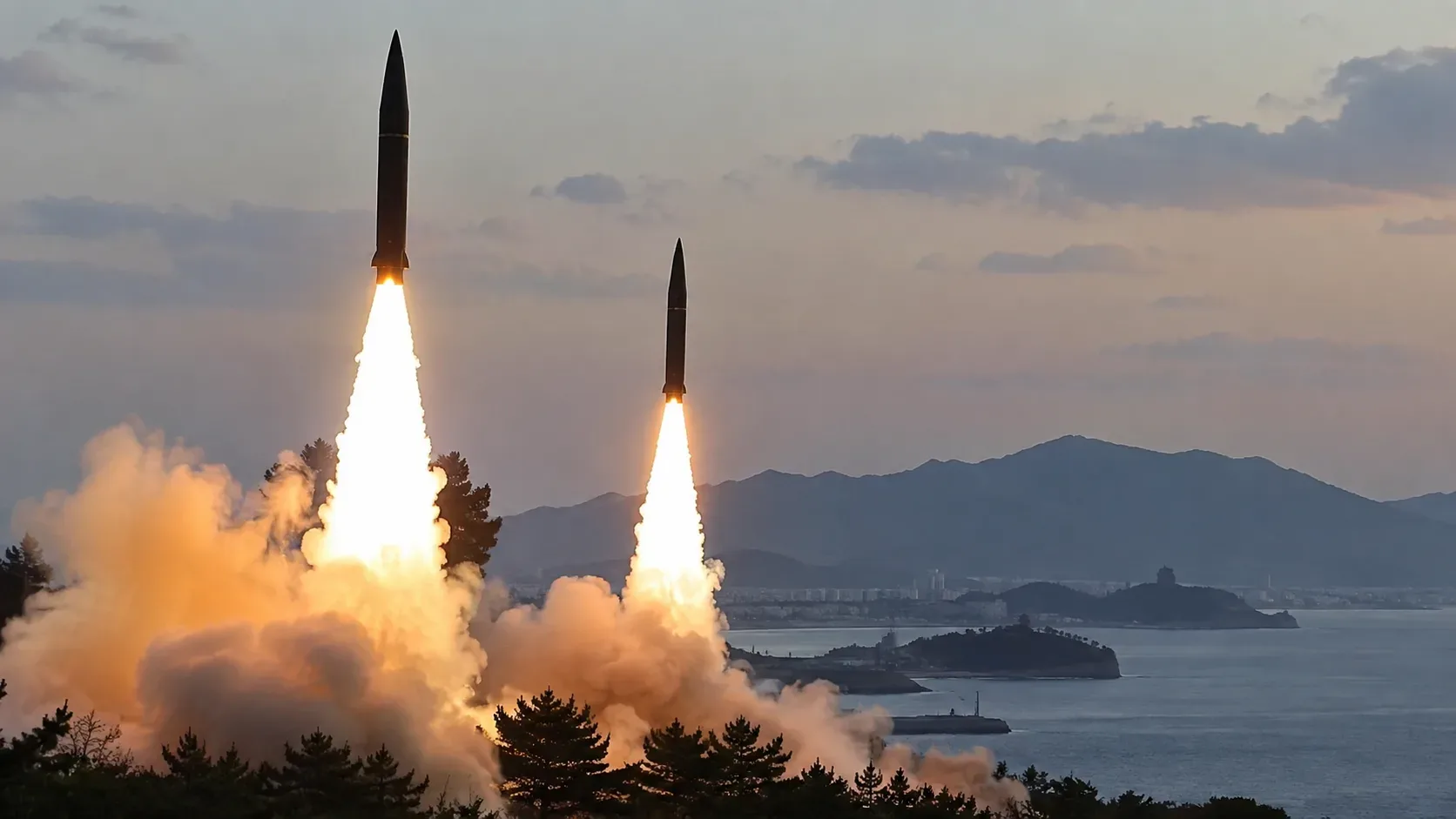
North Korea launched two short-range ballistic missiles toward the sea on Sunday, September 20, 2026, according to South Korea's military. The launches originated from the eastern coastal Wonsan area and occurred about three hours apart. The first missile traveled roughly 450 kilometers, while the second flew more than 600 kilometers, both toward North Korea's eastern waters.
The latest update changes the picture from the day's first alert. South Korea initially reported an unidentified projectile. The Joint Chiefs of Staff later classified the first launch as a short-range ballistic missile, and the Associated Press, citing South Korean authorities, reported that the second launch was also identified as a short-range ballistic missile.
What Seoul confirmed about the two launches
| Point | Confirmed information |
|---|---|
| Number | Two short-range ballistic missile launches. |
| Location | The Wonsan area on North Korea's east coast. |
| Interval | About three hours between the first and second launches. |
| First missile | Detected at around 3 p.m. Korea time and traveled about 450 km. |
| Second missile | Traveled more than 600 km, according to the update cited by AP. |
| Direction | Both headed toward waters east of North Korea and ended in the sea. |
The South Korean Joint Chiefs of Staff, as cited by Yonhap, said South Korean and U.S. intelligence authorities tracked and shared information from the early stage of the first launch. Information was also shared with Japan.
What has not yet been confirmed
The information released as of the update reviewed does not identify the exact model of either missile. The cited South Korean sources also have not publicly confirmed the payload, warhead type, maximum altitude, full flight profile or exact splashdown coordinates.
It also has not been confirmed whether the two launches were part of a single preplanned drill, a specific technical test or another military activity. Recent statements from Pyongyang about U.S.-led military exercises provide political context, but they do not replace an official explanation of the purpose of these launches.
For that reason, identifying the missiles now as KN-23, KN-24 or another specific system would be speculative. Flight distance alone is not enough to establish the exact model.
Why Wonsan is appearing again
Wonsan was already the origin point for recent launches. On September 12, South Korea's Joint Chiefs of Staff said it detected several short-range ballistic missiles fired from the same area at around 5:20 a.m. On that occasion, the projectiles traveled about 250 km before falling into the sea, according to Yonhap.
The repeated use of Wonsan allows a factual comparison of location, direction and range across closely spaced events. It does not, by itself, establish that all launches used the same missile model or had the same purpose.
How the September 20 launches compare with recent tests
| Date | Reported origin | Number | Reported range |
|---|---|---|---|
| 09/20/2026 | Wonsan | 2 short-range ballistic missiles | About 450 km for the first and more than 600 km for the second |
| 09/12/2026 | Wonsan | Several short-range ballistic missiles | About 250 km |
| 08/20/2026 | Pyongyang area | About 10 short-range ballistic missiles | About 300 km each |
In the August 20 episode, South Korea's military reported a barrage of about 10 short-range ballistic missiles launched from the Pyongyang area, each traveling roughly 300 km. The event was reported by the Associated Press.
What South Korea and Japan did immediately
South Korea's presidential office urged North Korea to immediately halt ballistic missile launches, which are prohibited by U.N. Security Council resolutions. South Korea's military also said it was maintaining readiness under its alliance with the United States.
Japan's Defense Ministry said it detected a suspected North Korean missile during the first episode of the day. According to AP, the projectile did not land in Japanese territorial waters.
What to watch in the next updates
The next relevant details will be whether Seoul releases additional data on altitude, speed, trajectory and splashdown points, or identifies a specific missile model. A later statement from North Korean state media could also show whether Pyongyang presents the launches as a test, a training drill or a demonstration of a particular weapons system.
Until those details appear, the most reliable reading is to separate what has been confirmed from what remains under analysis: two short-range ballistic missiles launched from Wonsan about three hours apart, with reported flight distances of about 450 km and more than 600 km, without a publicly confirmed exact model in the sources reviewed.