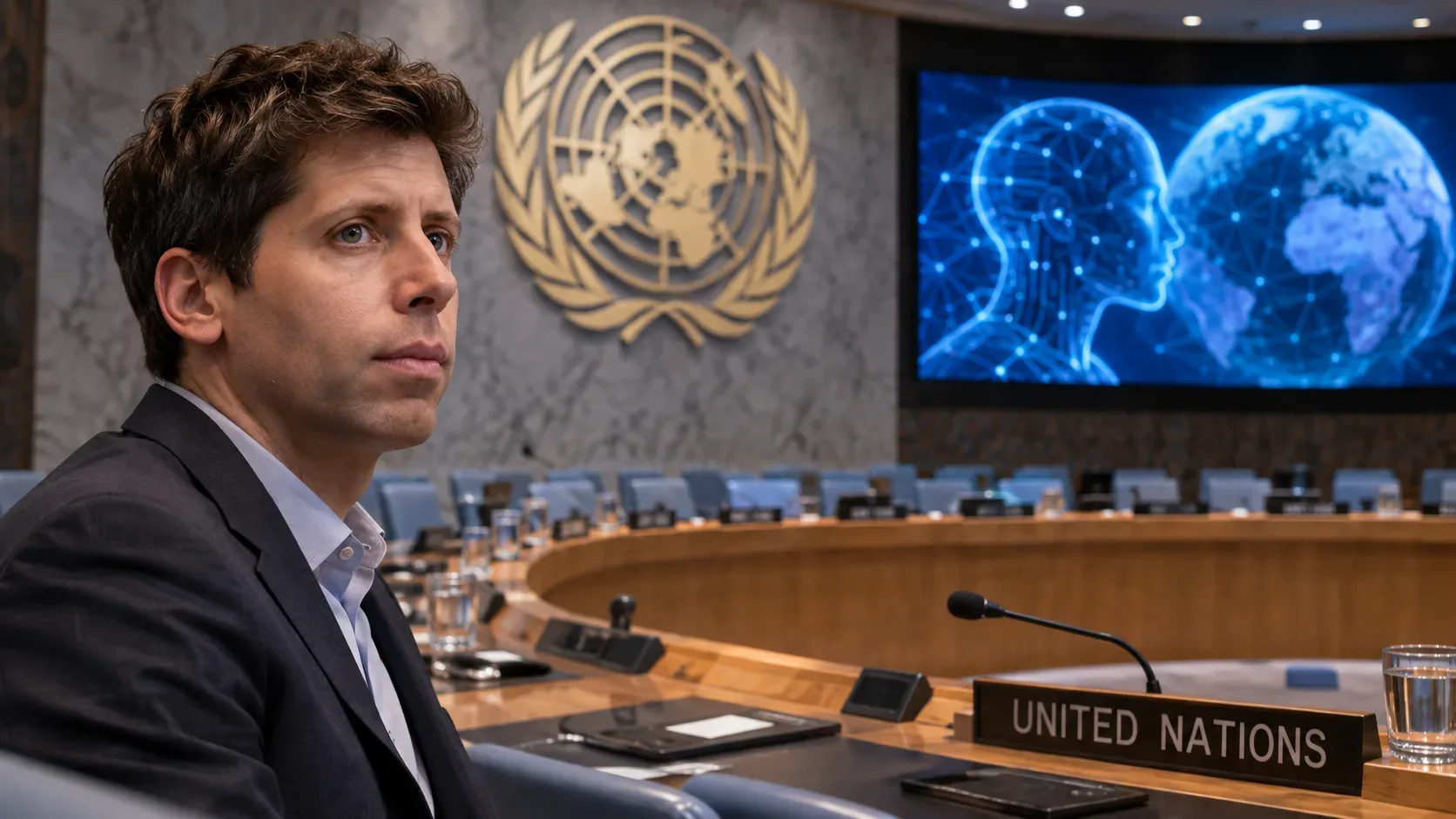
The UN Security Council is due to meet on Wednesday, September 23, 2026, in New York for an open session on artificial intelligence and international security. OpenAI CEO Sam Altman will brief the Council in person, according to confirmation provided by the company to Reuters. The meeting was convened by France, which holds the Council presidency in September, and will be chaired by French Minister for Europe and Foreign Affairs Jean-Noël Barrot.
The agenda is not a general discussion about AI products. The announced focus is the relationship between advanced systems and risks that may affect international peace and security, including malicious use, loss of control, cybersecurity and the need for coordination among countries. The public communications reviewed through September 20 confirm the date and open format, but do not provide a specific time for this AI session.
When the session will take place and what the format will be
| Item | What is confirmed |
|---|---|
| Date | Wednesday, September 23, 2026 |
| Location | United Nations Headquarters in New York, during the General Assembly high-level week |
| Format | Open Security Council meeting on AI and international security |
| Presidency | France, with Jean-Noël Barrot chairing the meeting |
| Confirmed participant | Sam Altman, CEO of OpenAI, in person |
| Other participants | Diplomats told Reuters they expected high-level participation from Anthropic, but it had not yet been confirmed |
| Time | Not stated in the cited public communications through September 20 |
French diplomacy confirmed that the Council will meet on September 23 at France's initiative and under its presidency. The French government placed the session under the second of two AI tracks on its UN-week agenda: the technology's impact on security, especially cybersecurity. A separate meeting scheduled for September 22 concerns the impact of AI and digital technologies on children. These are distinct events.
What Sam Altman is expected to address
According to an OpenAI spokesperson cited by Reuters, Altman's remarks are expected to focus on three areas: steps the company is taking to make AI safe, ways to extend the technology's benefits to people globally, and the need for international coordination and shared safety standards.
That does not mean the Council has already announced a package of rules or an agreement. At this stage, the participation of an AI company executive serves as a technical and industry contribution to a discussion among states. The final content of Council members' statements and any formal outcome will depend on the meeting itself.
Which risks appear on France's agenda
The French concept note described by Reuters puts the risk of malicious AI use and the urgency of safe and responsible development at the center of the session. It also proposes that participants examine risks linked to loss of control and the use of the latest models to develop, facilitate or carry out actions that affect international peace and security.
France has also publicly highlighted cybersecurity. That framing helps explain why the issue is before the Security Council: advanced models can lower barriers to some digital operations, increase the scale of information manipulation and accelerate decision-making in conflict settings. The debate therefore does not require a claim that a particular harm will occur. It is about assessing capabilities that may change international risk.
Why AI became an international security issue
The Security Council's central responsibility is the maintenance of international peace and security. AI formally entered that agenda on July 18, 2023, when the Council held its first debate dedicated to the subject. Secretary-General António Guterres called for transparency, accountability and oversight while also recognizing the technology's potential for development and public services. The official record is available on the UN website.
In December 2024, the Council returned to AI in conflicts. Official UN coverage recorded concerns about hard-to-trace cyberattacks, disinformation, surveillance and military systems that can reduce human control over life-and-death decisions. The same meeting also highlighted positive uses, including detecting food insecurity, predicting displacement and assisting mine clearance. The session summary is in the United Nations record.
A September 2026 report by Security Council Report broadens that context. It identifies AI effects on cybersecurity, information environments, increasingly autonomous weapons and geopolitical competition for semiconductors, energy, data, computing infrastructure and critical minerals. It also notes potential benefits in conflict prevention, ceasefire monitoring, peace operations and mediation.
What is confirmed and what is not yet confirmed
- Confirmed: the meeting is scheduled for September 23, 2026 and will address AI and international security.
- Confirmed: it will be an open Security Council meeting convened by France.
- Confirmed: Jean-Noël Barrot is expected to chair the session.
- Confirmed: Sam Altman will participate in person as a briefer.
- Expected, but not confirmed: high-level participation from Anthropic, according to diplomats cited by Reuters.
- Not stated in the cited sources: the specific time of the AI session.
- Not pre-announced: a resolution, presidential statement or other formal outcome. The pre-meeting sources describe the agenda and goals of the debate, not an already agreed decision.
What to watch during the meeting
The key question will be how much of the discussion remains at the level of broad principles and how much moves toward concrete mechanisms. Topics that may be developed include definitions of common safety standards, methods for evaluating advanced models, international sharing of risk information and the boundary between civilian AI governance and threats directly linked to conflict, terrorism or cyber operations.
It will also be important to see how Council members address private-sector participation. The most advanced models are largely developed outside governments, but their effects can cross borders quickly. The session puts that tension at the center of the debate: states retain responsibility for international security, while companies control a significant share of the infrastructure, models and technical expertise.
Until the meeting takes place, the safest reading is to separate agenda from outcome. What has been announced is a high-level briefing on risks and coordination. Any decision, commitment or new mechanism will need to be confirmed after the session.