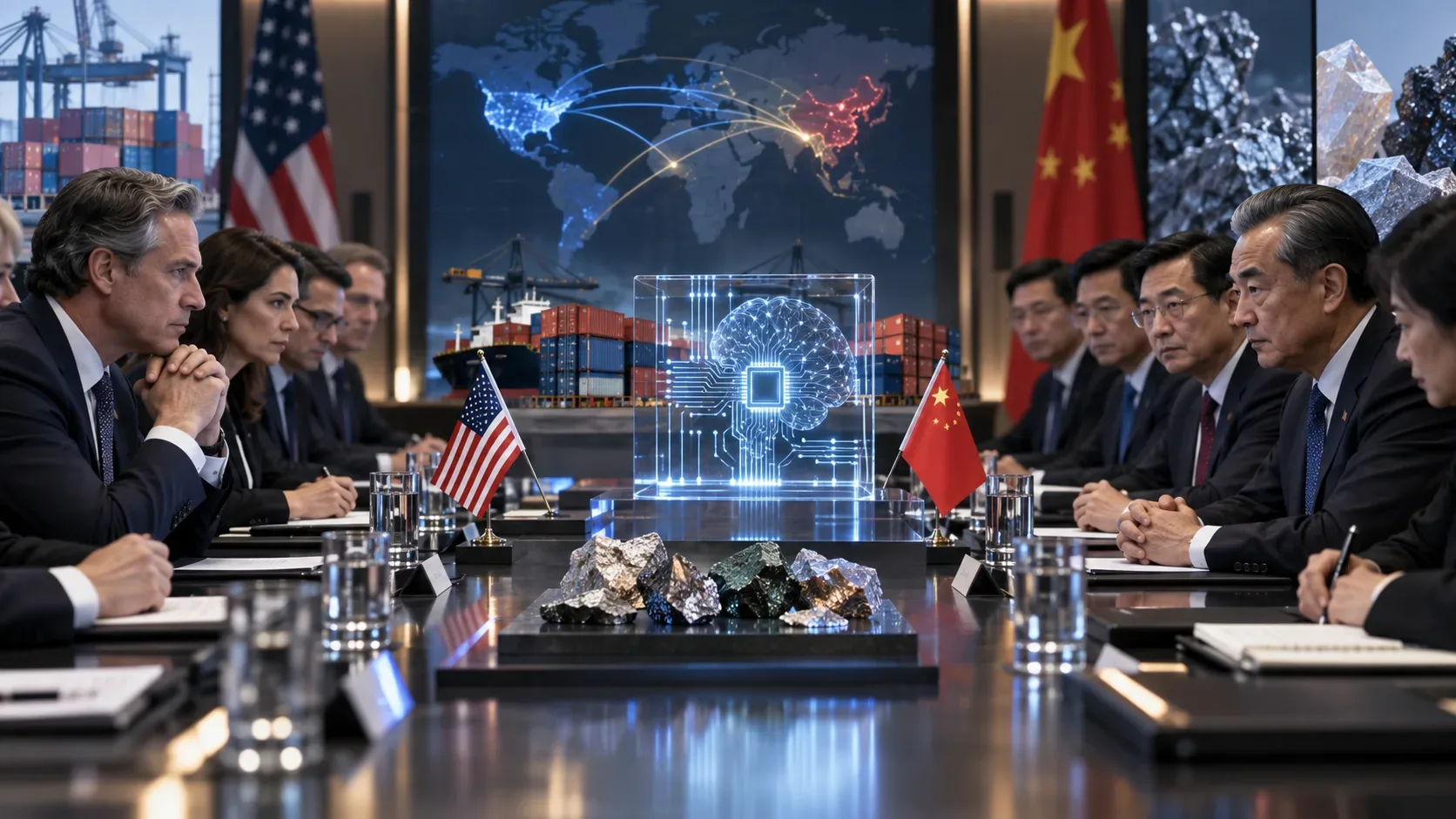
On September 20, 2026, the United States and China have a new round of talks scheduled in New York, with artificial intelligence, tariffs and critical minerals among the confirmed topics. The meeting brings together U.S. Treasury Secretary Scott Bessent, U.S. Trade Representative Jamieson Greer and Chinese Vice Premier He Lifeng. According to Reuters, the meeting is due to begin at 10:30 a.m. in Manhattan and serve as preparation for the summit between Donald Trump and Xi Jinping scheduled for September 24 in Washington.
The central point is that today's round does not start from a finished agreement. It is intended to organize unresolved issues, review earlier commitments and identify deliverables that could reach the two presidents. The USTR says the United States wants to monitor implementation of recent commitments, expand trade in non-sensitive goods and improve market access for American farmers and manufacturers. China's Ministry of Commerce, meanwhile, confirmed that He Lifeng would visit the United States from September 19 to 23 for economic and trade consultations on issues of concern to both sides.
What is confirmed for the September 20 round
| Topic | What is confirmed | What remains open |
|---|---|---|
| Artificial intelligence | Bessent said he expects to discuss open-weight and closed-weight models, as well as safeguards to reduce shared risks and prevent advanced systems from being used by malign actors. | There is no public text of an agreement on standards, enforcement, model access or limits on use. |
| Tariffs and trade | The U.S.-China trade truce expires on November 10. Negotiators are also revisiting discussions on tariff reductions for non-strategic goods and implementation of previous commitments. | It is not confirmed whether the truce will be extended, which tariffs might be cut or when any reductions would take effect. |
| Critical minerals | U.S. officials say flows of Chinese rare-earth magnets and other critical minerals remain below expectations and will raise the issue in the meeting. | There is no public announcement of new licenses, volumes, timelines or Chinese regulatory changes. |
AI: the talks begin with risks and rules, not technological alignment
Artificial intelligence is entering a high-level economic negotiation because it combines security, competitiveness and technological infrastructure. In a statement cited by Reuters, Bessent said the United States is open to discussing shared risks and ways to avoid a complete bifurcation of the two ecosystems. He also indicated that the talks should cover both open-weight models, whose core components can be downloaded and fine-tuned, and closed models.
The concept of safeguards is still broad. Bessent has previously argued for mechanisms to make it harder for powerful systems to fall into the hands of malign non-state actors. That does not amount to a bilateral governance agreement. Disputes remain over advanced chips, export controls, U.S. allegations of technology copying through distillation and different regulatory approaches in the two countries. These issues form the context of the talks, but should not be presented as matters already negotiated or resolved in today's round.
On the Chinese side, the recent public position emphasizes both development and security. On September 15, China's Ministry of Foreign Affairs said Beijing takes the inherent and secondary risks of AI seriously, supports safeguards and favors a global governance framework built through multilateral cooperation. That formulation leaves room for dialogue on safety, but it does not remove disagreements over technology access and national controls.
Tariffs: the November truce is the clearest deadline
On trade, the objective marker is November 10, when the current tariff truce expires. Reuters reports that negotiators are expected to review the status of that arrangement and continue earlier discussions on trade in non-strategic goods. In May, the two governments announced mechanisms called the Board of Trade and Board of Investment to address trade and investment, while commitments publicized by the United States included additional Chinese purchases of U.S. agricultural products and Boeing aircraft.
The USTR's official statement for the September 20 meeting avoids promising specific tariff cuts. Greer said Washington wants to monitor recent commitments, optimize trade in non-sensitive goods and improve market access for American farmers, manufacturers and workers. This indicates that the agenda is about implementation and access as well as new tariff measures.
Parallel negotiations could also shape the political package around the summit. Reuters reported on September 18 that the two countries were discussing a reduction or elimination of Chinese tariffs on U.S. liquefied natural gas as part of a broader framework for reciprocal tariff cuts. The report stressed that those talks had not been finalized. That issue should therefore be treated as an ongoing negotiation, not as a guaranteed outcome of today's meeting.
Critical minerals: the issue is now execution and predictability
Critical minerals and rare earths remain central to the contest over industrial supply chains. These materials are used in electronics, vehicles, aerospace equipment, defense and parts of the infrastructure that supports the AI economy. For Washington, the immediate question is not only the existence of Chinese commitments, but the actual flow of material and the predictability of licensing.
According to Reuters, a senior U.S. official said China's performance in restoring those flows had not met expectations. The White House had previously said, after earlier understandings, that China would address supply-chain shortages involving rare earths and other critical minerals. The September 20 round therefore also functions as an implementation test: whether announced commitments translate into sufficient supply for U.S. and global users.
What could move before the September 24 summit
The practical role of the Bessent, Greer and He meeting is to prepare points that could be presented to the presidents four days later. Reuters reports that analysts expect limited steps aimed more at showing continued engagement than at producing a broad resolution of the disputes.
- On AI, a possible step would be to define areas of shared risk and establish communication channels or safety principles, without resolving competition over chips and models.
- On tariffs, negotiators may try to settle details on reductions for non-strategic goods, market access or purchase commitments, but an extension of the November truce has not been announced.
- On critical minerals, attention may focus on licenses, regularity of flows and compliance with earlier commitments, while no new public volume has been agreed so far.
- On investment, the previously created forums provide a channel for specific cases, but there is no public indication of broad liberalization between the two countries.
What should not yet be treated as an agreement
Before the round begins, there is no public basis to say that the United States and China have finalized an extension of the trade truce, a new tariff package, critical-mineral quotas, bilateral AI rules or changes to technology export controls. There is also no confirmation that sector-specific negotiations, such as LNG tariff discussions or additional aircraft purchases, have been incorporated into a final agreement.
The distinction matters because the September 20 agenda mixes older commitments that are being implemented, proposals still under negotiation and technology-security issues that may require prolonged talks. The meeting may reduce uncertainty and organize deliverables for the summit, but the existence of dialogue does not prove convergence.
Why the round matters for geoeconomics
The three fronts are connected. Tariffs affect the cost and flow of trade; critical minerals determine the resilience of industrial supply chains; and AI intensifies competition over semiconductors, computing infrastructure and safety rules. The negotiators' challenge is to separate areas where some trade can be normalized from areas considered strategic or sensitive.
For companies and governments, the most relevant signal will not be only a political announcement, but the ability to turn understandings into predictable rules, licenses, volumes and verifiable timelines. Until those elements appear in official documents or communications from both governments, the situation should be read as active negotiation, not as a newly consolidated balance between Washington and Beijing.