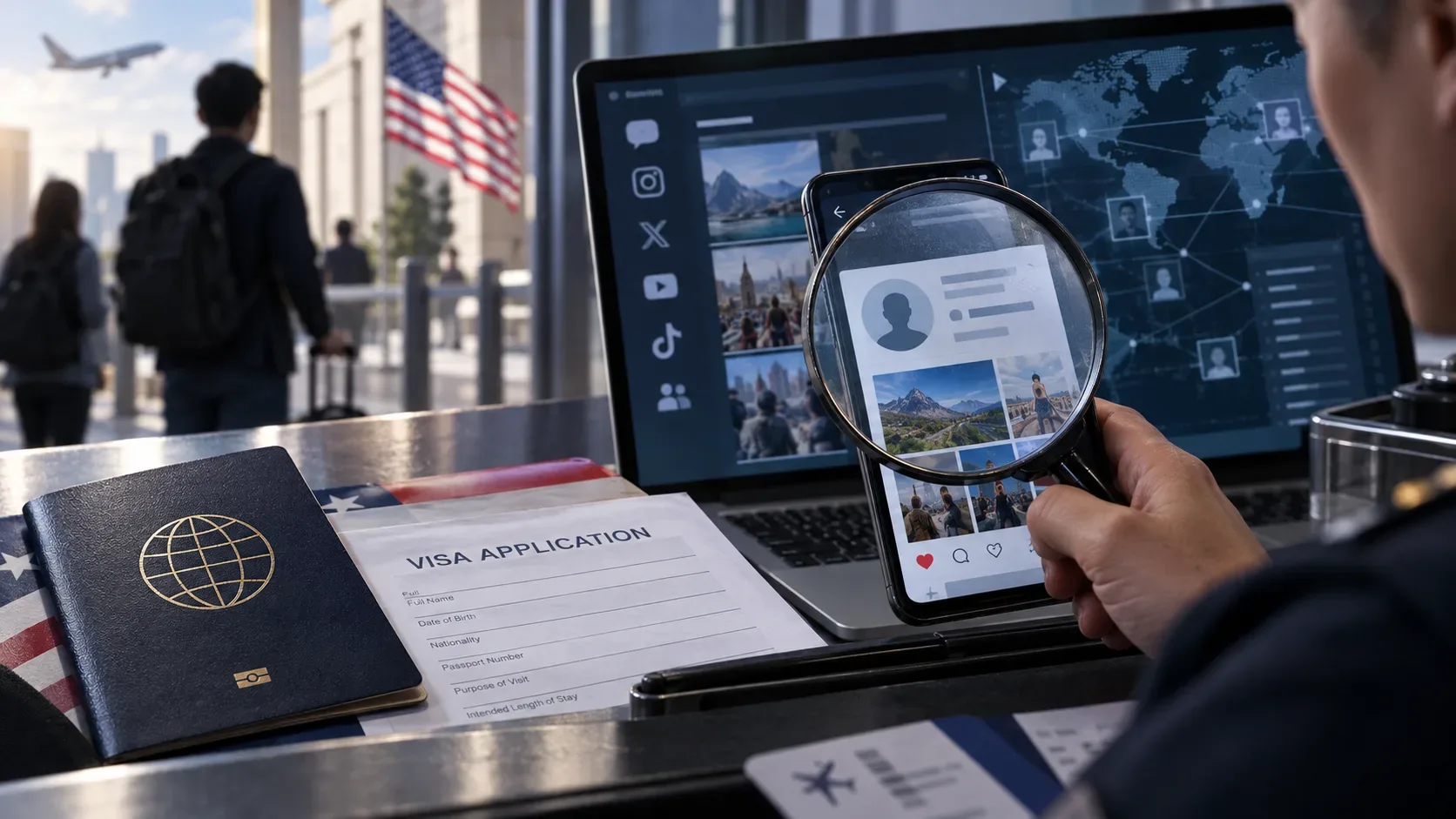
The U.S. Department of State announced on September 18, 2026 that, starting October 1, 2026, it will expand online presence review to applicants in three additional nonimmigrant visa classifications: I, TN and TD. The official guidance instructs applicants in these categories to set the privacy settings on all of their social media profiles to "public" or "open" to facilitate the review.
The change does not create an entirely new form of visa screening. The U.S. government was already applying online presence review to other categories and says it uses available information when screening all visa applications. The September announcement specifically expands the set of classifications subject to this online presence review.
Who enters the new rule on October 1
| Classification | Who it covers | Start of expanded review | Official social media guidance |
|---|---|---|---|
| I | Representatives of foreign media, including press, radio, film and other information media professionals traveling temporarily to the United States to work in that capacity. | October 1, 2026 | Set all social media profiles to public or open. |
| TN | Eligible Canadian and Mexican professionals who apply for a TN visa to perform qualifying professional activities under the USMCA. | October 1, 2026 | Set all social media profiles to public or open. |
| TD | Spouses and unmarried minor children who apply for a derivative TD visa to accompany or join a TN professional when a visa is required. | October 1, 2026 | Set all social media profiles to public or open. |
There is an important qualification for TN cases: Canadian citizens generally do not need a TN visa to seek admission to the United States as USMCA professionals, although a TN visa can be issued in some circumstances. The new guidance therefore should be read as applying to people who actually apply for a TN visa, not as a statement that every Canadian professional in TN status will go through a consular visa application.
What changes in practice for applicants
- More classifications enter online presence review. I, TN and TD are added to the State Department's published list for this type of vetting.
- Profiles are expected to be accessible. The official instruction is to set the privacy settings on all social media profiles to "public" or "open".
- Review remains case specific. The announcement does not establish an automatic approval or refusal rule tied to a specific post, like or profile.
- The underlying visa requirements are not replaced. Applicants still need to establish eligibility for the requested classification and meet the applicable requirements.
The notice also does not specify which platforms, historical time periods, technical criteria or particular signals will be examined in each case. It would therefore be inaccurate to conclude from the announcement alone that there is a public list of content that automatically triggers approval or refusal.
Which categories were already subject to the review
According to the September 18 update, the addition of I, TN and TD comes on top of categories that were already included in the online presence review policy:
| Group | Classifications already covered |
|---|---|
| Diplomatic and official visas | A-3, C-3 when the applicant is a domestic worker, G-5 |
| Students | F-1, M-1, F-2, M-2 |
| Temporary workers and trainees | H-1B, H-3, H-4 dependents of H-1B and H-3 |
| Exchange visitors | J-1, J-2 |
| Fiancés and dependents | K-1, K-2, K-3 |
| International cultural exchange participants | Q |
| Religious occupations | R-1, R-2 |
| Witnesses, informants and victims | S, T, U |
This list matters because it prevents overgeneralization. The State Department says it conducts rigorous screening of all applicants and relies on every available source of information, but the online presence review described in the notice is presented with a specific list of visa classifications. The September 18 announcement does not say that B-1 or B-2 visitor visas, for example, were added to that list.
What the government says it looks for during screening
The State Department says it uses available information to identify applicants who may be inadmissible to the United States, including people who could pose a threat to national security or public safety. It also says the review is intended to confirm that an applicant demonstrates eligibility for the requested visa and a genuine intent to comply with the terms of admission.
That describes the government's stated objective, but it does not allow a conclusion that a particular opinion, post or online association by itself leads to a specific outcome. The notice does not publish a scoring system or automatic decision criteria.
How to prepare before applying
- Confirm the correct visa classification. Check whether the application is for I, TN, TD or another category and review the rules for that visa.
- Note the effective date. The announced expansion for I, TN and TD takes effect on October 1, 2026.
- Review privacy settings. For these three classifications, the official instruction is to set all social media profiles to public or open.
- Keep application information accurate and consistent. Online presence review is part of the consular process but does not replace documents, interviews or other requirements when they apply.
- Check instructions from the responsible embassy or consulate. Local procedures, appointment rules and additional documentation can vary by post and by the applicant's circumstances.