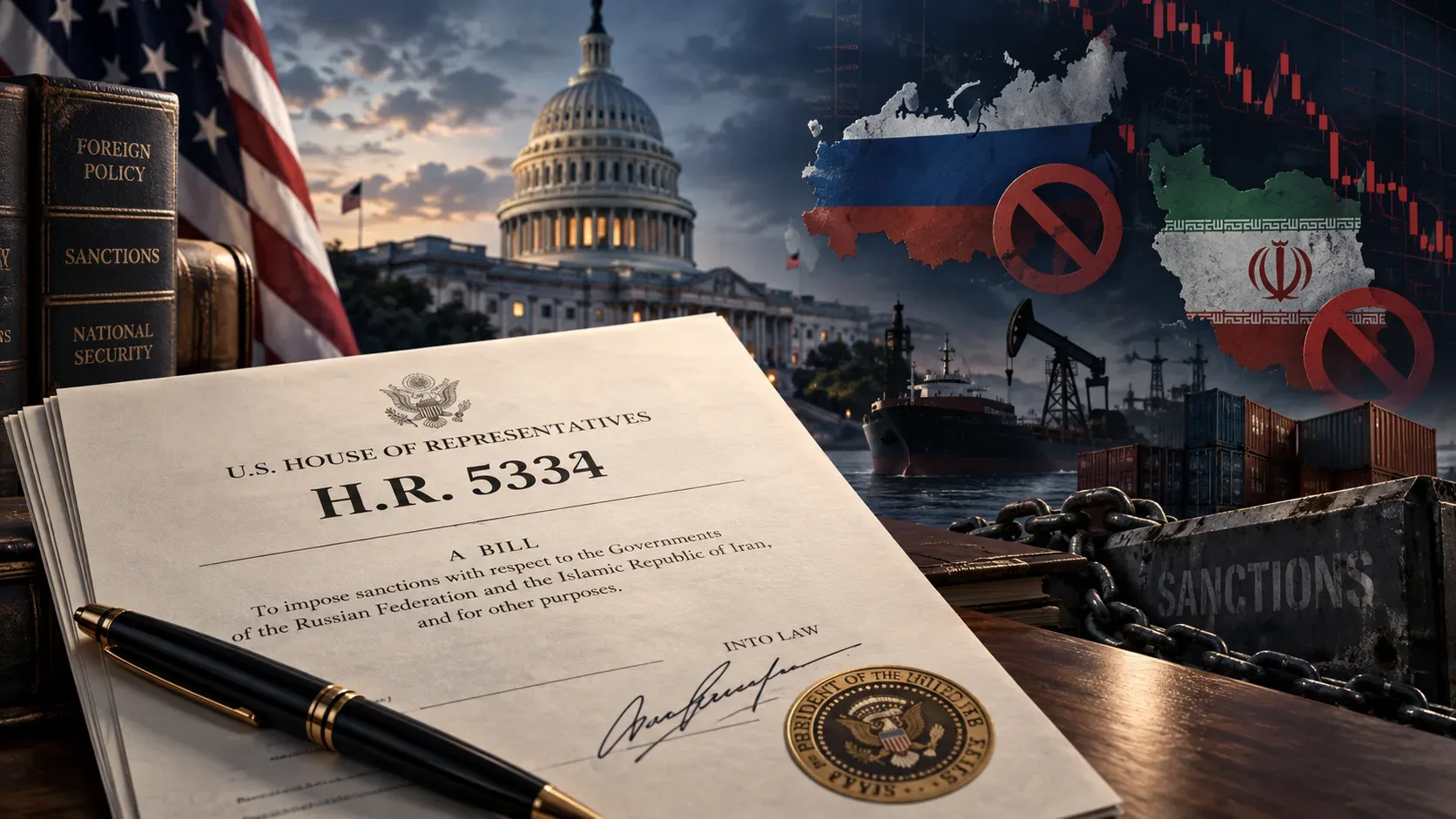
The President of the United States signed H.R. 5334 into law on September 18, 2026. The White House identifies the measure as the Lindsey O. Graham Sanctioning Russia and Iran Act of 2026 and describes its core as an expansion of statutory sanctions, tariffs, and prohibitions related to Russia, together with an extension of existing sanctions authorities concerning Iran. The enacted text, however, draws an important distinction between the law taking effect and each instrument being applied in practice: some rules apply upon enactment, others become effective 30 days later, and several require reviews, determinations, lists, regulations, or executive decisions.
For that reason, the signature should not be read as if every maximum tariff and every designation in the statute had been applied automatically. H.R. 5334 creates specific duties and authorities, sets deadlines and criteria, and leaves implementation steps to the President, the Department of the Treasury, the Securities and Exchange Commission, the United States Trade Representative, and other agencies.
Quick map: what the law creates or consolidates
| Instrument | Main rule | Expected timing |
|---|---|---|
| Sanctions on Russia-linked persons and vessels | Review and imposition of asset blocking and immigration restrictions on persons who meet the statutory criteria, along with blocking of identified vessels. | First review within 30 days, followed by reviews every 180 days. |
| Russian financial system | A sanctions package covering the Bank of Russia, Sberbank, VTB, Gazprombank, government-controlled Russian financial institutions, subsidiaries, and, under certain conditions, foreign financial institutions that conduct significant transactions with them. | Initial implementation within 30 days. |
| Investment, services, and energy | Ban on new U.S. person investment in Russia, restrictions on categories of services, and bans on new investment in Russia's energy sector and on U.S. energy exports to Russia. | Effective 30 days after enactment. |
| Russian sovereign debt | Ban on purchases of Russian government sovereign debt by U.S. persons. | Effective upon enactment. |
| Tariffs on Russian goods | The President must, within 30 days, raise the tariff rate on all goods imported from Russia to a rate of up to 500% ad valorem, in addition to other applicable duties. | The concrete rate depends on implementing action. |
| Tariffs on certain third countries | Goods from countries that meet the statutory criteria may face a tariff of up to 100% ad valorem, also in addition to other charges. | Depends on country identification, methodology, and the selected rate. |
What changes immediately upon enactment
Some legal effects do not wait for the general 30-day window. The statute prohibits U.S. persons from purchasing Russian sovereign debt as of enactment. It also directs the President to take the steps necessary to implement existing statutory requirements on imports of Russian uranium, including material from Rosatom and its subsidiaries or successors, subject to the nuclear-law rules and exceptions incorporated by H.R. 5334.
- Existing sanctions: the law requires sanctions and other measures based on executive orders tied to the national emergency concerning harmful activities of the Russian government, as they stood on the day before enactment, to remain in effect.
- Iran: section 201 changes the expiration reference in the Iran Sanctions Act of 1996 from 2026 to 2031.
- Statutory basis: the central Russia-related framework is now expressly set out in federal law, rather than resting only on existing executive actions.
What falls within the 30-day window
Much of the operational impact is scheduled for the following 30 days. The law directs the President to review persons and vessels that may meet the sanctions criteria and to apply the measures when the relevant determination is made. The same timeframe appears for financial sanctions, review of entities controlled by or affiliated with the Russian government, SEC action on trading in securities of covered issuers, and review of global financial messaging providers used to circumvent sanctions.
Thirty days after enactment, restrictions also take effect on fund transfers involving the Russian government, new investment by U.S. persons in Russia and Russia's energy sector, U.S. energy exports to Russia, and certain categories of services. The statute allows the Treasury Secretary, in consultation with the Secretary of State, to identify service categories subject to the prohibition.
How tariffs on countries buying Russian energy work
Section 113 is one of the most consequential provisions for third countries, but it does not name them. Instead, it establishes criteria. A country may fall within the provision if it knowingly makes new purchases of Russian-origin crude oil or natural gas beginning 30 days after enactment and was among the five largest importers by volume during the 12-month reference period. The five leading countries facilitating evasion of Russian oil sanctions may also be covered.
- The tariff may reach 100% ad valorem on all goods imported into the United States from that country.
- The duty is added on top of other tariffs, fees, or trade measures that already apply.
- Before imposing or changing the tariff, the President or USTR must provide Congress with a written justification that includes the methodology used to classify the country and the rationale for the rate.
- After the initial round, USTR, in consultation with the Secretaries of State and Energy, must review the list within 180 days and every 180 days thereafter.
- A specific exception applies to certain Russian natural gas imports when they represent less than 15% of Russia's annual gas exports during the reference period and the country has taken significant steps to reduce those purchases.
The law therefore creates a mandatory tariff mechanism for countries that are formally found to meet the criteria, but the effective rate, country identification, and documentation supporting each decision require later action. The 100% ceiling does not itself mean that a 100% tariff automatically applies to any specific buyer.
Who can be targeted by the Russia-related sanctions
The scope extends beyond Russian officials. Section 102 covers categories of foreign persons, vessels, and conduct that can trigger asset blocking and, for individuals, visa and entry restrictions. The principal groups include:
- senior officials of the Russian government and armed forces;
- persons supplying goods, services, or technology relevant to Russia's defense industrial base, including high-priority items identified by the Department of Commerce;
- persons involved in significant transactions with the Russian armed forces, support for strategic sectors, sanctions evasion, or activities described by the statute against Ukraine;
- vessels used to move oil, uranium, gas, petroleum products, coal, arms, or other goods for sanctions evasion, together with owners, operators, insurers, senior crew, and certain ports that support sanctioned vessels.
In the financial sector, the law can also reach foreign financial institutions that conduct significant transactions with covered Russian institutions, although it provides an exception when the Treasury Secretary determines that imposing the sanctions would not be consistent with the economic or foreign policy interests of the United States.
Iran: the central change is extension through 2031
For Iran, H.R. 5334 does not replicate the detailed tariff and prohibition architecture created for Russia in Title I. The explicit change in section 201 is temporal: the Iran Sanctions Act of 1996, which had an expiration reference of 2026, now runs through 2031.
As a matter of law, that preserves the existing statutory sanctions instrument for another five years. The White House itself described the new law as extending existing sanctions on Iran, in contrast with the set of new mechanisms directed at Russia.
Exceptions, licenses, waivers, and termination
The package does not operate without exceptions. Section 114 preserves, among other things, transactions involving food, agricultural commodities, medicines, medical devices, and humanitarian assistance; authorized intelligence and law-enforcement activities; certain international obligations; specified civilian nuclear cooperation; certain low-enriched uranium and medical-isotope cases; official U.S. government and United Nations business; transit of non-Russian oil through Russian territory; activities covered by Treasury general licenses; vessel and crew safety; and NASA activities.
There is also a 270-day window for certain wind-down or divestment operations in Russia. Treasury remains authorized to extend or issue general licenses, which will be important in translating the statutory rules into operational compliance guidance for companies and financial institutions.
The President may waive sanctions, restrictions, or duties under Title I, but must first certify to Congress that the waiver is in the U.S. national interest and explain the basis for it. To terminate measures applied to Russia, the statute requires, among other conditions, a peace agreement accepted by the free and independent Government of Ukraine and an end to hostilities and activities aimed at overthrowing or subverting the Ukrainian government. Termination is subject to a 30-day congressional review period.
What still needs to be watched
- Treasury and OFAC: designations, regulations, guidance, and licenses that turn the new obligations into compliance rules.
- SEC: steps to bar trading on national securities exchanges in securities of issuers covered by the statute.
- USTR: methodology, identification of countries covered by section 113, selected tariff rates, and advance reports to Congress.
- The President and State Department: determinations concerning persons, vessels, sectors, exceptions, and any waivers.
- Periodic reviews: several sections require reassessment every 180 days, so the target list and practical scope can change as implementation proceeds.
The main change is therefore institutional: H.R. 5334 turns a broad portion of U.S. economic pressure on Russia into a statutory framework with commands, criteria, deadlines, tariffs, and controls on waivers and termination. The practical effect is not limited to the day of signature. It will be defined by a sequence of administrative actions and determinations required by the statute itself.
Scope note: the enacted text also contains a separate Division B dealing with the tax deduction for early-childhood educator expenses. This article focuses on Division A, which contains the Lindsey O. Graham Sanctioning Russia and Iran Act of 2026.