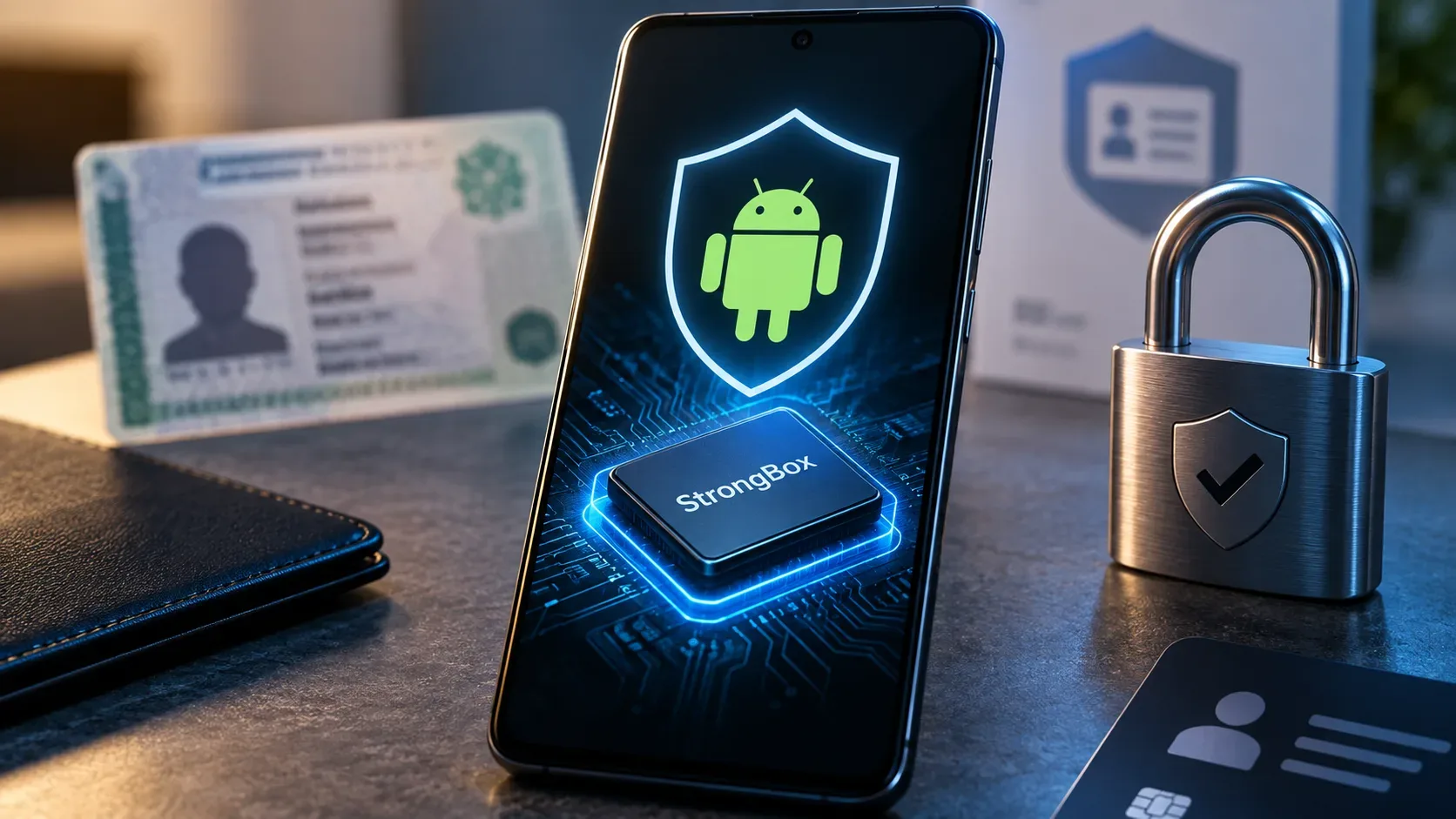
StrongBox does not make a digital credential “true” by itself. Its role is narrower: protecting cryptographic keys and enforcing usage policies in isolated hardware, so issuers and verifiers can place greater confidence in properties such as device binding, key non-exportability, and required user authentication. That distinction is central to understanding the architecture Google presented on September 1, 2026 for high-assurance digital credentials.
In the announcement and the technical whitepaper, Google describes Android as a layered trust stack: issuer signatures and credential standards at the application layer; Android Keystore as the common interface; TEE or StrongBox as the hardware backend; attestation to prove key provenance; and local authentication to authorize use. StrongBox is the highest-isolation layer in that stack when the device supports it.
First: what makes a digital credential trustworthy
A verifiable digital credential combines two different questions. The first is: who issued this data, and was it altered? That is answered by the issuer's cryptographic signature and by credential formats and protocols. The second is: does the party presenting the credential control the key that was bound to it? This is where device hardware starts to matter.
Android's own documentation stresses that a claim marked “verified” does not become a universal truth: the verifier still has to decide whether it trusts the issuer and the process the issuer used. In other words, StrongBox can increase confidence in protection of the holder's key, but it does not by itself validate enrollment quality, the claimed identity, or the issuer's policy. See the official explanation in Trust and safety with digital credentials.
Where StrongBox fits in the chain of trust
In the architecture described by Google, the trust chain can be read in four stages.
- Device and key attestation. Android Key Attestation, combined with Remote Key Provisioning (RKP), lets an issuer receive a certificate chain and evaluate properties of the environment where a key was created. For issuance flows, the android_keystore_attestation proof format is documented as a way to show that a key is locked in a TEE or StrongBox and cannot be exported or cloned. The documentation also makes clear that it does not define a universal minimum set of checks on its own: policy remains the issuer's responsibility.
- Device binding. When the private key is generated and retained in StrongBox, it is bound to secure hardware. The objective is to prevent a credential from being cloned to another device simply by extracting the key.
- User authorization. Keys can be configured to require a PIN, password, pattern, or biometric before every operation or within a time window. The hardware receives signed authentication tokens and releases the cryptographic operation only when the key's rules are satisfied.
- Proof of possession and intent. The key can sign a nonce or a transaction-specific payload. This lets the verifier confirm that the current presentation was produced by whoever controls the key bound to the credential, while unique challenges can also reduce replay attacks.
Google's 2026 overview describes this sequence as a chain of trust running from device manufacturing to credential presentation. The key point for developers is that none of these stages replaces the others: attestation proves properties of the key environment; StrongBox protects and executes operations; authentication seeks user presence or authorization; and the protocol defines what is signed and verified.
StrongBox is not just “Keystore with another name”
Android Keystore is the system interface that lets apps create and use keys without exposing cryptographic key material to the application process. Depending on the device and the key, the backend can be a Trusted Execution Environment (TEE) or StrongBox.
StrongBox, available on compatible devices starting with Android 9, requires a KeyMint implementation backed by a Secure Element or integrated secure enclave with stronger isolation than the TEE. Android documentation lists characteristics such as its own CPU, secure storage, a true random-number generator, a secure timer, and additional anti-tampering mechanisms. The 2026 whitepaper positions this backend for the highest assurance tier and discusses a certifiable boundary against physical attacks, electrical fault injection, and side channels.
That does not mean a TEE is inadequate. Android uses the TEE broadly and considers it secure hardware. The difference is threat profile and assurance level: a dedicated Secure Element provides a harder physical boundary for keys that must also resist attackers with possession of the device and advanced laboratory techniques.
What a developer can verify
For a key created in Android Keystore, an app can query the security level with KeyInfo.getSecurityLevel(). The values TRUSTED_ENVIRONMENT and STRONGBOX indicate that the key resides in secure hardware. To request StrongBox, an app can check FEATURE_STRONGBOX_KEYSTORE and use setIsStrongBoxBacked(true) when generating or importing the key.
There is an important practical consequence: do not treat StrongBox as guaranteed availability. The feature is not present on every device and it supports a more limited set of algorithms, key sizes, and operations. If the requested combination is unsupported, the platform can throw StrongBoxUnavailableException. The documentation recommends evaluating the threat model before requiring StrongBox because it is also slower, more resource-constrained, and supports fewer concurrent operations than common backends.
Attestation is the remote link — but it must be validated on the server
Attestation is the mechanism that turns a local hardware property into evidence a remote issuer can verify. When a key is generated, Android can produce certificates describing the security level, device state, and authorizations associated with the key. For digital credentials, an issuer can use that evidence before provisioning to decide whether the device meets its policy.
This design avoids relying only on a claim from the app. Even so, the security of the process depends on correctly validating the chain, attestation fields, and acceptance policy. The official documentation for hardware-backed attestation for digital credentials explicitly says it does not provide a minimum recommended set of attestation checks. In production, the server has to define which versions, security levels, boot states, roots of trust, and other properties it will accept.
User authentication lives in another layer
One of the most useful ideas in the whitepaper is the separation between key protection and user authentication. StrongBox can prevent key extraction and enforce that an operation occurs only after valid authorization, but biometrics, PIN entry, and confirmation UI involve sensors, the TEE, and the system interface. Therefore, saying “the key is in StrongBox” does not mean the entire authentication experience happens inside the same certified chip.
This separation allows policies such as per-operation authorization or a short authorization window. It also explains why identity security needs defense in depth: the cryptographic boundary, operating system, wallet app, authenticators, and presentation protocol have different responsibilities.
Privacy: strong hardware does not have to mean tracking
The whitepaper also addresses a less obvious risk: hardware keys and attestations can become correlatable identifiers if designed poorly. The architecture discussed by Google uses provisioning and attestation mechanisms intended to reduce the ability to link different credentials to the same device. Local and peer-to-peer presentations can also avoid giving a central server visibility into every credential use.
At the format and protocol layer, the ecosystem cited by Google includes ISO/IEC 18013-5 for mDL, SD-JWT VC, and OpenID4VCI/OpenID4VP, along with selective-disclosure and zero-knowledge techniques in specific implementations. Hardware protects the key; data minimization and unlinkability also depend on protocol and wallet design.
What changed with the September 2026 announcement
The September 1 announcement did not introduce StrongBox from scratch. The editorially important change is how Google is positioning it inside a broader strategy for high-assurance credentials and compliance. The company said the Android Ready SE program will become the Android Digital Credential Alliance, expanding collaboration across silicon vendors, device manufacturers, wallet developers, and government issuers.
Google also connected this architecture to high-assurance requirements, including the European eIDAS 2.0 context, and cited the open-source Multipaz project as an SDK implementing credential protocols and formats on top of Android Keystore and StrongBox. For product teams, this signals an effort to turn hardware capabilities that could otherwise be fragmented into a reusable and verifiable foundation for different wallets.
Practical reading for developers
- Start with the threat model. If the main risk is credential cloning or physical key extraction, StrongBox may be relevant. If not, the TEE may meet the need with lower performance and compatibility costs.
- Detect capability; do not assume it. Check StrongBox support and handle fallback explicitly.
- Perform attestation on the server. Remote trust comes from validating the certificate chain and applying a defined acceptance policy, not merely from the app requesting a StrongBox key.
- Separate authenticity, possession, and authorization. The issuer signature proves data origin; key binding reduces cloning; local authentication controls use; the protocol proves possession and presentation freshness.
- Do not sell absolute security. StrongBox reduces important classes of attack, especially extraction and physical tampering, but it does not fix an untrusted issuer, app logic bugs, weak verification policies, or every possible system compromise.
For developers, the most useful conclusion is to treat StrongBox as a hardware anchor inside a larger architecture. It is powerful when an application needs to demonstrate where a key lives, prevent export, and enforce usage rules; but the final assurance of a digital identity still depends on issuer, protocol, attestation, authentication, software, and verification policy working together.
Main sources: Google Security Blog, September 1, 2026; High Assurance Digital Credentials on Android; Android Keystore; Android Key Attestation.