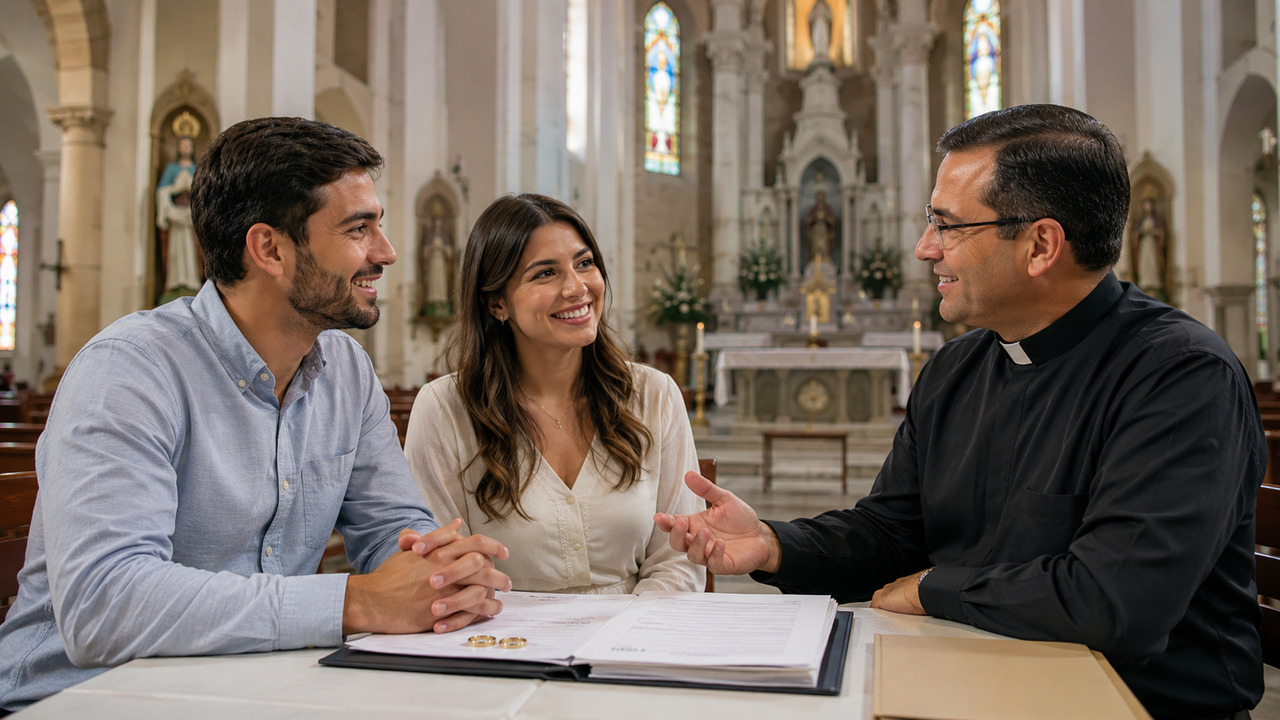
Getting married in the Catholic Church in Aracaju involves more than choosing an available date and putting together a ready-made list of documents. There is a process of marriage preparation and qualification, and part of it is governed by the general discipline of the Church; another part depends on the organization of the Archdiocese and the routine of the chosen parish. Therefore, the safest decision is to contact the parish office before assuming deadlines, closing reception or ordering services based on a generic guide on the internet.
The first step is to separate church reservation and marriage process
Reserving the date and the marriage process are not the same thing. The parish where the couple intends to celebrate may have its own agenda, times and procedures for reserving the church. The matrimonial license serves to verify the situation of the bride and groom and gather the necessary elements for the valid and licit celebration of marriage.
The Code of Canon Law determines that, before the celebration, it must be clear that nothing prevents the marriage and that episcopal conferences establish norms on the examination of the bride and groom, banns and other necessary investigations. In practice, this explains why the secretariat requests documents, conducts interviews and provides guidance on steps that do not appear in a simple date reservation.
Therefore, when contacting the parish, it is worth asking two things separately: how the celebration reservation works and where the marriage process will be opened. This distinction avoids the error of imagining that the marked date means that the entire canonical part has already been resolved.
In which parish should the process begin
The general rule of the Church is that the marriage is celebrated in the parish where one of the bride and groom has a domicile, quasi-domicile or residence for at least one month. With proper permission, the celebration can take place elsewhere. This is precisely where the marriage transfer appears when the process is carried out in one parish and the ceremony will be held in another.
In Aracaju, the fee table published by the Archdiocese in May 2026 provides for specific charges for marriage transfers and for proclamations in another parish. This shows that the circulation of the process between communities is part of the local administrative routine and must be dealt with in advance.
If the bride and groom live in different neighborhoods, belong to different parishes or want to get married in a church that is not the parish of either of them, the correct question for the secretariat is: where do we open the process and what will be needed to transfer it afterwards? This answer is worth more than copying the procedure of another diocese.
When to look for the parish: there is no magic calendar
It is common to find recommendations on the internet such as three, six or twelve months in advance. These numbers can be useful for reference, but are not a substitute for your local calendar. Marriage preparation can be organized in concentrated meetings, weekends or longer itineraries, and classes do not always meet every month.
In 2026, for example, the Family Pastoral of the Metropolitan Cathedral of Aracaju released training for newlyweds distributed between the afternoon of a Saturday and the morning of a Sunday. At a national level, the CNBB Family Pastoral has also been encouraging a longer follow-up model, starting around a year before the ceremony in its itinerary proposal
experiential. The two pieces of information do not contradict each other: they show precisely that preparation can take different formats depending on the pastoral reality.
The practical point is simple. The sooner the couple looks for the parish, the lower the risk of discovering that the next available formation takes place too late for the imagined date. The preparation agenda can be more decisive than the speed of obtaining a certificate.
Marriage preparation is not just a certificate
The Code of Canon Law provides for personal preparation so that the bride and groom understand the sanctity and duties of the new state of life. The Church also advises that this preparation helps the couple to understand the Christian meaning of marriage, the freedom of consent and the responsibilities of married and family life.
For this reason, the so-called bride and groom course can vary greatly in format. Some communities concentrate training on one weekend; others work with successive meetings and support of Family Pastoral couples. The important thing is not to assume that a certificate obtained anywhere, at any time, will be automatically accepted without verification.
Before signing up for training, confirm with the parish that will open the process whether that meeting is accepted, whether there is practical validity for the certificate and whether there is any additional preparation required by the community where the marriage will be celebrated.
What documents can be requested
There is no safety in presenting a single list as if it were universal for all parishes in Aracaju. Church law itself leaves part of the norms of premarital investigation to private discipline, and the personal situations of the bride and groom may require additional documents.
As a local reference, publications of community marriages from parishes in the Archdiocese in 2026 mentioned baptismal certificates, civil marriage certificates and identification documents such as ID and CPF. This helps to understand the type of documentation that usually appears, but does not transform this relationship into a mandatory checklist for any marriage.
The baptismal certificate deserves special attention because the marriage process needs to verify the canonical status of the bride and groom. When the parish requests an updated certificate for marriage purposes, the document must be requested from the church or parish where the baptism took place, according to the guidance received. The 2026 archdiocesan table also provides a specific value for issuing Baptism, Confirmation or Marriage certificates.
Proof of residence, civil identification, marriage preparation certificate, witness data and documents relating to civil marriage may also appear depending on the case. The decisive word, however, belongs to the secretariat that will lead the process.
The interview and the proclamations are part of the qualification
The process is not just documentary. The Church needs to verify that the couple are free to marry and that there is no known impediment. Therefore, qualification may include an interview with the priest or person responsible and the publication of banns in accordance with the norms applied locally.
The existence, in 2026, of a specific archdiocesan fee for banns in another parish is a practical sign that this stage can involve more than one community when the bride and groom belong to different parish territories.
If the couple lives outside of Aracaju, has recently changed address or has ties to another diocese, it is especially important to inform this at the first appointment. The secretariat will be able to guide how communications will be made and which documents need to be circulated between parishes.
Situations that require guidance before following a common script
Some cases should not be handled with a generic list. If one of the bride and groom is Catholic and the other belongs to another Christian community, permission from the competent authority may be required. If one of the parties is not baptized, canon law provides for an impediment to disparity in worship that needs to be addressed appropriately. Situations of previous marriage, obligations arising from a previous union, residence in another diocese or doubts about sacramental registrations also deserve early analysis.
This does not mean that marriage is automatically impossible. It just means that the process may require specific authorization, exemption, proof or referral. In these cases, looking for the parish early is even more important, because the deadline no longer depends only on the ceremony schedule and starts to depend on the necessary canonical analysis.
How much does it cost in Aracaju in 2026
The Archdiocese of Aracaju published on May 18, 2026 a new table of fees, effective from June 1st. For marriage, the table states R$300 for weddings, R$100 for marriage transfer and R$20 for banns in another parish. Baptism, Confirmation or Marriage Certificates appear with a value of R$ 20.
These values are the archdiocesan reference published for 2026 and remain subject to new determination. They should not be used to assume all expenses linked to the ceremony. Before booking, ask the parish if there are any local scheduling procedures, what payments are actually applicable to the case and if there are different conditions for community marriages.
It is also prudent to separate ecclesiastical fees from external expenses contracted by the couple, such as music, decoration, photography or ceremonies. These services should not be confused with the sacramental process.
What really varies between parishes
The essence of the sacrament and the general norms of the Church do not change from one parish to another, but the practical organization can change a lot. Dates and frequency of marriage preparation, times available for celebrations, how to reserve the church, internal deadline for submitting documents, how to forward transfers, requirements for music and decoration and secretariat routines are examples of points that require local confirmation.
This variation explains why a national guide can get the general structure right and still mislead the couple in detail. A website may say that the course takes place six months in advance, while the chosen parish works with classes on specific dates. Another may present a list of documents that includes items that the local secretariat does not request or fails to mention something necessary in that specific case.
The best use of a guide is to arrive at the office knowing what questions to ask, not to arrive believing that all the answers are already defined.
A practical sequence to avoid missing a deadline
Before closing the reception
Choose the desired church and directly confirm availability, wedding times and booking procedure. In the same contact, ask where the marriage process should be opened and whether the celebration in that church will require transfer.
As soon as the date is forwarded
Ask the secretariat for an updated list of documents and the marriage preparation calendar. Inform from the beginning if any groom was baptized in another city, lives in another diocese, belongs to another Christian community, is not baptized or has a previous marriage. This information can change the process path.
Before issuing all certificates
Confirm which documents need to be updated and what advance notice the parish accepts. Issuing certificates too early can generate rework if there is a defined update deadline for the process.
When preparation is complete
Keep the certificate or receipt provided by the responsible team and confirm whether it should be taken to the parish in the process. If the training was carried out in another community, check acceptance before considering this stage closed.
On the final stretch
Confirm whether the proclamations have been completed, whether the interview has already taken place, whether there is a pending transfer and whether the parish of the celebration has received the process. This is also the time to review local rules for liturgy, music, decoration, procession entrance and schedules, as these details are often left out of documentation guides.
What to confirm at the secretariat before considering everything resolved
The couple can consider the documentary planning truly underway when they know, with a response from the parish itself, where the process is open, which documents are still missing, which marriage preparation was accepted, whether the banns have already been provided, whether there is a transfer to another church and what values and deadlines are being applied in that case.
This final conference is more important than memorizing a ready-made list. In Aracaju, there is a common archdiocesan structure, but daily execution goes through parish secretariats and Family Pastoral teams. The safest way to avoid surprises is to treat a religious wedding as a step-by-step process, not a ceremony reservation accompanied by last-minute paperwork.