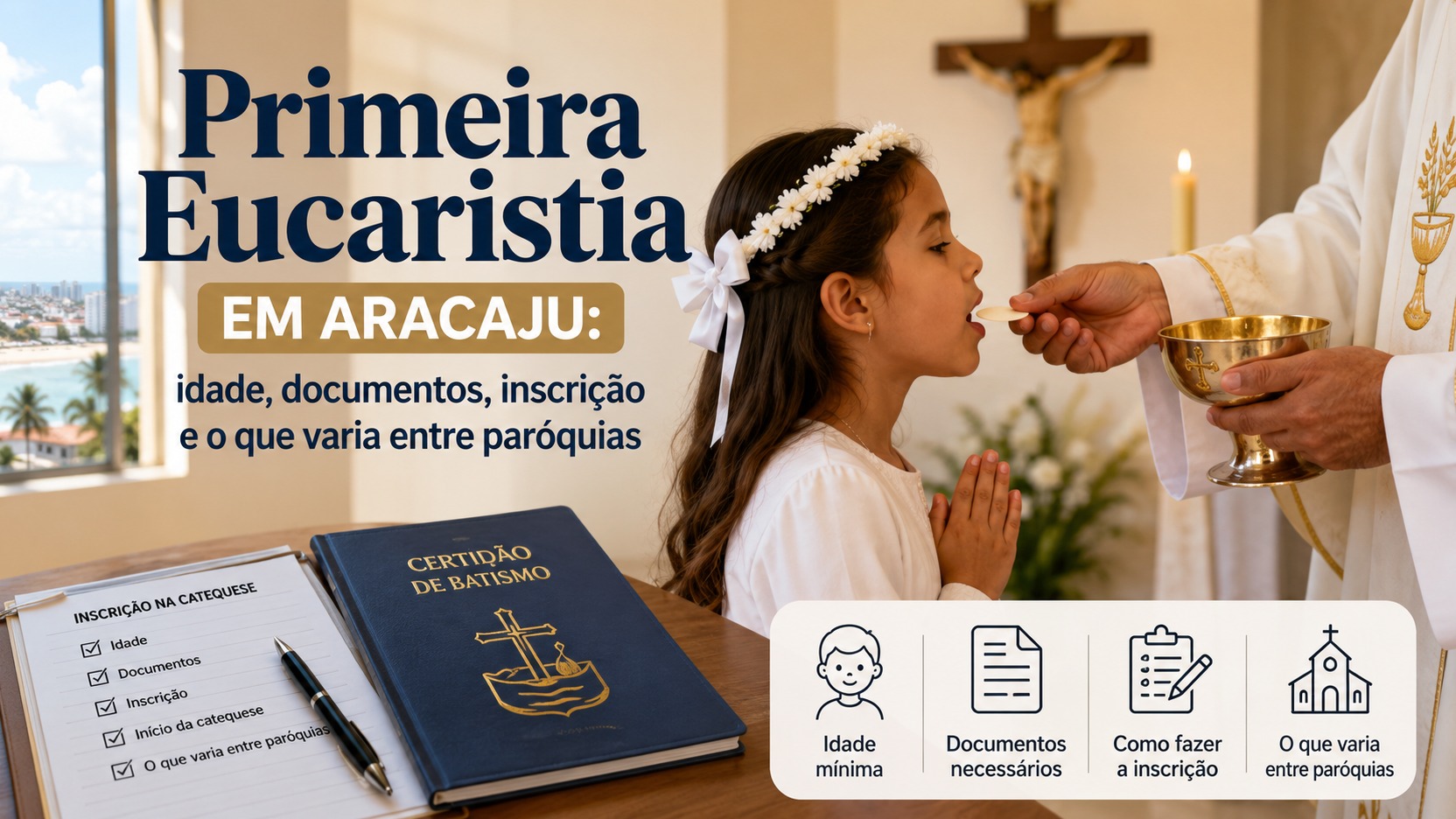
People looking for information about First Eucharist in Aracaju often find different answers about age, documents, and the length of catechesis. The most important distinction is between the archdiocesan norm and the practical organization of each parish. The Archdiocese establishes a common basis for Initiation into Eucharistic Life; enrollment dates, schedules, group organization, activities, and administrative documents may vary from one community to another.
For a family that wants to begin the process, the practical reference is this: the preparation itinerary can begin from the age of 7, but reception of the Eucharist should not take place before age 9. Enrollment should record the catechesis participant's information and provide proof of Baptism, normally through a certificate. This does not mean, however, that every 9-year-old child is automatically ready to receive Communion. The Archdiocese's own Directory places maturity of faith and completion of the itinerary at the center of the process.
At what age can a child begin catechesis for the Eucharist?
The Liturgical-Sacramental Directory of the Archdiocese of Aracaju sets 7 years of age as the minimum to begin the Initiation into Eucharistic Life itinerary, known in many communities as First Eucharist or First Communion catechesis.
This resolves a common confusion. Seven years is the reference point for beginning the itinerary, not for immediately receiving the Eucharist. The same Directory states that reception of the sacrament should not occur before age 9 and emphasizes that the catechesis participant's maturity of faith must be considered.
In practice, therefore, a child can enter catechesis at age 7 and receive First Eucharist after age 9, depending on the group's development and the path defined by the parish. The document also provides for the pastor to assess specific situations, both in relation to the itinerary and to the appropriate time to receive the Eucharist.
For children younger than 7, the archdiocesan guidance is that parishes may offer fellowship groups or other experiences that bring them closer to the community, without confusing those activities with the formal Initiation into Eucharistic Life itinerary.
Does First Eucharist necessarily happen at age 9?
No. What the Aracaju norm establishes is a minimum limit: the Eucharist should not be received before age 9. That does not make age 9 an automatic date for every child.
Preparation is described as an itinerary of faith, not as a course completed merely by attending for a set period. The Directory states that baptized children must be properly prepared, according to their capacity, to understand the mystery of Christ and receive the Eucharist with faith and devotion.
For this reason, the actual duration may vary. The itinerary should be developed and reviewed by the catechesis team and the Initiation into Christian Life commission in agreement with the pastor, taking into account the pastoral reality of the community and the group's maturation. This is precisely why legitimate differences arise among parish calendars.
Which documents are actually required by the archdiocesan norm?
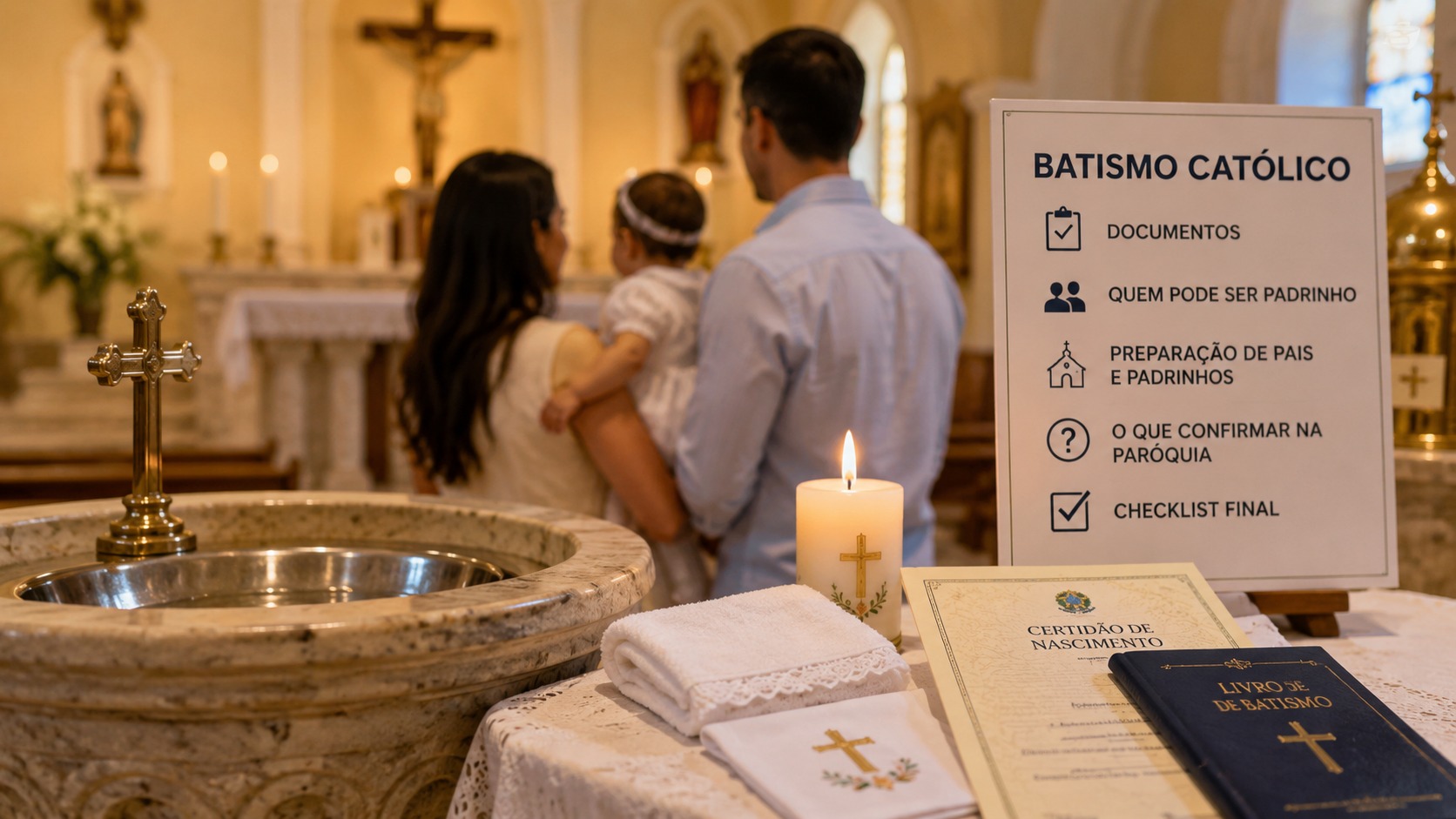
For enrollment in Initiation into Eucharistic Life, the Directory instructs parishes to prepare a form to record the catechesis participant's information and requires proof of Baptism through a certificate.
The baptism certificate is therefore the central document required by the archdiocesan norm. It proves that the person has already received the first sacrament of Christian initiation and allows the parish to organize the continuation of the sacramental journey correctly.
The norm also addresses the possibility that the certificate has been lost. Because the alternative form of proof depends on the circumstances and on Canon Law, the family should not simply replace the document with a self-made declaration. The safest course is to inform the parish office or catechesis team so that the parish can advise how to locate the record or follow the appropriate procedure.
Can the parish ask for documents in addition to the baptism certificate?
Yes. It is important to distinguish the sacramental document required by the norm from administrative documents used to organize enrollment. A community may request the catechesis participant's birth certificate or identification document, proof of address, a photograph, parents' or guardians' details, a signed form, or other registration items.
These additional requirements do not mean that there is one single, unchanging list for all of Aracaju. They may be used to identify the catechesis participant, organize contacts, determine the community of reference, complete records, or manage groups.
For that reason, printing a list from one parish found online and assuming it will apply to another is not a good strategy. The baptism certificate is the clearest documentary basis in the Directory; the other documents should be confirmed directly with the community where catechesis will take place.
How does enrollment work according to the Aracaju Directory?
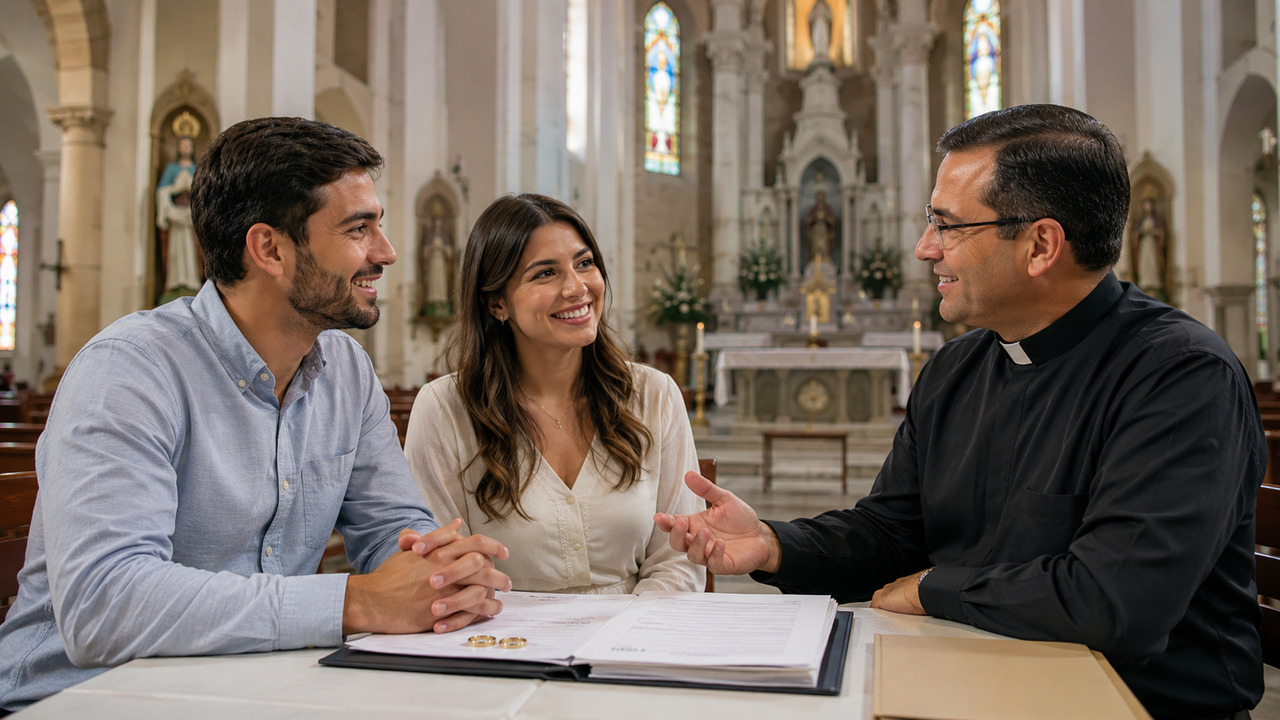
The archdiocesan document proposes that enrollment should not be treated as a simple bureaucratic registration. It recommends a personalized welcome and provides for an enrollment celebration, with catechists available to receive those who want to begin catechesis.
Parents or guardians should be invited to take part in that moment. The intention is for the family to receive the first guidance about the journey the child is about to begin, rather than merely handing documents to the parish office.
If the family cannot participate on the main enrollment date, the Directory provides for the possibility of a later conversation with the priest and the catechists to complete the admission. The parish itself, however, must establish a deadline for enrollment. This helps explain why one community may still be accepting new catechesis participants while another has already closed its group for the same year.
What really varies among parishes in Aracaju?
The first difference is usually the calendar. Each parish may open enrollment during its own period, define a final deadline, limit vacancies, and organize the beginning of groups according to its pastoral structure.
Meeting days and times also vary. Some communities work with Saturday groups; others may organize meetings during the week or in different chapels. The length of each stage, the division by age, and the number of groups may also change, provided that the itinerary respects the necessary preparation and archdiocesan guidance.
Another variable is complementary activities. The Directory provides, when possible, for retreats, kerygmatic meetings, and other age-appropriate experiences. It also encourages participation in Sunday Mass and family involvement throughout the journey. The concrete way these proposals are carried out depends on the reality of each community.
Administrative documentation may also vary, as can the enrollment method: parish office, assistance from catechists, a dedicated form, or another locally defined procedure. What should not be confused with parish choice is the need for serious preparation for the Eucharist and proof of Baptism.
Does catechesis completed at a school count in the same way?
The Archdiocese of Aracaju recognizes that some schools organize preparation itineraries for Initiation into Eucharistic Life, but the Directory states that primary responsibility belongs to the parish and that school itineraries must be submitted to archdiocesan approval and oversight.
This distinction matters because, in 2026, educational institutions in Aracaju publish their own First Eucharist programs with enrollment rules, school grade requirements, and specific schedules. These criteria help organize the school's pastoral program, but they should not be interpreted as the Archdiocese's universal age rule for all parishes.
If a child is preparing at a school, the family should confirm with the school's Pastoral Center and with the parish of reference how the record and celebration will be handled, especially if there is a change of community during the itinerary.
What if the child has not yet been baptized?
Lack of Baptism does not mean the family should give up on catechesis. The Directory provides that catechumen children from age 7 may remain with the Initiation into Eucharistic Life group
while they complete their preparatory process.
Because Baptism, Confirmation, and Eucharist are part of Christian Initiation, the situation needs to be organized pastorally so that the sacraments are received in the proper order. The catechesis team and the pastor should advise how Baptism will be integrated into the journey before full participation in the Eucharist.
For adolescents, young people, or adults who have not received one or more sacraments, it is also not advisable to place the person in a children's group on one's own initiative. The Archdiocese works with itineraries inspired by the catechumenate and provides specific preparation for adults.
Does the child need to make a first confession before First Eucharist?
The Directory instructs that, throughout the Initiation into Eucharistic Life itinerary, catechesis participants should be led to the Sacrament of Reconciliation. It even allows for an initial approach through a penitential celebration, called the Feast of Forgiveness in the document, or another activity organized for that purpose.
The exact way this moment is prepared and celebrated may vary by parish. Parents and guardians should therefore ask the catechesis team when preparation for Reconciliation will take place and whether there are any specific instructions for the family.
What should the family ask before enrolling?
The best way to avoid rework is to contact the parish where the child will participate in community life and confirm which group is available for the child's age. State the child's full age, say whether the child has already been baptized, and mention from the beginning whether the baptism certificate is available or a duplicate will need to be requested.
Then confirm the opening and closing dates for enrollment, meeting days and times, the expected length of the itinerary, any additional administrative documents, the participation expected from parents or guardians, and the activities included in preparation.
It is also worth asking how the parish handles transfers of catechesis participants who have already begun preparation in another community. Because the itinerary can be organized into different stages, the team will need to verify what has already been completed before deciding which group the child should join.
The 2026 reference still requires local confirmation
There is an update point that deserves attention. In August 2024, the Archdiocese of Aracaju announced the creation of a commission to study and revise the Directory of the Sacraments then in force. In the research conducted for this guide on August 25, 2026, no public announcement of the promulgation of a new version replacing the norms cited here was located on the Archdiocese's official website.
This reinforces a practical rule: use the Directory as the basis for understanding age, Baptism, and the logic of preparation, but confirm with the parish the procedure actually adopted for the current group. In sacramental matters, an old poster, a post from another community, or a school's program should not replace guidance from the parish where the catechesis participant will complete the itinerary.
The safest way to get started
For those in Aracaju, the central answer is simple. A child may begin the Initiation into Eucharistic Life itinerary from the age of 7, but should not receive First Eucharist before age 9. The baptism certificate is the documentary proof directly provided for enrollment, while the parish may add administrative documents and define its own calendar, schedules, and activities.
If the child has already reached the minimum age, the next step is not to wait until age 9 before contacting the Church. It is to contact the parish, find out when the next group opens, and begin the journey at the appropriate time. This helps the family avoid turning First Eucharist into a last-minute race for documents near the celebration and follows the main purpose of the itinerary: preparing the catechesis participant to take part consciously in the Eucharistic life of the community.