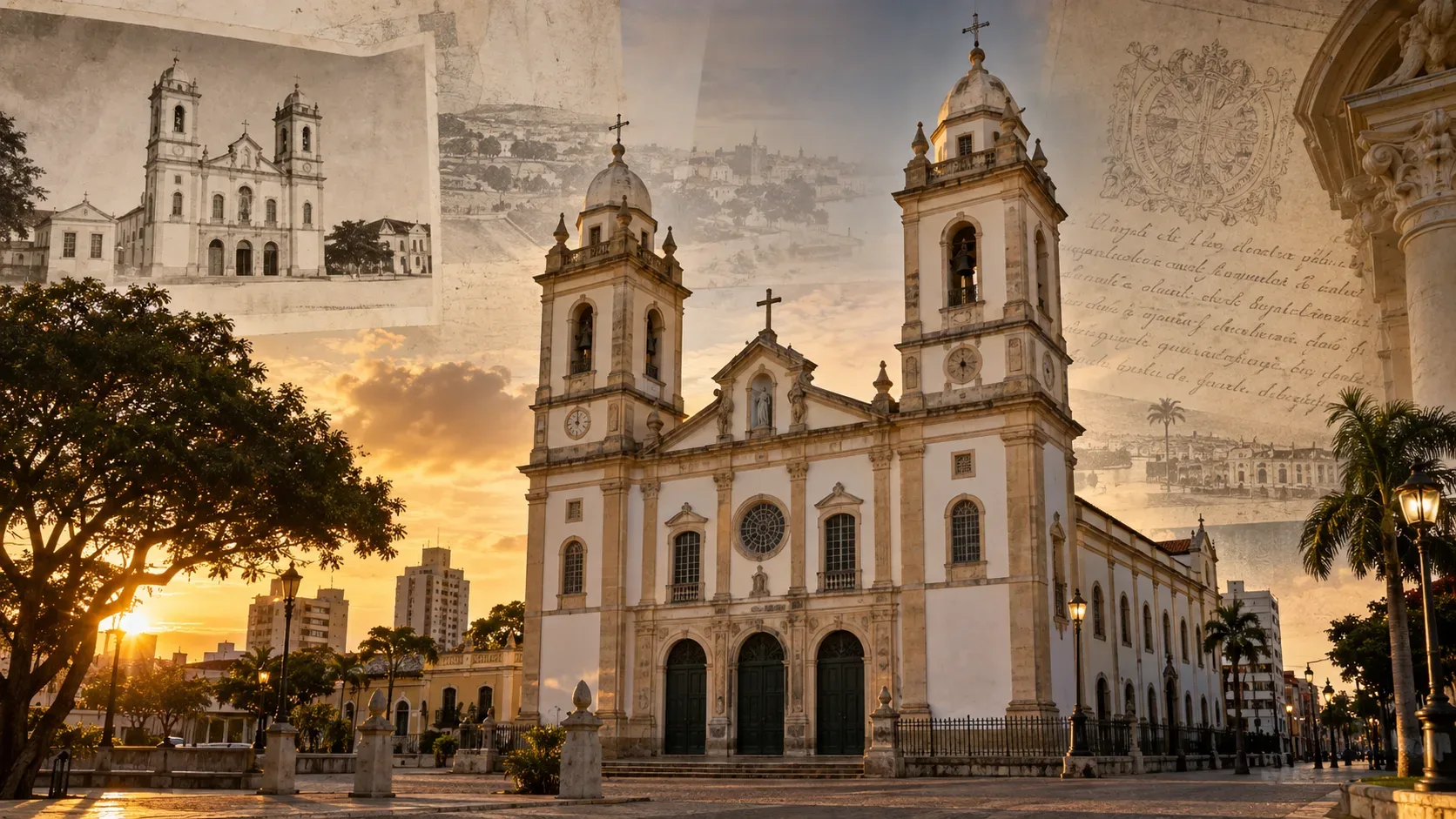
Aracaju Metropolitan Cathedral did not begin as a cathedral. The building that is now a religious and heritage landmark in the city center began as the parish mother church of Our Lady of the Conception in the new capital. Its history includes several distinct milestones: the laying of the first stone, the beginning and completion of construction, inauguration, creation of the Diocese, installation of the first bishop, elevation to a metropolitan see and state heritage listing. Separating these dates is the clearest way to understand how the former mother church became the seat of the Archdiocese and a protected historic property.
A timeline from the former mother church to protected heritage
| Date | Milestone | What changed |
|---|---|---|
| May 22, 1856 | First stone | The Archdiocese records the laying of the first stone of the future mother church of the new capital. |
| 1862 | Start of construction recorded by the city | Aracaju's municipal heritage diagnosis places the start of construction in 1862 under Canon Eliziário Vieira Moniz Teles. |
| December 22, 1875 | Inauguration | The Mother Church of Our Lady of the Conception is inaugurated after a long construction process. |
| January 3, 1910 | Creation of the Diocese of Aracaju | Pius X creates the Diocese through the bull Divina Disponente Clementia. The former mother church takes on the role of cathedral, meaning the church of the bishop's cathedra. |
| November 19 and December 4, 1911 | Consecration and installation | The archdiocesan history records the Cathedral's consecration on November 19 and the installation of the Diocese, with the taking of office of its first bishop, Dom José Thomaz Gomes da Silva, on December 4. |
| April 30, 1960 | Metropolitan see | John XXIII elevates Aracaju to a Metropolitan Archdiocese and creates the Ecclesiastical Province of Aracaju, with the new dioceses of Estância and Propriá. |
| January 28, 1985 | State heritage listing | Decree No. 6,819 protects the building as state historic heritage. The municipal diagnosis records Case No. 040/83 and its entry in the General Heritage Register on February 27, 1985. |
Why do 1856 and 1862 both appear as starting dates?
Both dates appear in official sources, but they describe different milestones. The Archdiocese of Aracaju states that the first stone of the future mother church was laid on May 22, 1856. The municipal diagnosis of historic and cultural heritage, in turn, says construction began in 1862 and was completed in 1875. Rather than choosing one date and rejecting the other, it is more precise to treat them as separate stages: 1856 marks the ceremonial beginning of the religious project, while 1862 is the date used by the municipal inventory for the start of construction of the building completed in 1875.
The Archdiocese's own account also describes interruptions after the death of Inácio Joaquim Barbosa, founder of the new capital, and during a cholera epidemic. This helps explain why a church conceived in Aracaju's early years took so long to reach inauguration.
Mother church, cathedral and metropolitan see are not synonyms
| Term | What it means | In Aracaju's history |
|---|---|---|
| Mother church | The principal church of a parish. | The church of Our Lady of the Conception served this role in the new capital before the Diocese was created. |
| Cathedral | The church that contains the bishop's cathedra and serves as the principal church of a diocese. | The institutional change begins with the creation of the Diocese of Aracaju in 1910 and is implemented locally with the episcopal installation in 1911. |
| Metropolitan cathedral | The cathedral of an archdiocese that is the seat of an ecclesiastical province. | This status follows Aracaju's elevation to a Metropolitan Archdiocese in 1960. |
The building therefore did not need to be replaced each time its title changed. What changed was the church's institutional role within Catholic organization, while the same structure continued to receive renovations and adaptations.
1910 and 1911: an institutional change in two stages
On January 3, 1910, Pius X created the Diocese of Aracaju through the bull Divina Disponente Clementia, separating Sergipe's ecclesiastical organization from the Archdiocese of São Salvador da Bahia. The creation of the Diocese gave the former mother church the status of cathedral because Aracaju now had its own episcopal see.
This does not mean that every practical step occurred on that same day. The official history of the Archdiocese says that the Cathedral was consecrated on November 19, 1911, and that the Diocese was installed on December 4 of that year, when Dom José Thomaz Gomes da Silva took office as its first bishop. The distinction between 1910 and 1911 separates the legal act creating the Diocese from its solemn local installation.
1960: why the Cathedral became metropolitan
On April 30, 1960, Pope John XXIII elevated the Diocese of Aracaju to an Archdiocese and Metropolitan See through the bull Ecclesiarum Omnium. The same act created the dioceses of Estância and Propriá, which became part of the Ecclesiastical Province of Aracaju. Dom José Vicente Távora, until then bishop of Aracaju, became the first metropolitan archbishop.
This is the milestone that explains the word “Metropolitan” in the Cathedral's current name. The 1960 change did not mark the inauguration of a new building, but a new position for Aracaju within the regional ecclesiastical structure.
The present architecture is the result of several layers
The building seen today should not be read as an untouched snapshot of 1875. The municipal diagnosis classifies the Cathedral as eclectic religious architecture with neoclassical and neo-Gothic features and records a major renovation coordinated by Father Carlos Camélio Costa. The same document highlights the interior decorative painting by Orestes Gatti and Rodolfo Tavares.
The Archdiocese also describes a broad intervention in the early 20th century to adapt and embellish the former mother church after it had become a cathedral. The architectural significance of the building therefore lies in the layering of periods: the 19th-century construction, early 20th-century renovations and artistic elements added over time.
1985: when the church also received heritage protection
The state heritage listing is another milestone, separate from the religious titles. According to the City of Aracaju's diagnosis, the Cathedral was protected through Case No. 040/83 and Decree No. 6,819 of January 28, 1985, with its entry in Heritage Register No. 01, General, page 8, on February 27, 1985. The document identifies the building at Praça Olímpio Campos within the historic center.
The listing recognizes the building's cultural value without erasing its religious function. The Cathedral continues to operate as a place of worship and an ecclesiastical seat while also forming part of Sergipe's protected historic heritage. This dual condition explains why its history matters both to Catholic memory and to Aracaju's urban history.
What the 150 years celebrated in 2025 actually counted
In December 2025, the Archdiocese released a commemorative booklet marking 150 years of the Cathedral. The anniversary uses the inauguration of December 22, 1875, as its reference point. It does not count from the 1856 first stone, the creation of the Diocese in 1910, the metropolitan elevation in 1960 or the heritage listing in 1985.
This choice shows why each date needs to be named correctly. The Cathedral can have more than one “age,” depending on the milestone being discussed: the project and first stone, construction, inauguration of the church, episcopal function, metropolitan status or heritage protection.
How to summarize the transformation of Aracaju Cathedral
The sequence is straightforward: the new capital received a mother church dedicated to Our Lady of the Conception; the church was inaugurated in 1875; the creation of the Diocese turned it into a cathedral from 1910, with the episcopal installation in 1911; Aracaju's elevation to a Metropolitan Archdiocese in 1960 made it a metropolitan cathedral; and the 1985 heritage listing formally recognized the building's historic value. Its present architecture, shaped by 19th-century construction and later renovations, materializes these institutional and urban changes in a single monument.