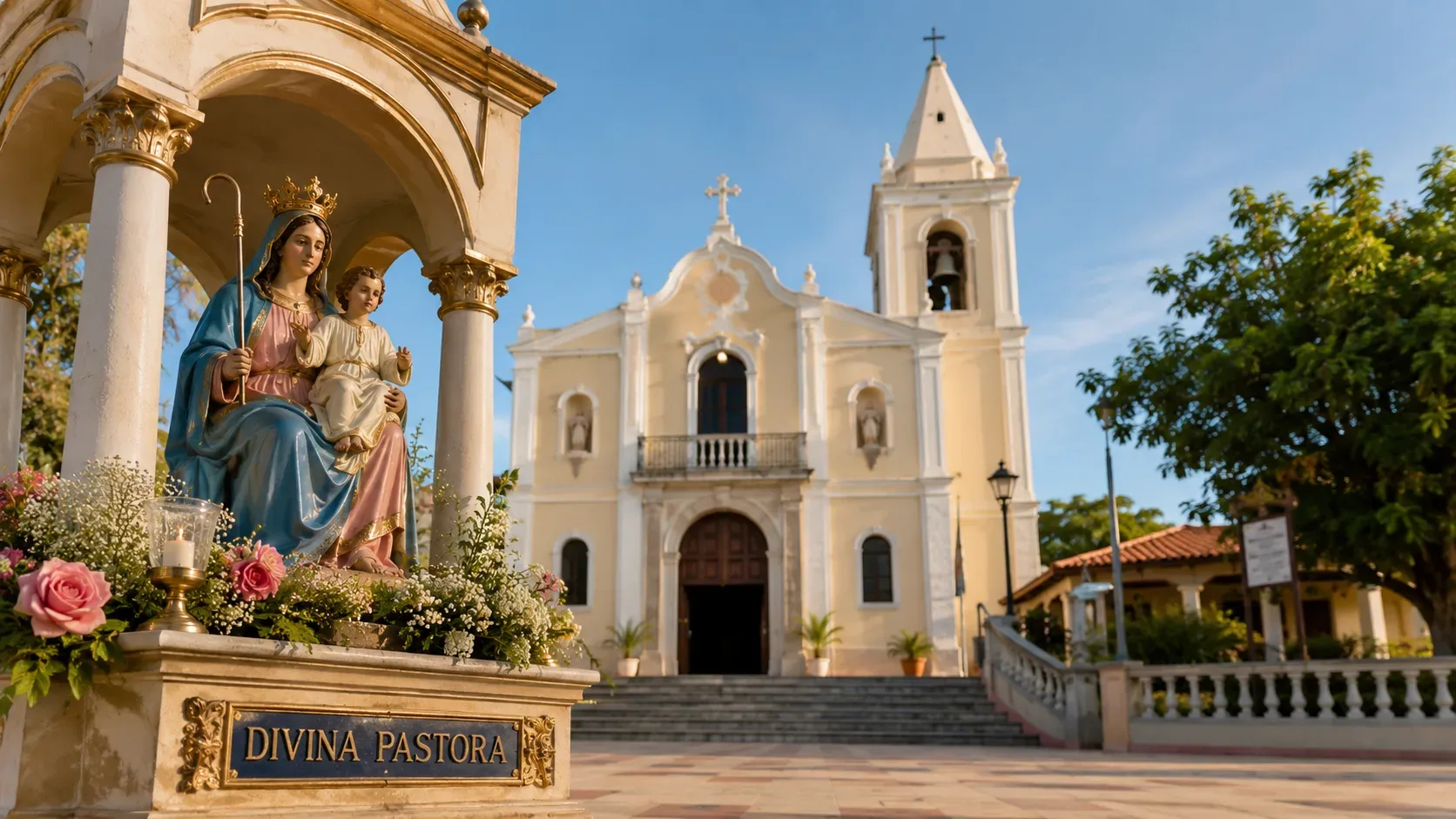
You can visit the Sanctuary of Our Lady Divina Pastora on an ordinary day, without taking part in the annual pilgrimage. For travelers who want to combine devotion, heritage and a quieter visit, the first step is to separate two pieces of information that many pages mix together: the regular Mass schedule and the hours when the church is actually open for visitors.
The Archdiocese of Aracaju publishes the Sanctuary's regular Mass schedule. The Sanctuary's official website provides its address and parish office contacts, but on the page checked it does not publish a fixed daily window for tourist visits. Anyone planning to enter the church outside celebration times should therefore confirm opening hours with the parish office in advance.
What are the Mass times at Divina Pastora Sanctuary?
When checked on August 31, 2026, the Archdiocese of Aracaju listed the following regular times for the Parish-Sanctuary of Our Lady Divina Pastora:
| Day | Published time |
|---|---|
| Sunday | 8:00 a.m. and 5:00 p.m. |
| Monday | No regular time listed |
| Tuesday | 7:00 p.m. |
| Wednesday | 7:00 p.m. |
| Thursday | 7:00 p.m. |
| Friday | 7:00 p.m. |
| Saturday | No regular time listed |
These are published regular times, not a guarantee that no additional liturgies will take place. Solemnities, novenas, Marian feasts, pilgrimages and special programs can change the routine. If you are planning well in advance, check the Archdiocese page again and, when attending Mass is the main purpose of the trip, confirm directly with the Sanctuary.
How to visit on an ordinary day
The Sanctuary is at Praça da Matriz, s/n, Divina Pastora, Sergipe, 49650-000, Brazil. Its official website lists the parish office phone as +55 (79) 9 9981-4382 and the email address par.santuarionsradivinapastora@gmail.com.
The key point for visitors who are not going during the pilgrimage is this: the official website checked does not clearly publish daily opening hours for interior visits. It is therefore unsafe to assume that the church will remain open throughout the morning or afternoon. If you want time to look at the heritage, take photographs when allowed or enter outside liturgical times, confirm opening before you travel.
- If you want to attend Mass: use the Archdiocese's regular schedule as your reference and reconfirm close to the date.
- If you only want to see the interior: ask the parish office what time the church will be open.
- If a service is taking place: respect the religious character of the space; movement, conversation and photography may need to be reduced.
- If the church is closed: you can still see how the building sits on Praça da Matriz and examine the façade, but the main artistic heritage is inside.
What to look for inside the Sanctuary
1. The façade and the date 1782
The main façade of the Church of Our Lady Divina Pastora bears the inscription 1782. Heritage sources use that date as an important marker in the building's history, although historical studies treat the construction chronology more cautiously. For visitors, the essential point is that this is a colonial-era church of major historical significance under federal protection.
Iphan, Brazil's federal heritage institute, records the Church of Our Lady Divina Pastora and its collection as a protected property since March 1943. The protection therefore extends beyond the façade and walls to the integrated collection associated with the church.
2. The high altar and carved decoration
One of the main highlights inside is the high altar with gilded and polychrome carving. The HPIP heritage description notes its large central niche, twisted columns and canopy, as well as carved decoration on other elements such as the chancel arch, side altars, pulpit, choir and tribunes.
This ensemble is particularly useful for seeing the Sanctuary not only as a devotional destination but also as a work of art and architecture. The space is easier to understand when you look at the relationship between the main altar, the side elements and the nave rather than focusing on a single object.
3. The ceiling paintings
The Iphan dossier on Irish lace in Divina Pastora highlights the paintings on the ceilings of the nave and choir, attributed to the Bahian painter José Teófilo de Jesus. The document treats these paintings as one of the church collection's notable features and relates them to the nineteenth-century tradition of illusionistic architectural painting in Sergipe.
In practical terms, look up when you enter before walking toward the altar. The ceiling helps explain why a quick look at the façade cannot replace an interior visit.
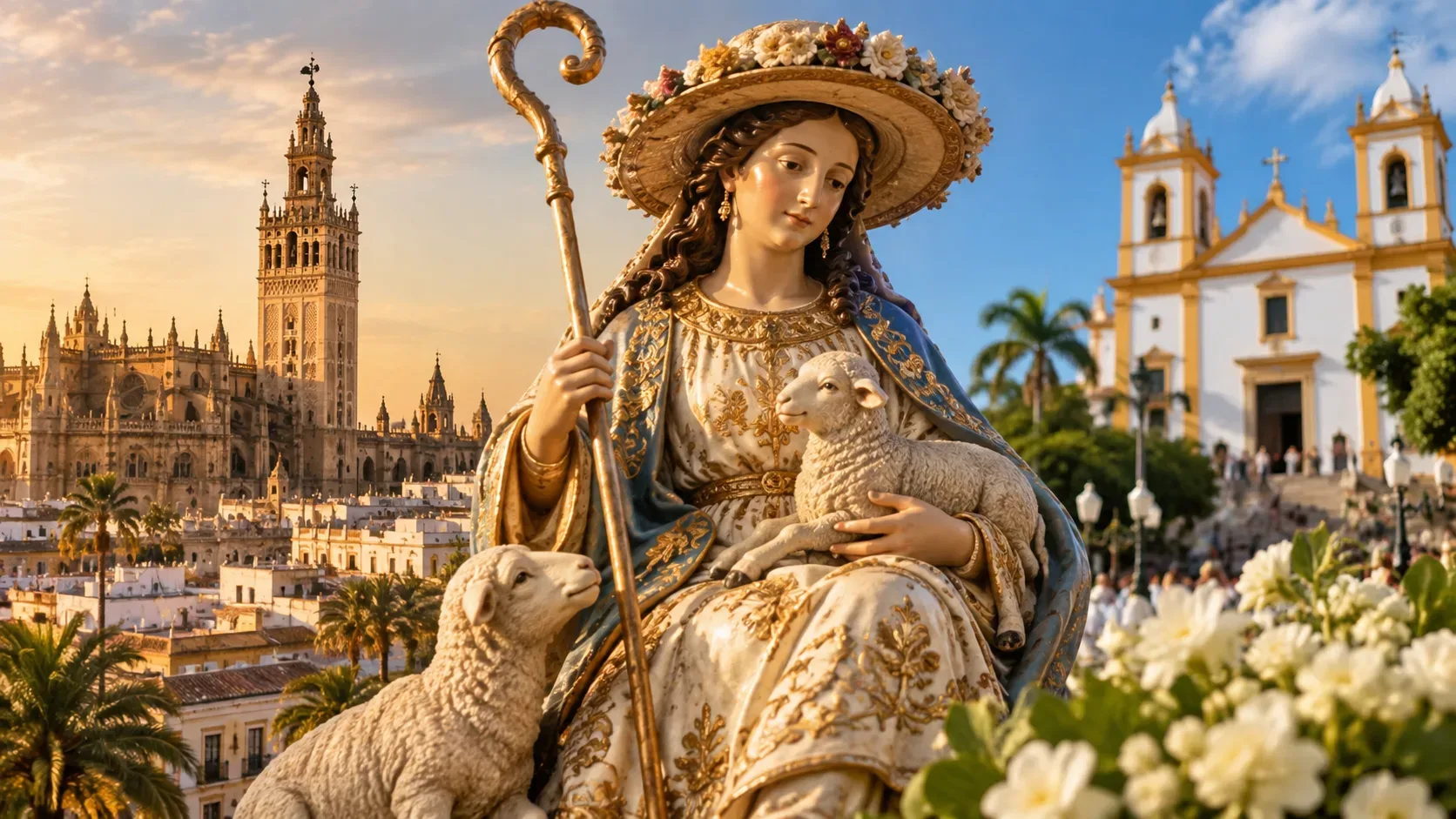
4. The image of the patroness
The image of Our Lady Divina Pastora enthroned on the main altar is another central element. The same Iphan dossier says the sculpture is made of wood and notes that documentary references to its arrival in the locality are scarce. It is a useful reminder that an object's religious significance can be much greater than what surviving historical documents can establish about its origin.
5. The nave, side passages and connection with pilgrimage
The architecture also helps explain the church's function. HPIP describes a nave, chancel and side passages opened through porticoes. The space has historically been associated with sheltering pilgrims. Even outside the main annual walk, the connection between architecture and devotion remains visible in the way the building organizes circulation, shelter and approach to the altar.
Getting there from Aracaju
Documentation from Brazil's National Institute of Industrial Property concerning the geographical indication for Divina Pastora's Irish lace places the municipality about 39 km from Aracaju. Road access to the municipal seat uses state highways in the region, with SE-245 serving as the main connection between Riachuelo and Divina Pastora.
Because road conditions and navigation-app recommendations can change, treat this as geographical context rather than fixed turn-by-turn directions. On the day of your visit, check an updated map and any road notices.
What changes when you visit outside pilgrimage season
The annual pilgrimage turns Divina Pastora into a major religious destination with exceptional visitor flows. An ordinary day is a different experience: it can be more focused on regular Mass, personal prayer and reading the church as heritage. At the same time, you should not assume the same reception services, commerce or extended operations seen during major events.
That difference is precisely why confirming church opening hours matters. Outside special programs, the parish calendar is more useful than news reports about the pilgrimage.
A 2026-specific note
In March 2026, the Archdiocese of Aracaju designated the Sanctuary of Our Lady Divina Pastora as a place where the plenary indulgence could be obtained in the Archdiocese during the Franciscan Jubilee Year, marking 800 years since the death of Saint Francis of Assisi. The Archdiocese explains that the indulgence depends on the spiritual conditions established by the Church and presents the Sanctuary as the designated local site for that observance. This special program does not replace the need to check regular Mass times and church opening hours.
Practical checklist before you leave
- Check the Mass schedule again on the Archdiocese of Aracaju website.
- If you plan to visit outside Mass, confirm interior opening with the parish office.
- Save the address: Praça da Matriz, s/n, Divina Pastora, Sergipe.
- Allow time to see the high altar, side altars, pulpit, choir and especially the ceiling paintings.
- Treat photography as secondary during services and follow local instructions.
- If you want to broaden the cultural outing, Divina Pastora is also a national reference for the traditional craft of Irish lace, registered by Iphan as Brazilian Cultural Heritage.