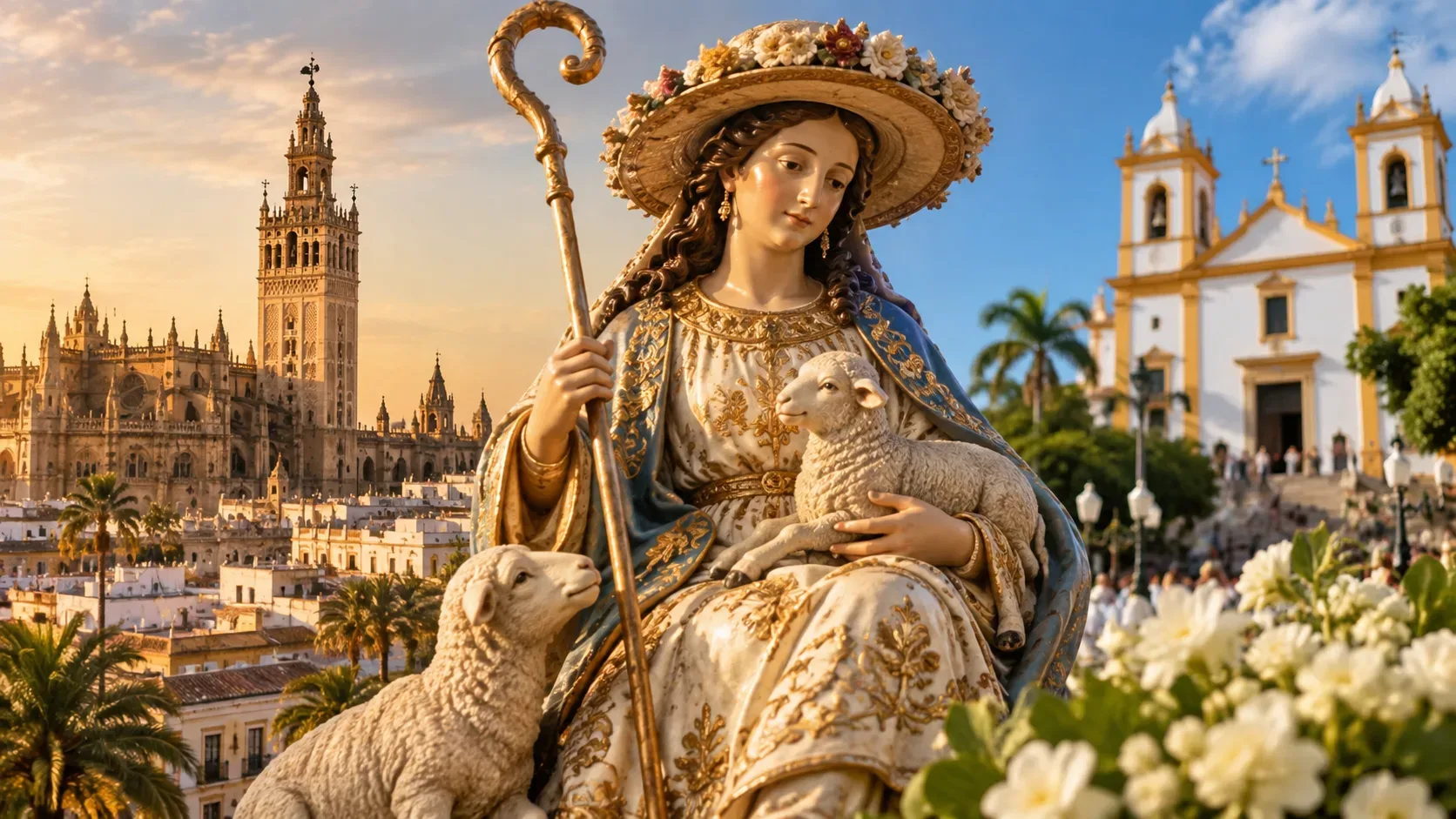
The history of Our Lady Divina Pastora connects two places separated by the Atlantic: Seville, where the devotion took public form in the early eighteenth century, and Sergipe, where the Marian title came to name a city, a sanctuary, and one of the state’s most significant religious traditions. In 2026, the Archdiocese of Aracaju marked 323 years since the milestone of September 8, 1703, when Friar Isidoro of Seville publicly presented an image of the Divina Pastora during a rosary in the Spanish city.
The key to understanding this trajectory is to separate what is well documented from what belongs to devotional tradition or historical hypotheses. The Seville origin and Friar Isidoro’s role are widely recognized. The exact way the devotion reached the Sergipe settlement of Ladeira — later named Divina Pastora — is not established by one continuous documentary chain. Church sources and local memory connect its arrival to Capuchin missionaries in the late eighteenth century, especially to the year 1782; academic studies, however, recommend treating that episode with caution.
What happened in Seville in 1703
The devotion emerged in Seville’s Capuchin environment. Religious tradition attributes to Friar Isidoro of Seville a spiritual experience in which Mary was contemplated as a shepherdess surrounded by sheep. Later accounts differ on the exact date of this inspiration or vision, so the safest public milestone is September 8, 1703.
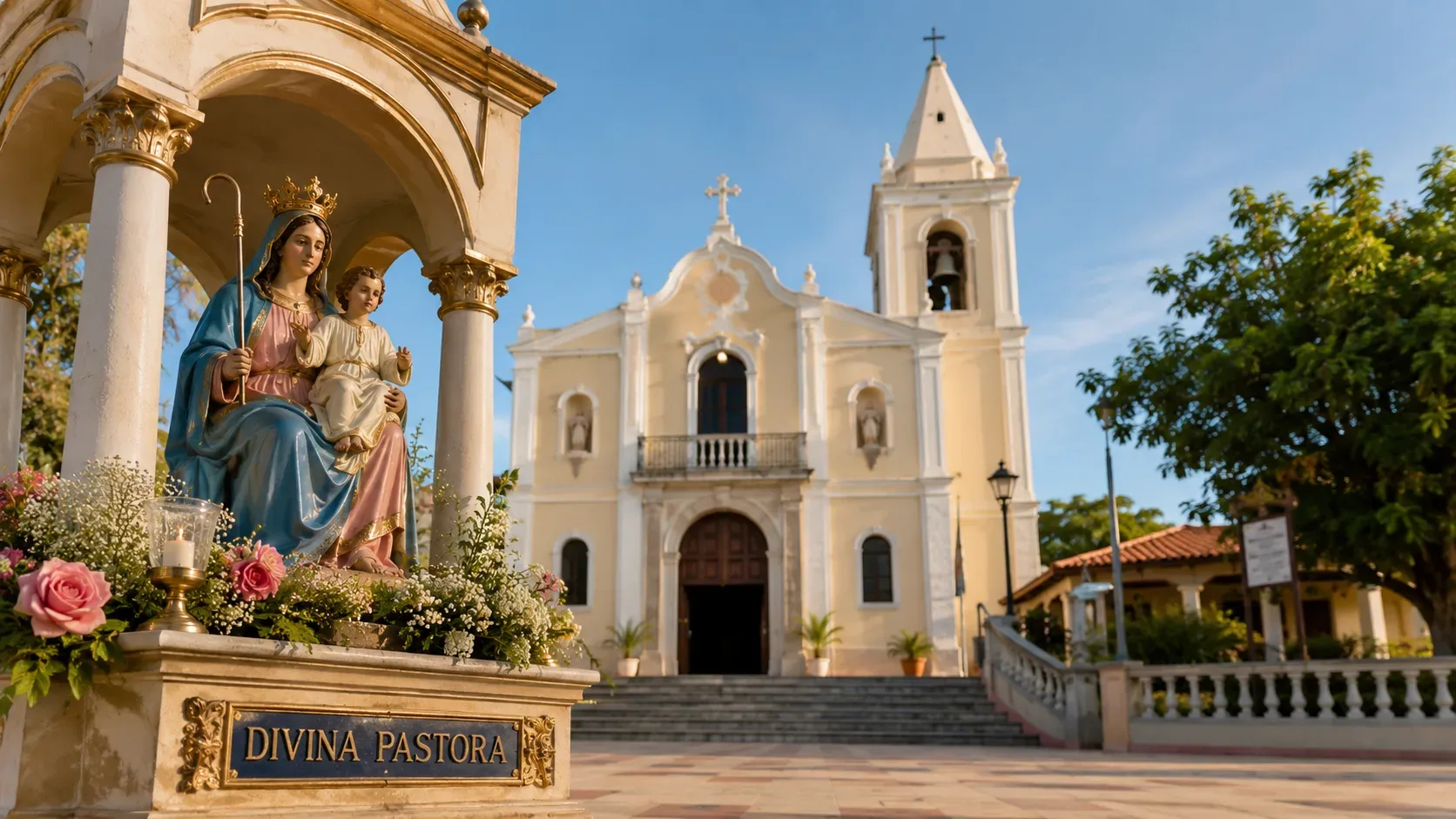
On that date, according to the Archdiocese of Aracaju and sources connected with Capuchin tradition, Friar Isidoro organized a public rosary in Seville and presented the faithful with a representation of Mary as the Divina Pastora. The iconography showed the Virgin in a pastoral setting: shepherdess clothing, a staff or other pastoral elements, sheep, and references to Jesus as the Good Shepherd. The image turned a theological idea — Mary as the mother of Christ, the Good Shepherd — into a simple and easily recognizable scene.
The strength of that representation helped the devotion spread. Confraternities and Capuchin preachers were decisive in its circulation across the Iberian Peninsula and later in other territories. The Order of Friars Minor Capuchin itself records the role of Isidoro of Seville and other preachers in spreading the title throughout the eighteenth century.
How a Spanish devotion could reach Sergipe
The Divina Pastora expanded at a time when religious orders, popular missions, confraternities, printed images, sculptures, and devotions traveled between Europe and Portuguese America. In that context, the Capuchin presence offers a plausible explanation for the title’s arrival in Sergipe.
The tradition preserved by the Sanctuary of Our Lady Divina Pastora states that the devotion reached Sergipe lands in the late eighteenth century and associates the year 1782 with that process. Local memory commonly credits Capuchin missionaries with introducing the Virgin Shepherdess to the old settlement of Ladeira.
Historiography, however, adds an important qualification: Capuchin activity in eighteenth-century Sergipe is known, but the available documentation does not allow an absolutely certain claim that a specific mission brought the image to Ladeira precisely in October 1782. A historical study published in the UFPB journals calls attention to this gap. Another study of the church considers two possibilities: dissemination by Capuchin missionaries or the presence of a family devotion connected to the temple’s patron, Colonel José Bernardino de Sá Souto Maior.
The most precise formulation, therefore, is: the devotion was putting down local roots by the late eighteenth century, and Sergipe tradition associates that advance with Capuchin missions and the 1782 milestone, but the exact mechanism of arrival remains open to historical investigation.
1782: why this date matters so much
The year 1782 appears repeatedly in the memory of the devotion in Sergipe and in the urban landscape itself. The façade of the Mother Church of Our Lady Divina Pastora bears that date. The heritage inventory of Portuguese-influenced Heritage notes that the inscription is related to the church’s construction and describes the building as a distinctive ensemble, with a high altar, carved decoration, paintings, and iconography dedicated to the pastoral Marian title.
It is important not to use the inscription as isolated proof that the image arrived in that same year. It works better as a material milestone of a phase in which devotion, church, and settlement identity began to intertwine. During the nineteenth century, that connection became increasingly explicit.
Church sources date the creation of the parish to 1817. In 1833, the locality became a district under the name Nossa Senhora da Divina Pastora and, in 1836, it became a town. The religious name was no longer only a devotional title; it also became the institutional identity of the place.
From a local church to Sergipe religious heritage
The church became one of the main material supports of this memory. In 1943, the Mother Church of Our Lady Divina Pastora and its collection were federally listed for heritage protection by IPHAN. The listing preserved not only the building but also an artistic ensemble that helps explain how the devotion was visually incorporated into local life.
The church brings together elements that reinforce this identity, including the image of the Divina Pastora at the altar and ceiling painting associated with the Bahian artist José Teófilo de Jesus. In this space, devotion, sacred art, and urban memory work together: the church is not merely a setting for worship but a material document of the historical consolidation of the title in Sergipe.
1958: pilgrimage changes the scale of the devotion
If the eighteenth and nineteenth centuries explain the devotion’s local implantation, the twentieth century explains why it became a statewide reference. On August 24, 1958, then-Father Luciano Cabral Duarte organized, with young people linked to Catholic University Youth, the first pilgrimage from Riachuelo to Divina Pastora. The Sanctuary records that the first group had fewer than fifty students and that the initiative was inspired by pilgrimage experiences Luciano Duarte had encountered in France.
This movement changed the scale of the tradition. The devotion ceased to be perceived only as the religious heritage of a parish or town and began mobilizing faithful from different parts of Sergipe. Academic research describes the pilgrimage as one of the largest manifestations of local Catholicism and highlights its role in turning Divina Pastora into a devotional center.
In 2014, the State of Sergipe recognized the Pilgrimage to the Sanctuary of Our Lady Divina Pastora as Intangible Cultural Heritage. The official recognition, recorded by the Archdiocese of Aracaju and analyzed in a study from the Catholic University of Pernambuco, shows how the walk had moved beyond a strictly liturgical dimension: it had also become a reference point for collective memory, belonging, and culture.
2017: from popular devotion to a religious symbol of the state
In October 2017, the bishops of the three dioceses in the Ecclesiastical Province of Aracaju proclaimed Our Lady Divina Pastora the Patroness of the State of Sergipe. The announcement was made before pilgrims at the sanctuary and was presented by CNBB Northeast Region 3 as recognition of a devotion already deeply rooted in Sergipe’s religious history.
That same year, State Law No. 8,302 added the Day of Our Lady Divina Pastora to Sergipe’s Cultural Calendar. These acts did not create the tradition; they formalized a position built over generations by parishes, families, pilgrims, vows, festivals, and journeys to the sanctuary.
Timeline: from Seville to Sergipe
| Date | Milestone | What it represents |
|---|---|---|
| 1703 | Friar Isidoro spreads the Divina Pastora devotion in Seville; the image is publicly presented on September 8 | Public milestone of the modern devotion |
| Late eighteenth century / 1782 | Sergipe tradition links the arrival of the title to Capuchin missions and to the year inscribed on the mother church façade | Local implantation, with details still debated by historians |
| 1817 | Creation of the Divina Pastora parish | Ecclesiastical consolidation of the devotion in the territory |
| 1833–1836 | The place officially adopts the name Nossa Senhora da Divina Pastora and becomes a town | The devotion also comes to identify the civil community |
| 1943 | Federal heritage listing of the Mother Church and its collection | Recognition of the church’s historical and artistic value |
| 1958 | First pilgrimage organized by Luciano Cabral Duarte and university students | Expansion of the devotion to a statewide scale |
| 2014 | Pilgrimage recognized as intangible cultural heritage of Sergipe | Recognition of the practice as collective memory and culture |
| 2017 | Bishops of the Ecclesiastical Province proclaim the Divina Pastora Patroness of Sergipe | Ecclesiastical formalization of an already consolidated devotional identity |
| 2026 | 323 years since the public milestone of 1703 | Continuation of a tradition that is still reinterpreted and transmitted |
Why the Divina Pastora became part of Sergipe’s identity
The strength of the devotion in Sergipe cannot be explained by a single moment of “arrival.” It is the result of historical layers. First, a Marian title created in a European Capuchin environment found space in a Catholic society connected to the religious networks of the Portuguese-American world. Then the devotion became fixed in a church, in images, and in the town’s very name. Finally, twentieth-century pilgrimages turned this local memory into an experience shared by faithful across the state.
This combination helps explain the passage from a devotion born in Seville to a Sergipe tradition. The link is not merely geographic. It was built through religious circulation, material heritage, church organization, family memory, and pilgrimage. Documented history and oral tradition do not always coincide in every detail, but together they show how the Divina Pastora ceased to be an imported title and became a reference of Sergipe’s own religious culture.
Sources for further reading
- Archdiocese of Aracaju — 323 years of devotion to the Divina Pastora
- Sanctuary of Our Lady Divina Pastora — origin and iconography of the devotion
- Sanctuary of Our Lady Divina Pastora — history of the pilgrimage
- Archdiocese of Aracaju — intangible heritage and proclamation of the patroness
- CNBB Northeast Region 3 — proclamation as Patroness of Sergipe
- Journal of Theology and Religious Sciences — study on the heritage recognition of the pilgrimage
- Portuguese-influenced Heritage — Mother Church of Our Lady Divina Pastora