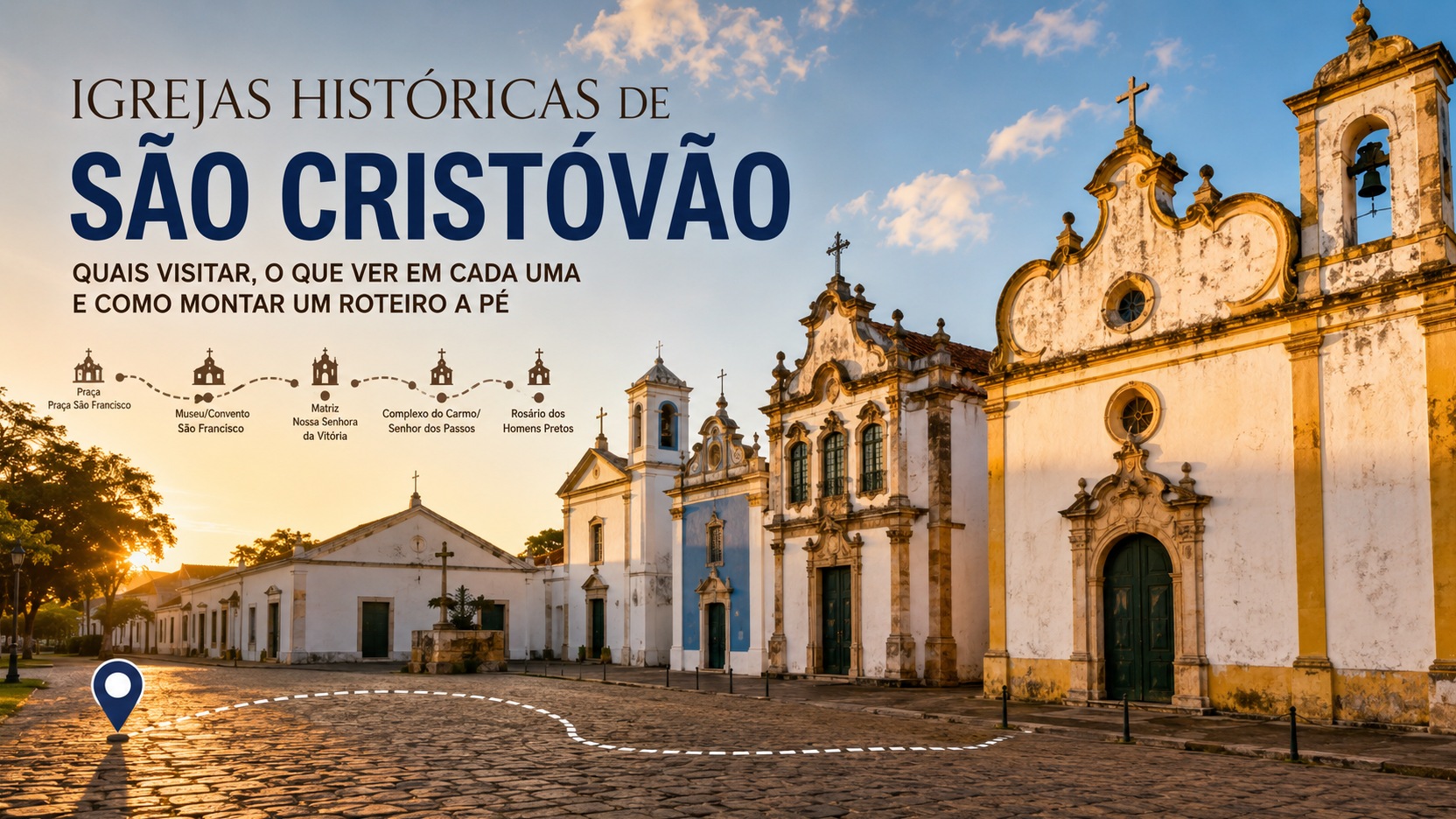
São Cristóvão concentrates, in a few blocks of the Historic Center, churches and religious complexes that help tell different stories of the same city: the colonial urban formation, the weight of religious orders, popular devotion and also the racial inequalities that marked access to temples. For a first visit, it makes sense to explore this heritage on foot, starting at Praça São Francisco and continuing on to the Matriz de Nossa Senhora da Vitória, the Complexo do Carmo and the Church of Nossa Senhora do Rosário dos Homens Pretos.
This route is an editorial proposal for a visit, not the reproduction of an official itinerary that has already been completed. In October 2025, the City of São Cristóvão and Sebrae informed that the Catholic churches in the Historic Center were being included in work to format tourist experiences to interconnect them in an itinerary. The sequence below uses the spatial and historical logic of these places to help the visitor understand what changes from one stop to the next.
Before leaving: visiting hours are not mass times
The easiest part of any historic church guide to get out of date is the opening hours. In 2023, City Hall announced the expansion of visitation to churches in the Historic Center on weekends, from 9am to 5pm. But subsequent municipal bulletins show that holidays, religious events and special dates can completely change this functioning.
In June 2026, for example, Matriz, Carmo, São Francisco and Rosário were listed as closed on the São João and São Pedro holidays. On the Sergipe Political Emancipation holiday, on July 8, 2026, the City Hall announced visits to churches from 9am to 5pm. This difference, every few weeks, shows why a time found on an old page should be treated as a historical reference, not as a guarantee for the day of travel.
It is also important to separate tourist visits from religious celebrations. A church may be open for mass and not for tourist circulation, or may suspend visitation during a celebration, retreat, procession or event assembly. Before traveling, confirm the opening in the most recent publications from City Hall and on the channels of the Parish and Sanctuary of Nossa Senhora da Vitória or the Archdiocese of Aracaju. For the Museum of Sacred Art, check specifically the museum's operation, as it has its own calendar.
1. Praça São Francisco: start by understanding the city before entering the churches
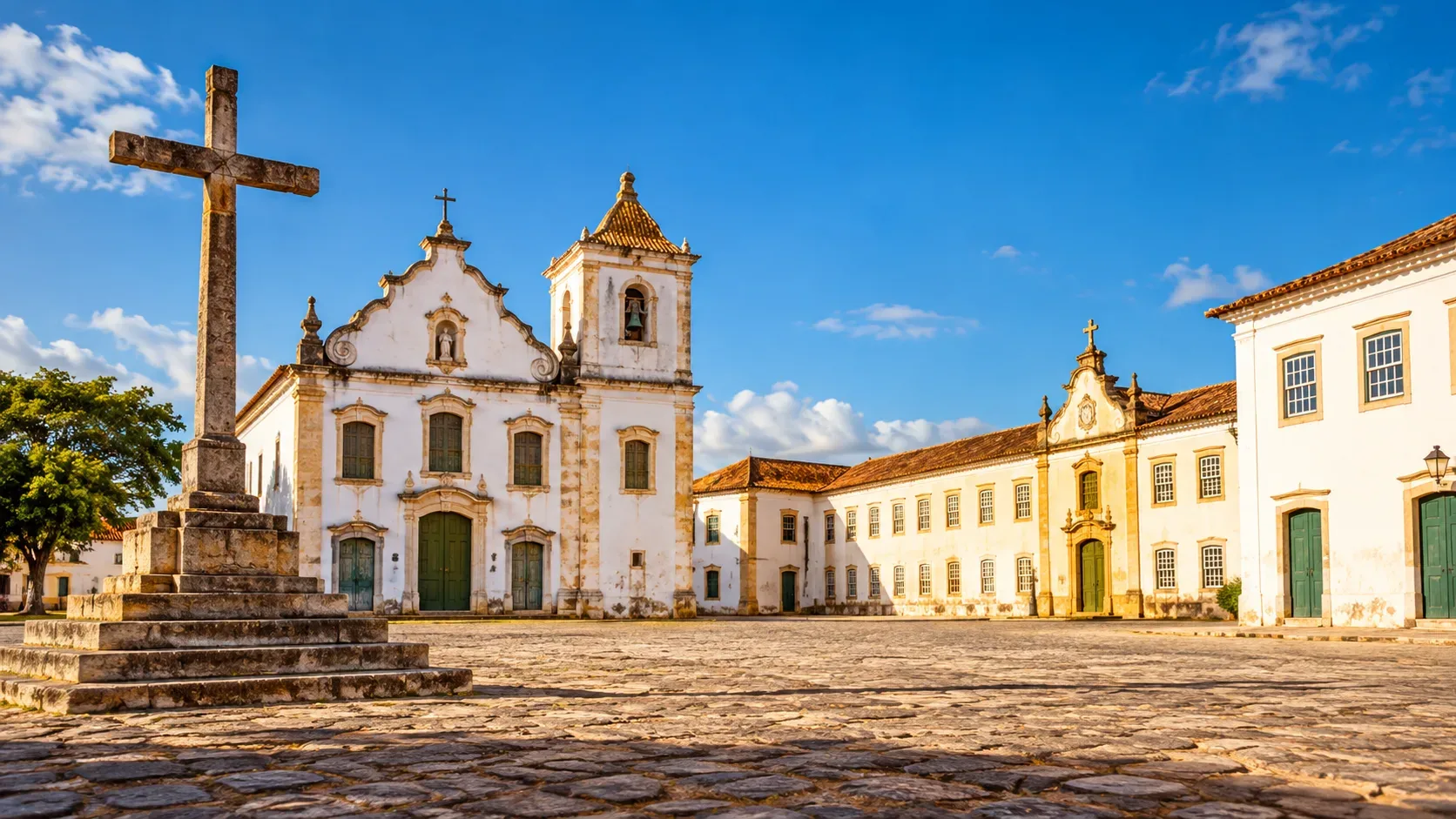
Praça São Francisco is the best starting point because it helps you see the Historic Center as a whole, and not as a collection of isolated facades. Inscribed on the UNESCO World Heritage List in 2010, the square brings together civil and religious buildings and is valued for the combination of Portuguese occupation patterns and Hispanic planning references from the period in which the crowns of Portugal and Spain were united.
Before entering any building, walk around the quadrangle and observe how the Church and Convent of São Francisco, the old Provincial Palace, the Santa Casa and the houses form the edges of the square. UNESCO rightly highlights the coherence of this ensemble and the way in which the square articulates architecture, urbanism and social life.
São Francisco Church and Museum of Sacred Art: why this stop matters
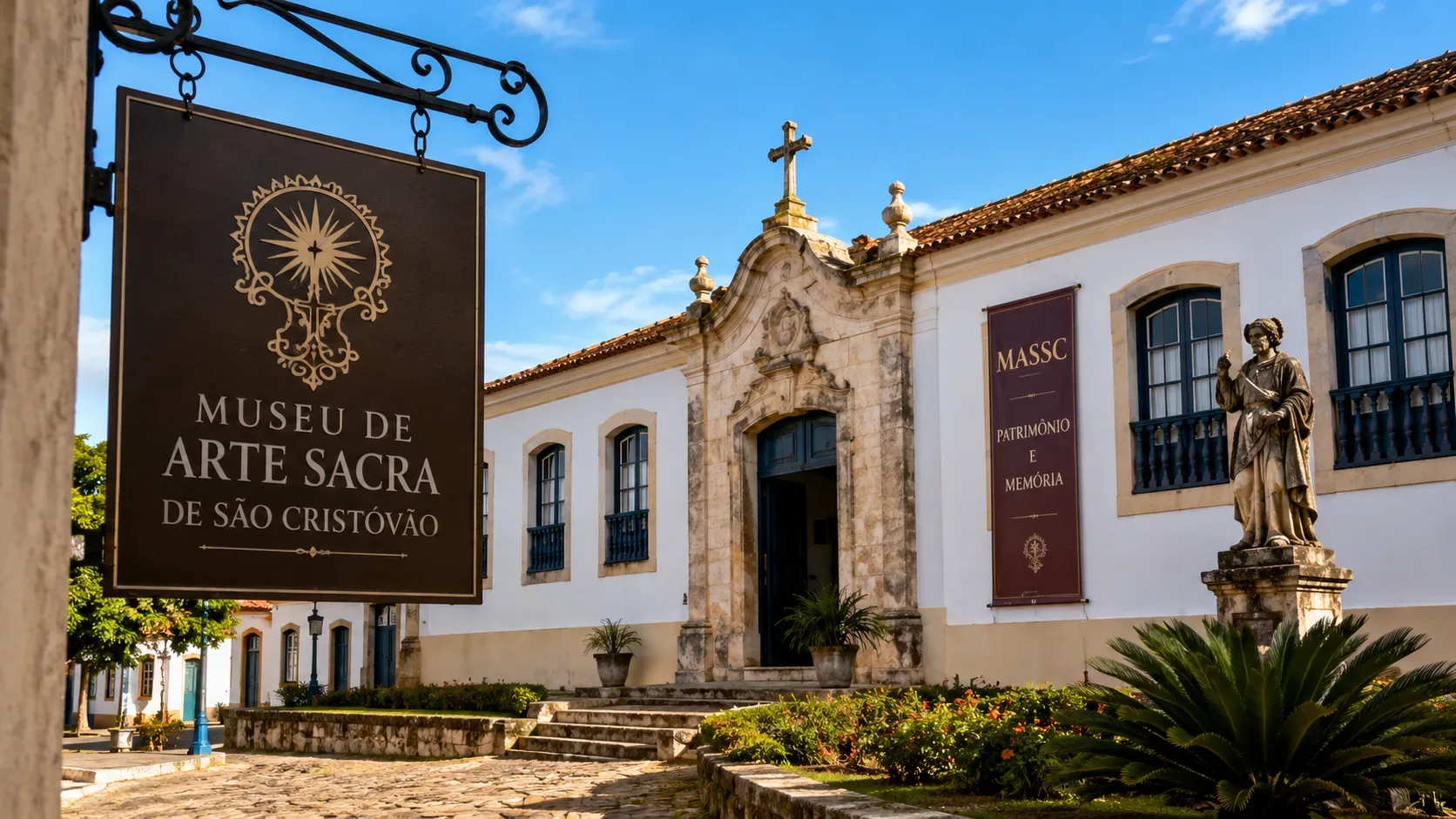
The Franciscan complex is the centerpiece of Praça São Francisco. UNESCO identifies it as an example of architecture linked to the Franciscan order developed in the Brazilian Northeast. Next to the church and convent, the former Chapel of the Third Order houses the Museum of Sacred Art of São Cristóvão.
The municipal page dedicated to the museum records a collection of around 500 pieces from the 18th to the 20th centuries. Among the highlighted elements are liturgical objects in gold and silver, sacred images, a golden main altar, an ancient bell and a ceiling painting attributed to the Bahian José Teófilo de Jesus. The benefit of this visit is in moving from the urban scale of the square to the scale of the objects: after looking at the complex from the outside, the visitor realizes how art, devotion and religious power materialized inside.
The museum deserves its own time. Don't just treat it like a room attached to the church. If it is open, this is where the itinerary stops being just architectural and gains a broader interpretation of Sergipe's Catholic culture.
2. Nossa Senhora da Vitória Parish Church and Sanctuary: the city’s religious continuity
From Praça São Francisco, head to the area of the old Praça da Matriz, where Nossa Senhora da Vitória is located. The City Hall presents it as the oldest main church in Sergipe and informs that it was elevated to Main Church in 1608. In 2026, the Archdiocese of Aracaju identifies it as the Nossa Senhora da Vitória Parish and Sanctuary, which reinforces that the historic building also continues to be an active religious space.
What to observe starts with the facade. The municipal description draws attention to the two towers, the contrast between the white of the composition and the details of the doors and windows, in addition to the central axis marked by the crucifix. Inside, the main altar brings together Our Lady of Victory, images of Saint Christopher and the crucified Christ, while altars and side chapels show how the church accumulated devotions over time.
The importance of the Matrix is not just about age. It helps to understand the continuity between the colonial formation of São Cristóvão and current religious life. It is a different stop from a museum: here, the visitor is in a heritage site that remains in liturgical use. Therefore, silence, respectful dress and attention to ongoing celebrations are part of the visit.
3. Complexo do Carmo and Senhor dos Passos: architecture, cloister and popular devotion
The next nucleus is Praça Senhor dos Passos. The Carmo Complex brings together the Conventual Church of Nossa Senhora do Carmo, known as Carmo Maior, the Chapel of the Third Order, or Carmo Menor, as well as the Museum of Ex-votos and the Santa Dulce dos Memorial
Poor.
The construction of the complex spanned the 17th and 18th centuries, beginning in 1699 by the City Hall. Reforms and reconstructions altered parts of the architecture over time, so the interest of the visit is precisely in observing layers, and not in looking for a church that has remained frozen in a single style.
Inside, it is worth paying attention to the columns of the cloister, the secondary altars of Carmo Menor and the wall and ceiling paintings associated with the history of the Carmelite order and Saint Teresa. The complex also preserves the memory of Santa Dulce dos Pobres, who lived in the convent during her religious training, a theme presented in the memorial installed at the site.
Senhor dos Passos changes the reading of the complex
Carmo Menor is especially important for understanding the Pilgrimage of Senhor dos Passos, one of the most striking religious manifestations of São Cristóvão. The image of Senhor dos Passos is maintained as a whole and participates in a tradition of processions and celebrations that has mobilized the city for generations.
This means that visitors should not look at Carmo just as architecture. The value of the place also lies in its continuous religious use and in the collective memory associated with processions, ex-votos and rites of penance. During times of pilgrimage, the dynamics of the Historic Center change, and the tourist itinerary needs to adapt to the religious program.
4. Rosary of Black Men: finish the journey with a story that changes perspective
The Church of Nossa Senhora do Rosário dos Homens Pretos, on Rua Erundino Prado, is smaller and simpler than the previous large complexes, but it is indispensable for understanding the social history of the religious heritage of São Cristóvão.
The City Hall records that the temple was built in the 18th century by and for freed black people, in a context in which racial segregation restricted participation in other religious spaces. The church was listed by IPHAN in 1943. Its history allows us to see that the multiplication of brotherhoods and temples was not just the result of devotional differences: it also reflected hierarchies and exclusions from colonial society.
What to observe here is precisely the material difference. The municipal description itself contrasts the simplicity of the Rosary with the city's richer churches. The wooden floor and unpolished baked brick, the less ornate benches and altars and the images of Our Lady of the Rosary and Saint Benedict form a set in which social memory weighs as much as the decoration.
It's also worth looking at the facade and asking what the church represents beyond institutional Catholicism. Local memory links the temple to black cultural practices and expressions, and the City Hall records contemporary manifestations such as the washing of the stairs and the participation of traditional groups in celebrations. It's a good last stop because it forces you to reread everything that was seen before: artistic wealth, religious power and social exclusion coexisted in the same urban space.
How to organize your walking itinerary without turning your visit into a race
The most logical sequence for a first visit is Praça São Francisco, Igreja de São Francisco and Museu de Arte Sacra, Matriz de Nossa Senhora da Vitória, Complexo do Carmo and Igreja do Rosário dos Homens Pretos. It begins with the urban complex recognized by UNESCO, passes through the main church and the main Carmelite nucleus and ends in a temple whose history highlights racial segregation and the resistance of black brotherhoods.
Allow at least one morning or afternoon to take your time on the route. If the Sacred Art Museum is open and you want to enter all spaces, a larger window is more comfortable. The Historic Center combines squares and hills, so travel time is less important than avoiding fitting too many visits into rigid intervals.
If you're short on time, don't try to just choose the most ornate church. Each stop answers a different question. San Francisco explains world heritage and urban design; the Matrix shows the continuity of the religious institution; Carmo brings together architecture, convent life, Santa Dulce and Senhor dos Passos; the Rosary reveals how race and social condition also organized religious experience in the colonial city.
How to confirm that each place will be open
Do the check the week of your visit and repeat it the day before when there is a holiday, festival, pilgrimage or big celebration. First look for recent notices from São Cristóvão City Hall about tourist facilities and churches. For liturgical times, consult the Parish and Sanctuary of Nossa Senhora da Vitória and the Archdiocese of Aracaju. For the Museum of Sacred Art, confirm the museum calendar directly.
Do not automatically use mass times as tourist times, nor the visiting hours of one church as a rule for all others. The city's recent history shows special openings, complete closings and different opening times on specific dates.
With this check made, the script gains an important advantage: it stops being a list of churches and becomes a continuous reading of Saint Christopher. From Praça São Francisco to Rosário dos Homens Pretos, the visitor follows how urban planning, religious orders, sacred art, popular devotion and social inequality were overlapping in the same Historic Center.