Not necessarily. Passage through auction may appear in observations or official records, but the CRLV-e should not be treated as a complete provenance report. The national rule currently in force, Contran Resolution No. 1,027, of August 17, 2026, defines that the document brings together registration and licensing data and includes restrictions, observations or records whose presentation is required by legislation or Contran regulations. This is different from saying that every historical event of the vehicle needs to be printed on the document.
For this reason, opening the CRLV-e, not finding the word “auction” and concluding that the car was never auctioned is a bigger leap than the evidence allows. The origin may be registered elsewhere in the official database, in the operational rule of the federative unit's Detran, in documents from the auction itself or in a private historical database. The safest way is to cross-reference sources that answer different questions.
There is still an important complication: “auction”, “claim”, “recovered”, “restriction” and “mechanical condition” are not synonymous. A vehicle may have gone to auction without having suffered an accident; it may have been damaged without going to auction; may have been recovered by a financial institution due to default; and may be without current registration restrictions even if there are relevant facts in the past. Before purchasing, you must separate these layers.
Auction car appears at CRLV-e?
The current national CRLV-e model does not create, among its minimum fields, a universal line called “auction passage”. Annex III of Contran Resolution No. 1,027/2026 requires identification of the vehicle and owner, registration and licensing information, registration and technical characteristics and restrictions, observations or records whose display is determined by applicable standards. The resolution itself allows for additional information.
In practice, this means that the presence of an auction observation is direct and relevant evidence, but the absence of this observation does not act as a certificate that the vehicle has never been auctioned. The document shows what must be included in it according to the registration and the rules applicable in that context; it does not replace a provenance investigation.
The difference between federative units helps to understand why absolute answers often fail. In Goiás, for example, Detran-GO Ordinance No. 912/2025 establishes that, in certain registrations or transfers of vehicles from auctions, the information “acquisition at auction” must appear in the observations field. The same ordinance, however, says that this observation is not mandatory for private auctions promoted by insurance companies, financial institutions, rental companies or other proprietary companies when the sale is treated as an ordinary transfer. It is an official example that the simple “whether or not” depends on the type of operation and the applicable rule.
Therefore, when evaluating a used vehicle from another federative unit, also consult the Detran procedure where the vehicle is registered and, if there is a history of transfers between states, consider that administrative routines may have changed over time.
Auction, claim, recovered and restriction say different things
The expression “auction car” describes, firstly, a way in which the asset was disposed of. It does not alone explain why the vehicle was put up for auction or what condition it was in. There are auctions of vehicles collected by public authorities, judicial disposals, repossessions by financial institutions, sales promoted by insurance companies, rental companies and other situations with different origins.
Sinister is another layer. Contran Resolution No. 810/2020 regulates the classification of damages resulting from accidents and regularization procedures. For regularized medium-sized damage, there are specific records linked to the accident, including information in the observations field. This type of annotation talks about damage and regularization, not about the mandatory existence of an auction.
“Recovered” also requires context. The inspection regulations themselves provide for vehicles recovered by a financial institution by court order or friendly delivery, a situation that is not equivalent to a vehicle recovered after an accident. In a sales advertisement, therefore, the isolated word is insufficient: ask recovered from what, through what process and with what documentation.
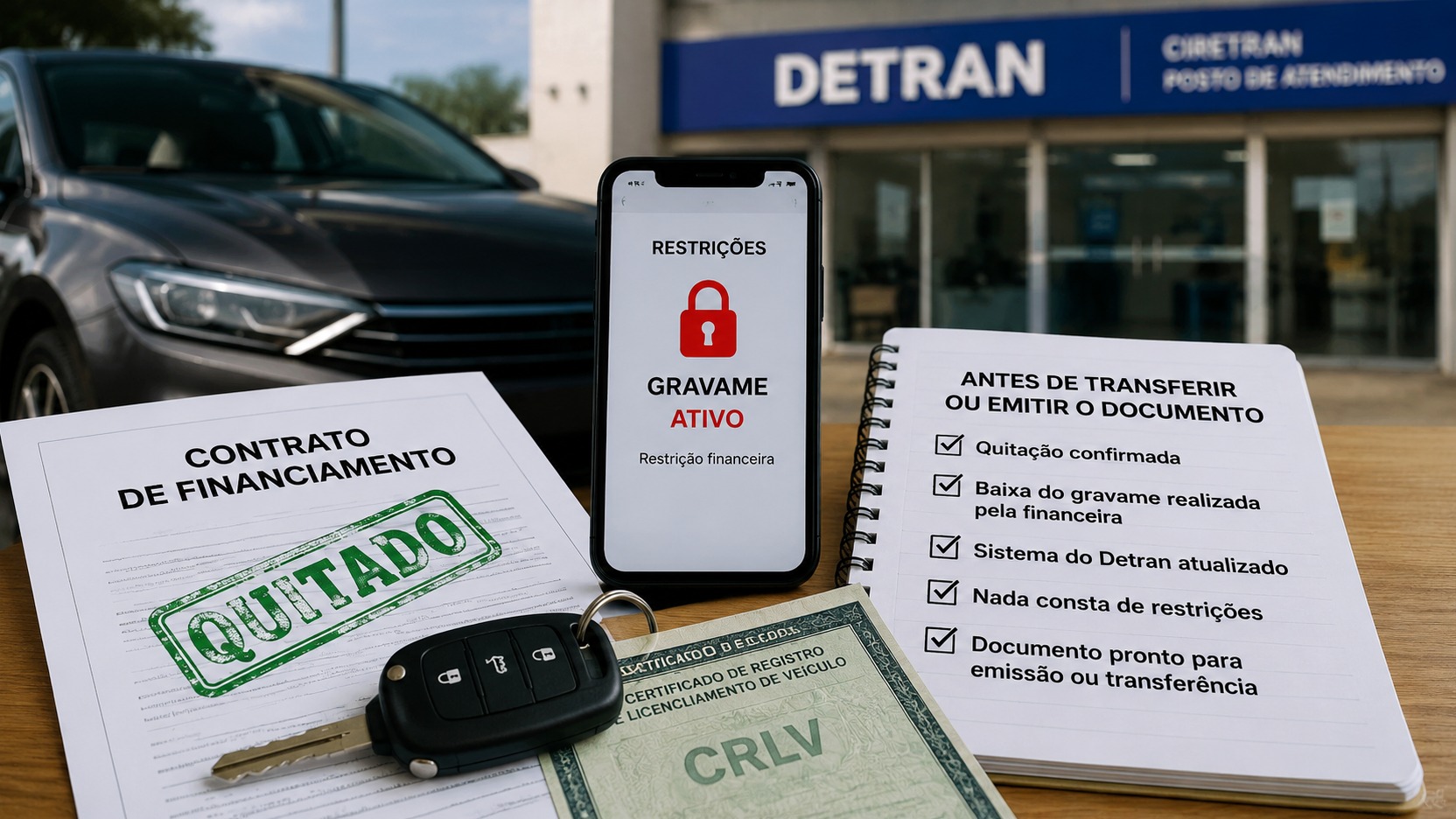
Cadastral restriction is a fourth layer. An administrative, judicial or financial restriction normally informs an impediment or current situation relevant to circulation, transfer or regularization. The lack of restrictions today does not necessarily erase past events. Finally, mechanical and structural condition is a fifth layer: a clean record does not state that the engine, transmission, structure, airbags, suspension or repairs are in good condition.
The correct matrix is “source, proof and limit”
CRLV-e and observation field
The CRLV-e proves the documentary status presented at that time and allows you to validate registration and licensing data. According to the current national rule, it can also bring restrictions and observations that are required to be presented. If the document contains “acquisition at auction”, “injured”, “DMM” or other relevant annotation, this information must be included directly in the business evaluation.
The limit is equally important: a field of observations without reference to an auction does not prove that there never was an auction. Also check the authenticity of the CRLV-e using the official validation mechanism and compare the license plate, Renavam, chassis and other data with the vehicle itself.
Official consultation from Detran and Senatran
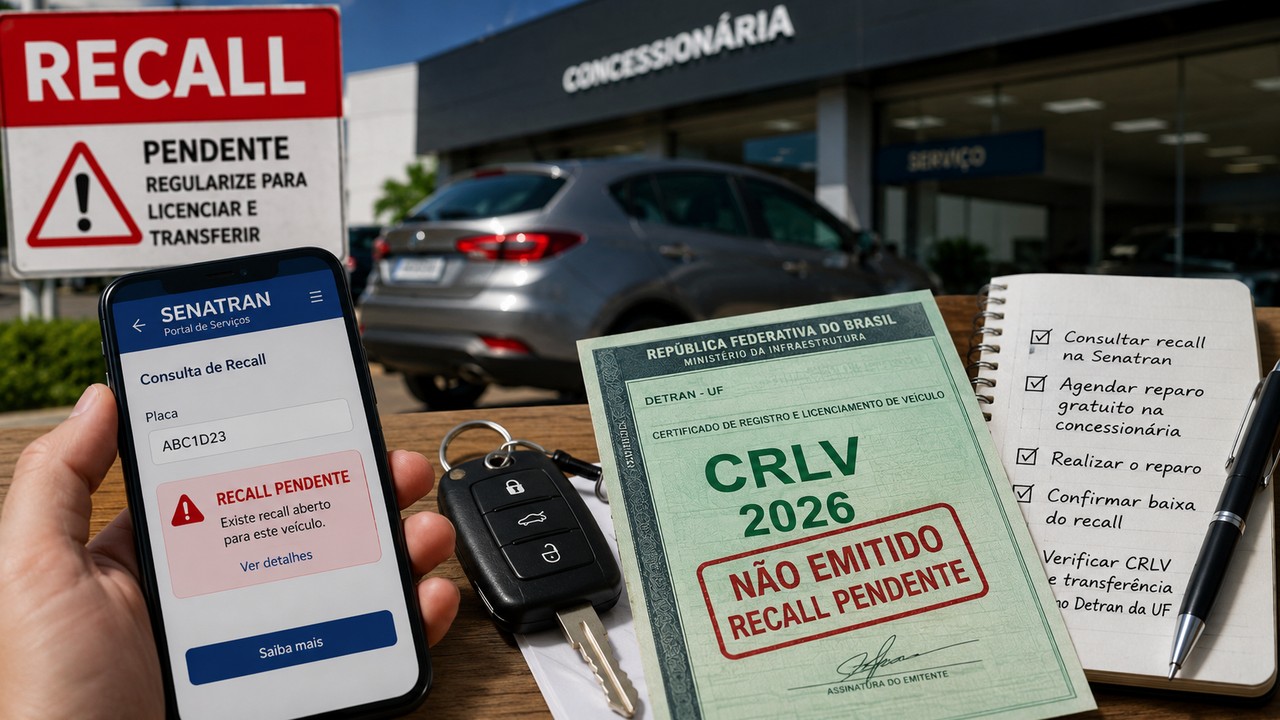
Official consultations serve to look beyond the visual version of the document. Senatran maintains a restrictions and indicators service capable of presenting administrative, judicial, financial information and other indicators associated with the vehicle. Through the Services Portal, vehicle consultation may require Renavam, license plate and the owner's CPF or CNPJ; In a negotiation, this may require the seller's cooperation or carrying out the consultation in the seller's presence.
The Senatran Online Consultation documentation also provides for vehicle-specific indicators, including an auction indicator for certain consultation products. This reinforces an essential distinction: what exists in the database or in a query service does not need to be identical to the set of information visually printed on the CRLV-e.
The federative unit's Detran remains relevant because it carries out registration and transfer procedures and can offer its own consultations on debts, restrictions, history or service. The Detran of Sergipe, for example, advises buyers to consult state and national databases to verify information such as previous owners, theft or theft and financial restrictions, in addition to recommending an inspection to detect possible tampering with the chassis.
Private history consultation and precautionary report
Private services can aggregate data from different sources and locate signs that are not visible in the document delivered by the seller, such as going through an auction, old advertisements, reported accidents or other occurrences, depending on the contracted basis. A positive result, especially when it informs the date, origin and verifiable reference, deserves investigation.
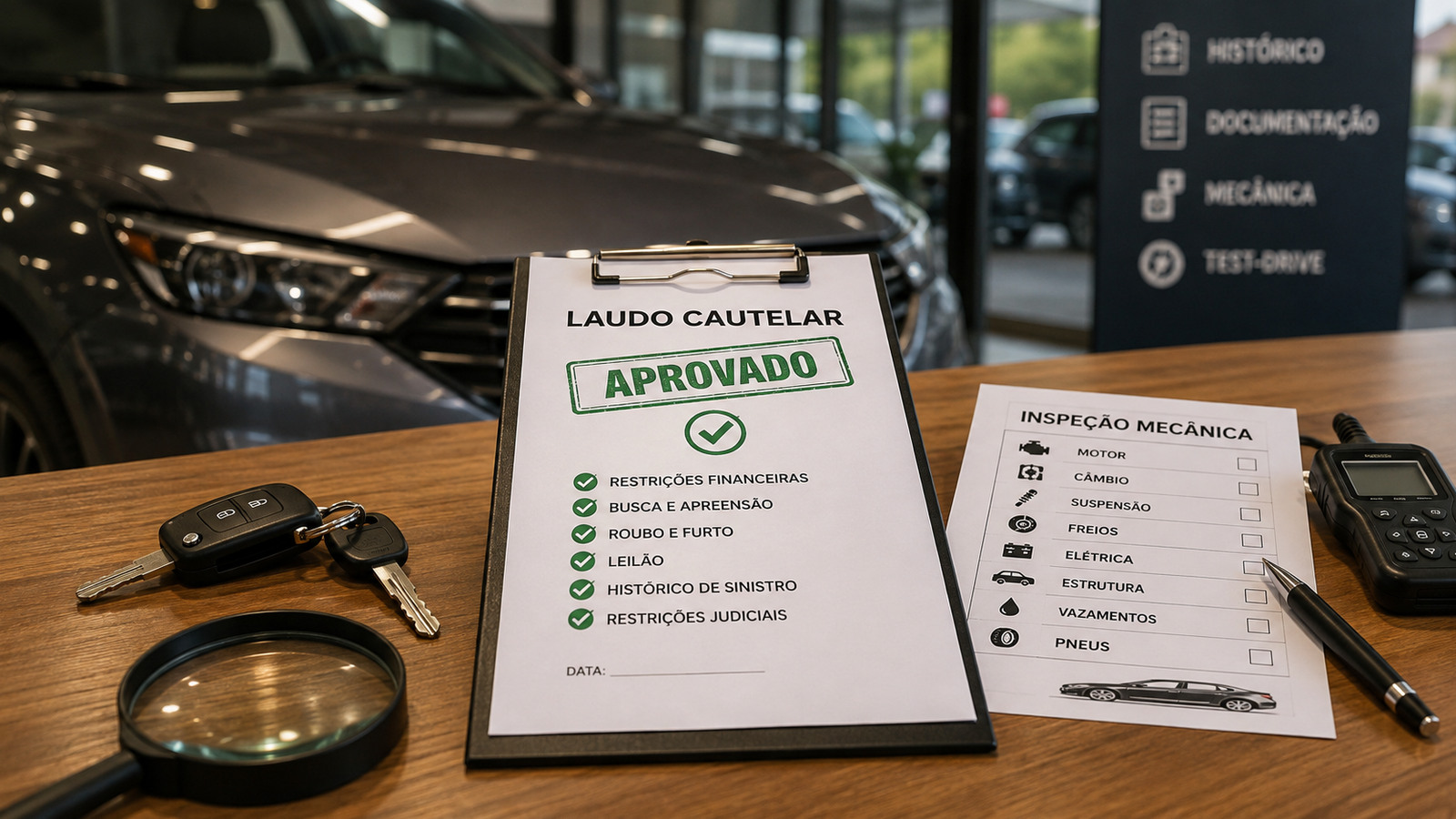
The limit is coverage. No private consultation should be assumed to be a perfect mirror of all public banks, insurance companies, auctioneers and historical records. A “no ticket” return is only valid within the sources and period that that service can actually consult. The same care applies to precautionary reports: different companies check different items. “Approved” is not an automatic synonym for “never been put up for auction”.
Documents from the auction itself
When they exist, transaction documents are the most direct evidence of a specific auction. For auctions of collected vehicles governed by Contran Resolution No. 1,025/2026, the acts and documents are registered in Sivec and, after the auction, the auctioneer issues the auction note. The resolution defines this note as proof of transfer of ownership of the vehicle to the bidder.
In other types of auction, the set of documents may change. Notice, auctioneer's invoice, auction notice, auction letter and equivalent documents may appear depending on the origin and procedure. If the seller admits going through an auction, asking for the corresponding documentation helps to overcome vague descriptions and understand the nature of that sale.
Identification inspection and physical inspection
The official vehicle identification inspection has objectives defined by Contran Resolution No. 941/2022: verify authenticity of identification and documentation, legitimacy of ownership, mandatory equipment and changes in vehicle characteristics. The rule even includes mobile inspection of a vehicle listed for auction or already auctioned.
This does not transform the identification inspection into a complete mechanical assessment. For a purchase, an independent physical inspection remains necessary to observe structure, alignment, welds, repairs, paint thickness, airbags, mechanical functioning and other points compatible with the type and value of the vehicle. An inspection may reveal signs consistent with major repairs, but it does not alone prove that an auction took place. Documentary provenance and physical condition need to be evaluated together.
How to confirm origin before paying
Step 1: Validate the document, not just the photo sent by the seller
Order the complete CRLV-e and check the official validation. Compare license plate, Renavam, make, model, year, color, chassis and owner identification with the vehicle and with the negotiation in progress. Read the entire comments field. A cropped print or partial photo is insufficient to make a significant purchase.
Step 2: make the official query with the correct data
Consult the federal unit's Detran channels and the services available from Senatran. Look for administrative, judicial and financial restrictions, robbery or theft, sales communication and other indicators presented. If the service requires information from the owner, ask the seller to cooperate with the inquiry rather than relying on data obtained without authorization.
The objective here is not to just look for the word “auction”. It involves confirming whether the current registration is coherent, whether there are no impediments to transfer and whether any indicators appear that require additional investigation.
Step 3: Look for auction-specific evidence
If a historical query indicates an auction, try to identify the date, type of auction, responsible entity and source document. If the seller has already declared that the car has been sold, ask for an auction note, notice, notice, auction letter or document corresponding to the case. The more specific the evidence, the less reliance on generic labels used in advertisements.
If the seller claims that the car has never been auctioned, a private consultation can act as an additional layer, but the negative result should not replace the official basis or inspection. Checking gains strength when independent sources converge.
Step 4: Separate auction history from damage history
When you find “accident”, “DMM”, insurance company registration or structural repairs, do not automatically conclude that the issue is just an auction. Investigate the damage event, regularization and quality of repair. Likewise, a vehicle from a financial auction may have arrived at the auction due to credit recovery, without this revealing, in itself, structural damage.
This separation improves the decision because it avoids two opposite errors: rejecting any auction vehicle as if they all had the same origin and accepting a vehicle “without an auction on the document” as if this guaranteed the absence of accidents or serious repairs.
Step 5: Perform independent inspection before final sign
Take the car to a professional or company that is not dependent on completing the sale. The scope must be compatible with the risk: identification, structure and repairs; and, when necessary, mechanical, electronic and safety assessment. Compare what was found physically with what appears in the history.
If relevant divergences arise between document, registration, historical consultation and inspection, do not force a single explanation. Stop the negotiation until the seller presents documentation capable of closing the gap. In a used purchase, an unexplained inconsistency is worth more as a sign of caution than a quick “this is normal” response.
Step 6: record in writing what was informed in the sale
If the absence of an auction, relevant accident or certain condition of origin was decisive for the price and your decision, make sure that the information appears clearly in the proposal, receipt, contract or statement used in the negotiation. This does not replace technical and registration checks, but it reduces dependence on informal conversations that can later be difficult to reconstruct.
How to interpret results that seem contradictory
If the CRLV-e does not mention auction, but a historical query indicates an auction, treat the query as a starting point for confirmation, not as something to be discarded because of the document. Check date, source, type of auction and corresponding documents. The case of Goiás expressly shows that a private auction may not require the observation “acquisition at auction” in CRLV-e.
If the CRLV-e reports a claim or DMM, but there is no reference to an auction, the correct reading is that there is information about damage or regularization. There is no basis for automatically transforming this note into proof that the vehicle was auctioned.
If “acquisition at auction” appears, the origin by auction is now documented in that record. Still, other questions remain to be answered: what type of auction it was, why the vehicle arrived there and what the current condition of the car is. The note is not a mechanical report.
If the document, official consultation and private consultation do not show anything relevant, the informational risk decreases, but the conclusion must remain proportional to the evidence. Bases can have different scopes, and physical state is not resolved by a query screen. The best scenario is convergence between official registration, documentation of origin, available history and independent inspection.
The safest answer is neither “yes” nor “no”
Asking whether an auction car “appears on the document” is useful, but the question alone is too narrow. In 2026, the correct answer is: it may appear when the applicable rule determines an observation or when the registration presents it, but the absence of this mention in the CRLV-e does not universally prove that the vehicle has never been auctioned.
Before purchasing, treat each source as a piece with its own range. The CRLV-e shows what is formalized in the document; official consultations reveal registration status and available indicators; auction documents prove a specific auction; private consultations expand the search, but depend on coverage; and physical inspection tells about identity, repairs, and current condition, not the entire documentary history.
When these layers tell the same story, the decision is better supported. When they differ, the most prudent course of action is to find out why before paying. And as registration procedures may vary by federative unit and may be updated, confirm the current flow at the competent Detran for the vehicle you are evaluating.