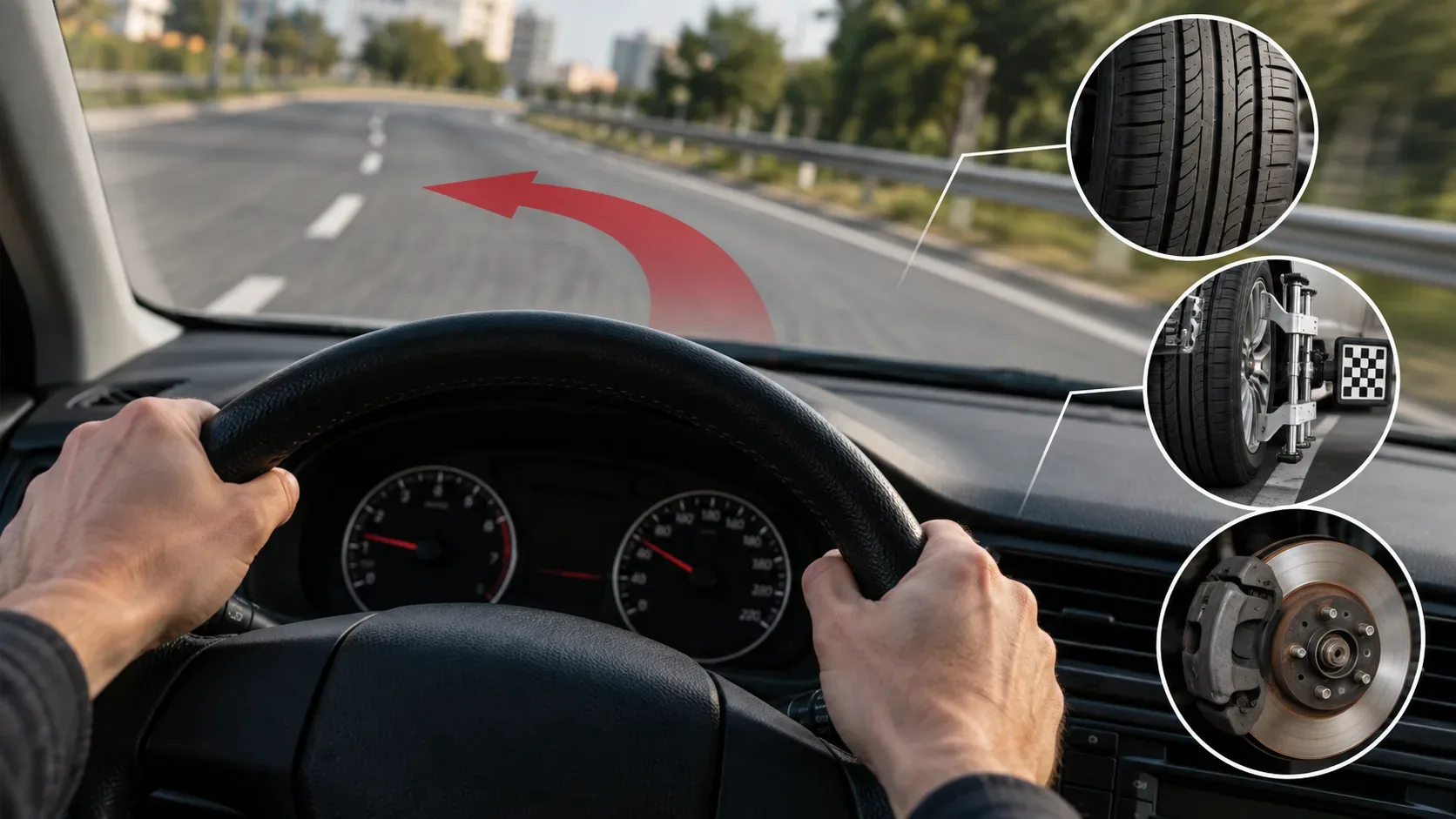
When a car pulls to one side under braking, the most useful place to start is not guessing which part failed, but observing when the deviation happens. If the vehicle tracks straight at a steady speed and changes direction only when the brake pedal is pressed, a braking-force imbalance becomes more important in the diagnosis. If it already tends to one side without braking, tires, wheel alignment, suspension and wheel geometry also move higher on the list.
That distinction does not complete the diagnosis by itself. It helps decide what is safe to check with the car parked and cold, and when driving should end there. Brake problems can affect stability and stopping distance, so a strong pull, an abnormal pedal or signs of overheating are not symptoms to “test a little more.”
First question: does it pull only while braking or also while driving straight?
| Observed pattern | What becomes more likely | Safest next step |
|---|---|---|
| Pulls mainly when the brakes are applied | Unequal braking force, such as a caliper, pad, rotor or hydraulic circuit acting differently from side to side | Professional brake-system inspection; do not assume which side is faulty |
| Pulls continuously on a straight road, even without braking | Tire pressure, uneven wear, alignment, suspension or tire damage | Check cold tire pressures and, if it persists, inspect tires, suspension and alignment |
| Started after a pothole, curb strike or impact | Tire damage, wheel or alignment change; mechanical damage is also possible | Visual inspection and technical assessment before returning to normal use |
| Strong pull with a low/soft pedal, longer stopping distance, strong odor, smoke or brake warning | A fault that may reduce braking capacity or vehicle control | Stop in a safe place and arrange roadside assistance/towing |
Michelin uses the timing of the pull as a useful clue: a constant tendency generally points first toward tires and alignment, while a pull that appears mainly during braking increases suspicion of a brake problem. AAA also lists pulling to one side while braking as a sign that can accompany a caliper problem or uneven brake wear.
What you can safely check without taking anything apart
1. Tire pressure, using the vehicle specification
With the tires cold, compare pressures with the vehicle placard — usually on the driver's door pillar or frame — or the owner's manual. Do not use the maximum pressure molded into the tire sidewall as the target. The NHTSA recommends checking pressure cold and following the value specified by the vehicle manufacturer.
A meaningful side-to-side pressure difference can change rolling resistance, grip and steering response. Correcting pressure is a simple check, but it should not be used to “explain away” a strong pull that clearly appears only under braking.
2. Tire condition and wear
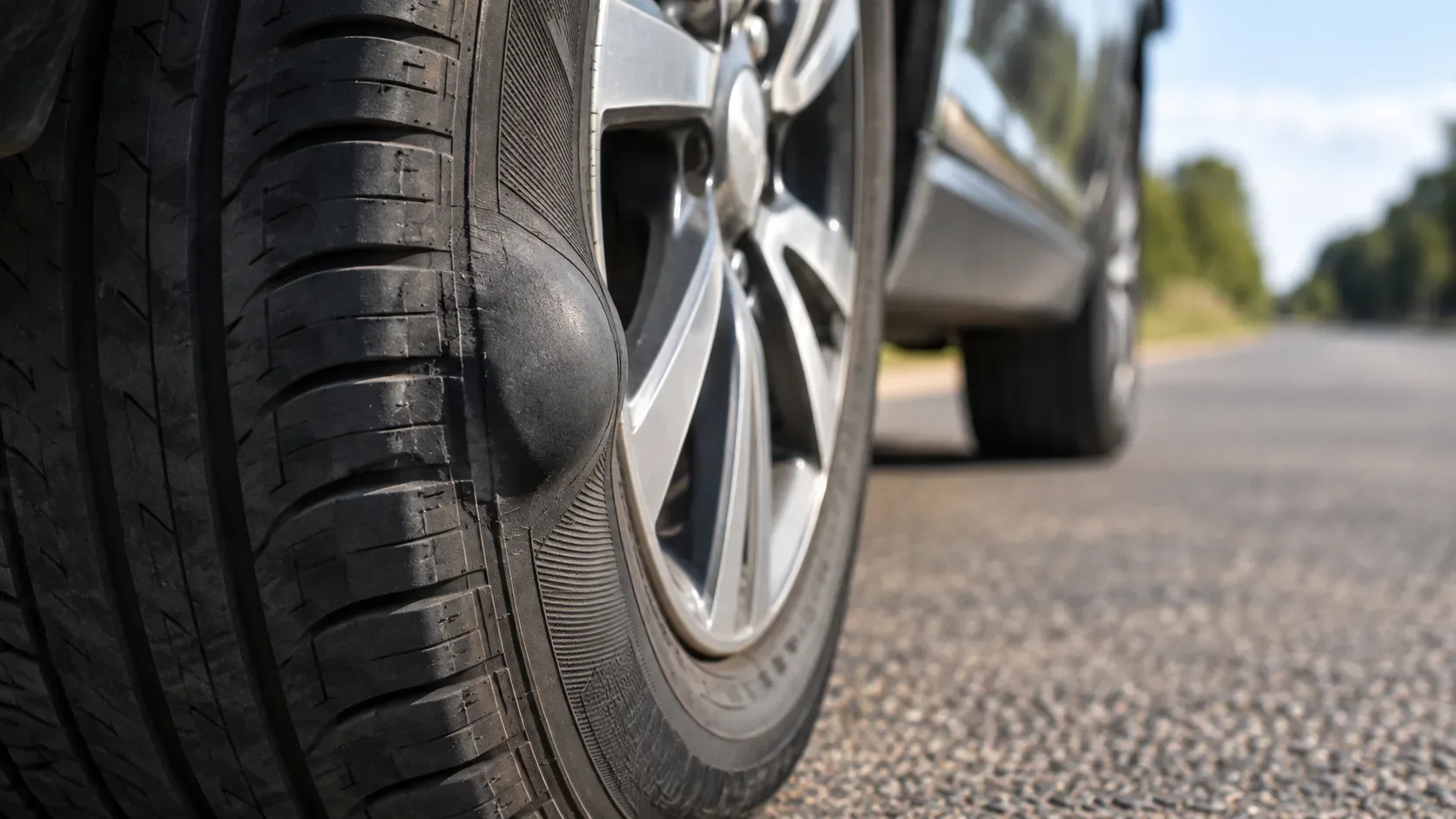
Without removing a wheel, look for a visibly low tire, sidewall bulges, cuts, deformation and substantially different wear from one side of the axle to the other. Rapid wear on one edge, an off-center steering wheel and a constant tendency to leave the line fit alignment or suspension issues better than a fault that appears only when the brake pedal is pressed.
3. Steering wheel and behavior outside braking
On a flat, straight road, a properly adjusted car should not require constant correction to remain in its lane. If the steering wheel sits crooked while the vehicle tracks straight, or if the pull is present all the time, alignment becomes more plausible. Michelin lists constant pulling, an off-center steering wheel and irregular wear as typical signs of misalignment.
4. Signs of excessive heat or friction
An acrid overheated smell, smoke near a wheel or fading performance after only a few braking events are reasons to stop using the vehicle. Do not touch the rotor, caliper or wheel to “compare temperatures”: brake components can become hot enough to cause burns. If there is odor or smoke, park safely, move away from traffic and seek assistance.
How to distinguish tires, alignment and brakes from the symptom pattern
When tires are a strong possibility
Tires move up the list when pressure differs from side to side, there is visible damage, tread wear is very uneven, or handling changed after hitting a pothole or curb. A tire with very different pressure or condition can affect stability during braking too. If there is a bulge, deep cut, exposed cords or rapid pressure loss, do not keep driving normally.
When alignment makes more sense
Alignment usually creates a problem that is not exclusively tied to the brake pedal: the car tends to wander or pull on a straight road, the steering wheel may be off-center, and tread wear can become irregular. That does not mean a misaligned vehicle can never pull more under braking; it means that if the pull only begins when you brake, alignment alone is a less convincing explanation.
When brakes rise to the top of the list
If the car tracks reasonably straight but repeatedly changes direction when the brakes are applied, attention should shift to braking balance from side to side. Possible causes include a caliper that does not move correctly, pads in very different condition, a contaminated or damaged rotor, or a restriction/leak in the hydraulic circuit. The driver does not need — and should not — disassemble the brakes to find out.
It is also unsafe to conclude that “the side the car pulls toward is the bad side.” Depending on the failure, one wheel may brake too much, too little, or remain dragging. Identifying the faulty component requires inspection of both sides of the axle.
Should you do a road test?
If the deviation is mild, the pedal feels normal, and there is no brake warning light, odor, smoke, grinding noise or loss of response, you can simply observe the pattern at low speed in a flat, predictable area with no nearby traffic. The goal is not to perform a hard stop, but to confirm whether the tendency is also present without using the brakes.
If the pull is strong, new, unpredictable or accompanied by any brake-failure sign, do not use public roads as a diagnostic area. In those conditions, the safer decision is to reduce exposure to risk and have the car inspected.
When to stop driving and call for assistance
- A strong pull that requires significant steering effort to stay in the lane.
- A very low, soft, spongy or sinking pedal compared with the car's normal behavior.
- Longer stopping distance or the feeling that the vehicle no longer slows as it used to.
- A strong burning smell or smoke near a wheel after braking.
- Metal-on-metal noise, grabbing, jolting or severe vibration while braking.
- A brake-system warning light together with a change in pedal feel or braking behavior.
- A suspected fluid leak or severe tire damage such as a large bulge, deep cut or rapid pressure loss.
AAA advises against driving a vehicle with weak brakes and associates a low or spongy pedal, side pull, burning odor and leaks with situations that need prompt inspection. If you are unsure whether the car can stop predictably and under control, towing is the more conservative choice.
What to tell the repair shop to speed up diagnosis
An accurate symptom description is usually more useful than arriving with a part already “condemned.” Tell the technician:
- whether it pulls toward the driver's side or passenger side;
- whether it happens only while braking or also at a steady speed;
- whether it changes with braking intensity;
- whether it started after a pothole, impact, tire replacement or brake service;
- whether there is vibration, noise, odor, a warning light or a change in pedal feel;
- whether tire pressures were correct according to the vehicle placard.
Ask for the brakes on both sides of the affected axle to be inspected, along with tires, wheels, steering/suspension components and alignment when the pattern points that way. This helps avoid parts replacement by guesswork and separates the primary fault from issues that only make the symptom worse.
Practical summary: a simple decision tree
- Strong pull or changed pedal feel? Stop and arrange assistance.
- Pulls only while braking? Treat it as a possible brake imbalance and schedule inspection.
- Also pulls without braking? Check cold tire pressures and tire condition, then evaluate alignment and suspension.
- Visible tire damage, odor, smoke or loss of braking? Do not continue testing.
- Mild but persistent symptom? Document when it happens and have the car diagnosed before wear or failure progresses.
The key point is simple: pulling under braking is a vehicle-behavior symptom, not a diagnosis of a specific part. The pattern “only while braking” deserves special attention to the brake system; a constant pull broadens the investigation to tires, alignment and suspension. In either case, safety comes before discovering the cause by continuing to drive.