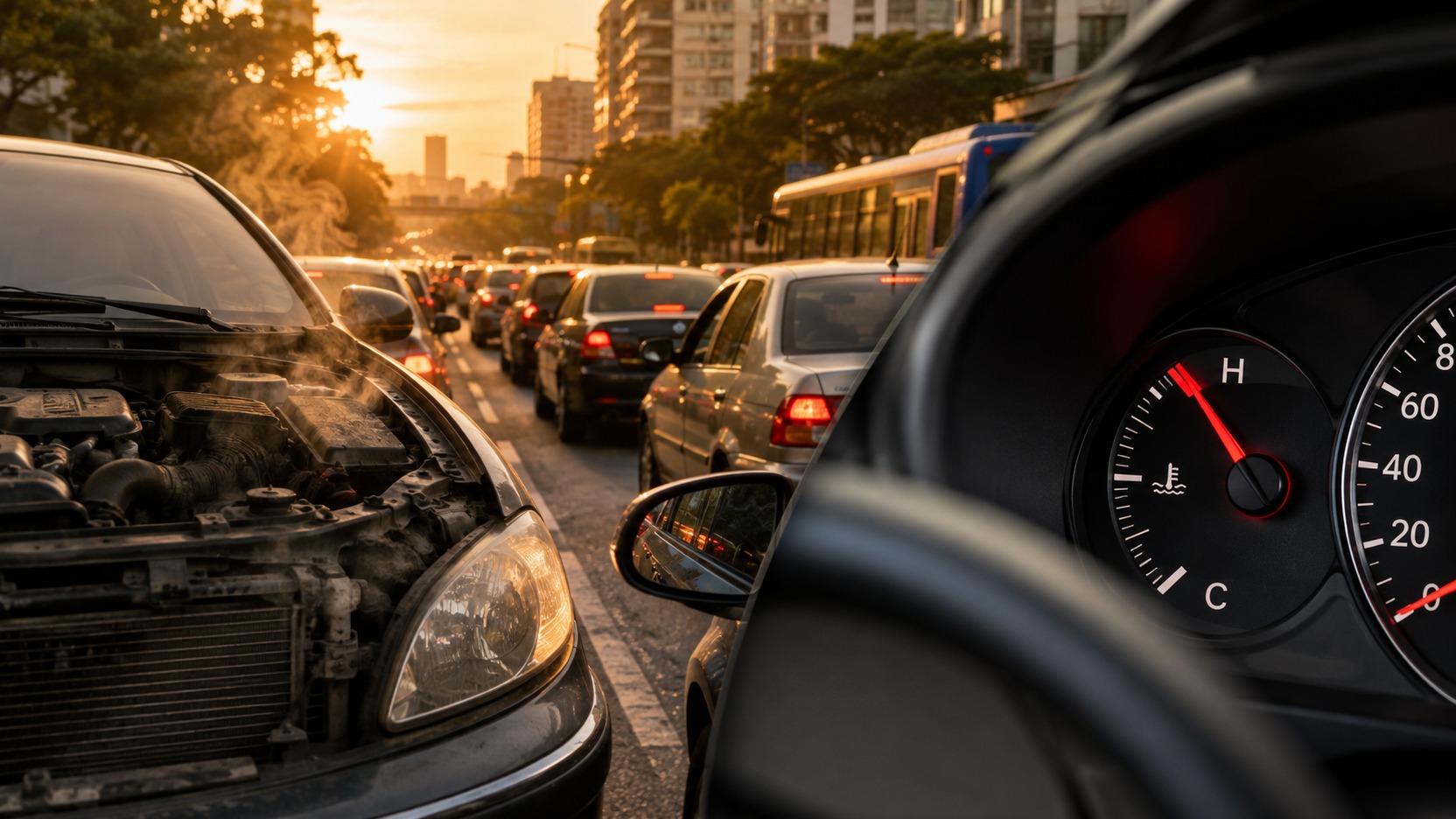
When the engine temperature rises in traffic and drops again after the car picks up speed, there is a relevant mechanical clue: in motion, air passes through the front of the vehicle and helps the radiator to reject heat. When stopped or at low speed, this natural help decreases and the system starts to depend much more on forced ventilation and thermal exchange capacity. This makes the fan, electrical control and air passage important hypotheses, but does not allow us to conclude, remotely, that a specific part is defective.
It is also important to separate a small variation within the range predicted by the manufacturer from actual overheating. The fact that the needle or indicator rises a little in traffic is not enough, alone, to classify the situation as a failure. The relevant threshold is what the vehicle manual defines as the normal range, high temperature alert, red zone, or stop-driving condition. If there is a red warning, a high temperature message, vapor or obvious loss of liquid, the decision stops being "see if it improves by walking" and becomes following the safety procedure in the manual.
Why traffic changes cooling capacity so much
The engine transforms part of the fuel's energy into heat. The coolant absorbs a portion of this heat, circulates through the system and reaches the radiator. There, thermal energy needs to be transferred to the air. When the car is moving at speed, the displacement itself creates airflow through the front of the vehicle and the radiator fins.
In congestion, this flow drops drastically. This is why vehicles with an electric fan use the fan to pull or push air through the assembly when the car's speed is no longer sufficient. In modern systems, performance may depend on measured temperature, air conditioning pressure, control unit strategy and different ventilation stages or speeds.
This mechanism explains why the "heats up while standing still, cools down while moving" pattern draws attention to the part of the system that manages air. At the same time, a system already at its limit due to a low level,
poor circulation or a radiator with reduced capacity can manifest the problem first precisely in traffic, because there the help of the displacement wind disappears.
If the temperature rises only in traffic and drops as soon as the car is moving
This is the scenario that most places radiator ventilation at the center of the investigation. A fan that does not turn on, turns on late, only operates at one speed, loses power, operates intermittently or is commanded incorrectly can leave the system running insufficient on the road and insufficient at low speeds.
The control circuit is also included in the bill. Depending on the project, fuses, relays, modules, resistors, sensors, wiring harness and the control unit itself can participate in the activation. In some cars there is more than one fan or more than one rotation stage. Therefore, hearing a fan running does not in itself prove that the entire ventilation system is operating as it should.
Another point is the physical passage of air. Dirt, leaves, insects, deformations or obstructions between the condenser and radiator can reduce thermal exchange. The radiator may also lose efficiency internally or externally. The track remains consistent with a lack of ability to dissipate heat at low speed, but the cause needs to be measured, not guessed.
It also heats up when the car is at speed
When the temperature continues to rise even with good frontal air flow, the hypothesis of a problem restricted to the fan loses strength. The investigation needs to look more closely at the entire system: amount of coolant, leaks, circulation, thermostat operation, water pump performance, and radiator's ability to transfer heat.
A thermostat that does not open properly can restrict the flow of liquid to the radiator. A pump with insufficient circulation also compromises heat removal. Likewise, a blocked radiator or one with reduced heat exchange may not be able to cope even when the car is moving. These defects can produce similar symptoms and, in some cases, more than one condition can exist at the same time.
Therefore, the speed standard is useful for prioritizing tests, not for transforming a symptom into a closed diagnosis. If the car heats up under any condition of use, the tolerance to continue running must be even smaller.
What changes when the air conditioning is on
The air conditioning adds another thermal load to the front of the vehicle. The condenser needs to reject heat and normally occupies the same air passage region as the radiator. In many projects, the system also uses air conditioning pressure information to control ventilation.
If the car remains stable with the air conditioning turned off, but the temperature rises quickly when it is turned on in traffic, this reinforces the need to check whether the air flow through the assembly is adequate and whether all ventilation stages are responding. Still, this behavior does not allow you to automatically blame the fan. A marginal cooling system may reveal its deficiency only when it receives this additional load.
Turning off the air conditioning can reduce thermal demand in an extreme situation, but should not be used to mask an overheating warning. If the manual tells you to stop, the manufacturer's guidance prevails.
Low level changes the interpretation of the symptom
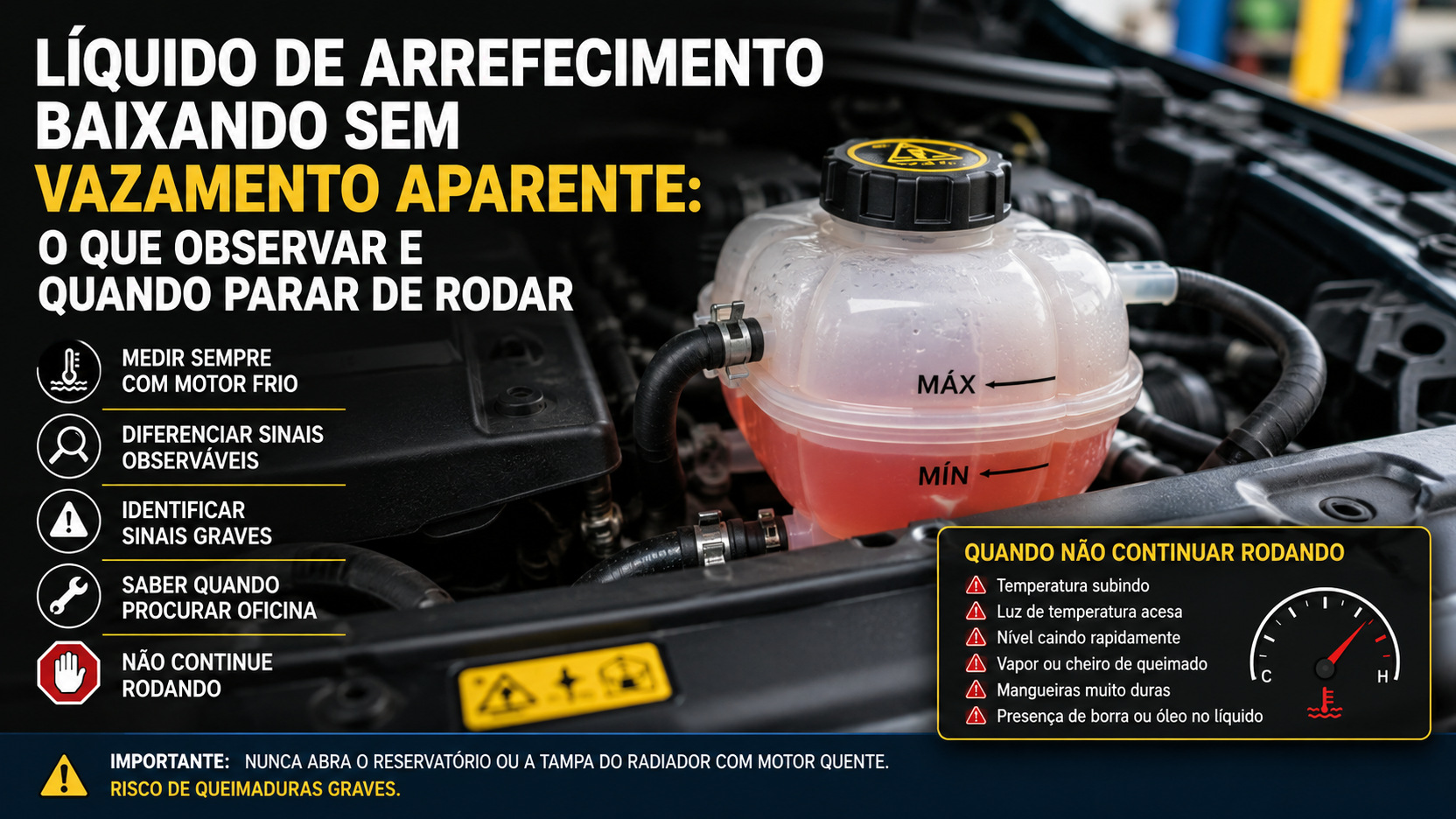
The coolant level must be checked with the engine cold and according to the procedure in the manual. If it is below the indicated range, system capacity may be compromised and the temperature reading may become more unstable. Low level also requires looking for the cause, because filling the reservoir repeatedly without finding out why the volume dropped does not solve the original problem.
Never open the reservoir or radiator cap when the system is hot just to "take a look". The circuit works under pressure and superheated liquid or steam can cause serious burns. Manufacturers advise waiting for it to cool down before checking or topping up the system.
If the level is normal, this eliminates only one simple hypothesis. Does not confirm fan, pump, thermostat, sensor or radiator in good condition.
The fan works: is that enough to rule it out?
No. Visual observation that the blades are rotating is helpful but incomplete. Some vehicles work with more than one speed, more than one fan or progressive control. A fan may operate in one condition and fail in another, or rotate without producing the expected flow due to an electrical, mechanical or control problem.
A workshop can compare the temperature reported by the sensor with the actual behavior of the system, activate the fan by diagnosis when the project allows, check electrical supply, control and rotations, and observe when each stage comes into operation. This procedure helps differentiate a fan motor failure from a relay, module, sensor, harness or command strategy defect.
It is also important to check that the panel indicator correctly represents the temperature. A faulty sensor or readout circuit can create the appearance of flickering even without equivalent thermal change. Correct diagnosis compares signals rather than replacing parts based on the pointer alone.
How to read the main scenarios without turning clues into sentences
Only goes up in traffic
The standard favors the investigation of air flow, fan and its control. If the temperature drops quickly when the vehicle gains speed, the displacement is compensating for some limitation that appears at low speed. It is a strong clue, not confirmation of a defective part.
Climbs in traffic and also on the road
Overall system capacity may be compromised. Liquid level, circulation, thermostat, pump, radiator and other causes need to be considered. In this situation, the improvement associated with speed is no longer the main data.
It gets worse with air conditioning
The thermal load and the need for ventilation increase. The behavior makes it especially important to check that the fan assembly and the flow through the condenser and radiator respond as predicted by the manufacturer.
The liquid level is low
Before thinking about an isolated electrical cause, it is necessary to treat the low level as a relevant finding and investigate why it occurred. The check must be carried out with the system cold and following the vehicle specification.
The fan does not turn on
This finding brings the diagnosis of the ventilation chain very close, but it still does not identify the defective component on its own. Fan motor, fuse, relay, module, sensor, harness or control may be involved, depending on the project.
There is a red warning, steam or loss of power
This scenario should not be treated as a simple pointer oscillation. Manuals from different manufacturers advise stopping the vehicle in a safe place when warning of high temperature or overheating and avoiding continuing to drive until the condition is treated. Steam in the engine compartment also requires care to avoid burns.
What is worth asking the workshop to check
A useful diagnosis begins by reproducing the symptom. It is important to know at what temperature the reading rises, how long the car was stopped, whether the air conditioning was on, whether the fan started working and what happened when the vehicle started moving again. This context directs the tests and avoids tentative changes.
Then, it makes sense to check the level and condition of the liquid with the engine cold, look for leaks and check whether the system maintains the expected pressure. The workshop can evaluate the fan activation, the different speed stages, the electrical state of the circuit, the circulation of the liquid and the behavior of the thermostat. Temperature differences in the radiator and signs of obstruction also help locate thermal exchange limitations.
Electronic reading is especially useful in modern cars. Comparing the temperature reported by the sensor with the moment when the control unit controls ventilation helps to separate measurement defect, control defect and mechanical deficiency. The goal is to find the cause of the behavior, not choose the most common part of that symptom.
Can you continue riding if the temperature drops when you walk?
The answer depends on where the temperature reached and what the manufacturer considers safe. If there was only a slight variation within the normal range, with no high temperature message, no red zone, no steam and no liquid loss, the behavior can be observed and compared with the manual before classifying it as overheating. If the oscillation is new or repeats, an inspection is prudent because cooling systems may lose margin before producing a critical alert.
If the indicator enters the high temperature zone, a red warning appears, steam appears, there is a strong smell accompanied by loss of liquid or the temperature continues to rise, do not use the fact that it drops while moving as authorization to continue your journey. Current manufacturer manuals treat the overheating condition as a reason to stop safely, turn off the engine, or wait for it to cool down according to the model-specific procedure.
The safest rule is simple: traffic may reveal the fault, but it does not alone define the driving limit. Your car's manual defines the stopping point; The pattern of warming up while still and relieving while moving serves to guide diagnosis once safety is resolved.
The pattern is a clue about airflow, not a ready diagnosis
When the car heats up in traffic and cools down when gaining speed, the first physical explanation is the difference in air flow through the radiator. This makes the fan and ventilation control natural candidates for verification. But liquid level, circulation, thermostat, pump, radiator, sensors and obstructions can produce or worsen the same behavior.
Observing when the temperature rises, whether the air conditioning changes the symptom, how the fan responds and whether there is an overheating warning gives the workshop a much more useful set of clues than arriving already asking for a part to be replaced. And, when the panel enters the alert condition defined by the manufacturer, the priority stops being diagnosing while moving and becomes stopping safely.