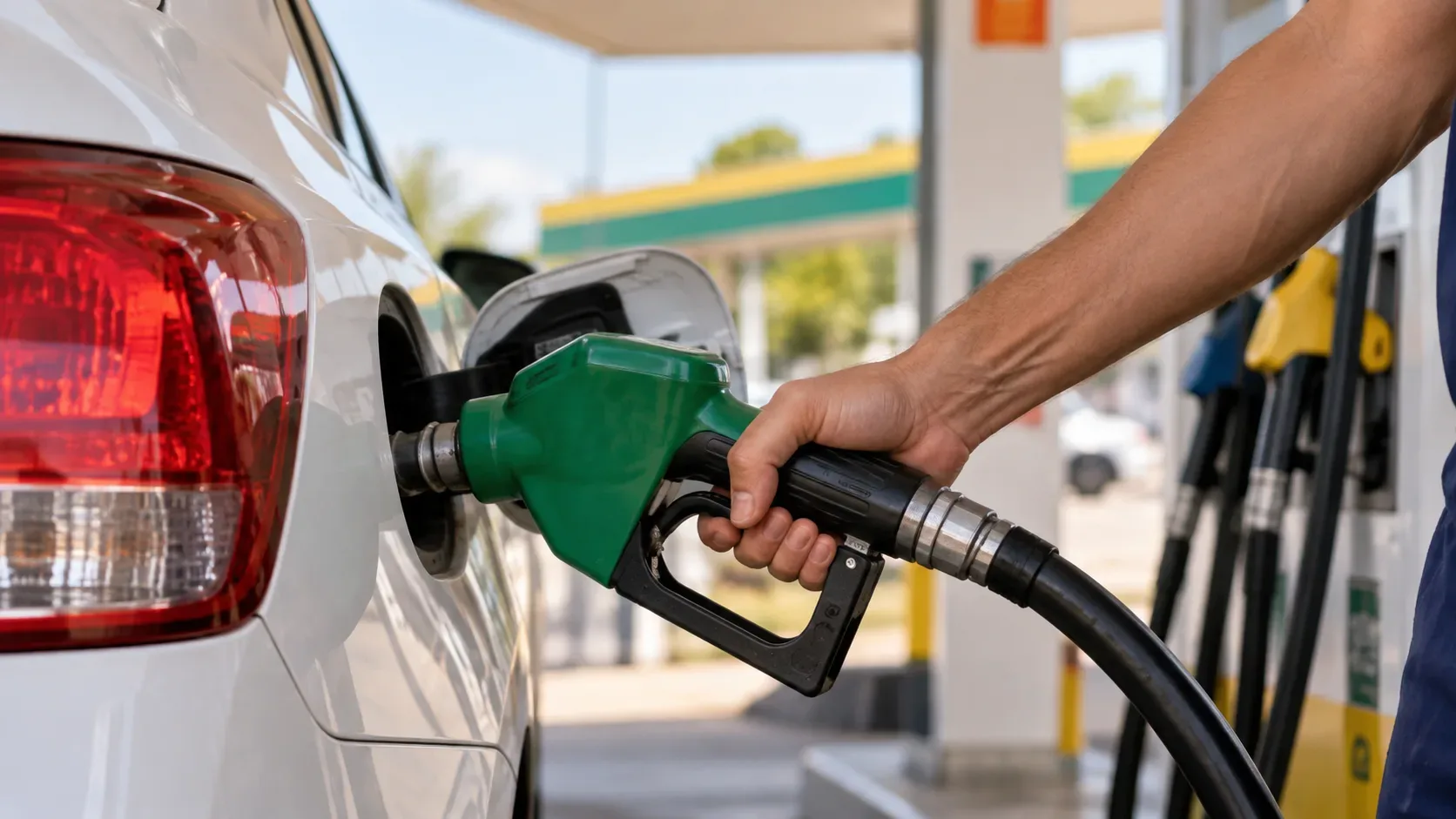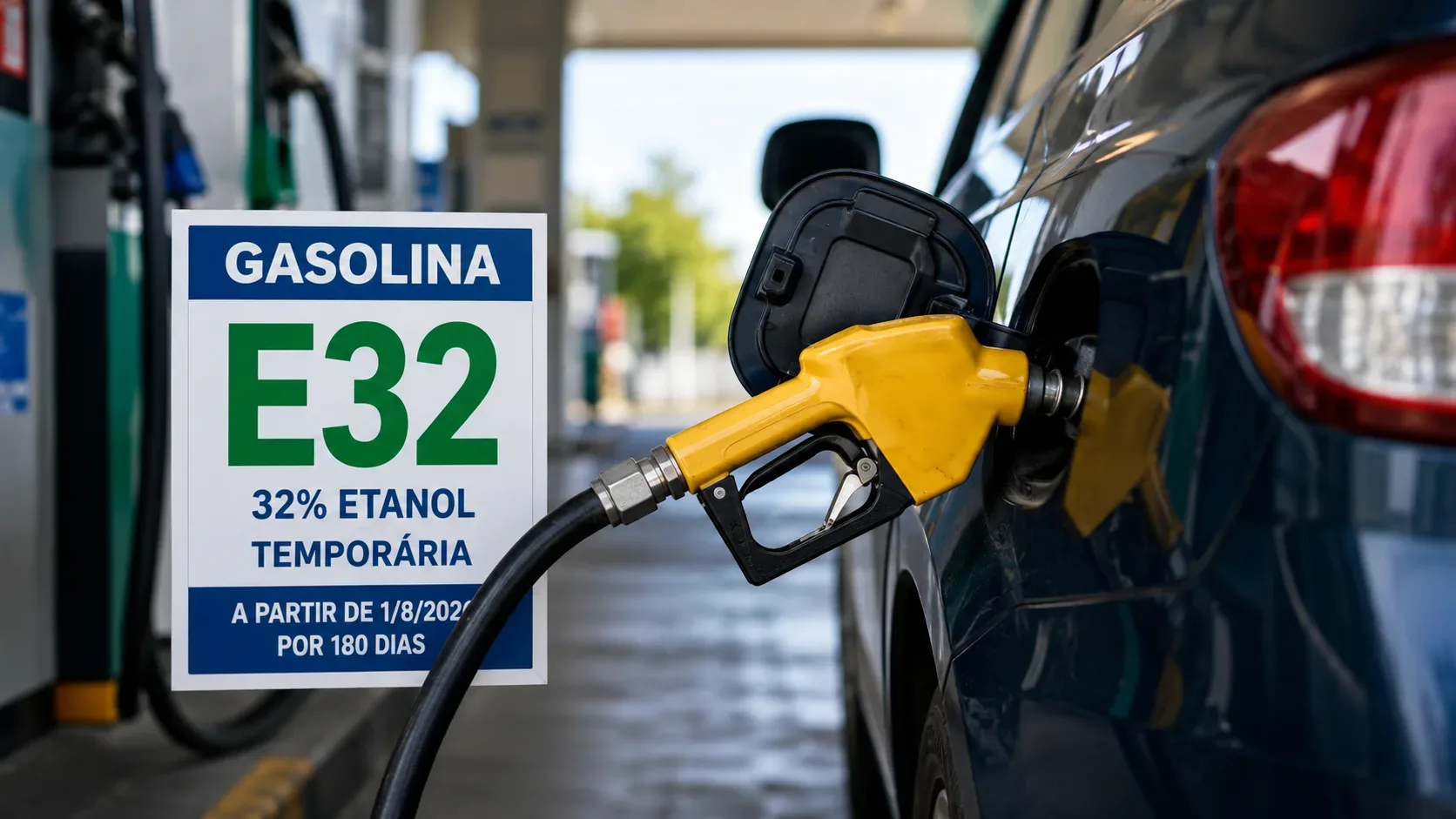
Since August 1, 2026, regular and additive-treated gasoline C sold in Brazil has temporarily changed from E30 to E32: 32% anhydrous ethanol and 68% gasoline A. Brazil's ANP states that the rule lasts 180 days and may be extended once for the same period. Premium gasoline remains at 25% ethanol.
For drivers, the practical answer is straightforward: there is no mandatory vehicle modification simply because the blend moved from E30 to E32. In a flex-fuel vehicle, everyday use continues normally. In a gasoline-only vehicle, the government says E32 testing did not show relevant operating impacts, including in models of different ages and technologies. There is, however, an important caveat: automotive industry groups questioned the lack of specific long-term durability testing before adoption. Older cars, imports, or vehicles with very specific fuel requirements in the owner's manual therefore deserve individual attention.
Flex-fuel vs gasoline-only: what changes in practice
| Issue | Flex-fuel car | Gasoline-only car | Practical action |
|---|---|---|---|
| Refueling | E32 gasoline can be used normally, just as hydrated ethanol or blends of the two can be used within the vehicle's design. | E32 is the regular/additive-treated gasoline currently sold under Brazil's nationwide rule. | Refuel at an authorized station and use the fuel type specified in the owner's manual. |
| Starting | No specific adjustment is required because of the switch to E32. | Tests cited by the MME assessed cold and hot starts and found no relevant change attributed to E32. | Persistent starting difficulty calls for diagnosis, not an automatic assumption that the new blend is responsible. |
| Fuel economy | It can vary with engine, route, temperature, load and the actual gasoline/ethanol mix used. | The MME reports behavior equivalent to lower-ethanol blends, with no relevant impact in testing. | Compare averages over several tanks before concluding that consumption changed. |
| Warranty | The E32 rule does not rewrite the manufacturer's warranty contract. | There is also no public rule allowing a universal claim that every model and model year will receive the same warranty interpretation. | Follow the manual and, for imported, older or explicitly ethanol-limited vehicles, confirm guidance with the manufacturer/importer. |
| Maintenance | E32 alone is not a reason to bring forward oil, spark plug, filter or fuel-system service. | The same applies to gasoline-only vehicles: keep the manual's intervals unless there is a concrete diagnosis. | Do not add preventive maintenance solely because of E32. |
What official E32 testing says
Brazil's Ministry of Mines and Energy (MME) says tests were carried out directly with E32 in gasoline-only light vehicles and motorcycles representing different ages and technologies in the fleet. Testing included cold and hot starts, idle stability, acceleration, passing acceleration, drivability and adaptation of electronic engine systems. According to the MME, no relevant impacts on performance or drivability were found; emissions testing also stayed within applicable limits.
For component durability, the government says it relied on a technical assessment by AVL List GmbH concluding that relevant impacts on fuel-system materials in the Brazilian fleet are not expected with E32. The monitoring group decided to reserve specific durability tests for blends at E35 or higher.
That official conclusion does not eliminate the technical debate. Before implementation, Anfavea, according to a Folha de S.Paulo report, argued that the existing studies did not replace a specific long-term durability validation for making E32 mandatory. The disagreement, then, is not simply “does it work or not”: the government considers the available tests and assessments sufficient for temporary adoption, while industry representatives requested additional validation, especially for long-term effects.
Do you need a remap, new parts or an additive?
As a general rule, no. The change from E30 to E32 does not create a requirement to remap the engine control unit, replace injectors, fuel pump, hoses, spark plugs or any other component. There is also no official guidance telling drivers to add a product to the tank to “offset” the extra ethanol.
In flex-fuel cars, the engine management system already works across a broad range of fuel composition. In gasoline-only cars, the public policy was adopted for the commercial gasoline available in the country, and official testing was intended to verify operation across that fleet. Preventive modifications without manufacturer guidance can add cost and even create new problems.
Will E32 increase fuel consumption?
It would be misleading to promise identical fuel economy in every car, and it would also be wrong to say that consumption must rise noticeably. Ethanol contains less energy per liter than gasoline, but the regulatory change was only two percentage points relative to E30. Engine calibration, octane, traffic, temperature, tire condition, load and driving style also affect the result.
The CNPE states that E32 tests included fuel consumption and found behavior equivalent to lower-ethanol blends, with no relevant operating impact even in non-flex engines. For an owner, the useful way to track this is to measure several full tanks, preferably on similar routes, and compare km/L with a previous average rather than with a single fill-up.
Cold starts: is there anything special to do?
There is no special starting procedure created by E32. Official testing included cold and hot starts and, according to the MME, did not identify a relevant problem attributable to the blend. In modern flex-fuel vehicles, electronic management and starting systems were designed to handle fuels containing far more ethanol than E32.
If starting becomes repeatedly worse right after a fill-up, it is worth investigating. A weak battery, spark plugs, ignition coils, fuel pressure, sensors, off-spec fuel and other faults can produce similar symptoms. E32 content by itself should not be used as a diagnosis.
What about the vehicle warranty?
The resolution that created E32 defines gasoline composition; it does not function as an amendment to every automaker's warranty terms. Two extreme claims should therefore be avoided: “E32 voids the warranty” and “the warranty is automatically protected in every vehicle in the world.” Neither is a general rule established by the public sources reviewed.
For vehicles officially sold in Brazil, the owner's manual and the manufacturer's required fuel specification are the starting points. If the manual sets an explicit ethanol limit, if the vehicle was imported from a market using a different fuel standard, or if an older model raises doubts, the best approach is to obtain documented guidance from the manufacturer or importer before making any modification. In a warranty dispute, maintenance history, diagnostic records and fuel receipts help distinguish a mechanical defect from a fuel-quality issue.
Is premium gasoline now a way to avoid E32?
The ANP clarifies that premium gasoline remains at 25% ethanol. That does not mean every car should switch to premium. Premium gasoline is defined by higher octane and should be used when the engine design requires it or the manufacturer recommends it. Switching only because of concern about E32 can raise cost without a proven benefit for an engine specified for regular gasoline.
Which signs justify a diagnosis
The blend change is not a reason to visit a repair shop preventively, but new and persistent symptoms deserve evaluation. Seek diagnosis if you notice:
- repeated hard starting;
- unstable idle or stalling;
- a clear and persistent loss of power;
- an illuminated check-engine light;
- a fuel-economy increase that persists across several tanks under comparable conditions;
- strong fuel odor, leakage or signs of deterioration in the fuel system.
A fuel leak is a safety issue and requires stopping vehicle use until it is properly assessed. For other symptoms, record when they began, where you refueled and which fault codes were found. That reduces parts-swapping by guesswork.
If the problem started after refueling
A fault appearing after a fill-up does not prove that E32 is the cause. Fuel can be off-spec or contaminated, and the ANP itself distinguishes noncompliant fuel from deliberate adulteration. Keep the receipt or proof of purchase because it identifies the station and helps document the case.
The ANP maintains channels for complaints and reports and the ANP com VC - Postos app, which lets consumers check authorized stations and inspection results. If bad fuel is suspected, combine a station report with a technical diagnosis of the vehicle; one does not replace the other.
What actually needs to change in daily use
For most drivers, almost nothing. Refuel normally, follow the owner's manual and observe the car as you already would. There is no general reason to remap the ECU, drain the tank, add a product, bring maintenance forward or switch to premium gasoline solely because of E32.
Extra attention makes sense in three situations: an older vehicle with a sensitive fuel system, an import built for a different market specification, or a manual that clearly limits ethanol content. In those cases, model-specific manufacturer guidance is more useful than a generic internet rule.
Because E32 was adopted temporarily and there is still debate over long-term durability validation, it helps to separate two questions: “Do I need to do anything now?” — generally, no — and “Is there residual technical uncertainty for every part of the fleet over the long term?” — yes, especially in the segments that prompted industry reservations. That distinction avoids both alarmism and an unsupported promise of universally zero effect.