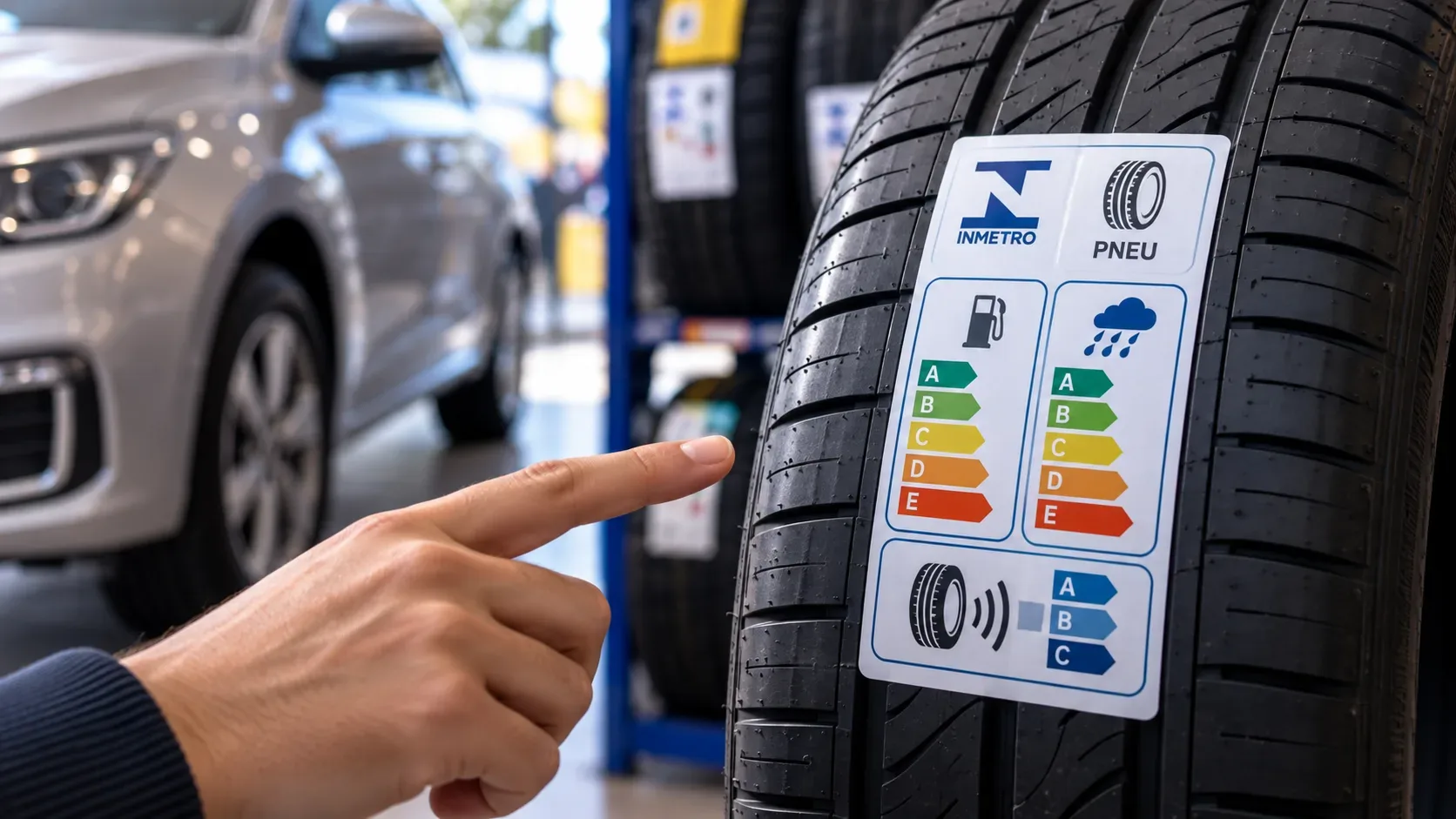
The letter A is not a universal “best tire” seal. On Brazil's National Energy Conservation Label (ENCE) for tires, Inmetro presents three separate performance dimensions: rolling resistance, wet grip and external rolling noise. A sound choice starts with vehicle compatibility and then with the intended use — wet-weather safety, energy efficiency, external noise or a balance among these factors.
What the tire ENCE label actually measures
According to Inmetro, rolling resistance is tested using methods such as ISO 28580 or UN Regulation No. 117; wet grip uses methods such as ISO 23671, ISO 15222 or the same UN regulation; and noise is measured through sound-emission tests. The official guidance on tire markings summarizes the scales shown to consumers.
| Criterion | What it indicates | Scale shown by Inmetro | How to read it when comparing |
|---|---|---|---|
| Rolling resistance | Energy dissipated by the tire while rolling, affecting fuel or energy consumption. | A to G | The closer to A, the lower the rolling resistance in the standardized test. |
| Wet grip | Grip/braking performance on wet asphalt in the test. | A to F | The closer to A, the better the classification for this criterion. |
| External rolling noise | Sound emitted by the tire/road interaction to the outside environment. | Three bands | The more favorable band represents lower external emission; it is not a cabin-comfort score. |
The three ratings should not be added together or converted into an “overall average”: each answers a different question.
Before comparing letters: confirm that the tire fits the vehicle
The ENCE helps you choose among technically compatible tires. It does not replace size, construction, load index, speed category, approved rim or other vehicle specifications. Inmetro Ordinance No. 379/2021 remains the regulatory basis identified by Inmetro in 2026, and the mandatory-information page notes that dimensions, load and speed are linked to the tire's ability to perform safely.
- Start with the owner's manual, vehicle label or applicable technical specification.
- Compare only tires that meet the required size and indexes for that configuration.
- If equivalence of size, load or speed is uncertain, confirm it with the vehicle manufacturer or a qualified professional before buying.
How to weigh rolling resistance, wet grip and noise
1. Wet grip: give it more weight when rain and braking are critical
For drivers who frequently face rain, high-speed roads or situations where emergency braking has serious consequences, the wet-grip rating deserves substantial weight. It is a specific indicator of performance in wet conditions; it does not measure every aspect of handling, but it is directly relevant to this scenario.
2. Rolling resistance: matters more when consumption and range matter
A better rolling-resistance class indicates lower energy loss in the test and can help reduce fuel use or extend range. It does not support a fixed savings promise in real-world use. Inmetro itself notes when explaining vehicle consumption that tire pressure, load, traffic, speed, climate, maintenance and driving style affect the consumption a driver experiences.
3. Noise: use it as a tiebreaker or an environmental priority
The label's noise criterion is external noise measured during rolling. It is useful for comparing sound emission to the environment and can be a good criterion when two choices are close on the factors that matter most to you. However, it is not the same as the noise heard inside the car, which also depends on body insulation, road surface, suspension, speed and other factors.
Three hypothetical selection examples
Example A — urban and highway use in a rainy region: imagine two compatible tires. The first is class B for rolling resistance and A for wet grip; the second is A for rolling resistance and C for wet grip. If the stated priority is wet-weather safety, it can make sense to give more weight to the first tire, even at the cost of one rolling-resistance class.
Example B — a long daily commute focused on efficiency: a tire rated A for rolling resistance and B for wet grip may better match the goal than another rated C for rolling resistance and A for wet grip, provided both meet the vehicle specifications and the buyer considers class B wet grip acceptable for the intended use and safety priorities.
Example C — two choices tied on the main criteria: if two tires have the same wet-grip and rolling-resistance classes, the external-noise band can serve as a tiebreaker. In that case, choosing the lower sound emission does not require sacrificing the criteria already identified as priorities.
These examples are a way to organize priorities, not a recommendation of any brand, model or universal minimum class.
Why choosing “only by the letter A” can be a poor decision
The regulatory history of tire labeling itself recognizes that tire-performance attributes can interact. Inmetro's regulatory impact analysis recorded the importance of considering efficiency, grip and noise together instead of pursuing a single parameter. In practice, the label makes these trade-offs visible for comparison — it does not eliminate them.
- An “A” for rolling resistance does not, by itself, tell you the wet-grip rating.
- An “A” for wet grip does not, by itself, tell you the effect on consumption.
- The best external-noise band does not guarantee a quieter cabin in every car.
- The label does not provide a single score for durability, expected wear, dry performance, hydroplaning in every condition or ride comfort.
A 5-step method for comparing tires at the store
- Filter by the correct specification. Remove any option that does not match the required size, load, speed or vehicle requirements.
- Define the use priority. Wet-weather safety, consumption/range, external noise or balance.
- Compare the priority criterion first. Do not focus on one highlighted letter while ignoring the other two fields.
- Use the remaining criteria to break ties. A tire may be a better compromise for your use even without the best possible class in every category.
- Check the registration and official data. Inmetro says PBE tire data are available in a public database; use the guidance for accessing the table and the PBE System when you need to confirm declared data.
What the label does not replace after purchase
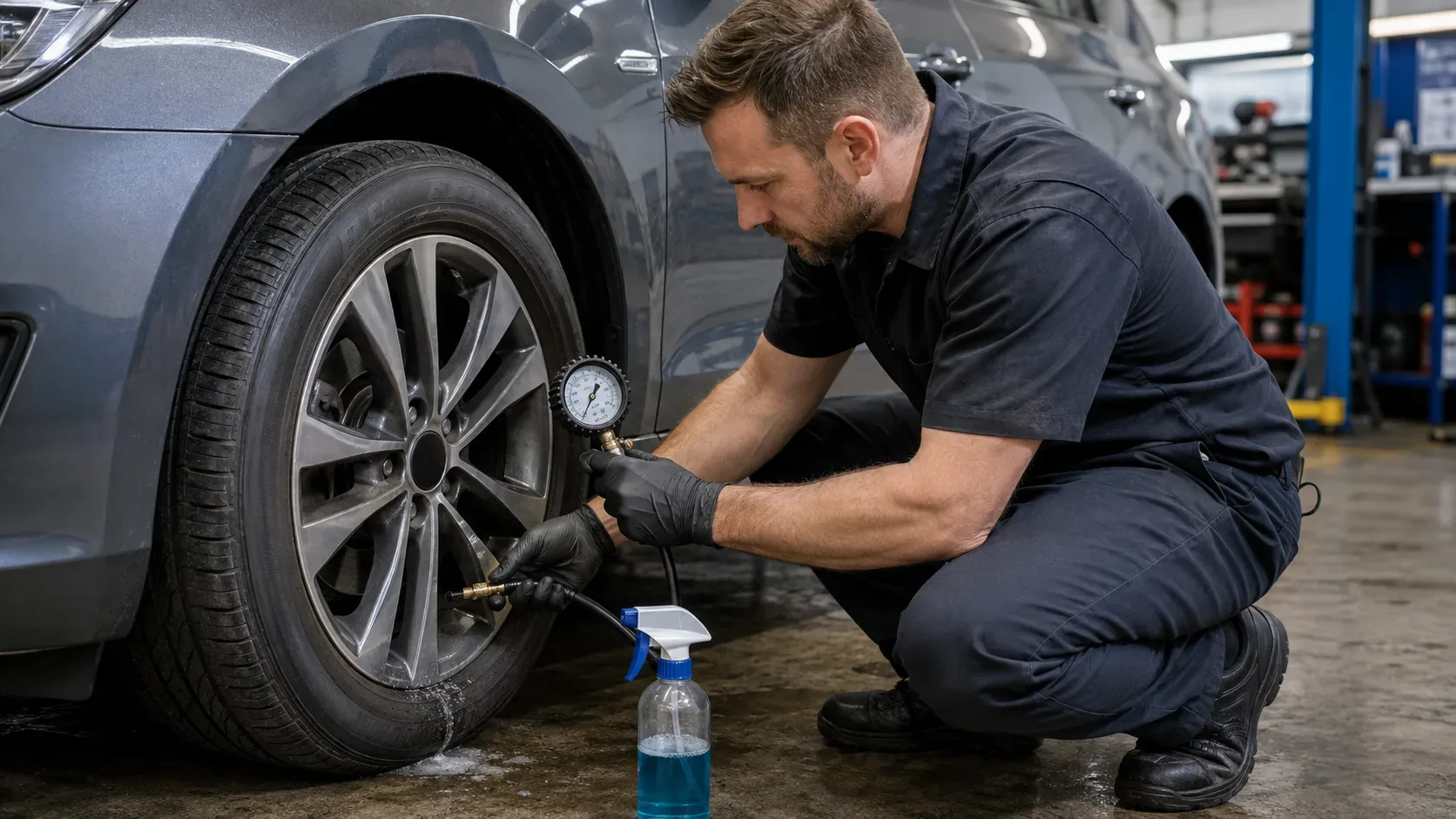
A good classification cannot compensate for improper use. Incorrect pressure, excessive load, misalignment, wear and poor maintenance can affect consumption, stability and service life. Inmetro also points out that inflation pressure, load, road roughness and alignment influence tire behavior and durability. Follow the pressure and limits specified by the vehicle manufacturer.
There are also tires and applications for which ENCE performance requirements do not apply in the same way. Inmetro lists exceptions, including some bias-ply tires, temporary-use tires and other specific applications. For ordinary passenger-car and commercial-vehicle tires covered by the program, the practical rule is simple: compare all three label criteria, but only after confirming that the tire is suitable for the vehicle.
In short: use the ENCE as a decision matrix. First confirm compatibility and basic safety; then give more weight to the criterion that matches your real-world use. The best purchase is not necessarily the tire with the most A ratings, but the one whose performance mix best fits the vehicle and the driver's priorities.