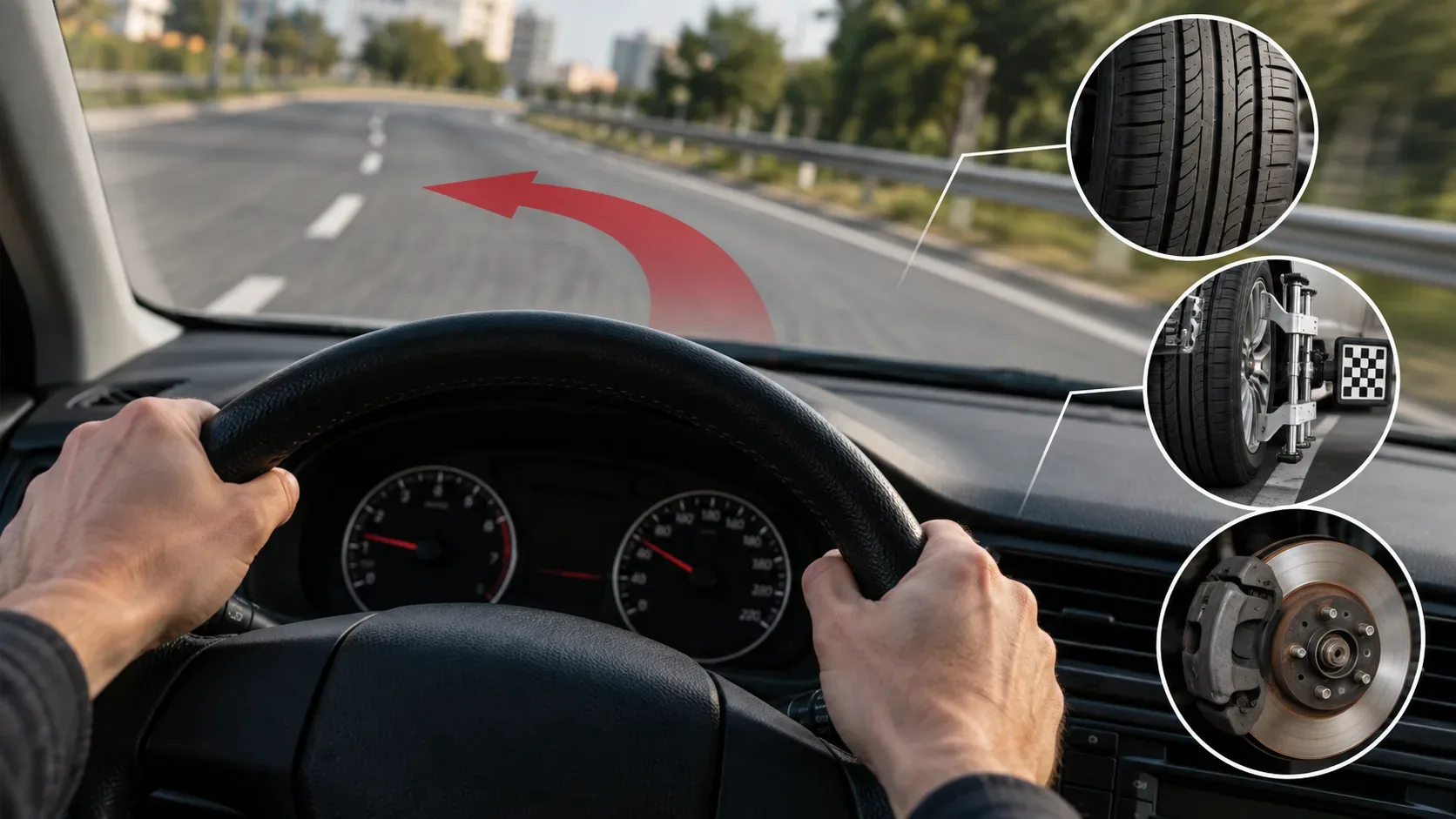
If the car feels normal at low speed and the steering wheel starts vibrating only within a specific speed range — for example, around highway speeds — tire/wheel assembly balance is one of the first things to suspect. That does not mean every steering-wheel vibration is an “alignment problem,” or that a simple wheel balance will fix every shake.
The most useful clue is when the vibration appears: at a steady road speed, while braking, under acceleration, or even while the car is stopped. That pattern helps you ask for the right inspection and avoids replacing parts or paying for services that do not address the cause.
The timing of the vibration is the first clue
| When it happens | What to suspect first | What to ask the shop to check |
|---|---|---|
| Within a speed range, with steady throttle | Tire/wheel imbalance; tire or rim uniformity/runout; mounting or centering | Tire and wheel inspection, pressure check and dynamic balancing; if it persists, measure runout and uniformity |
| Only or mainly while braking | Brake system, rotor/hub and wheel installation | Inspect rotors, pads, hubs, bearings and wheel mounting/torque |
| Mainly while accelerating or under load | Drivetrain, CV axles/joints, driveshaft where fitted, engine/transmission mounts or suspension | Mechanical diagnosis focused on the drivetrain and components affected by load |
| While stopped or idling | Engine operation/ignition or powertrain mounts | Engine and mount diagnosis; wheel balancing is not the first-line check |
| Vehicle pulls to one side or steering wheel is off-center, without typical speed-related vibration | Wheel alignment and steering/suspension condition | Check pressure, play in components and alignment geometry |
When wheel balancing is the most logical first suspect
Michelin explains that balancing corrects uneven mass distribution in the tire and wheel assembly. When the imbalance is large enough, rotation can generate vibration in the suspension and vehicle structure at specific speeds. The manufacturer notes that the vibration may be felt in the steering wheel, floor, dashboard or seats. Continental also lists highway-speed vibration, often around 80 to 120 km/h (50 to 75 mph), as a common sign of imbalance — but that range is not a universal rule.
So, if the shake appears within a relatively narrow band, fades below it and changes intensity with vehicle speed, it makes sense to start with a tire/wheel inspection and dynamic balancing. That is especially reasonable after tires have been replaced or remounted, a balance weight has been lost, the car has hit a pothole or curb, or irregular wear has appeared.
The key is not to turn the pattern into a final diagnosis. Michelin clearly distinguishes balancing from alignment: a vehicle can be properly aligned and still vibrate because of imbalance. The NHTSA likewise describes balancing as the service that helps wheels rotate properly without causing the vehicle to shake or vibrate.
Balanced but still vibrating: look beyond the wheel weights
A “zero” reading on a conventional balancer does not prove that the tire and rim are perfect under every condition. Some faults can create vibration even when mass balance is correct.
- Bent or out-of-round rim: a pothole or curb impact can alter wheel geometry. Radial and lateral runout need to be measured; adding weights alone will not correct shape.
- Tire uniformity or out-of-round issue: variations in stiffness and shape can create a different force once per revolution.
- Improper bead seating or tire installation: the tire may not sit uniformly on the rim.
- Wheel-to-hub mounting error: the assembly can rotate with runout if it is not properly centered or seated.
- Tire damage or irregular wear: a bulge, deformation, scalloped wear or pressure loss calls for inspection, not just another balance.
“Road force” diagnostic balancers apply a load to the tire to better simulate road contact. Hunter says this type of test can identify tire uniformity variation, rim runout, improper bead seating and other issues that a conventional balancer may not detect. It is not necessary for every vibration complaint, but it can be useful when the problem remains after a properly performed balance. See the technical overview from Hunter Engineering.
Alignment is not the same as balancing
Alignment adjusts the wheel angles relative to the vehicle and road; balancing corrects mass distribution in the rotating assembly. In practice, pulling to one side, an off-center steering wheel and heavier wear on one edge of a tire point more directly to alignment or steering/suspension issues. A vibration that appears at particular road speeds is more consistent with a rotating tire/wheel issue.
The two problems can coexist, especially after an impact. So checking geometry is reasonable when there are alignment symptoms or a history of a hard hit — the mistake is to sell alignment as the automatic cure for any shaking steering wheel. Michelin's guidance for vibration is to start with balancing and, if that does not eliminate the vibration, check alignment and suspension components as well.
If it vibrates while braking, check the brake system before blaming the tire
If the steering wheel is smooth at a steady speed but begins to pulse or shake as soon as the brake pedal is applied, the pattern is different. The inspection should include rotors, hubs, bearings, pads, calipers and wheel installation.
Brembo explains that rotor lateral runout, deformation, overheating, deposits and installation problems can create braking vibration. The manufacturer also notes that incorrect wheel tightening can contribute to vibration and irregularities in the rotor/hub assembly. See Brembo's guidance on vibration during braking.
This does not rule out simultaneous tire or wheel problems. It changes the priority: if the shake depends on brake application, asking only for “balancing” can leave the main cause unchecked.
If it vibrates under acceleration, drivetrain load becomes a clue
A vibration that grows mainly when the driver accelerates, climbs a hill or puts the powertrain under load deserves a different diagnostic path. CV axles and joints, driveshafts and universal joints where fitted, engine/transmission mounts and suspension components can all produce load-related vibration.
As examples of this pattern, Firestone lists noticeable vibration especially while accelerating among possible symptoms of CV axle/joint problems and also lists vibration that intensifies with acceleration for driveshaft issues. These symptoms cannot identify a failed part by themselves; they show why load-dependent vibration should not automatically be treated as wheel imbalance. See its pages on CV axles and joints and driveshafts.
What if the car vibrates while stopped?
If the steering wheel, seat or body vibrates while the vehicle is stationary, the tire/wheel assemblies are not rotating, so wheel balancing cannot explain that symptom. The diagnosis shifts to engine operation, idle quality, ignition and powertrain mounts. Worn mounts, for example, can transmit more engine vibration into the body.
The same reasoning applies when the vibration clearly changes with engine rpm without a proportional change in vehicle speed: that relationship is a clue to investigate the engine or drivetrain rather than repeatedly focusing only on the wheels.
What to ask the shop to do, in a practical order
- Describe the exact speed range: say when the vibration starts, where it is strongest and whether it disappears above or below that range.
- Describe the condition: steady speed, acceleration, deceleration, braking, turning or stopped.
- Ask for a visual inspection and correct pressure check: look for bulges, cuts, deformation, irregular wear, objects, pressure loss and rim damage.
- If the pattern is speed-related, ask for dynamic wheel balancing: and confirm that the tire/wheel assemblies are correctly mounted and centered.
- If it persists, ask for runout and uniformity measurements: a bent rim, out-of-round tire, improper bead seating or radial force variation may require diagnosis beyond ordinary balancing.
- If the symptom depends on braking or acceleration, direct the diagnosis accordingly: brakes/hubs in the first case; drivetrain, mounts and suspension in the second.
- Alignment belongs in the process when its own signs are present: pulling, an off-center steering wheel, irregular wear or an impact that may have changed geometry.
When not to keep “testing” the car at speed
A new vibration or one that is getting worse quickly deserves inspection. NHTSA recommends consulting a tire service professional when tire behavior changes, including noise or vibration, and says tires with physical damage such as cuts, cracks or bulges should be taken out of service. If the shake began after a hard impact, comes with pressure loss, visible deformation, metallic noise, unstable steering or suspicion of a loose wheel, reduce speed safely and arrange an inspection before repeating highway-speed tests.
Bottom line: the right question is not “alignment or balance?”
When the steering wheel vibrates only within a particular speed range, balancing is a strong initial suspect — but diagnosis should follow the symptom pattern. Steady-speed vibration points first to tires, wheels, balance, uniformity and mounting. Braking vibration shifts attention to brakes and hubs. Acceleration-related vibration calls for a drivetrain and mount check. Vibration while stopped points toward the engine and mounts.
If the first balance does not fix the problem, do not keep adding weights indefinitely: ask the shop to check wheel geometry, tire uniformity, bead seating and, when indicated, the vehicle's other systems.