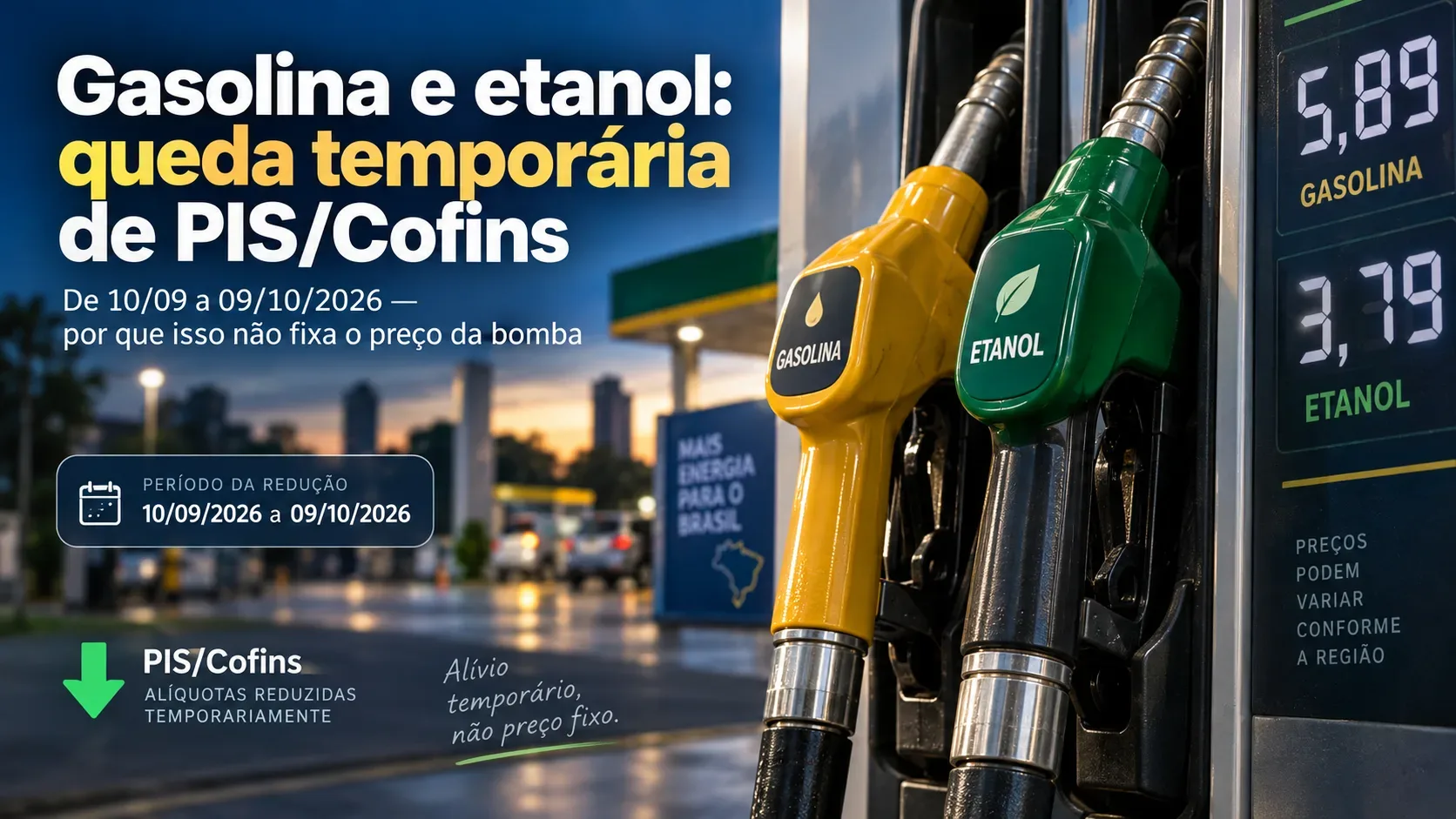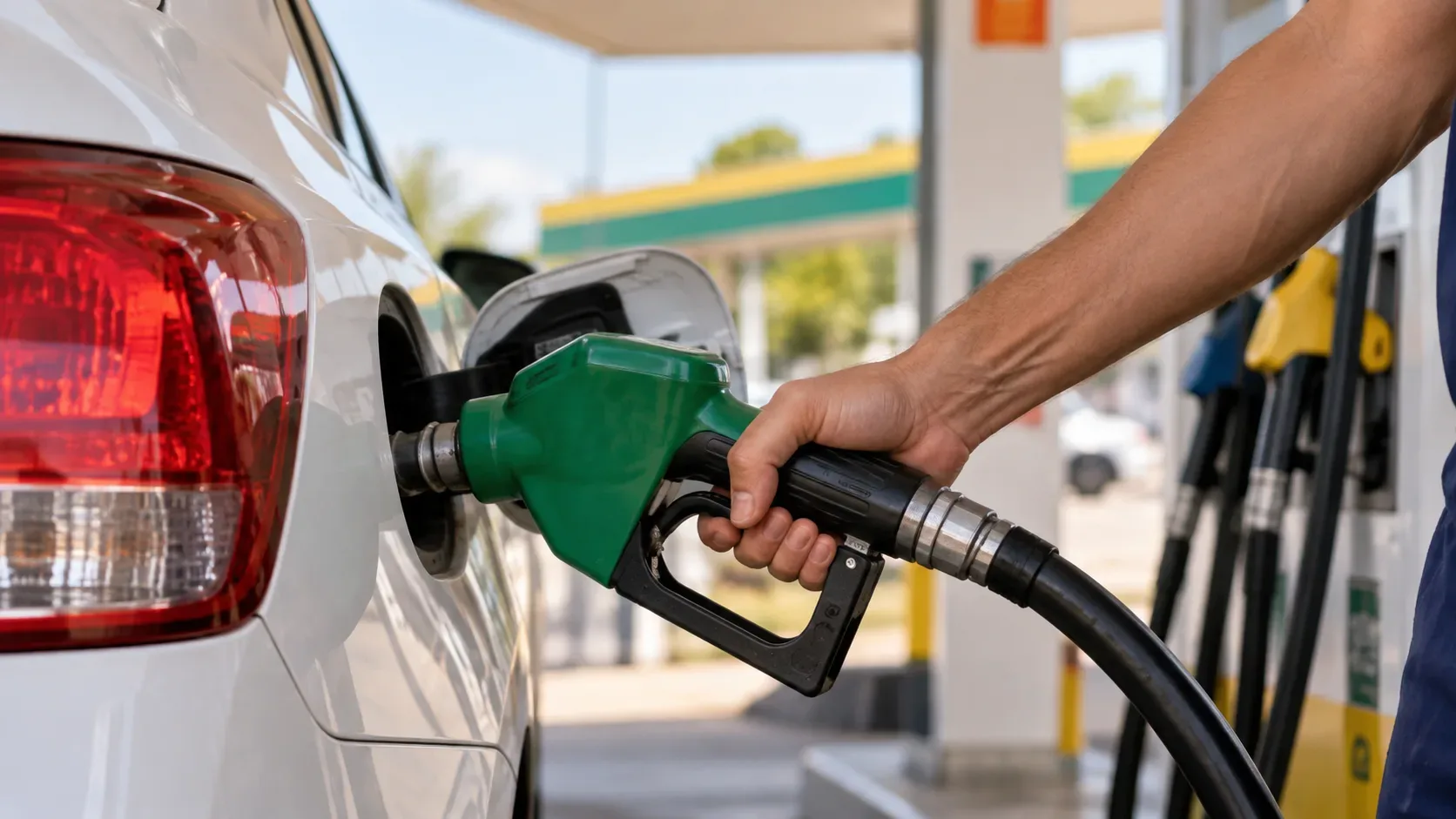
Short answer: from September 10 to October 9, 2026, Brazil’s federal government is reducing the PIS/Pasep and Cofins tax burden on gasoline by R$0.63 per liter. That lowers one component of the price, but it does not require every gas station to cut its pump price by exactly R$0.63 per liter. The final retail price still reflects other components that can rise, fall or remain unchanged during the same period.
What changes from September 10 to October 9
Brazil’s Ministry of Finance said on September 9 that a decree reduces, from September 10 through October 9, the PIS/Pasep and Cofins rates on the import and sale of gasoline and gasoline streams, except aviation gasoline. The tax burden is reduced by R$0.63 per liter and, while the measure is in effect, those federal taxes total R$0.16 per liter.
The key point is the nature of the policy: it is a tax reduction within the fuel supply chain, not retail price controls or a fixed discount guaranteed on the pump display.
Why R$0.63 less in taxes does not automatically mean R$0.63 less at the station
Brazil’s oil and fuels regulator, ANP, explains how fuel prices are formed and notes that, since 2002, prices have been freely set at the production, distribution and retail stages. For gasoline, the final price can simultaneously reflect:
- the price of straight gasoline charged by the producer or importer;
- the cost of anhydrous ethanol blended into gasoline sold to consumers;
- freight and operating costs along the distribution chain;
- state taxes and other tax components that are not the specific target of this PIS/Pasep and Cofins cut;
- distribution and retail margins set by market participants under free competition.
The federal tax cut can therefore push the price downward, but the net result depends on what happens to the other components. If one of them rises at the same time, part of the tax relief may be offset. If other components also fall, the pump-price reduction could exceed R$0.63.
How to interpret the R$0.63 without confusing a tax cut with a guaranteed discount
A purely arithmetic example helps. Assume a liter cost R$6.50 before the measure. The scenarios below are not price forecasts; they simply show how different components can interact.
| Illustrative scenario | Change in other components | Net effect versus R$6.50 | Illustrative price |
|---|---|---|---|
| Full tax cut, all other items unchanged | R$0.00 | - R$0.63 | R$5.87 |
| Other components rise by R$0.20 | + R$0.20 | - R$0.43 | R$6.07 |
| Other components rise by R$0.63 | + R$0.63 | R$0.00 | R$6.50 |
| Other components fall by R$0.10 | - R$0.10 | - R$0.73 | R$5.77 |
In other words, R$0.63 is the reduction in the federal tax burden per liter. It should not be read as a promise that the posted retail price will fall by the same nominal amount at every station, city or state.
What to track to see whether gasoline actually became cheaper
To assess the retail effect, compare the same fuel type over several weeks and prefer price series over a single observation. ANP publishes a weekly fuel price survey with averages for Brazil, regions, states and municipalities, as well as data for surveyed stations.
- Compare regular gasoline with regular gasoline; do not mix it with premium or additive gasoline.
- Look at the same city or region because freight, competition and market structure vary.
- Use more than one week to distinguish a persistent change from a one-off fluctuation.
- Do not automatically subtract R$0.63 from the price you saw at a station on September 9.
Gasoline, ethanol and diesel: the measures are different
The federal package announced on September 9 treats the three fuels through different mechanisms. The values should not be added together or interpreted as the same type of discount.
| Fuel | Announced measure | How to interpret it |
|---|---|---|
| Gasoline | R$0.63/liter reduction in PIS/Pasep and Cofins from September 10 to October 9 | It lowers one tax component; the pump price still depends on the entire supply chain. |
| Hydrous ethanol | PIS/Pasep and Cofins temporarily reduced to zero, equivalent to R$0.19/liter in tax relief | This is a separate measure for hydrous ethanol and does not change the R$0.63 figure for gasoline. |
| Road diesel | A separate economic subsidy, initially R$1.00/liter for participating producers and importers | It is a subsidy mechanism with its own rules and possible adjustments, not the same tax cut applied to gasoline. |
Why the pump price may fall by less — or not fall at all — during the period
Even while the tax relief is in force, retail prices can react differently from one station to another. An increase in the distributor’s acquisition cost, producer/importer component, anhydrous ethanol, freight or margins can offset part of the cut. The reverse is also true: declines in those components can amplify the reduction seen by consumers.
This does not make the tax cut irrelevant. It means its effect must be assessed against the price scenario that would have existed without the cut, rather than only by comparing two pump prices on nearby dates.
Consumer checklist from September 10 to October 9
- Check the per-liter price before filling up and compare stations in the same area.
- Watch the weekly trend, not just the first day of the measure.
- Use ANP data to check the average trend in your city or state.
- Keep gasoline, ethanol and diesel separate when reading news about the package.
- Remember that R$0.63 is a federal tax reduction on gasoline, not a mandatory R$0.63 retail discount.
Bottom line
From September 10 to October 9, 2026, gasoline carries R$0.63 per liter less in PIS/Pasep and Cofins, according to the federal government. The measure favors lower prices, but ANP shows that the pump price is the sum of several components and is set under a free-pricing regime. Consumers may therefore see a decline smaller than, equal to or greater than R$0.63 — and if other costs rise enough, they may not see a nominal decline at the station at all.