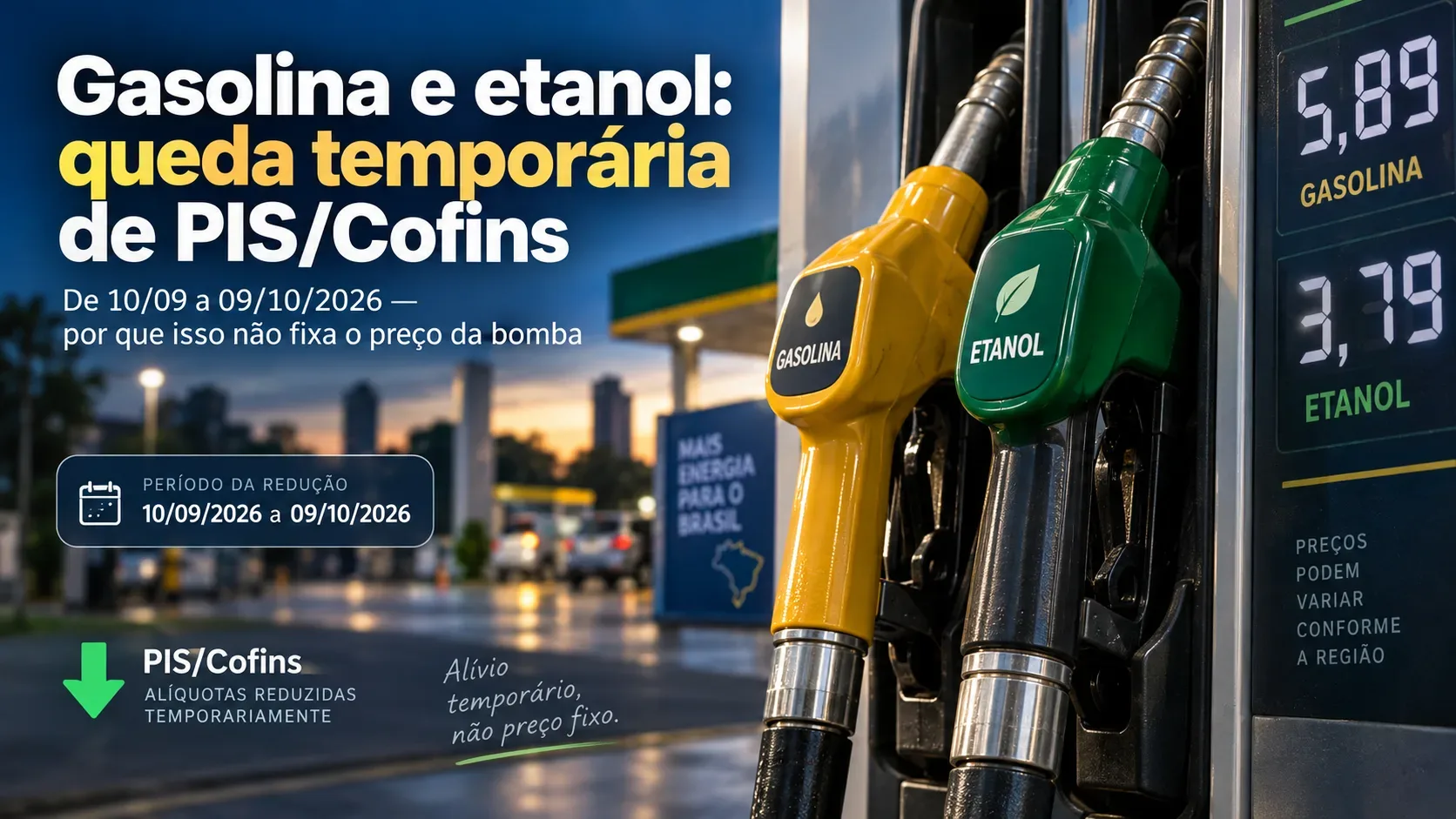
Decree 13,116/2026 introduced a temporary reduction in PIS/Pasep and Cofins on gasoline and its components, except aviation gasoline, and on hydrous ethanol fuel. The window is short: it runs from September 10 through October 9, 2026. The measure lowers federal taxes in the supply chain, but it does not impose price controls or require service stations to cut pump prices by the same amount.
What changed under Decree 13,116/2026
Published in the Federal Official Gazette on September 10, the decree temporarily changes the specific PIS/Pasep and Cofins rates applied to gasoline and sets those contributions at zero, under the regime cited by the rule, for hydrous ethanol fuel. It covers imports and domestic sales and expressly excludes aviation gasoline.
| Fuel | Reference outside the temporary window | From Sep. 10 to Oct. 9, 2026 | Stated reduction |
|---|---|---|---|
| Gasoline and its components | PIS/Pasep: R$141.10/m³; Cofins: R$651.40/m³; total: R$792.50/m³ | PIS/Pasep: R$28.49/m³; Cofins: R$131.51/m³; total: R$160.00/m³ | R$632.50/m³, equivalent to R$0.6325 per liter of the taxed base |
| Hydrous ethanol fuel | Under the specific regime cited by the decree, PIS/Pasep of R$34.33/m³ and Cofins of R$157.87/m³ | R$0.00/m³ for both contributions | R$192.20/m³, or about R$0.1922 per liter under that regime |
Brazil's Ministry of Finance summarized the tax effect as a R$0.63-per-liter reduction for gasoline and a R$0.19-per-liter reduction for hydrous ethanol. Those figures show the scale of the tax measure, but they should not be read as a mandatory discount at the pump.
How long the reduction lasts
- September 9, 2026: date of the decree.
- September 10, 2026: publication in the Federal Official Gazette and start of the reduction window.
- October 9, 2026: last day expressly covered by the temporary rates.
- From October 10 onward: Decree 13,116/2026 no longer keeps the temporary reduction in force. The law applicable at that time must be checked, including any new measure extending or changing the rates.
So the question “how long are PIS/Cofins reduced?” has a clear answer in the current text: through October 9, 2026. The decree does not promise an extension.
Where PIS/Cofins enters the fuel supply chain
Gasoline
For gasoline, the decree lowers the specific rates applied to gasoline and its components. In simple terms, the combined burden falls from R$792.50 per cubic meter to R$160.00 per cubic meter during the window. Since one cubic meter equals one thousand liters, the mathematical difference is R$0.6325 per liter of the taxed base.
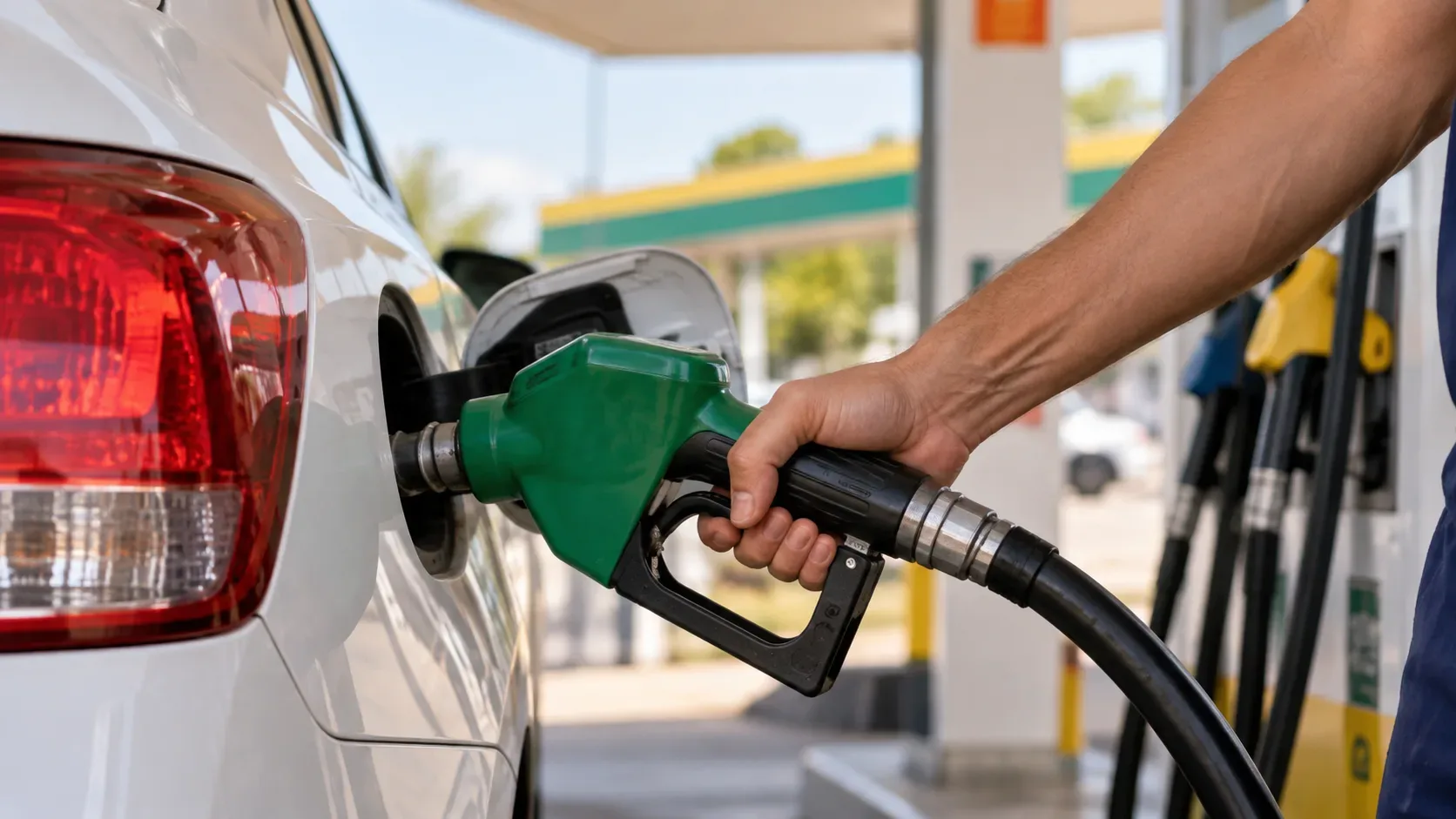
That is still not the retail price of regular gasoline seen at the pump. The fuel sold to motorists results from a chain that includes, among other elements, the product at origin, blending with anhydrous ethanol, freight, distribution, ICMS state tax and the retailer's margin. Brazil's ANP describes the price formation process step by step through the final service-station price.
Hydrous ethanol
For hydrous ethanol fuel, Decree 13,116/2026 sets the reduction coefficient at one for the specific rates under the regime cited in Law 9,718/1998, bringing PIS/Pasep and Cofins to R$0.00 per cubic meter during the period. The government described the tax effect as roughly R$0.19 per liter.
Here too, setting those contributions to zero does not eliminate other costs or determine commercial margins. Ethanol remains subject to supply conditions, logistics costs, applicable state taxation and pricing decisions throughout the chain.
Why the decree does not set the pump price
The key point is that Brazil uses a free-pricing regime for fuel production, distribution and retail. According to ANP, there is no general price table and no requirement for prior government authorization before price changes. The consumer price reflects several components that can move at the same time.
- Product price at origin: it may change with oil prices, exchange rates, supply conditions and commercial strategies.
- Taxes: PIS/Pasep and Cofins are only part of the tax burden. ICMS and, depending on the fuel, other tax components also matter.
- Fuel blend and composition: gasoline sold at stations contains gasoline A and anhydrous ethanol, so a tax reduction calculated at one stage does not mechanically pass through cent for cent to the final liter.
- Freight and logistics: distance, storage, transportation and regional conditions affect costs.
- Distribution and retail margins: distributors and stations set prices in a competitive market.
- Inventory replacement timing: a station may be selling fuel purchased before or after the tax change, so pass-through can appear at different speeds.
Therefore, lower taxes can create room for lower prices or soften an increase caused by other factors, but the decree by itself does not determine what each service station must charge.
How to track whether consumers see an effect
Instead of comparing a single price board before and after the decree, it is better to follow market data for several days and take regional differences into account. ANP maintains fuel price surveys and dashboards and tracks both retail and distribution prices.
- Compare the same fuel and, when possible, the same stations or the same region.
- Look at a sequence of days or weeks, not only the first day of the measure.
- Do not treat R$0.63 for gasoline or R$0.19 for ethanol as a “mandatory minimum discount.”
- Remember that other price components may rise or fall during the same period.
What happens after October 9
The decree expressly limits the temporary rates to September 10 through October 9. For transactions and fill-ups after that date, readers should check the legislation then in force. Any extension, new reduction or redesign of the tax treatment would require another legal act.
Unless a new rule is issued, the safe conclusion is: the reduction created by Decree 13,116/2026 is temporary, lowers PIS/Pasep and Cofins in the supply chain, but does not freeze or regulate the final retail price of fuel.