Coolant dropping without a visible puddle does not automatically point to a single cause. The first useful piece of data is the pattern: an isolated reading may vary with temperature or recent service, but a sequence of cold measurements showing a progressive drop deserves investigation. The system works pressurized and a small loss may only appear when the engine is hot, evaporate on heated components or occur in a point that does not drip directly onto the floor.
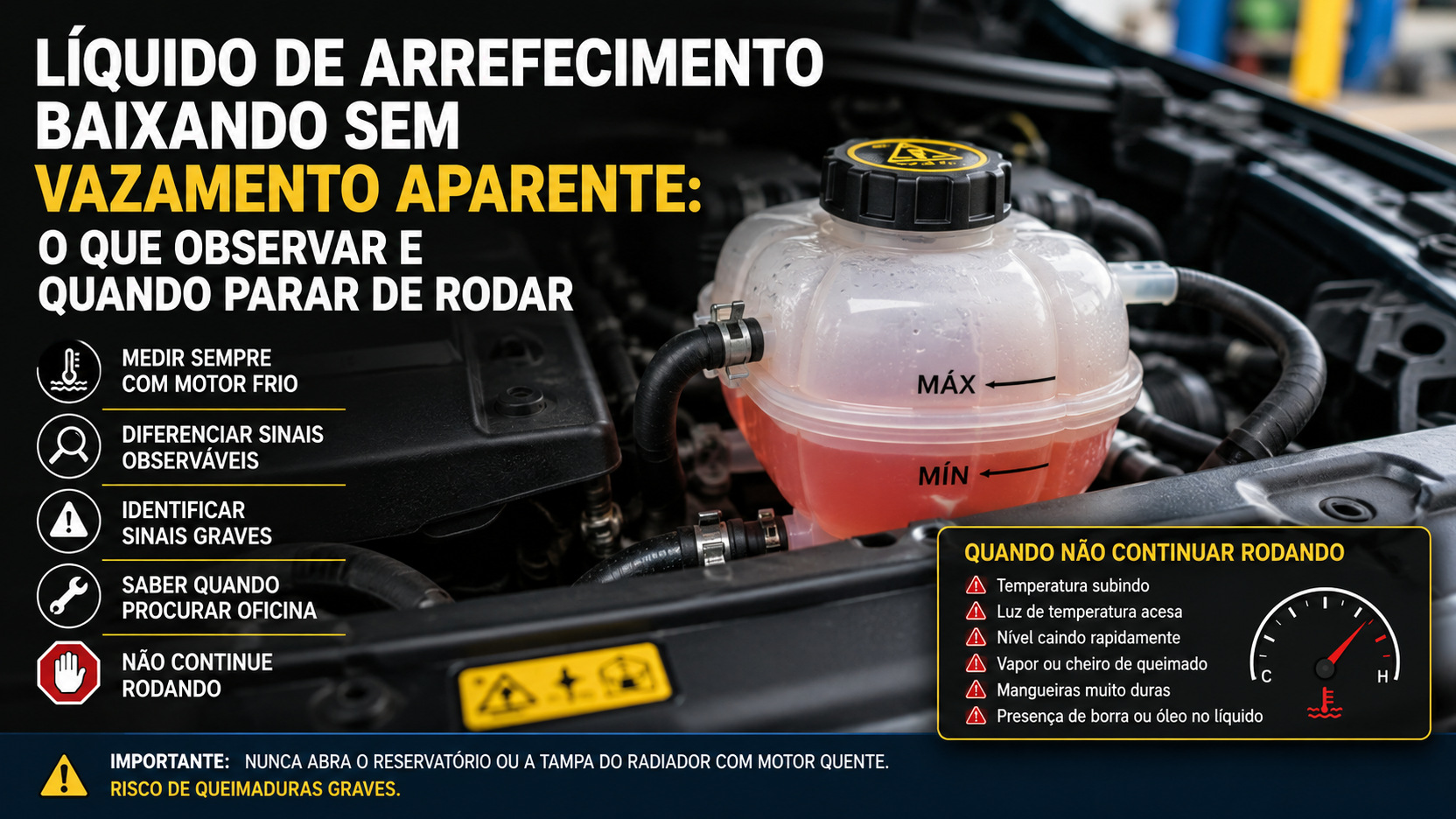
The safety rule comes before the diagnosis: do the check with the engine cold and follow the procedure in the vehicle manual. Never open the pressurized tank or radiator cap when the system is hot. Fluid and steam can escape under pressure and cause serious burns.
First node: is the level really falling?
Always compare readings taken under similar conditions. In many vehicles, the correct level is checked with the engine cold, between the minimum and maximum marks on the reservoir. Liquid expands when it heats, so comparing a hot reading to a cold one can create the impression of loss that isn't there. The design of the system itself varies between models, so the brands and procedure in the car manual must prevail.
If the level is at or below minimum when the engine is cold, top up only with the fluid that meets the manufacturer's specifications. Don't choose just by color and don't mix different types on your own. Then, mentally record or photograph the position of the level and repeat the check on the next uses, always with the engine cold and on a similar surface.
A stable reading after the correction changes the scenario. A drop that reappears, especially after a few days or a few journeys, changes the question from "how much to complete" to "where the system is missing".
Second node: did the crash start right after maintenance?
After changing the liquid, replacing the hose, radiator, water pump or other service that opened the circuit, there may be air remaining in the system. Manufacturer service procedures include bleeding steps to remove air pockets. Therefore, a small accommodation of the level after the service, followed by stabilization, may occur.
The decisive point is repetition. If it was necessary to correct once and the level remained stable, with no increase in temperature, no smell of fluid or other signs, it makes sense to continue monitoring. If the reservoir drops again with each cycle of use, if it reaches the minimum level again or if it requires successive replacements, do not treat this as "air coming out" indefinitely. Recurring loss needs to be located.
Third node: can there be an external leak even without a puddle?
Yes. The absence of a mark on the floor does not eliminate external leakage. A small leak may only appear when the system is pressurized, flow onto a lower protection, evaporate when touching a hot surface or leave only dry residue. In maintenance manuals, when the level drops shortly after completion, visual inspection usually includes the radiator, hoses, covers, connections and water pump.
With the engine cold, observe the reservoir and lid region, hose junctions, sides of the radiator and the area of the water pump that is visible without disassembly. Colored crusts, whitish stains, dry trails, localized moisture or a characteristic smell near the engine compartment are clues. They help direct the workshop, but do not replace system testing.
The lid is also part of the circuit. Modern systems use caps capable of controlling pressure and relief; a defective seal can alter the system's behavior. This is why the workshop can test both the cooling assembly and the cover itself, rather than condemning it based on appearance alone.
There is also a loss path that may not appear under the car: the hot air radiator, called a heater core in some technical materials. Moisture on the carpet, especially near the dashboard, a smell of fluid inside the cabin or a persistent film on the glass can accompany this type of leak. These signs do not confirm the diagnosis, because water infiltration and air conditioning problems can produce similar symptoms.
Fourth node: when to consider internal loss?
When the level continues to drop and external inspection does not find the source, the workshop can investigate whether liquid is escaping into the engine. This does not mean that all non-puddle loss is a head gasket. The hypothesis gains weight when the drop is recurrent and appears together with other signs, such as overheating, abnormal pressurization of the circuit or irregular operation that the technician can relate to the cooling system.
Isolated signs require caution. Steam in the exhaust just after a cold start could just be normal condensation. Residue in the oil can have other causes. Bubbles in the reservoir also depend on the system design and the condition in which they were observed. Confirmation must come from testing, not from a single symptom seen in the garage.
One of the workshop resources is the system pressure test. It applies the specified pressure and allows you to look for leaks that do not appear when the car is cold and stopped. The lid too
can be tested. If the pressure drops and there is no external leak identified, the diagnosis progresses to possible internal losses. Another available test is the combustion gas test in the cooling circuit, used to investigate the passage of gases associated, for example, with gasket, cylinder head or block failure.
When it is reasonable to observe for a short time
The most favorable situation is one in which the drop occurred shortly after a system service, was small, occurred once and then stabilized in repeated cold measurements. Temperature remains normal, there is no warning on the panel, steam, strong smell, leak residue or need to top up again. Even in this scenario, monitor the level in future uses and respect the specifications in the manual.
A very slow decline in a car that has not had a recent service should not be ignored just because the engine has not yet warmed up. The cooling system is closed; Recurrent replacement should not become routine. If the mark drops consistently between equivalent checks, schedule an evaluation before the loss increases or results in overheating.
When looking for a workshop without waiting for the temperature to rise
Seek short-term diagnosis when the level drops again after being corrected, when there is a need for repeated replacement, when residue appears in the hoses, radiator, reservoir or pump, or when a smell of fluid appears in the engine compartment or in the cabin. The same applies if the reservoir drops well below the minimum without a clear explanation, even if the panel does not yet show overheating.
The reason not to wait for the needle to rise is simple: the temperature warning indicates that the system is already having difficulty controlling heat. Finding a small loss before this point is often a better scenario than discovering the fault during an overheating situation.
When not to continue running
Stop the vehicle in a safe place when the temperature indicator enters the overheating zone, when a high temperature message or light appears, or when there is steam or a jet of liquid coming out of the engine compartment. Current manufacturer manuals advise not to continue driving if there is an excessive temperature warning, as this could cause damage to the engine.
A quick loss also changes the decision. If the reservoir that was at a normal level empties in a short time, if there is a significant active leak or if the temperature starts to rise along with the drop in the level, do not try to resolve the situation by just filling up and continuing your journey. Discontinue use and provide assistance.
If there is steam coming out of the safe, do not immediately open the hood. Wait for the condition to cease and follow the instructions in the manual. And, even after stopping, do not remove the reservoir or radiator cap while the system is hot. Pressurization can release boiling fluid and steam.
What the workshop can do that observation at home cannot do
Professional inspection can reproduce conditions that make a leak more obvious. The pressure test checks whether the system maintains the specified pressure and helps find leaks in hoses, connections, radiator, reservoir or other components. The lid test evaluates whether it seals and relieves as expected for that system.
If there is no visible external loss, the technician can proceed to tests for combustion gases in the liquid and other procedures defined by the manufacturer for the model. After any repair that opens the circuit, correct bleeding is also important, because trapped air can alter the level, circulation and cabin heating in certain systems.
What not to do while trying to figure out the cause
Do not transform liquid replacement into a permanent solution. Completing fixes the level, but does not fix the source of the loss. Also avoid “leak stop” additives without specific recommendations from the manufacturer; There are manuals that warn that unspecified sealants and additives can harm cooling and heating system passages.
Do not improvise the mixture just based on the color of the fluid. The correct specification depends on the vehicle, and manufacturers warn that liquids of different types may not be compatible. If it is necessary to top up, consult the manual to identify the appropriate product and concentration.
The pattern of loss is what defines the next step
A single accommodation after maintenance, followed by stability, is different from a reservoir that drops every week. A small external loss that only appears under pressure is different from a system that loses pressure without a trace and requires internal investigation. And any of these scenarios are different from high temperature, steam or rapid stalling, when the priority stops being diagnosing and becomes stopping the car safely.
The best information that the driver can take to the workshop is simple: level measured when cold, frequency of drop, approximate amount of replacement, relationship with any recent service and presence or absence of high temperature, smell, steam or residue. This history reduces the room for guesswork and helps turn "the fluid is disappearing" into a verifiable diagnosis.