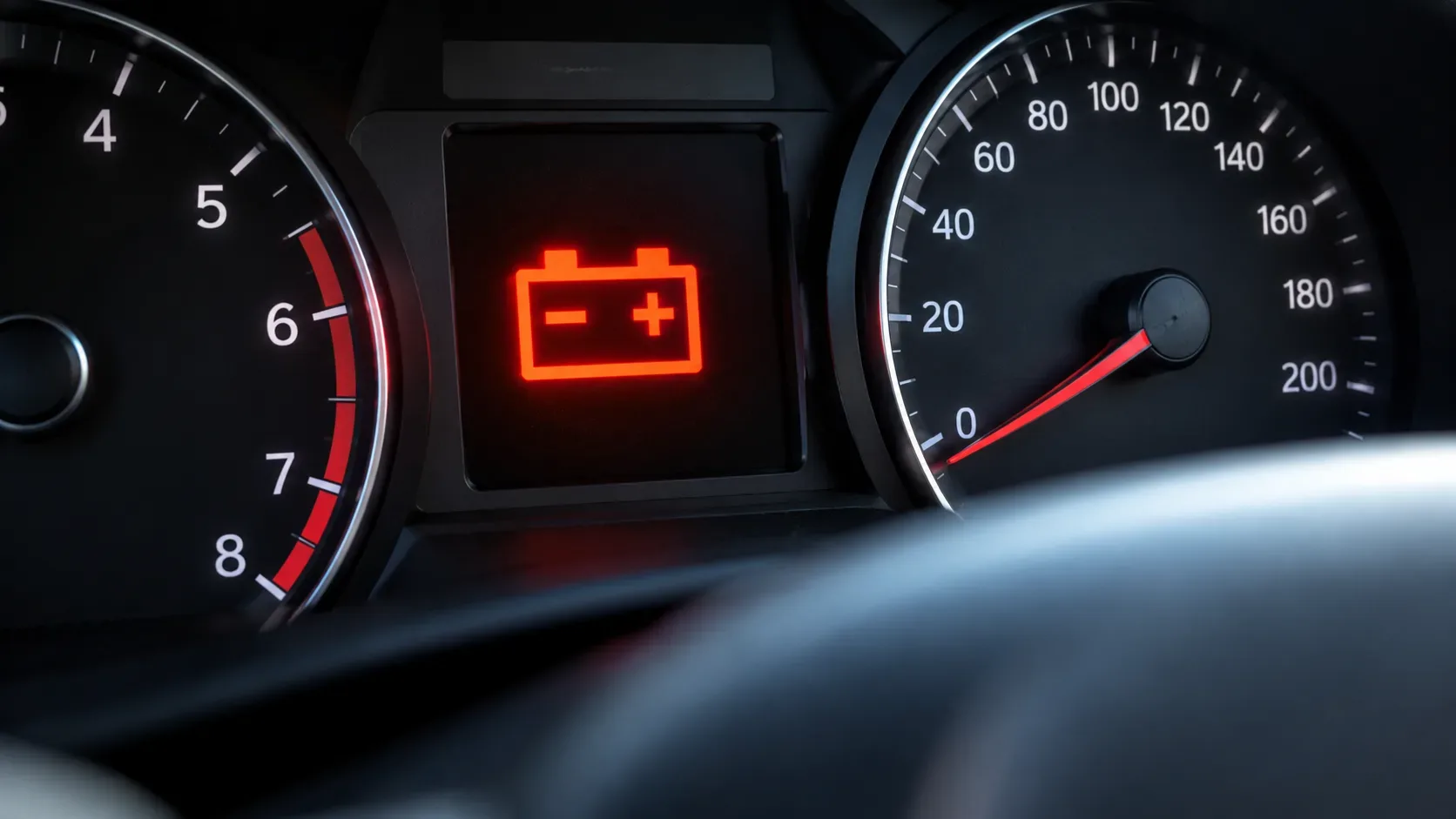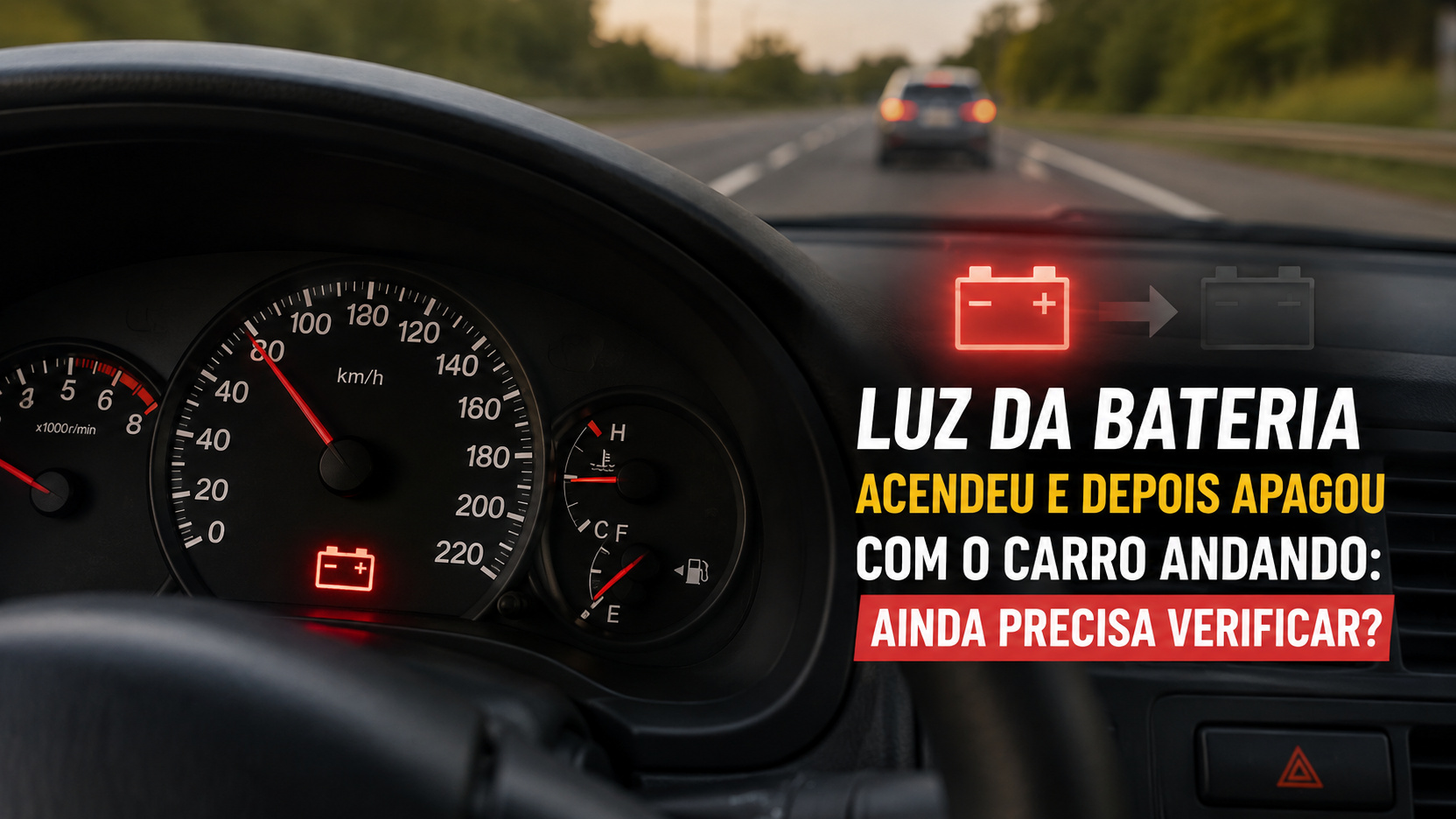
Yes. If the battery light appeared after the engine was already running and the car was moving, the fact that it went out on its own is not enough reason to ignore the episode. This symbol is generally a charging-system warning, not a diagnosis that the battery has "failed." An intermittent warning can disappear when the electrical condition temporarily returns to normal and reappear later.
The first distinction prevents a lot of confusion: it is normal for the battery light to come on during the dashboard self-test when the ignition is switched on and to go out after the engine starts. The situation that deserves attention is different: the light had already gone out, you were driving, and it came on again, even if only for a few seconds. Vehicle manuals treat a charging-system warning that appears while driving as a sign of a problem in the charging system; they also provide guidance to have the vehicle checked when the warning remains on or keeps reappearing.
What the battery light is actually monitoring
The battery-shaped symbol leads many people to think only about the battery itself, but the monitored circuit involves the vehicle's ability to maintain electrical power and recharge the battery while the engine is running. The alternator, voltage regulator, drive belt when applicable, cables, terminals, grounds, fuses, and the monitoring electronics themselves may all be part of this system, depending on the vehicle design.
That is why "the battery is new" or "the car started normally" do not end the investigation. A battery in good condition may continue powering the car for some time even if charging is failing. Likewise, an alternator may work properly at one moment and develop a fault at another.
It came on at startup and went off: when that is normal
When the ignition is placed in the on position before the engine starts, several dashboard lights usually illuminate as part of the self-test. After the engine starts, the charging-system light should go out. This behavior, described in vehicle manuals, is different from a light that reappears after you have already begun the trip.
If you only saw the symbol for a few moments during startup and it went out right afterward without returning, that may be exactly the expected behavior. If you are unsure about the normal sequence for your model, consult the owner's manual because warning logic and associated messages vary among vehicles.
It came on while driving and then went off: what changes
When the warning appears while driving, there was at least one moment when the system detected a condition outside the expected range. If the light went out, that only tells you that the condition that triggered the warning was no longer present at that moment. It does not confirm that the cause was corrected.
Technical alternator diagnostic documentation includes a specific category for "intermittent charging." Possible causes include insufficient belt tension, poor contact at battery connections, inadequate alternator grounding, and internal faults in the alternator or voltage regulator. This helps explain why a car may arrive at a repair shop apparently normal and still have a defect that only appears under certain conditions.
The important point is not to turn that list into a guess. The same warning light can have different causes depending on the vehicle, and a brief episode is not enough to declare "it is the alternator," "it is the battery," or "it is the belt" without diagnosis.
What to observe if the warning disappeared
Try to reconstruct the context of the episode. Note whether the light appeared right after startup or many minutes later, whether it happened at idle or at steady speed, whether it came on when you switched on the air conditioning, defroster, headlights, or other electrical loads, and whether there was light flickering, electronic systems restarting, difficulty starting, belt noise, or any other dashboard warning. These details help the repair shop try to reproduce the fault.
It also matters whether the warning returned on another trip. A single occurrence should not be treated as proof of a serious defect, but repetition increases the need for prompt diagnosis. The vehicle manual remains the reference for immediate action, especially when the manufacturer instructs the driver to stop the car if the charging-system warning appears.
What can cause an intermittent warning
Belt, tensioning, or alternator drive
In vehicles where the alternator is belt-driven, momentary loss of traction, improper tension, or a problem in the drive assembly can reduce electrical generation and turn on the light. Depending on the design, the belt may also drive other engine components, which makes it inappropriate to keep driving if there is loud noise, an unusual smell, overheating, or another mechanical sign.
Cables, terminals, and grounds
Loose, oxidized, or high-resistance connections can interrupt or limit current flow. This type of defect is consistent with intermittent behavior because vibration, temperature, and cable position can change the contact. Battery manufacturers and alternator technical materials list connections and grounds among the points that should be checked.
Alternator and voltage regulator
Faults in the voltage regulator, diodes, windings, or other internal components can appear continuously or intermittently. That is why a normal measurement taken minutes after the warning does not, by itself, prove that the entire system is healthy. If the fault is not active during the test, the evaluation may need to combine measurements, inspection of connections, verification of the drive system, and, when applicable, a review of fault codes stored by the vehicle.
Battery and energy-management electronics
The battery should also be tested, but replacing it as a trial is not a sound automatic conclusion. In cars with more sophisticated electronic management, sensors and modules take part in charging control. The correct procedure depends on the model's architecture and the manufacturer's specifications.
When to stop using the car
If the light comes back on and stays on, treat the warning with greater urgency. Find a safe place to stop and follow the instructions in the owner's manual. Some manufacturers advise stopping immediately and contacting assistance when the charging-system warning appears while driving.
The decision becomes even clearer if the dashboard starts to dim or flicker, the headlights lose intensity, electrical equipment restarts, several warning lights appear at the same time, the steering becomes unusually heavy, the engine temperature rises, or there is belt noise. These signs may indicate that the problem is no longer just a passing warning. In that situation, insisting on driving "just a little farther" can end in a breakdown and, depending on the vehicle, increase the risk of other problems.
If the warning came on once, went out, and the car continues to behave completely normally, the situation is different from a permanently illuminated light, but it is still not a good reason to postpone the check for weeks or begin a long trip without a diagnosis. The conservative approach is to schedule a charging-system check as soon as possible.
What to request during diagnosis
A useful evaluation is not limited to asking whether the battery "is good." The goal is to check the charging system as a whole and try to understand the intermittent behavior. This normally involves testing battery condition, the alternator's charging capability according to the vehicle specifications, the condition of the belt and tensioning system when applicable, terminals, cables, grounds, and possible voltage drops across connections.
In vehicles with energy-management modules, it may also be necessary to check stored faults and system data. Because charging strategies vary among models, a single voltage reading should not be used as a universal rule to declare the alternator good or bad. The result needs to be interpreted according to the vehicle and the test conditions.
If the test is normal, does the episode stop mattering?
Not necessarily. A normal test is useful information, but it should be considered alongside the fact that the light appeared during use. If the fault is intermittent, it may not show up while the car is stationary at the repair shop. The warning history, inspection of connections and belt, repeat testing under appropriate conditions, and the vehicle's electronic records may be needed to reach a diagnosis.
This does not mean that every warning light that flashed once is hiding a serious fault. It only means that the warning disappearing is not, by itself, a repair. The best outcome is to find out why the system reported that condition before the problem chooses a worse moment to reappear.
A practical rule for distinguishing the scenarios
If the light comes on with the ignition and goes out after the engine starts, you are probably seeing the normal self-test. If it appears with the engine already running and the car moving, treat the episode as a charging-system warning. If it goes out on its own, record the context and arrange a diagnosis; if it returns, stays on, or comes with other symptoms, stop safely and follow the vehicle manual or assistance guidance.
So the question is not only "did the light go out?" It is "why did it come on while the car was moving?" That second question helps avoid both replacing parts by trial and error and ignoring a fault that may still be present.