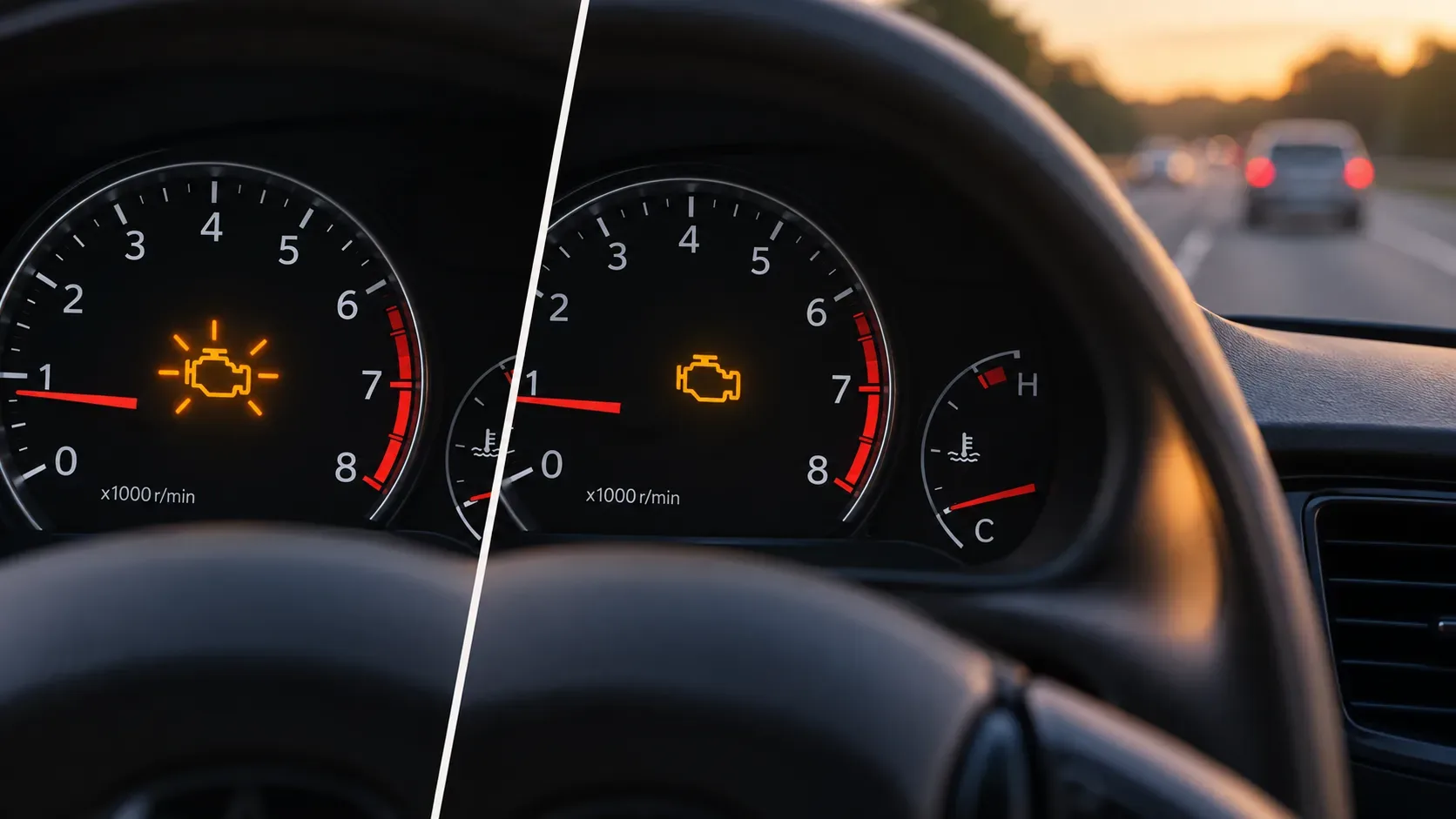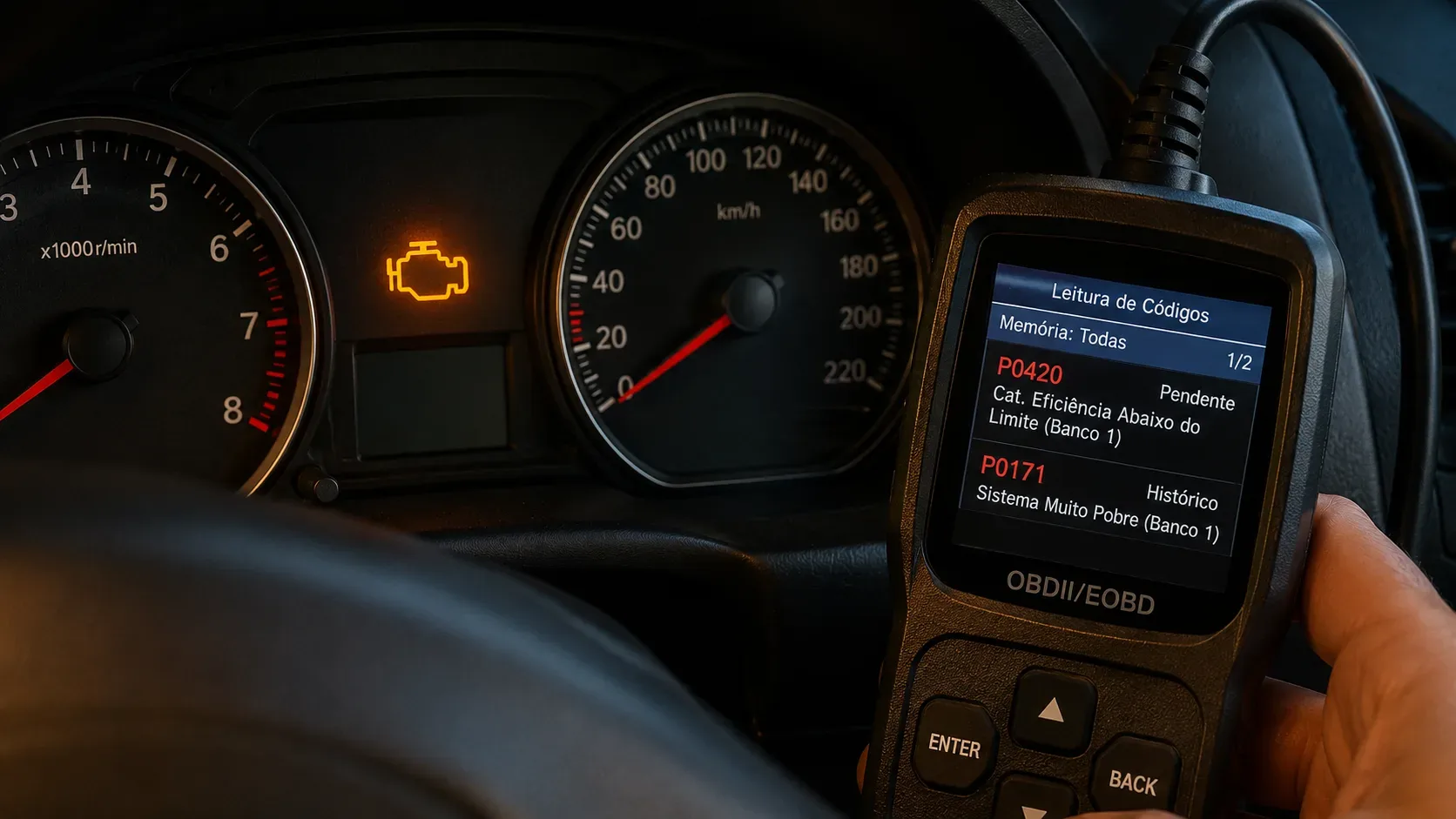
Yes: the check engine light can turn off while the fault remains stored in the diagnostic system. Under Brazil's OBDBr-3 rules, the malfunction indicator lamp (MIL) and the diagnostic code memory do not follow the same timing. The current Ibama regulation allows the MIL, for most faults, to be switched off after three consecutive driving cycles with no new detection, while a conventional fault code may remain until the fault has not been recorded again for at least 40 consecutive engine warm-up periods. So an extinguished light is not proof that nothing is still stored.
This changes the practical decision: if the light came on for no clear reason, scanning the car soon after it goes out can preserve an important clue. The system may still contain a pending, confirmed or, on vehicles where the feature applies, permanent code. Ibama Normative Instruction No. 23/2020, currently in force and consolidated with later amendments, is the technical reference for OBDBr-3 on light-duty vehicles.
The light turning off and the code disappearing are different events
The MIL is the warning shown to the driver. A diagnostic trouble code is the record used by the OBD system to identify the type of malfunction it detected. When a fault stops recurring, the visual warning may disappear before the memory is cleared. The regulation itself separates these two stages: one section governs MIL deactivation; another governs fault-code erasure.
For malfunction conditions other than the distinct warning mode associated with combustion misfire, the MIL may be deactivated after three consecutive driving cycles in which the responsible monitor no longer detects the fault and no other independent fault requires the light. The fault code, associated distance and freeze-frame data may be erased if the malfunction is not recorded again for at least 40 consecutive warm-up periods.
Pending, confirmed and permanent: what each status means
| Status | Meaning under OBDBr-3 | Why it matters after the light is off |
|---|---|---|
| Pending | A record stored after the initial detection of a malfunction, before the MIL is activated. | It can reveal an event the system detected but that has not yet met the criteria for confirmation and MIL activation. |
| Confirmed | A fault the system detected and confirmed over the minimum required number of driving cycles, with MIL activation. | It may remain available after the visual warning disappears, depending on what happens in later cycles. |
| Permanent (PDTC) | A confirmed code stored in non-volatile memory and, where applicable, not erasable with an external diagnostic tool. | It helps preserve the history of certain MIL-triggering faults until the system itself verifies the conditions for erasure. |
The pending, confirmed and permanent definitions were added to the regulation through a 2021 amendment. PDTC requirements are tied to the phases and applications specified by OBDBr-3, so the same behavior should not be expected from every car, especially older vehicles or earlier OBD generations. The 2021 regulatory amendment details these categories.
When is it worth scanning after the light goes out?
In practice, a scan is especially useful in four situations:
- Soon after an unexplained warning: the fewer driving cycles that have passed, the better the chance that useful information is still available to reconstruct the event.
- When the light has appeared more than once: recurrence is a strong reason to retrieve the code and the conditions under which it was set, even if the car feels normal now.
- When drivability changed: loss of power, hesitation, rough idle, abnormal fuel consumption or another symptom that occurred with the warning gives the scan a concrete event to correlate.
- When the light flashed: OBDBr-3 provides for a distinct mode, such as flashing, for combustion misfires severe enough to damage the catalyst on spark-ignition engines. In that situation, the later disappearance of the warning should not be treated as proof that the episode was harmless.
If the light stayed steadily on only once, then went out, the vehicle is operating normally and there were no other symptoms, a scan can still be useful but does not automatically mean there is a serious defect. The goal is to recover evidence before it disappears and use it to guide the next check.
What to ask for in the scan report
A useful scan goes beyond asking “what code did it show?” When the vehicle and tool support it, ask for:
- current, pending, confirmed and permanent codes, including the status of each;
- freeze-frame data, the operating data stored when the fault was detected;
- event-related parameters, such as engine speed, coolant temperature, calculated load and, when available, vehicle speed, intake-manifold pressure, fuel trims and other parameters covered by the regulation;
- monitor readiness/status, especially if codes have already been cleared or the battery disconnected before the scan.
Freeze-frame data are particularly valuable because OBDBr-3 requires relevant engine operating conditions to be stored when the first fault in a component or system is detected. That means the scanner may show not only what was detected but also under what conditions it happened.
Avoid clearing codes before understanding the record
If the goal is to learn why the light came on, do not start by pressing “clear faults”. With conventional codes, clearing can remove information that would help diagnose the episode, including data associated with the event. The important exception is an applicable permanent code: it cannot simply be erased with an external scan tool and follows its own system-controlled erasure criteria.
Likewise, avoid disconnecting the battery merely to “reset” the light before reading the system. Even when that does not remove a PDTC, it can change other diagnostic information and make the investigation less direct. Read and save the information first; then clear it only when appropriate after diagnosis or repair.
A trouble code is a clue, not an automatic parts order
A DTC identifies a monitored condition or type of malfunction. It should be combined with symptoms, freeze-frame data, live data, inspection and system-specific tests. This avoids the common mistake of reading the description of a code as an instruction to replace a particular component immediately.
If the scanner finds a record after the light has gone out, save the code, status and event data, then determine whether the condition is active, intermittent or no longer occurring. If no code is available, that also does not prove no event occurred: elapsed time, manufacturer strategy, OBD generation and any previous clearing can affect what remains accessible.
Practical rule: what to do when the light goes out by itself
- Do not clear memory or disconnect the battery before a scan if you want to investigate the cause.
- If possible, scan soon after the event and save the codes, status and freeze-frame data.
- If the light returns, flashes or is accompanied by drivability problems, prioritize a technical inspection.
- If it was an isolated event, the light is off and the car is running normally, monitor the vehicle — but a preventive scan may still recover the history before the system discards it.
In short, a check engine light turning off does not guarantee that the fault record has been erased. Under OBDBr-3, the visual warning can disappear after fault-free driving cycles while diagnostic information remains available for longer. That window is exactly when a scanner can be most useful in turning a warning that “went away” into usable diagnostic evidence.