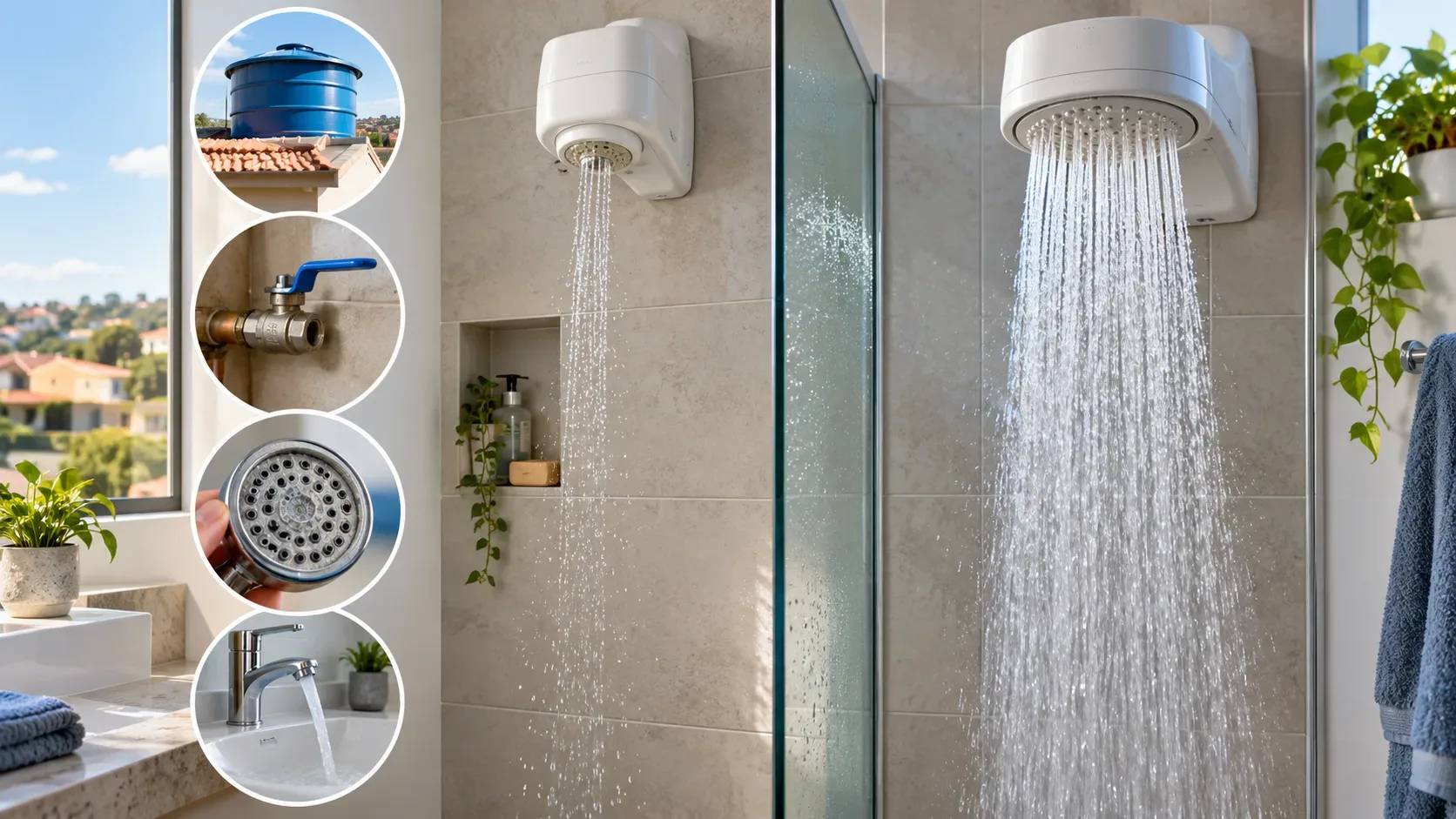
A shower with a weak spray can have very different causes. A pressurized model helps when the pressure available at the outlet is genuinely low, but it will not fix a partially closed valve, a clogged spray plate, debris in the piping, or an insufficient water supply. Before replacing the unit, it is worth separating low pressure from restricted flow.
Low pressure and low flow are not the same thing
Pressure is the condition that pushes water through the plumbing. Flow rate is the amount of water that actually passes per unit of time. In practice, a shower can have low flow because pressure is low, but also because there is a restriction somewhere along the path.
This distinction can prevent an unnecessary replacement. If the bathroom sink faucet has good flow and only the shower is weak, the initial suspicion shifts to the shower itself, the local valve, or the final section of piping. If several fixtures in the home are weak at the same time, the cause is more likely to be upstream of the shower.
What to check before buying a pressurized shower
1. Compare the shower with other water outlets
Open a nearby faucet and see whether its flow is also lower than normal. If possible, do the same in another room. When the sink, laundry faucet, and shower all show a similar drop, the home may have a supply limitation, a low water-tank level, a partially closed main valve, a utility-supply issue, or significant pressure loss in the piping.
When only the shower is affected, the diagnosis can stay more local.
2. Check the valves without forcing them
Make sure the bathroom valve and, where accessible, the main water valve are fully open. Do not force a stuck valve: older mechanisms can break and turn a simple diagnosis into a leak. If the problem started after construction work, maintenance, or a supply shutdown, displaced debris or trapped air may also be involved.
3. Look for signs of a restriction in the shower itself
Crooked jets, dry sections on the spray plate, or a gradual loss of flow suggest dirt or scale. Lorenzetti's Acqua-line manual advises cleaning the spray plate when flow decreases and instructs users to switch off the circuit breaker before maintenance. Always follow the manual for your exact model and do not open the electrical section of the appliance for this diagnosis.
If the appliance has an inlet screen or filter specified by the manufacturer, clean it only as described in the manual. Do not remove pressure reducers, flow restrictors, or safety components on your own: some models rely on those parts to operate within their designed range.
4. Consider the height between the water tank and the shower
In gravity-fed systems, available height directly affects static pressure. As a physical reference, 10 kPa is approximately equal to 1 meter of water column (1 m.w.c.). In a real installation, bends, pipes, valves, and fittings create additional losses, so geometric height is not the same as the pressure actually available while showering.
This is why bathrooms close to the tank, such as top-floor apartments or houses with little vertical difference between the tank and shower, can have low pressure even when the tank contains enough water.
When a pressurized model really helps
A pressurized shower uses a small integrated or associated pressurizing system to raise pressure and, as a result, improve the volume of water at the shower. Manufacturers offer these models specifically for low-pressure installations.
The important point is that pressurized does not mean compatible with every condition. Each product has its own operating-pressure range. Bella Ducha Turbo Ultra, for example, lists 0.7 to 2.5 m.w.c.; Duo Shower Quadra Turbo Electronic lists 0.7 to 4 m.w.c. In one Duo-line manual, the non-turbo version requires a higher minimum pressure than the Turbo version. These figures are examples for specific products, not a universal rule.
Before buying, compare the pressure available at the outlet with the range specified in the manual for the model you want. If pressure cannot be estimated safely, a plumber can measure it and determine whether the problem is pressure, flow, or the sizing of the installation.
When pressurization is unlikely to solve the problem
- Clogged spray plate: more pressure does not remove accumulated debris from the holes.
- Partially closed or faulty valve: the restriction remains in place.
- Blocked or overly restrictive piping: the bottleneck remains upstream of the appliance.
- Water tank that is not refilling properly: a pressurizer cannot create water when adequate volume is not available.
- Supply drop throughout the home: the cause needs to be found in the supply system.
- Electrical problem: low voltage, inadequate wiring, grounding, or breaker issues are not corrected by higher water pressure.
A conservative five-step test
| What you observe | Most likely explanation | Safe next step |
|---|---|---|
| Weak shower, but nearby faucet is normal | Restriction in the shower, spray plate, local valve, or final pipe section | Check the manual, valve position, and permitted cleaning steps |
| Several fixtures in the home are weak | Low supply pressure, tank level/height, main valve, or piping issue | Check the water supply and call a plumber if it persists |
| Crooked jets or part of the spray plate has no water | Clogging or mineral buildup | Switch off the circuit breaker and follow the manufacturer's cleaning procedure |
| Shower performance drops sharply when another faucet opens | Limited supply capacity or significant pressure loss | Have the plumbing assessed before replacing the shower |
| Pressure is low, but the installation is clear and adequately supplied | Low available head at the shower point | Compare product pressure ranges and consider a pressurized model |
More flow can change shower temperature
There is a practical effect that is easy to overlook: at the same electrical power, a large increase in flow reduces how much the shower can raise the water temperature. In other words, a stronger spray can be less hot, especially on cold days. That is why selection should not be based on pressure alone; voltage, appliance power, climate, and bathing preference also matter.
Electronic models allow more gradual temperature adjustment, but they still operate within the power limit of the appliance.
What to check in the specifications of a new unit
- the correct household voltage, commonly 127 V or 220 V in Brazil depending on the outlet;
- minimum and maximum operating-pressure range;
- appliance power and wiring/breaker requirements;
- grounding requirements and residual-current device compatibility as stated in the manual;
- hydraulic connection type and available space;
- whether the pressurizer is integrated, optional, or a separate accessory.
Hydraulic and electrical issues should be treated separately. A plumber is the appropriate professional for pressure, piping, valves, tanks, and flow. A qualified electrician should assess circuit capacity, conductors, breaker, grounding, or any change in power/voltage. Do not use extension cords, improvised adapters, or wiring modifications to install a more powerful electric shower.
Useful sources and manuals
- Lorenzetti — FAQ on electric showers
- Lorenzetti — Bella Ducha Turbo Ultra and pressure range
- Lorenzetti — Duo Shower Quadra Turbo Electronic
- Lorenzetti — Acqua-line installation and cleaning manual
- Hydra — example manual with minimum operating pressure
Bottom line
A pressurized shower makes sense when the plumbing genuinely delivers low pressure at the shower point and the chosen model is designed for that range. Before replacing anything, compare other fixtures, confirm valve positions, check only the obstructions the manual allows you to clean, and consider the water-tank height. If the cause is in the piping or supply, changing the shower may only mask the problem; if there is any electrical uncertainty, the installation should be evaluated by a qualified professional.