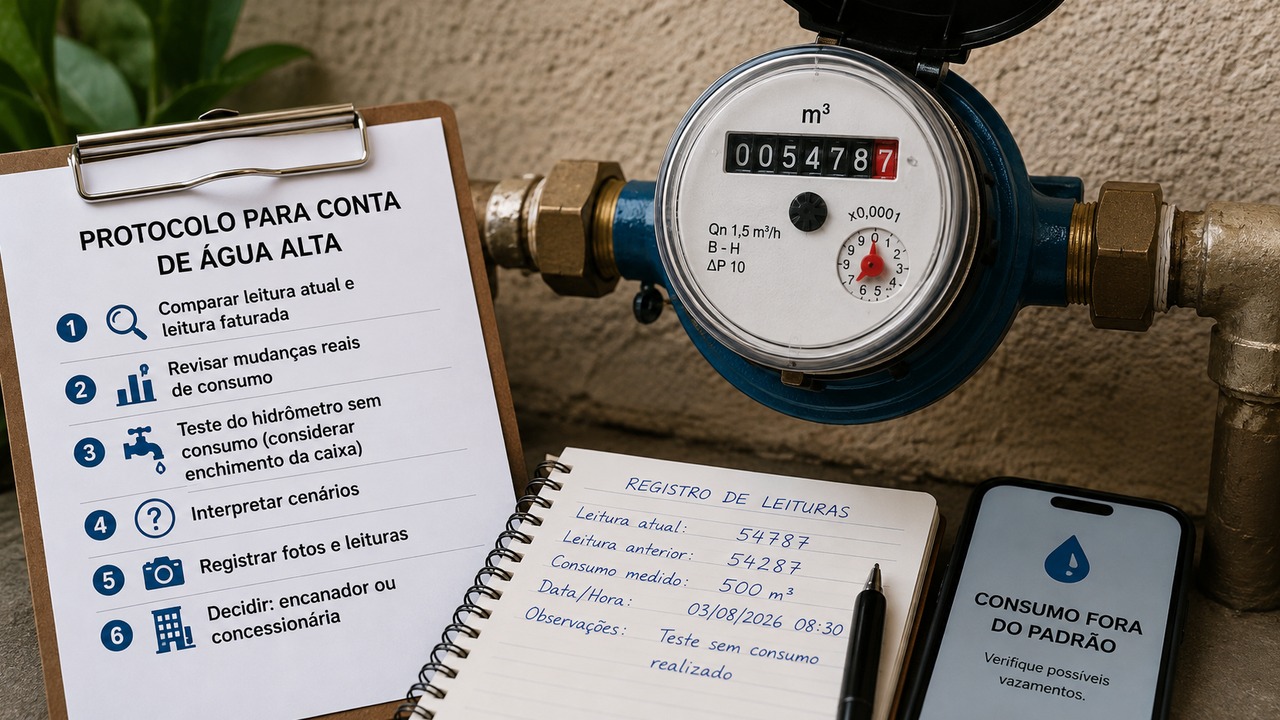
Before looking for a leak, check whether the volume consumed in cubic meters has increased or just the value in reais. If the cubic meters remained similar and only the final price increased, the explanation could be tariffs, sewage charges, other services or invoice adjustments; the water meter alone does not clarify a price change. When the measured volume also increases, three groups of causes help to organize the diagnosis: there was actually more consumption, water is passing through a leak in the installation or the reading and billing need to be checked with the concessionaire.
On August 3, 2026, Sabesp reported having sent more than 800 thousand non-standard consumption alerts since the implementation of its monitoring tool. The alert itself is treated as a signal to investigate the cause, not automatic proof of a leak. This is the safest logic also for those who notice the increase only based on the invoice: first check what was measured; then test whether there is still unused water passing through; only then decide who should be called.
Before looking for leaks, check what the account actually recorded
Start with the invoice. Look for the previous reading, the current reading used in billing, the dates of the readings, the volume consumed and the water meter identification number when this information is available. The National Agency for Water and Basic Sanitation provides, in its reference standard on the provision of services, that hydrometered billing depends on the meter reading and that the invoice must contain information relevant to the user, including the consumption history and the identification of the water meter.
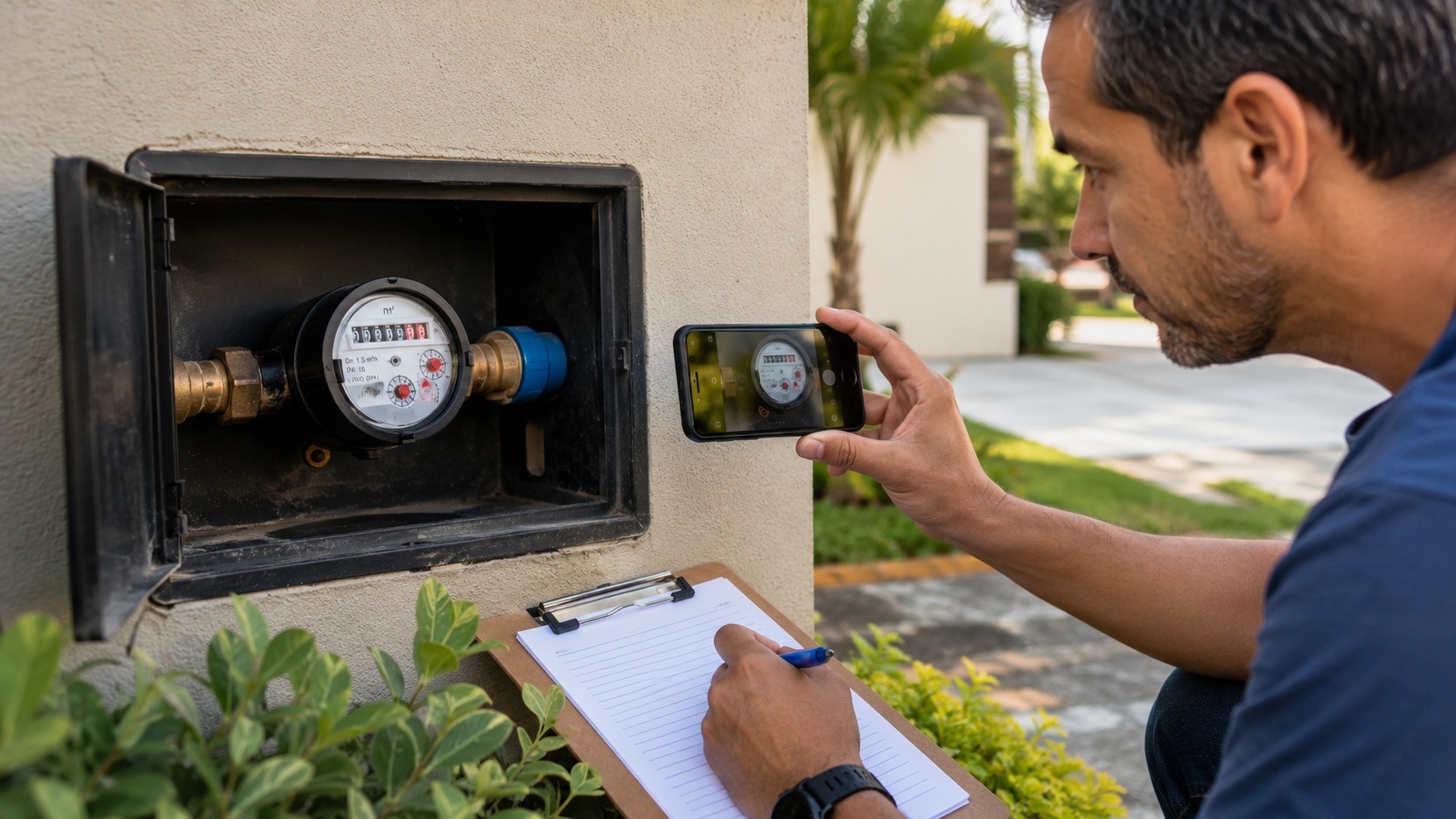
Then photograph the property's water meter, including the display and, if possible, the device's identification. Compare the number on the meter with what appears on the bill. A different water meter may indicate a recent change, registration to be checked or another reason that needs to be clarified before comparing numbers.
Also, do not compare today's reading with the reading billed as if they were taken at the same time. The invoice uses a reading taken at an earlier date. Under normal conditions, the accumulated value on the meter tends to increase with consumption since that date. If the reading you see today seems lower than what was invoiced, take the photo and contact the dealership; This may involve changing the meter, the way the display is read, or an error that should not be diagnosed just by looking at the digits.
The number of days in the cycle also matters. An account with more days between readings can bring more cubic meters even without a sudden change in habit. To compare months with different durations, it is worth looking not only at the total consumed, but also at the average consumption per day. Cycle and billing rules vary depending on the provider and local regulator.
The water meter shows water flow, not the cause
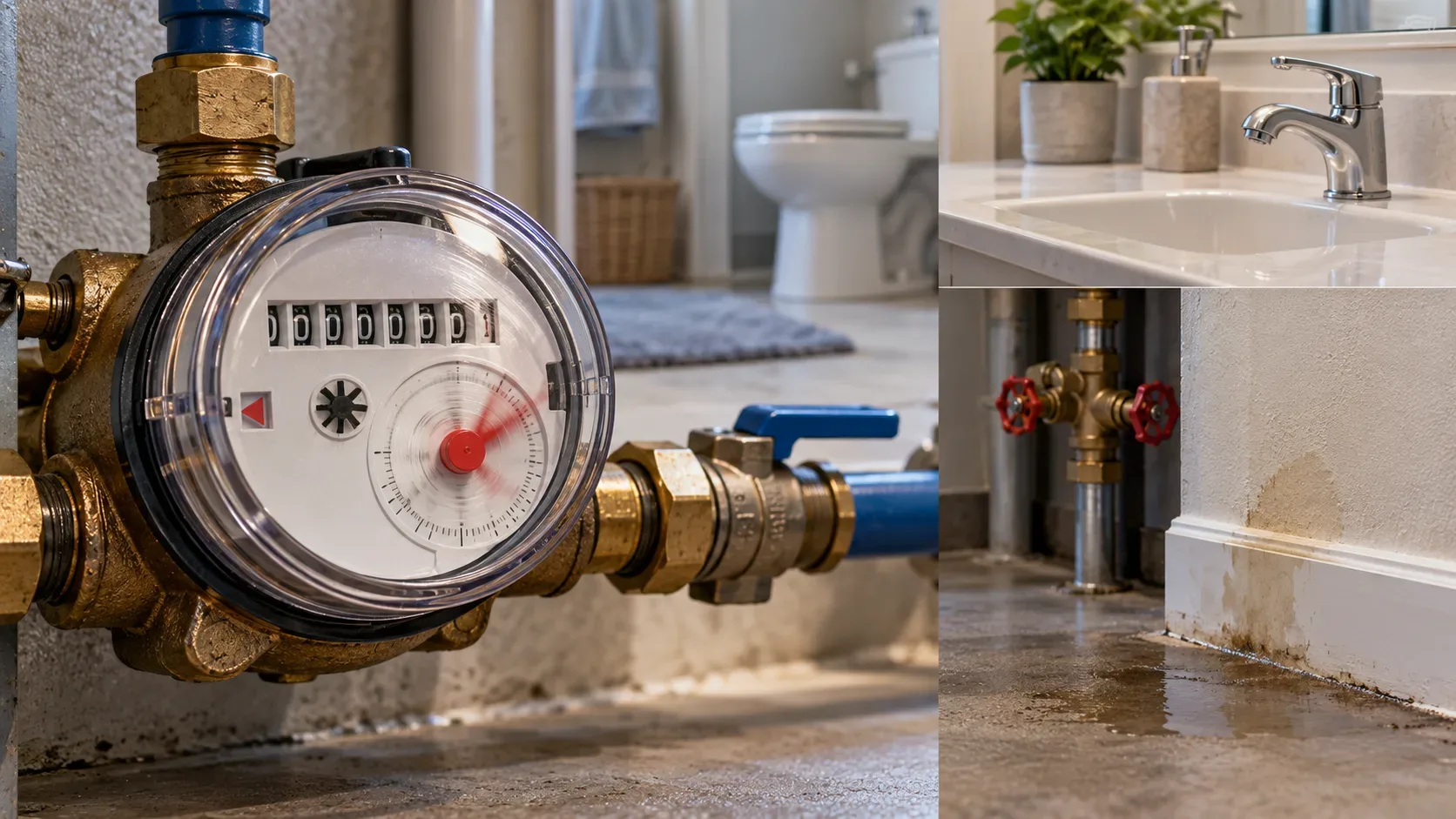
The hydrometer totals the volume that passes through the meter. If it progresses when someone takes a shower, washes clothes or fills the water tank, it is recording expected usage. If you proceed during a period in which there should be no consumption, there is an indication that water continues to pass to the side of the property.
This clue is useful, but it does not pinpoint the problem.. The movement may be linked to a forgotten tap, a flush valve, a water tank float, automatic equipment or an invisible leak. The test is used to answer whether water is passing at that moment, not to confirm which wall or pipe the defect is in.
How to do a low-stakes test without taking anything apart
Choose a period in which it is possible to go without consuming water. Close taps and showers, do not use flush toilets, washing machines, filters that drain water, irrigation or other equipment connected to the network. If there is a water tank, wait for it to finish filling and for the float to stop entering before starting. If the tank is still replenishing water, the water meter may move normally and the result will be ambiguous.
Photograph the initial reading and note the time. Without consuming water, wait an interval that allows you to notice a change in the totalizer. Sabesp advises, in its consumption variation test, to mark the reading and wait one hour. Other providers may adopt different protocols; If your dealership has its own test, prefer the local procedure.
At the end, take photos again. Do not open the water meter, do not force connections, do not tilt the device, do not break seals and do not try to adjust the mechanism. The goal is just to observe and record.
If the reading stays exactly the same, the test did not find continuous passage of water in that interval. This reduces the chance of a permanent leak at that time, but does not eliminate intermittent problems. A float that only fails occasionally, a flush that occasionally blocks, or programmed equipment may not appear in a single observation.
If the reading progresses even though all uses are interrupted and the tank is already full, there is a consistent sign of water passing through the water meter without intentional consumption. From there it makes sense to investigate the internal installation with a professional, without having to break the wall before there is a better technical hypothesis.
The water tank is the main trap in this test
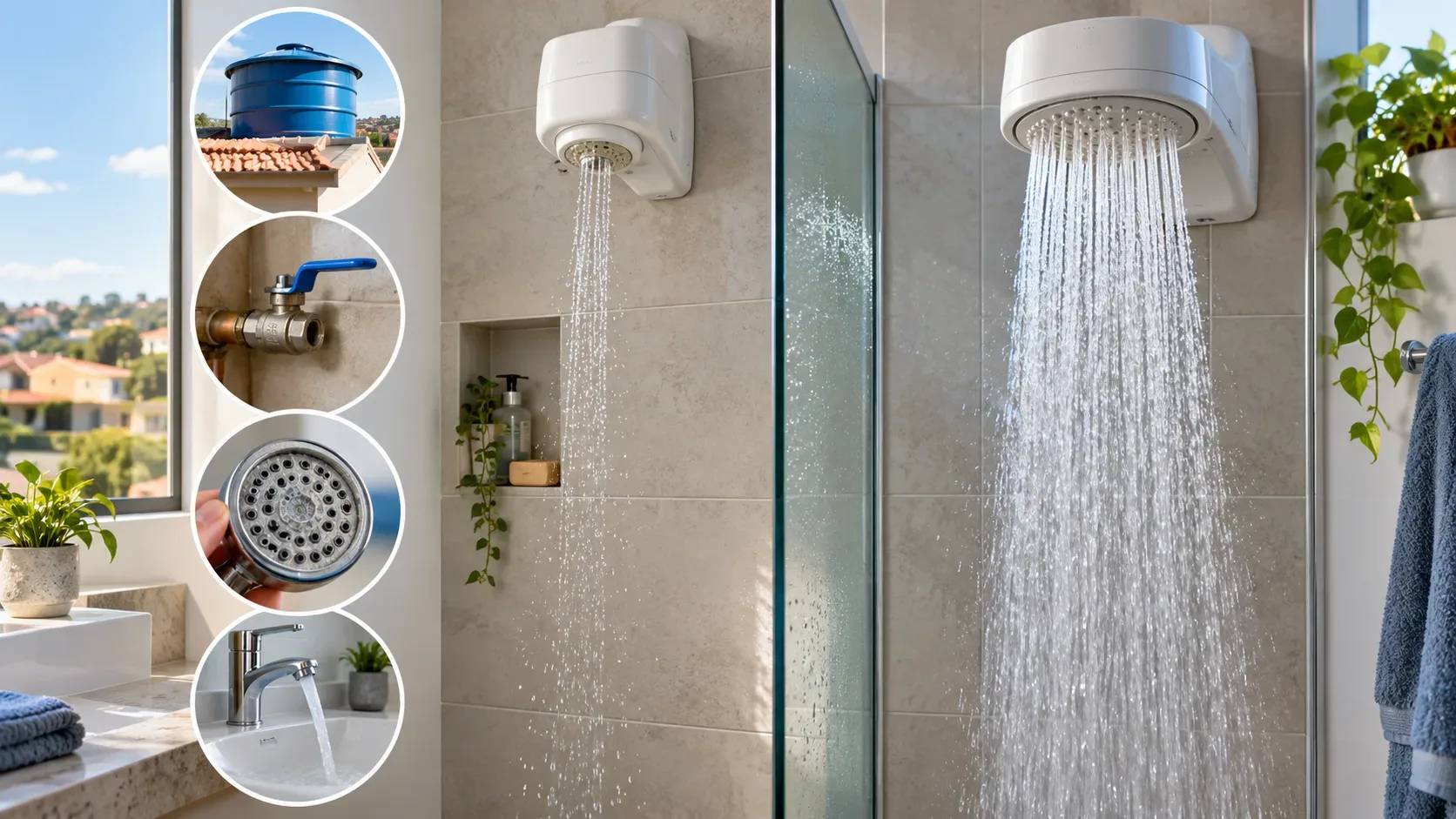
In properties with a reservoir, turning off the taps in the house does not guarantee that the water meter will stop. If the tank is below the float's closing level, the network will continue sending water to replace the volume. The meter registers this filling correctly.
For this reason, a test done shortly after bathing, washing clothes or other heavy use may appear positive for a leak when, in fact, the tank is still filling. Caesb, for example, separates its procedures depending on whether the installation has a water tank or not and advises considering the power supply and the reservoir float. For a low-risk home check, the simplest way is to wait for the tank to fill before starting the observation.
If you can't tell if the box is full, if the float is working or if there are different power circuits, don't force registers or touch parts you don't know. In this case, the home test loses diagnostic power and the plumber can do the
separation safely.
Scenario 1: the bill reading makes sense and the water meter continues to advance without use
When the water meter number matches the invoice, the accumulated reading is compatible with the history and the meter continues to register during a test without consumption, the most likely path is to investigate the installation of the property.
This does not mean that the leak is necessarily inside a wall. Before any work, a professional can check accessible points, reservoirs, floats, toilets, taps, visible connections and equipment. The water meter test only establishes that there is a passage; localization requires another step.
Scenario 2: the bill reading makes sense and the water meter stops testing
If the meter does not advance during the period of non-use, first look for explanations of actual consumption in the billed interval. More residents at home, visitors, heavy cleaning, garden, swimming pool, washing external areas, works and equipment that use water can increase the volume. It's also worth comparing the number of days between readings.
Still, a test stopped today does not prove that there was no leak last month. Intermittent problems may have stopped, and a recent repair may have eliminated the passage. The reading history and new observations at different times help to clarify.
Scenario 3: the billed reading or the registered water meter do not match what is in the property
If the meter number does not match, if the billed reading seems incompatible with the current photo or if there is a difference that cannot be explained by the passage of time, the next step is the dealership. Keep the bill, photograph the water meter dial and identification, and record the date and time.
Ask for a review of the account or verification of the reading through official channels and note the protocol. In São Paulo, Arsesp advises that, when the consumer cannot find a reason for the high bill, the provider must be contacted to analyze the bill and check the reading or meter. In other locations, the name of the service, deadlines and responsible regulator may be different.
Scenario 4: the bill reports estimated or average consumption
When the reading could not be done, some rules allow average billing. ANA Reference Standard No. 11 determines that, if it is impossible to read the water meter, the charge is based on the average consumption of previous months according to the number of months defined by the subnational regulator.
This means that an estimated invoice should not be treated as if it were a physical reading for the day. Compare your history, check your current meter reading, and contact your dealership if a later adjustment or charge doesn't make sense. The form of recomposition and deadlines depend on local regulation.
What to record before calling someone
A good record shortens the investigation. Keep the disputed invoice and at least a few previous ones to compare your history. Take legible photos of the water meter with date and time, including the device identification. Write down the reading before and after the no-consumption test and how long the observation lasted.
If the meter continues to advance, a short video can help document the behavior, as long as you just watch the device. Also record facts that may explain a real increase in usage, such as guests, construction, pool filling or more frequent irrigation.
When speaking to the dealership, write down the protocol and service requested. If the meter is inspected, exchanged or checked, keep the documents provided. This sequence avoids relying solely on memory when it is necessary to compare a new bill or dispute the charge.
When to call a plumber and when to look for a dealership
The plumber is the most logical choice when the water meter continues to register after you confirm that there is no intentional consumption and that the water tank has finished filling. It also makes sense when there are signs in the internal installation, such as humidity, a float that does not close, a drain that runs continuously or the noise of water without an open point.
The concessionaire must be contacted when the problem is in the billed reading, in the identification of the meter, in an estimated charge that needs to be clarified, in a visible leak in the water meter assembly or in a section for which the provider is responsible according to local rules. Caesb, for example, states that it is responsible for the installations up to the point of delivery, including the water meter, and assigns the customer to identify problems in internal installations. The exact limit must be confirmed with the company that services the property.
What if the suspicion is that there is a defect in the water meter itself?
Do not attempt to test accuracy by opening or altering the meter. Hydrometers are instruments subject to metrological control, and Inmetro informs that verification can be carried out by its delegated bodies. In practice, the request usually starts with the concessionaire or the local regulator, which informs the procedure, conditions and any applicable charges.
If the seal is broken, if there is apparent damage or if the meter appears to have been moved, take photographs without tampering and notify the provider. Metrological verification is different from domestic consumer testing: one thing observes whether water is passing through; the other evaluates whether the instrument measures within the technical requirements.
A high bill is not a ready diagnosis
The best way to deal with an unexpected invoice is to make the surprise obvious. First confirm which water meter was billed and which readings entered the bill. Then compare the period and consumption history. Then make an unused observation, ensuring that the water tank is not just replenishing water. Finally, record photos and times before deciding between plumbing investigation and billing review.
This script avoids two common mistakes: calling the dealership without any evidence of reading or, at the opposite extreme, starting to break down walls just because the bill went up. The water meter is most useful as a path divider. It helps to show whether water continues to pass through; the cause, responsibility and correction come in the next step.