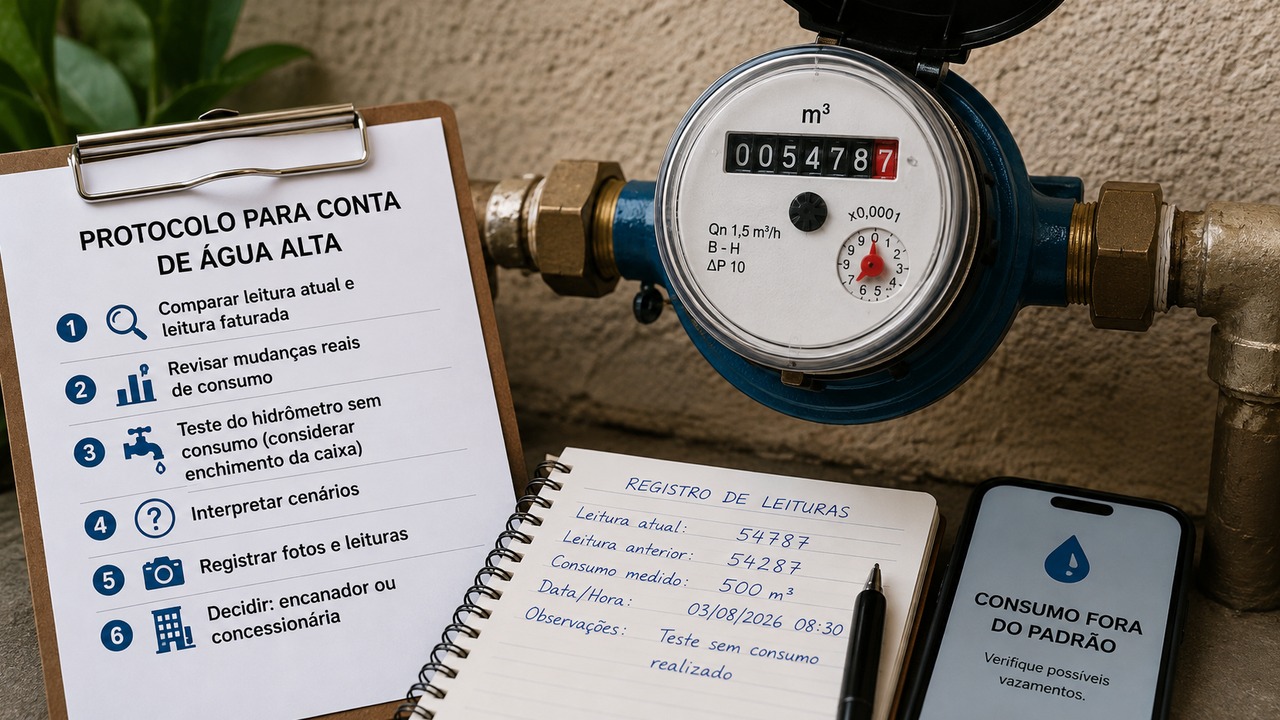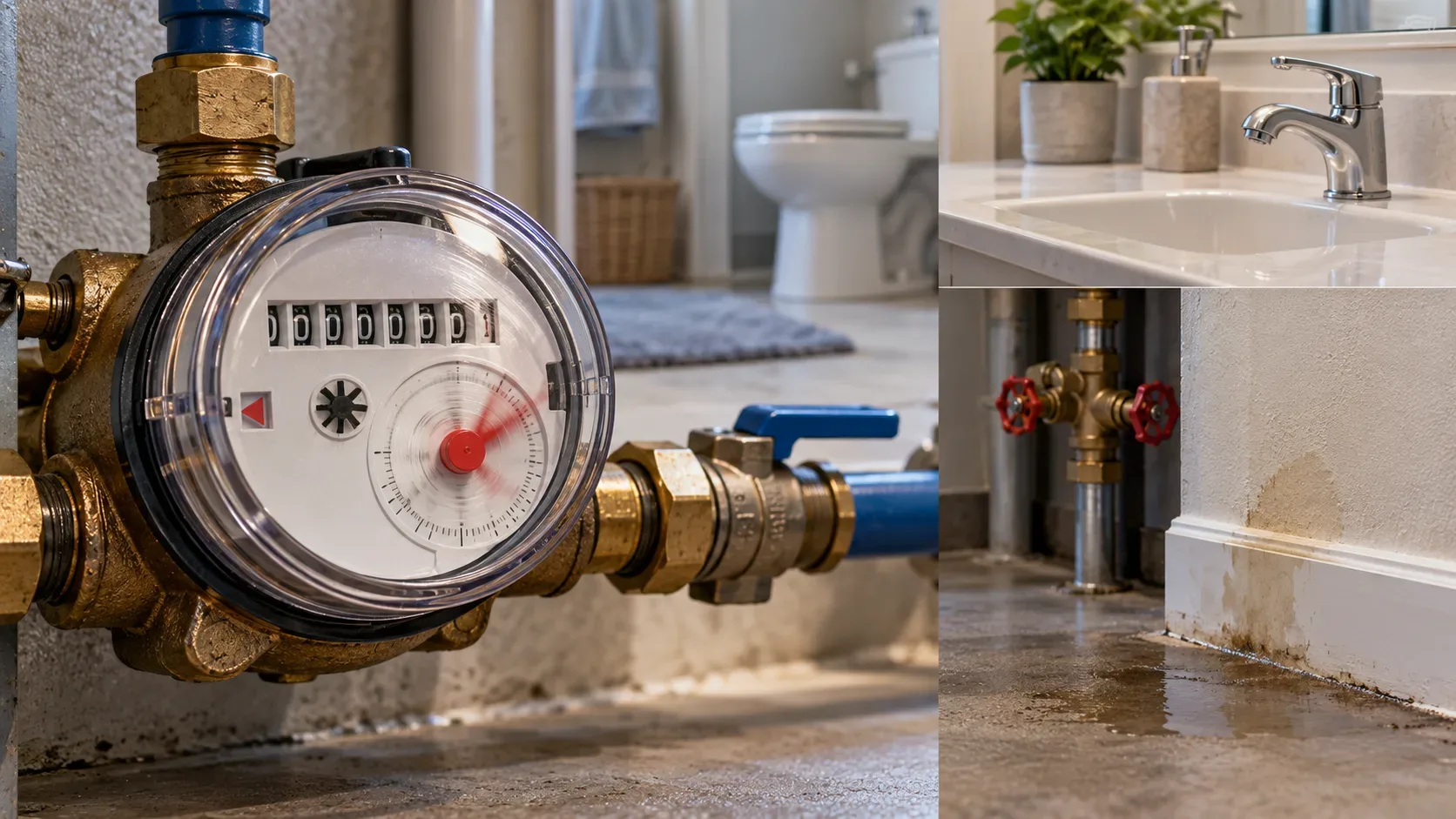
A water bill that is well above the standard, without a perceived increase in usage, is a sign to investigate before breaking the wall, swapping parts tentatively or jumping straight into a dispute. The first objective is not to locate the exact point of the problem. It's answering a simpler question: is there water passing through the water meter at a time when no consumption should be happening?
The test can be carried out safely when following the guidance of the local provider and respecting the type of installation of the property. The water meter reading also serves as an objective record of what happened. If you later need to call a plumber or request a bill review, photos, schedules, readings and receipts can help reconstruct the case.
Start with reading, not with the value in reais
Before concluding that there is a leak, check the reading recorded on the bill and compare it with the number that appears on the water meter. Also note the consumption period stated on the invoice and, if you have access, compare the last few months. The value in reais may vary depending on tariff, consumption range and other components of the charge; To investigate a leak, the most useful data is the measured volume.
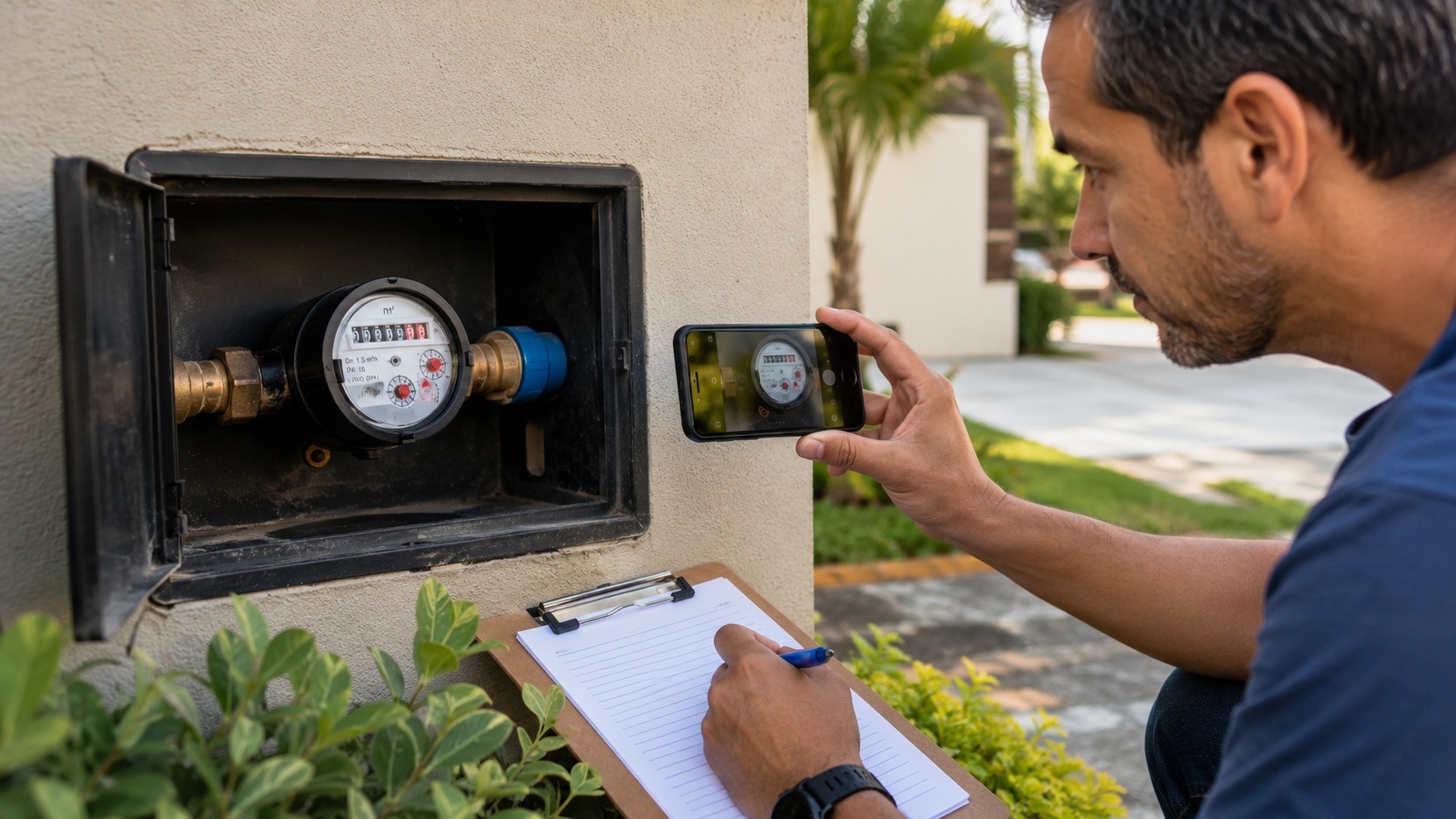
Photograph the water meter with the clear display and write down the date and time. If the meter identification number is visible without touching the equipment, record it as well. The idea is to create a starting point that can be compared with a second reading after the test.
If the water meter reading is very different from the reading used on the bill, or if there is doubt about the billing method, it is worth recording this separately and contacting the provider. The leak test only responds if there is consumption passing through the meter; it does not alone explain any revenue discrepancy.
What the water meter test actually checks
The hydrometer measures the water that passes through the connection. Therefore, when all intentional uses are interrupted, any advance in reading may indicate that water continues to flow to some point in the installation.
In properties without a water tank, Caesb recommends maintaining normal water supply, not consuming water during the test and observing the water meter. If the marker continues to register, a leak is indicated. In installations with a water tank, the procedure is different because replacing the tank itself can move the meter even without a tap open at that time.
Águas de Joinville, for example, recommends turning off the taps, not using the toilets, preventing water from entering the tanks by closing the float and observing the smaller dials on the water meter for at least an hour. If there is movement, the company considers this a sign of a leak in the internal branch after the water meter. Other providers may indicate another interval or another form of isolation.
This is the reason to avoid an impromptu test. First, look on your provider's website or customer service for specific guidance on "leak testing", "hidden leak" or "consumption check". Only carry out the procedure compatible with the installation of the property.
How to prepare the property for a reliable reading
The time of testing must be truly non-consumptive. Taps must be turned off, showers unused, washing machines and dishwashers turned off and no toilets must be run during the observation period.. Automatic irrigation, filters with water disposal, filling systems and other equipment can also interfere.
If there is a water tank, it is not enough to simply turn off the taps in the house. An open float can fill the reservoir and make the water meter register the flow of water. Follow exactly the form of isolation indicated by the provider to avoid interpreting a normal refill as a leak.
Before starting, take a photo of the reading. Write down the time. After the guided break, take another photo in the same frame. On analog water meters, observe both the numerical sequence and the small low flow indicators. On digital meters, compare the displayed reading according to the manufacturer's or provider's guidance.
Do not remove seals, do not open the water meter and do not disassemble the easel. Home testing must be limited to observing the meter and installation registers or buoys when the official procedure itself dictates that they be operated.
If the reading has changed, the test still doesn't show where the leak is
Movement of the water meter when consumption has been correctly stopped is a strong indication of unwanted water flow, but it does not locate the defect. The problem may be in a buried pipe, embedded in the wall, in the section between the water meter and the water tank or in another internal point.
It is also important to separate hidden leaks from visible leaks. A dripping tap, a drain that doesn't close, water running down the tank overflow or an open hose already point to observable causes. Some providers also make this distinction in their account review rules and may treat each situation differently.
different.
If there is no movement during a short test, this reduces suspicion at that time, but does not completely eliminate intermittent problems. A float that only fails in certain positions, a drain that occasionally leaks or an automatic system may not manifest itself within the chosen interval. When the account remains incompatible with the history, it is worth repeating the procedure in another period recommended by the provider and reviewing the consumption points.
What to record before calling for repair
The most useful documentation is that which shows the situation before the intervention and what changed afterwards. Keep the invoice that prompted the investigation and, if possible, previous bills for comparison. Save the initial photo of the hydrometer, the final photo of the test and the note with date, time and duration of the observation.
If there is a damp spot, continuous water noise, wet floor or other physical sign, photograph the location before any breakage or repair. A short video of the water meter recording water flow during the non-consumption period can also help, as long as it does not replace photos of the readings.
When a professional is called, record the date of service and the point at which the leak was found. If there is a replacement of parts, opening a wall or replacing a section of piping, photograph the location before and after. Keep an invoice, receipt and any report or description of the service. Not every provider will require all of these documents, but they can be decisive where there is a formal hidden leak process.
There is one especially important detail: some providers ask for a water meter reading on the date of repair. So don't wait to finish the entire repair to find out what evidence the local procedure requires.
When is it best to call a plumber or detection service
If the water meter continues to register consumption after the property has been isolated in accordance with official guidance, and no visible leak appears, the next step is usually a professional assessment. This is even more appropriate when the suspicion involves embedded, buried piping, slabs, floors or sections that would require breaking the finish just to look for the point.
Detection services can use methods such as acoustic eavesdropping to reduce the search area. The important thing is to avoid attempted demolition before there is minimal evidence of the likely location. If there is water in the water meter assembly itself, in the easel or in the part of the connection that belongs to the public network, contact the provider instead of dismantling the equipment.
Before disputing the account, check your provider's rules
There is no single national rule saying that every hidden leak generates an automatic discount. Review procedures, deadlines and documents change depending on the provider and local regulator.
Official pages consulted in August 2026 clearly show this difference. Caesb informs that account complaints can be requested without presenting initial documentation, although the holder is responsible for identifying problems in internal facilities. Already
Águas de Joinville requires, in the process of a hidden leak after repair, a declaration of the occurrence, photographic records and, when available, a report and invoice, in addition to establishing its own deadline for the request.
Therefore, before the repair or as soon as suspicion appears, search your provider's official channel for bill review, consumption check or hidden leak services. Write down the protocol number and confirm which documents, photos and readings must be presented. If there is a deadline for contesting, record it.
The existence of a proven leak should not be treated as a promise of abatement. The analysis may consider type of leak, period, responsibility for installation, documents presented and local tariff rules. The purpose of documentation is to allow the case to be evaluated with as much information as possible.
A simple flow avoids hasty decisions
When the bill goes up without explanation, the safest course is to check the reading and history, only carry out the water meter test recommended by the provider, record the readings and times, separate visible leaks from hidden suspicions and only then decide if it is necessary to call a professional.
If the leak is confirmed, preserve evidence of the previous condition and repair. Then, consult the provider's specific rule to find out if there is a charge review process and what conditions apply. Thus, the water meter stops being just the point where the bill is measured and starts to function as objective evidence to guide the next step.