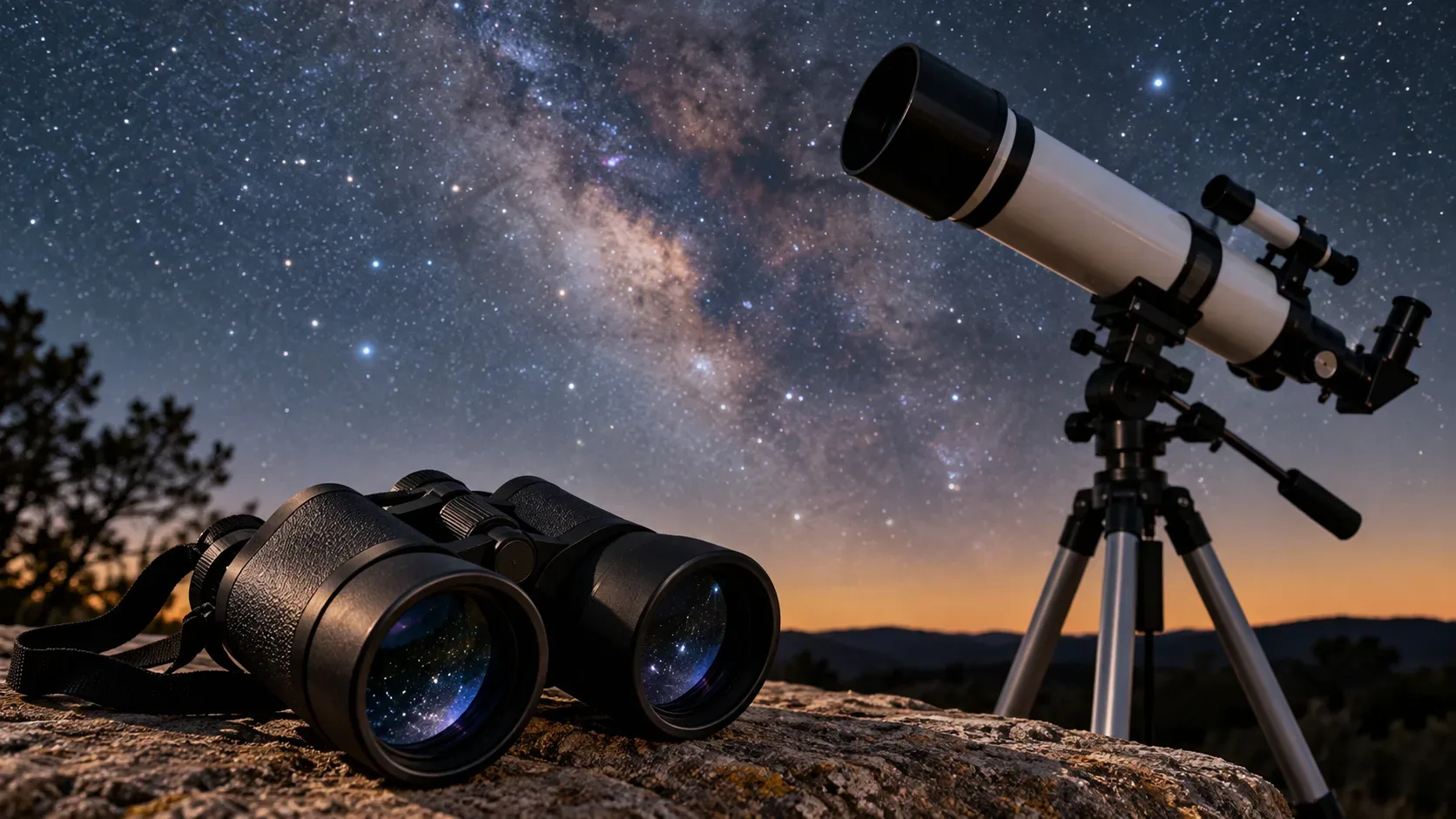
For most beginners who are still learning how to find objects in the sky, 10x50 binoculars usually make more sense as a first instrument. They are easy to aim, provide a wide field of view, travel well, and can reveal far more than the unaided eye without requiring a mount, alignment, or eyepiece changes. A telescope moves ahead when your main goal is to observe smaller details on the Moon and planets, use higher magnification, or go deeper on targets that benefit from more aperture.
The choice is not a contest between a "weak" and a "strong" instrument. Binoculars and telescopes solve different observing tasks. The best first purchase is the one that matches the targets you actually want to see, the place where you will observe, and the amount of setup you are willing to do before each session.
Quick answer: when to choose each one
| Priority | 10x50 binoculars | Telescope | Most logical first choice |
|---|---|---|---|
| Learning constellations and finding objects | Wide field makes it easier to scan the sky and compare it with charts | Usually narrower field requires more precise aiming | Binoculars |
| Moon, clusters, and rich star fields | Very good for the overall view and large structures | Shows more detail when magnification and aperture allow | Binoculars to start; telescope to go deeper |
| Milky Way, Pleiades, and extended targets | Wide field is a clear advantage | Some combinations may not frame the whole target | Binoculars |
| Saturn's rings and planetary detail | Not the right tool for clearly separating Saturn's rings | The appropriate option for more magnification and detail | Telescope |
| Portability and fast use | Almost no setup beyond focus and interpupillary distance | May require a tripod or base, assembly, alignment, and eyepieces | Binoculars |
| Observing mainly from a fixed location | Still useful and quick | Weight and setup become less of a problem | Depends on the targets |
| Limited starting budget | Often provides strong utility with fewer accessories | Mount and optical quality matter greatly | Binoculars are often the lower-risk entry point |
What 10x50 means
In 10x50 binoculars, the first number is the magnification: the image is magnified 10 times. The second number is the diameter, in millimeters, of each front objective lens: 50 mm. NASA explains this naming system and recommends models in the 7x35 to 10x50 range for beginners.
The 50 mm objectives gather enough light for many night-sky targets without making the instrument excessively large for hand-held use. The 10 times magnification is enough to reveal details hidden from the unaided eye, while remaining near the upper end of what many people can hold reasonably steady. NASA also warns that larger, more powerful binoculars tend to have narrower fields, weigh more, and show more shake, which may require a tripod or image stabilization.
What 10x50 binoculars can realistically show
Good 10x50 binoculars will not turn the night sky into observatory photographs, but they open a large set of targets. According to NASA, suitable binoculars can show lunar craters around 10 km across or larger, large open clusters such as the Pleiades, the Andromeda Galaxy under dark skies, the Orion Nebula, and, with practice, Jupiter's moons. The experience improves greatly under dark, transparent, steady skies.
This kind of instrument is also effective for sweeping the Milky Way, following dense star fields, and confirming an object's position before moving to a telescope. That is why binoculars do not become useless after you later buy a telescope. The two instruments complement each other.
Limits you should accept
- Saturn's rings will not be clearly separated the way they can be in a suitable telescope.
- Planets remain small even when their moons or positions are easy to identify.
- Galaxies and nebulae look much more subtle visually than they do in long-exposure photographs.
- Holding 10x50 binoculars for several minutes can be tiring and increases shake; supporting your arms, sitting down, or using a tripod adapter can help.
When a telescope is already the better first purchase
A telescope makes more sense from the start when you already know you want more magnification and detail on compact targets, especially the Moon and planets, and you are willing to spend time on setup and aiming. It is also a natural choice for someone who will observe mostly from the same yard, balcony, or field site and does not need to carry the equipment over long distances.
In that case, do not choose based on the largest "times magnification" number printed on the box. In telescopes, aperture, the diameter of the main lens or mirror, is a central specification because it determines how much light the instrument collects and how much detail it can resolve. Sky & Telescope identifies aperture as the telescope's most important feature and emphasizes that a solid mount is essential for the instrument to work well.
An unstable mount can ruin the experience even when the optics are acceptable. When you touch the focuser, change an eyepiece, or track an object, the image should stop shaking quickly. For beginners, simple mounts that move up, down, left, and right are usually more intuitive than more complex systems. The Sky & Telescope buying guide also advises paying attention to stability, smooth movement, and observing comfort rather than magnification claims alone.
Why binoculars usually make finding objects easier
Finding a target in the sky is a skill of its own. A telescope at moderate magnification shows only a small patch of sky; if your aim is slightly off, the target may simply be outside the field. Binoculars preserve more reference stars around the target, making it easier to compare the view with a star chart and correct your aim.
This matters for anyone still learning the constellations. Instead of turning the first night into a series of frustrating attempts, binoculars let you practice the basic observing motion: identify a region with the unaided eye, raise the instrument without losing the reference, and refine the search.
Budget: compare the complete system, not only the tube
With binoculars, the package is usually simpler. You need the instrument and, if you want more stability, perhaps an adapter and tripod. With a telescope, the experience also depends on the mount, eyepieces, finder, and, depending on the design, additional adjustments or accessories. Comparing only the telescope tube price with the binocular price can therefore hide costs and usability tradeoffs.
The NASA Night Sky Network recommends binoculars for beginning observers who are learning the sky and notes that, at a similar price, their optics can be more consistent than those in very inexpensive telescopes. This does not mean every low-cost telescope is poor. It means the mount and optical system need careful evaluation because an impressive specification cannot compensate for a shaky base or a system that is hard to aim.
If you choose 10x50 binoculars, use this checklist
- See whether you can hold the model for several minutes without excessive discomfort.
- Check that the central focus and diopter adjustment move smoothly.
- Adjust the spacing between the two barrels until you see one circular image.
- Start with the Moon and bright star clusters before searching for very faint objects.
- Use a chair or support your elbows to reduce shake.
- If the binoculars have an adapter socket, a tripod can greatly improve comfort during long sessions.
If you choose a telescope, prioritize these features
- Aperture appropriate to your targets: more aperture gathers more light and can reveal finer detail when the rest of the system is good enough.
- Stable mount: it should let you aim and focus without prolonged vibration.
- Useful low power: starting with a wider-field eyepiece makes targets easier to find and center.
- Realistic portability: consider where the instrument will be stored and how many steps separate storage from the observing location.
- Easy-to-align finder: a good aiming system reduces the time spent searching for the target.
A practical rule for deciding
Choose 10x50 binoculars if you are still learning the sky, want to start immediately, travel or move to different observing sites, enjoy wide fields, and want to spend less before discovering which targets you like most. Choose a telescope first if your main motivation is to enlarge the Moon and planets, you accept a steeper learning curve, and you have room to store and set up a stable instrument.
If the choice is still unclear, the best next step is to try both at a public observing session or astronomy club. NASA recommends hands-on experience because size, weight, ergonomics, and aiming are difficult to judge from specifications alone.
Safety when observing the Sun
Never point binoculars or telescopes at the Sun without a purpose-built solar filter correctly secured over the front of the optics. Eclipse glasses must not be placed between your eyes and unfiltered binoculars or a telescope. NASA warns that sunlight concentrated by optical instruments can cause immediate severe eye injury.
In summary
For a beginner who wants to learn the sky with little setup, 10x50 binoculars are a very versatile choice. They offer a wide field, mobility, and access to many classic targets. A telescope makes more sense as the first purchase when the goal is clearly to pursue more detail and magnification and when the user is willing to deal with setup, aiming, and accessories. The decision becomes much easier when you start from the target you want to observe, not from the apparent size of the equipment or the largest magnification number on the box.