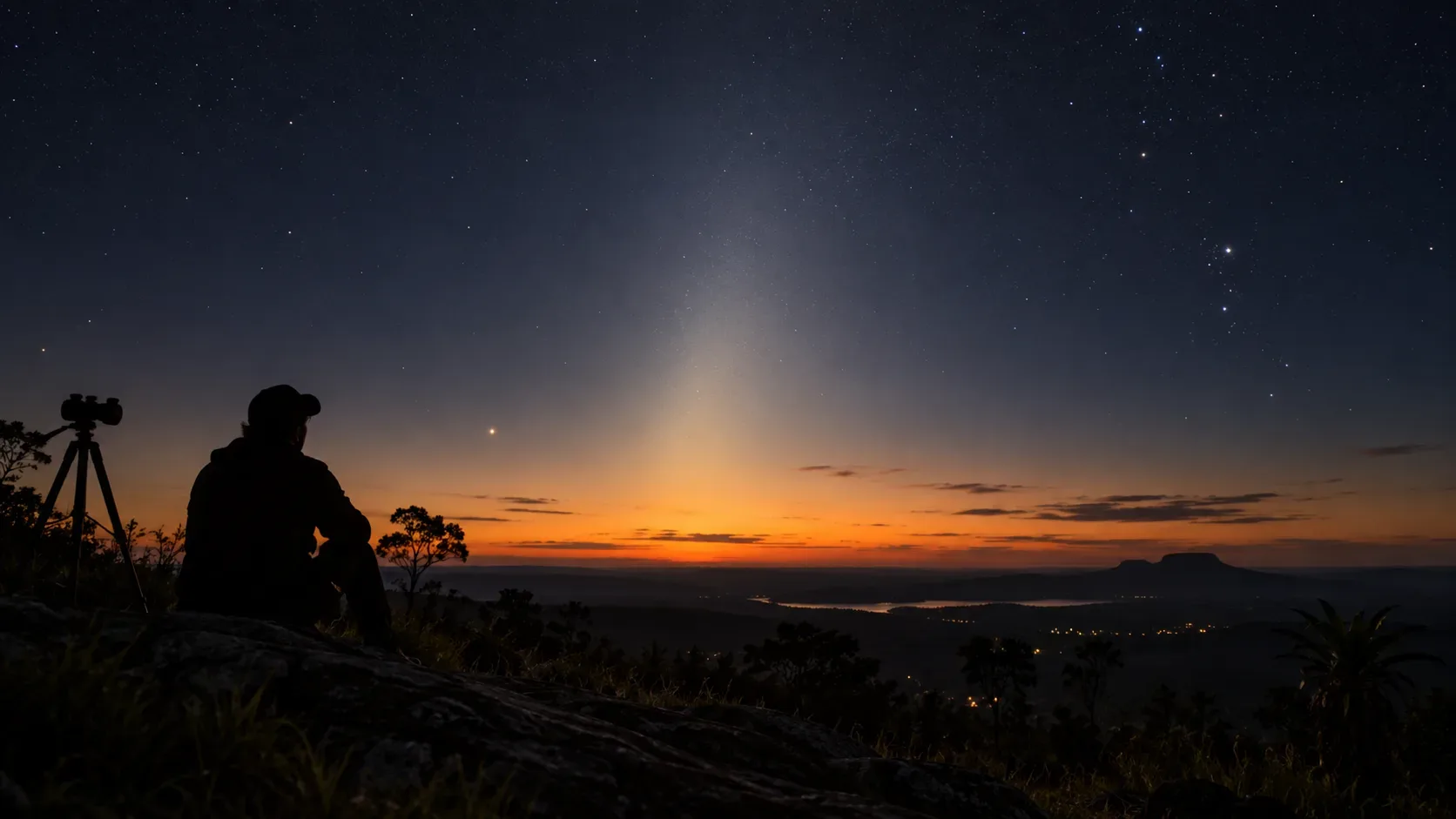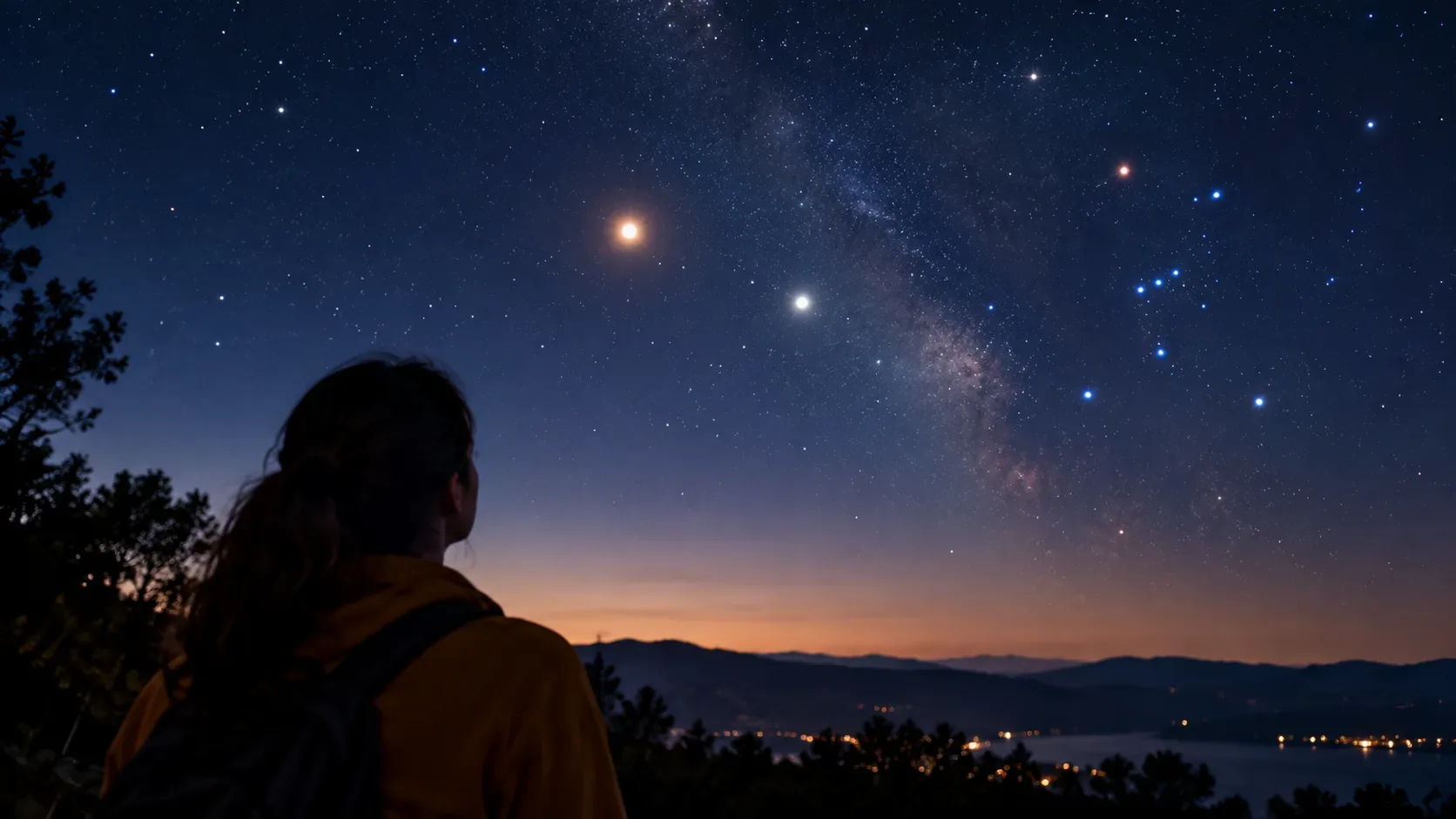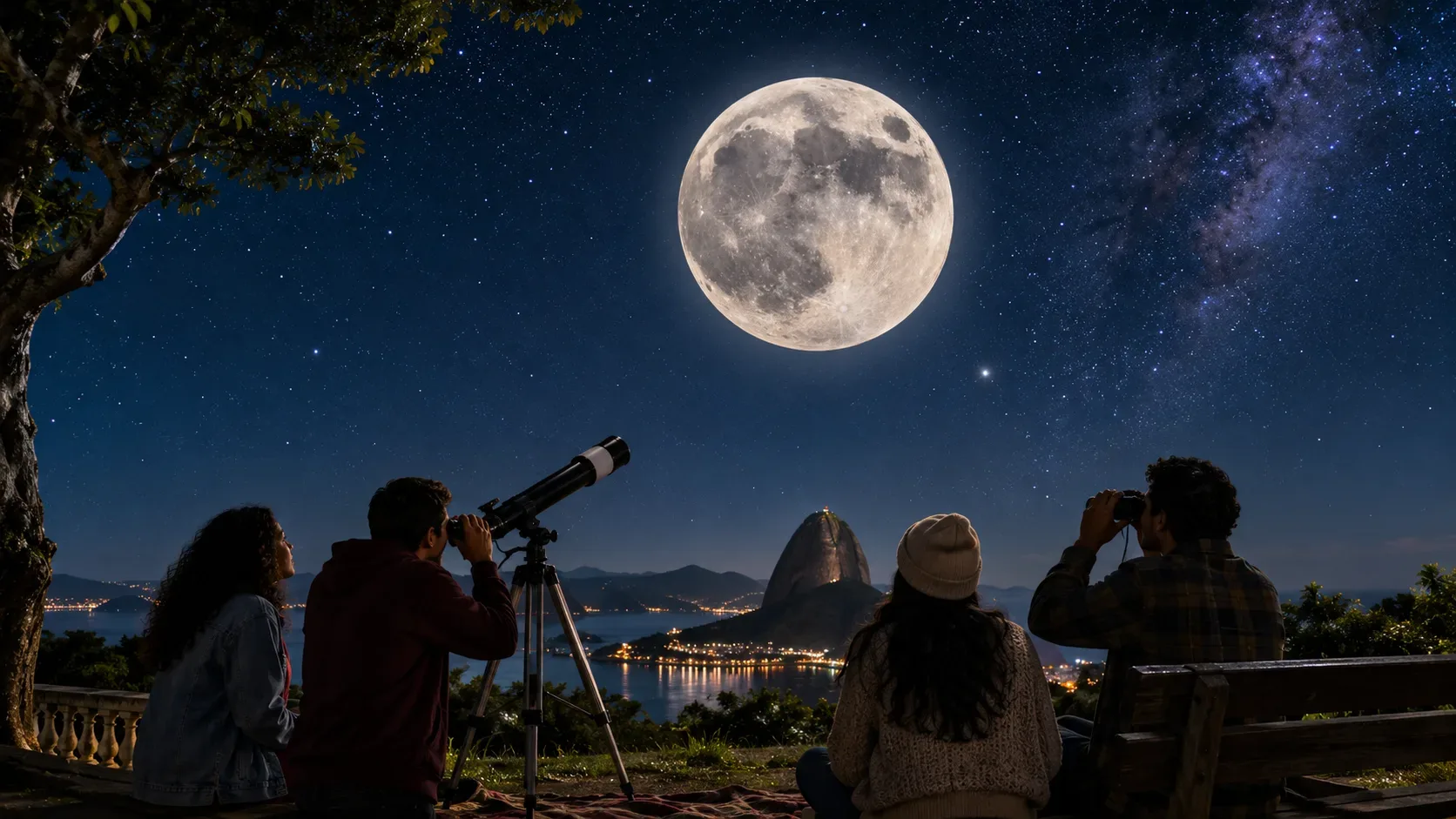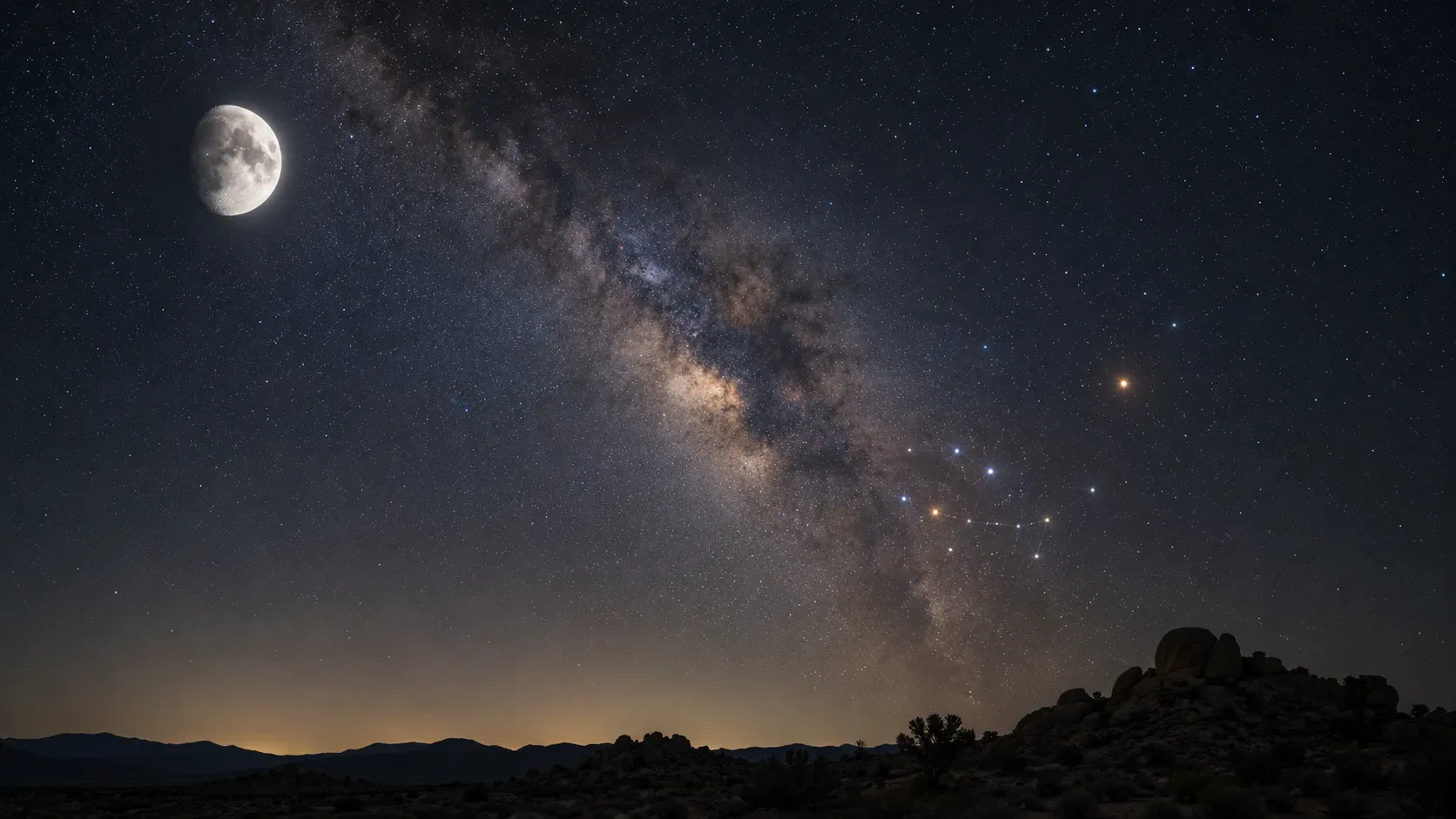
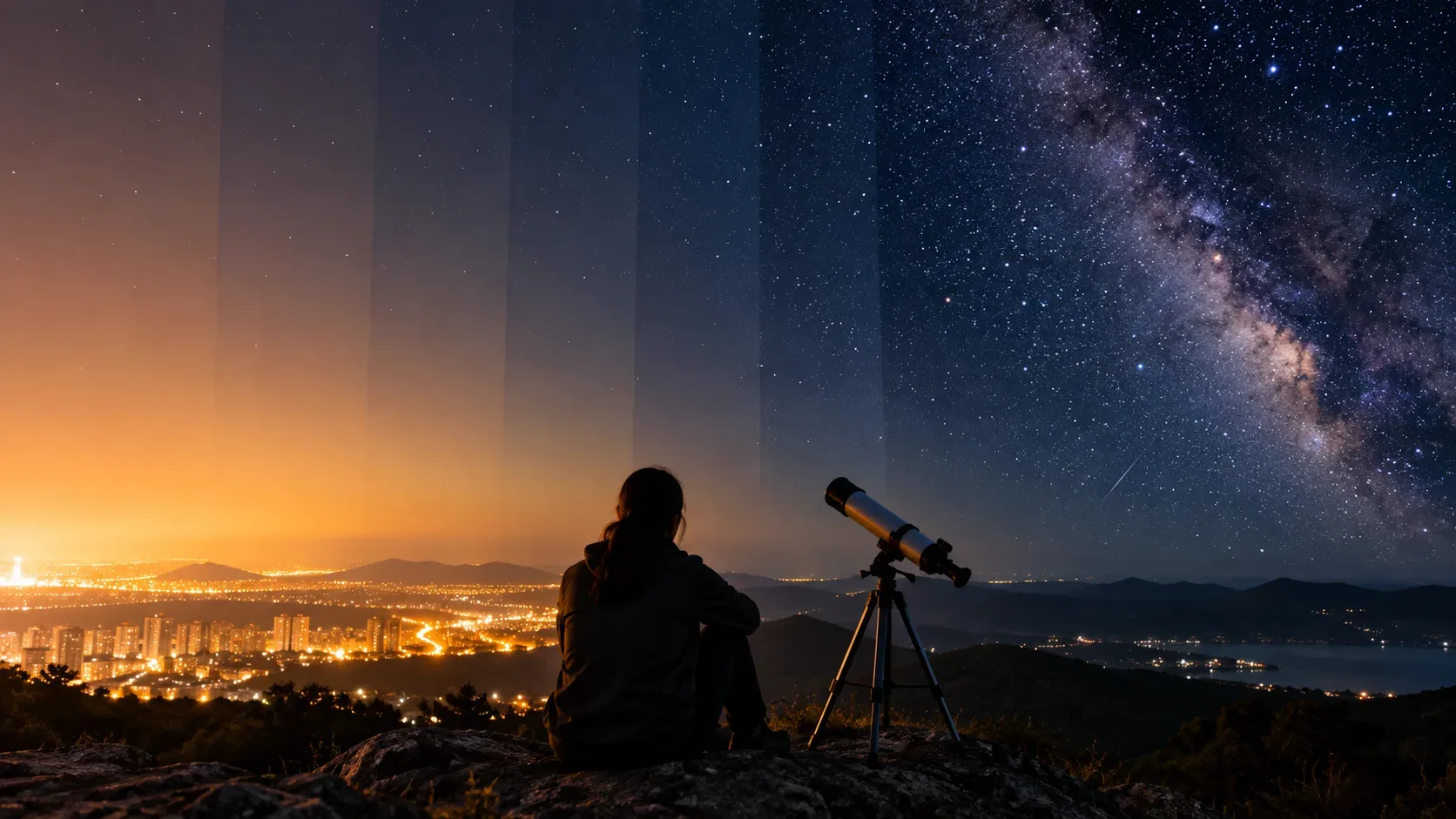
The Bortle Scale is a practical way to describe how dark or light-polluted the night sky appears at a location. It runs from Class 1, associated with the darkest natural skies, to Class 9, typical of heavily illuminated urban areas. Observer John E. Bortle proposed the scale in 2001, combining several visual clues such as the appearance of the Milky Way, artificial glow near the horizon, the visibility of diffuse objects, and the faintest stars that can still be detected with the unaided eye.
The most important point is that Bortle is not an instrument reading or a permanent number attached to an address. It is a visual classification. Two nights at the same place can look different because of the Moon, atmospheric transparency, clouds, smoke, humidity, dark adaptation, and the direction you face. Use the scale to set realistic expectations, not as laboratory precision.
What the Bortle Scale measures in practice
Instead of asking only "how many stars can I see?", the scale uses a set of clues. This matters because naked-eye limiting magnitude depends strongly on eyesight, experience, and how long a person has adapted to darkness. Bortle's original proposal aimed to reduce that dependence by combining several criteria into one assessment.
- Milky Way: the darker the sky, the stronger its contrast, apparent width, and visible structure.
- Horizon glow: cities and other artificial sources create light domes that can dominate one direction even when the zenith looks better.
- Diffuse objects: galaxies, nebulae, and comets quickly lose contrast as the sky background becomes brighter.
- Faint stars: darker skies reveal fainter stars, although this clue varies between observers.
- Clouds: near cities they may look bright because they reflect artificial light; at very dark sites they can look like dark patches against a star-filled sky.
The original description was published by Sky & Telescope. The U.S. National Park Service also uses Bortle Class as one narrative indicator of night-sky quality alongside photometric measurements.
Bortle Classes 1 to 9, focused on what you can observe
| Class | Overall sky appearance | What to expect with the naked eye | Impact on observing |
|---|---|---|---|
| 1 | Exceptionally dark natural sky | Extremely structured Milky Way, very prominent zodiacal light, and a huge number of stars; very faint objects may be detected by experienced observers | Excellent for galaxies, nebulae, comets, and low-contrast detail |
| 2 | Truly dark rural sky | Detail-rich Milky Way and only weak light domes near the horizon | Excellent for deep-sky observing and demanding visual work |
| 3 | Rural sky | Clear, structured Milky Way with some distant glow near the horizon | Very good for deep sky; directions away from cities usually provide better contrast |
| 4 | Rural to suburban transition | Milky Way still obvious but with reduced contrast; artificial glow noticeable in some directions | A broad range of targets remains accessible, but diffuse objects begin to lose detail |
| 5 | Suburban sky | Milky Way weak or incomplete, especially away from the zenith; sky background clearly brighter | Clusters and brighter objects remain accessible; faint galaxies and nebulae become harder |
| 6 | Bright suburban sky | Milky Way may appear only as a very subtle band near the zenith on good nights | The Moon, planets, double stars, and bright clusters are often more rewarding targets |
| 7 | Suburban to urban transition | Milky Way is normally invisible and artificial glow is widespread | Deep-sky objects are strongly affected, especially those with low surface brightness |
| 8 | Urban sky | Only fairly bright stars stand out and some constellation patterns look incomplete | Prioritize the Moon, planets, bright stars, double stars, and some clusters |
| 9 | Heavily illuminated inner-city sky | The sky stays bright and many stars in familiar constellations disappear | The Moon and planets are the most robust targets; visual deep-sky observing is very limited |
These descriptions should be read as appearance ranges, not exact boundaries. The scale itself relies on visual judgment. Light-pollution maps, sky-brightness values, and apps can help with planning, but the class you perceive in the field still depends on the conditions that night.
How to estimate your Bortle class without equipment
Try the assessment on a night without a bright Moon in the sky and away from streetlights or building lights shining directly into your eyes. If possible, spend about 20 to 30 minutes without looking at bright screens so your night vision can improve. Then use several clues rather than a single star.
- Start at the zenith. The region directly overhead often suffers less from horizon light domes. Judge whether the sky background looks truly dark or grayish.
- Look for the Milky Way when it is above the horizon at the right season and time. Note whether it is invisible, a faint milky band, a clearly defined band, or a structure full of bright and dark texture.
- Compare horizons. Check whether a city or road creates a light dome. One site can look like Class 4 in one direction and much worse in another.
- Check clouds if only a few are present. Clouds lit from below point to strong artificial-light influence. Under a very dark sky, clouds may look darker than the starry background.
- Test familiar objects. Notice whether constellations are missing important stars and whether well-positioned diffuse objects have enough contrast.
- Repeat on other nights. If your estimate changes a lot, record a likely range, such as Bortle 4 to 5, instead of forcing a single number.
Why the Moon can mislead your estimate
The Moon naturally brightens the sky and can wash out the Milky Way and many low-contrast objects even at a site with little artificial light pollution. If your goal is to estimate artificial skyglow, choose a night near new Moon or a time when the Moon is below the horizon. This helps avoid confusing moonlight with human-made skyglow.
If you are observing with the Moon up, the Bortle class still describes the site's baseline quality, but it does not by itself predict the contrast of that session. Adjust the target list accordingly: the Moon, planets, double stars, and bright clusters handle a brighter background better than faint nebulae and galaxies.
Transparency, humidity, smoke, and clouds can change the result
Light pollution does not act alone. Particles and aerosols scatter light and can make the sky brighter. The National Park Service notes that air pollution and other atmospheric conditions can intensify artificial skyglow. A humid, hazy, or smoky night can therefore provide less contrast than a dry, transparent night at the same location.
This is why a light-pollution map is a planning reference rather than a visual guarantee. It indicates typical or modeled artificial lighting conditions, while you observe through the actual atmosphere present that night.
The horizon can be worse than the sky overhead
Sky quality is not uniform in every direction. A city dozens of kilometers away can create a light dome near the horizon while the zenith remains relatively dark. For deep-sky targets, this means altitude matters: a target higher in the sky is usually seen through less atmosphere and may also avoid some of the glow concentrated near the horizon.
The NPS measures components that help describe brightness in different parts of the sky and notes that vertical illuminance is more sensitive to sources near the horizon. In practice, it can be more useful to write "Bortle 4 at the zenith, strong light dome to the west" than to record only "Bortle 4."
What is still worth observing from a city
A high Bortle class does not mean astronomy is over. It changes target selection. Under Bortle 7 to 9, the best strategy is often to favor high-surface-brightness objects and targets that do not depend on a black background to stand out.
- Moon: phases, craters, maria, mountains, and shadows along the terminator.
- Planets: Jupiter, Saturn, Venus, and Mars when favorably placed.
- Double stars: many remain accessible even under heavy light pollution.
- Bright star clusters: many stellar targets withstand skyglow better than extended galaxies.
- Bright events: eclipses, conjunctions, and passes of bright objects can be followed from cities.
Large faint nebulae and low-surface-brightness galaxies benefit far more from trips to dark skies. In Bortle's original explanation, even a modest amount of light pollution degrades diffuse objects more severely than stars.
When a meter or map is better than a visual class
If you want to compare locations over time, document an observing site, or track changes in outdoor lighting, an instrumental sky-brightness value is more repeatable than a visual classification. Tools such as sky-quality meters and photometric methods quantify brightness, while Bortle Class summarizes how that sky appears to an observer.
The tools work best together: use maps to choose destinations, Bortle to translate the visual experience, and instrumental measurements for consistent comparisons. The National Park Service method, for example, uses calibrated imagery of the entire celestial hemisphere to separate and quantify natural and human-caused components of sky brightness.
A simple way to keep a record of your sky
At the end of a session, note the date, time, Moon phase or presence, apparent transparency, direction of major light domes, Milky Way visibility, and your estimated Bortle range. This turns a one-night impression into a useful history. After several sessions, you will know not only whether a site is "dark," but also under which conditions it works best for each type of target.
That is the greatest practical value of the Bortle Scale: it connects the appearance of the sky to observing decisions. It does not promise absolute precision, but it helps answer an essential question before setting up the telescope: under this sky, tonight, which objects have a realistic chance of giving a satisfying view?