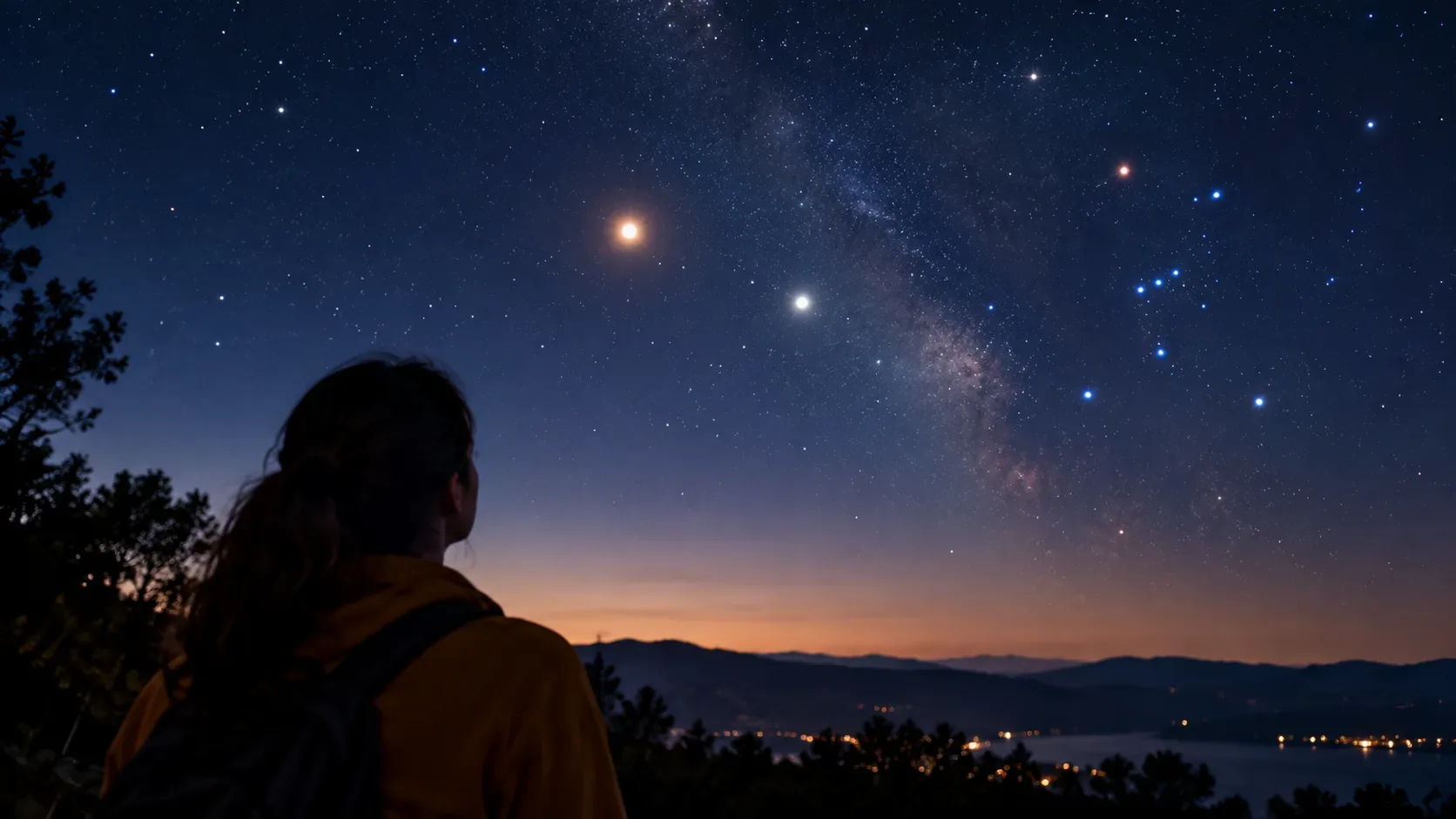
To distinguish planets from stars with the naked eye without an app, do not rely on a single sign. The best method combines five clues: steadiness of the light, position along the ecliptic band, height above the horizon, relative brightness, and changes in position against the stars over several nights. In general, stars scintillate more and planets shine more steadily, but this rule has exceptions, especially when an object is low in the sky.
Quick checklist: planet or star?
| Observed sign | What it suggests | Caveat |
|---|---|---|
| Nearly constant brightness for several seconds | Favors the planet hypothesis | Some very bright stars can look relatively steady, and low planets can scintillate. |
| Obvious twinkling, with rapid small changes in brightness or color | Favors the star hypothesis | Atmospheric turbulence has a stronger effect near the horizon. |
| Object lies in the same general band traveled by the Sun, Moon, and planets | Favors the planet hypothesis | The ecliptic is a visual band, not a line drawn across the sky. |
| Very bright point, especially near dawn or dusk | Could be Venus, Jupiter, or another bright planet | Brightness alone does not identify a planet. |
| Position changes slowly relative to the star pattern across nights | Strong evidence for a planet | The change can be subtle and require observations on different dates. |
Why do stars twinkle more than planets?
NASA summarizes the difference in a practical way: the five planets easily seen without a telescope, Mercury, Venus, Mars, Jupiter, and Saturn, tend to shine more steadily, while stars commonly flicker. The explanation involves the atmosphere and the apparent size of the light sources.
Even through telescopes, a distant star behaves visually like an almost point-like source. Small cells of air at different temperatures and densities bend the incoming light by changing amounts. This effect, called atmospheric scintillation, can make the point seem to fluctuate in brightness and sometimes color. Planets are much closer and present a tiny apparent disk. Their light arrives from a slightly more extended area, so many atmospheric disturbances tend to average out and the brightness looks steadier.
That does not make twinkling a foolproof test. Near the horizon, light travels through more atmosphere. A low planet can visibly twinkle, while a bright star under good atmospheric conditions can appear less variable. For that reason, first watch the object for several seconds, then confirm with other clues.
Height above the horizon can mislead you
NASA notes that, for most observers, planets are easier to see when they are at least a few degrees above the horizon, with about 10 degrees or more being better. Very close to the horizon, the atmosphere scatters and absorbs more light, while buildings, trees, haze, and twilight also make observing harder.
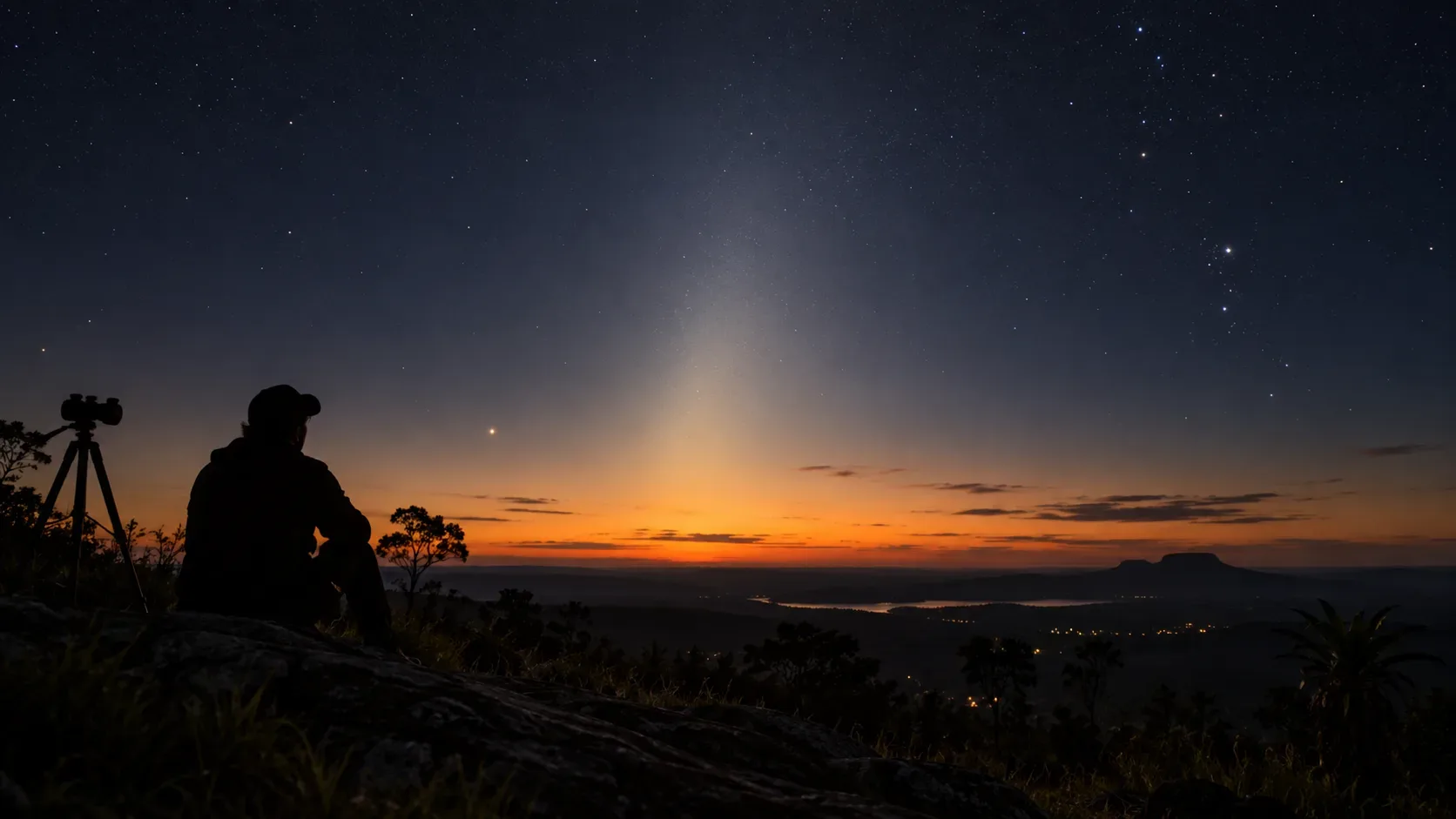
If the bright point is rising or setting, avoid deciding from twinkling alone. Wait for it to climb higher when possible, or compare it on another night. This caution is especially important for Mercury and Venus, which never appear very far from the Sun in our sky and therefore are observed around dawn or dusk.
Use the ecliptic as a second filter
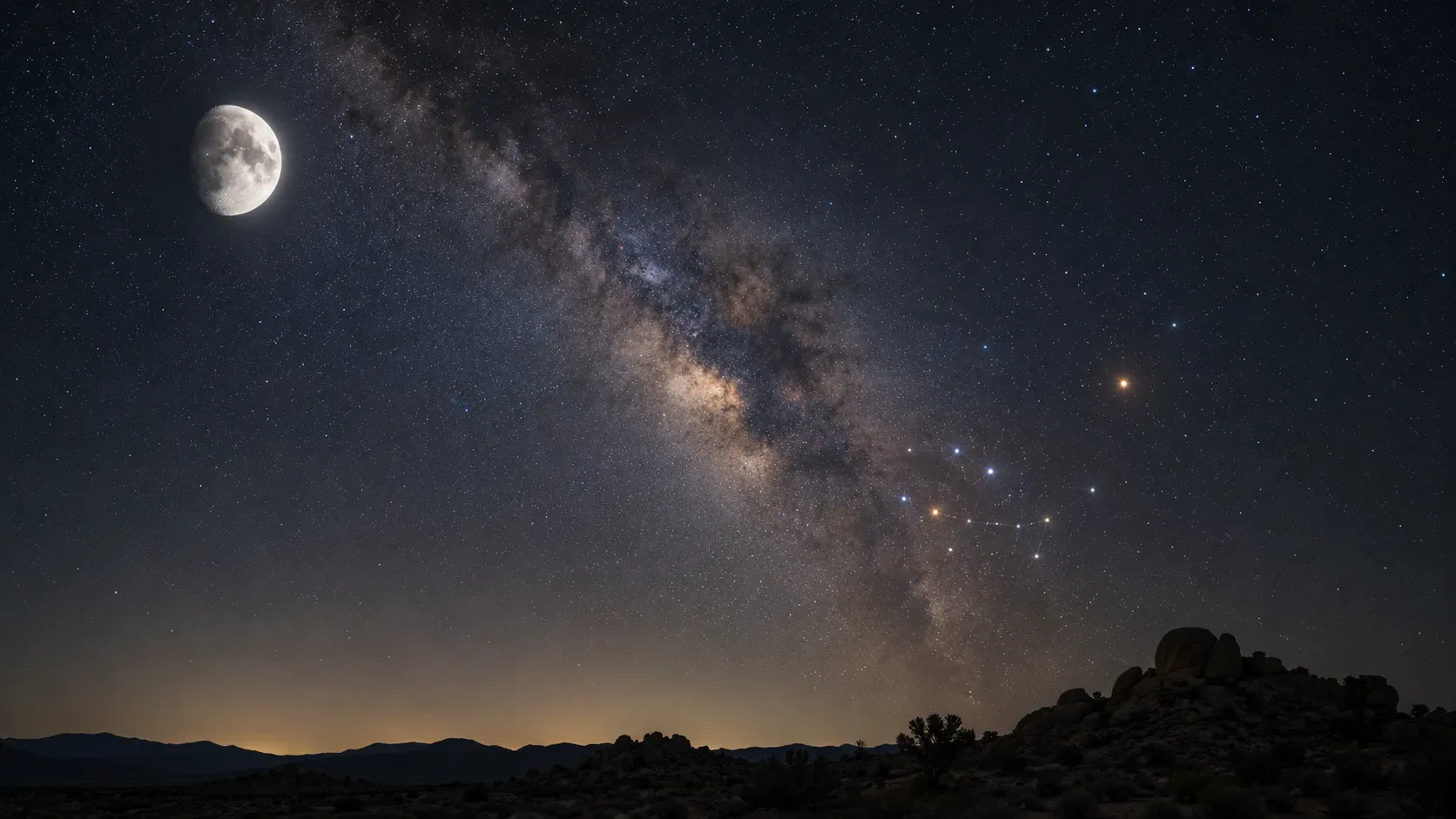
The planets in the solar system orbit the Sun in roughly the same plane. From Earth, they appear distributed along a band or arc called the ecliptic. This is also the general path followed by the Sun in the sky, and the Moon usually stays near this region.
In practice, after finding a bright point, look for whether known planets, the Moon, or the apparent path of the Sun around sunset suggest the same broad band. A candidate far away from this region is less likely to be one of the naked-eye planets. Still, do not imagine the ecliptic as a hair-thin line. Use it as broad guidance rather than a precision ruler.
Movement across nights is a strong confirmation
The word planet comes from the idea of a wandering object. The stars preserve their relative constellation patterns over ordinary human observing timescales, while planets slowly change position against that background as Earth and the planets orbit the Sun.
You can test this without an app. Choose two or three nearby stars around the suspected object and remember the geometry, such as a small triangle or the separation from a brighter star. Observe again one or more nights later at a similar time. If the point has shifted relative to the reference stars, that is much stronger evidence that it is a planet.
Do not confuse this slow displacement with the apparent motion caused by Earth's rotation. Stars and planets together seem to cross the sky from east to west through the night. Satellites and aircraft, by contrast, can cross a region of the sky in minutes; aircraft also commonly show regularly flashing lights.
Which planets are practical to see with the naked eye?
| Planet | Useful clue without an app | Important limitation |
|---|---|---|
| Mercury | Look low in the sky shortly before sunrise or shortly after sunset. | Its visibility windows are short and it is easily lost in twilight. |
| Venus | It can be extremely bright and appears around dawn or dusk. | It never gets very far from the Sun in angular separation. |
| Mars | It can become as bright as prominent stars, and its brightness varies greatly over time. | Its appearance changes with the geometry between Earth and Mars. |
| Jupiter | It is often among the brightest points in the sky and tends to shine steadily. | A very bright star can still be mistaken for it without other clues. |
| Saturn | It looks like a relatively steady bright star to the naked eye and remains in the planetary band. | Its rings are not visible to the naked eye; precise identification depends on context and follow-up. |
Uranus is technically visible under exceptional conditions to observers with excellent eyesight, very dark skies, and precise knowledge of its position, but it is not a practical target for casual unaided identification. Neptune requires optical aid. For this task, focus on the five classical planets visible without a telescope.
Light pollution changes what you can compare
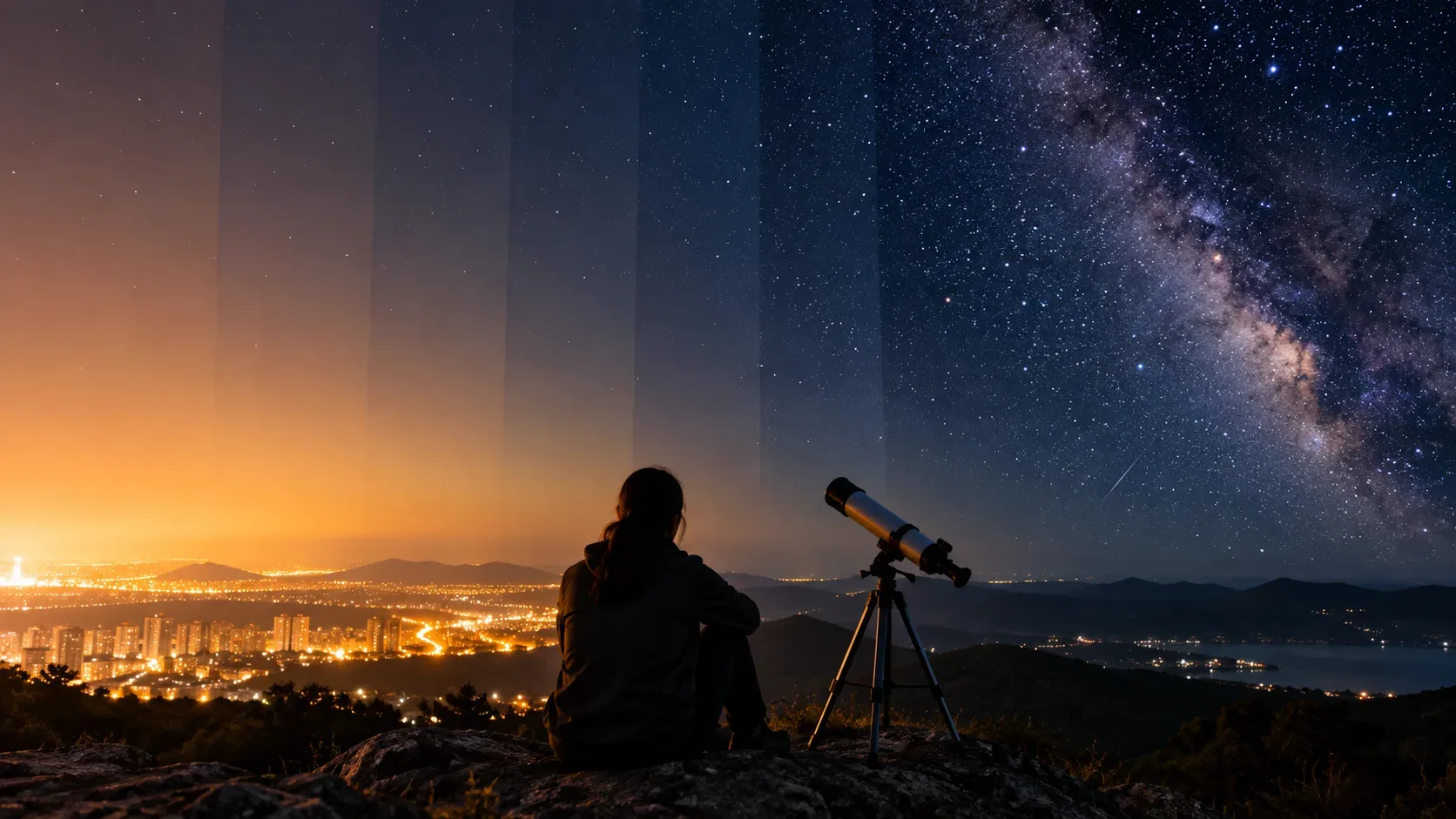
Light pollution brightens the sky background and lowers the contrast of faint objects. In a city, the brightest planets may still be visible, but many reference stars disappear. That can make it harder to trace the ecliptic or confirm a planet's shift against the stellar background.
If you cannot leave an urban area, choose a safe location with an open view, stay out of direct glare from streetlights and storefronts, and use a wall or tree as a shield from side lighting. Give your eyes time to adapt to darkness. NASA says full dark adaptation can take half an hour or more and recommends minimizing bright screens and white lights; dim red light interferes less with night vision.
A perfectly dark sky is not required to recognize Venus or Jupiter, but better conditions provide more comparison stars and make the method more reliable.
A simple five-minute procedure
- Choose a bright point and watch it for 15 to 30 seconds. Note whether its light is steady or clearly twinkling.
- Check its height. If it is very close to the horizon, postpone any conclusion based on twinkling.
- Look for the planetary band. Use the Moon, the Sun's sunset path, or other bright points as broad references for the ecliptic.
- Compare brightness without overvaluing it. A very bright point may be a planet, but brightness alone is not enough.
- Return on another night. Slow movement relative to nearby stars is the most valuable visual confirmation available without an app.
Common mistakes when identifying planets
- "If it does not twinkle, it is a planet." That is a useful clue, not an absolute rule.
- "The brightest object is always Venus." Venus is the brightest planet seen from Earth, but it only appears in certain positions near the Sun. Time and direction remain essential context.
- "Planets stand still." During a single night, they share the general apparent motion of the sky caused by Earth's rotation. The key difference is their slow drift relative to the stars over days and weeks.
- "The ecliptic is an exact line." For naked-eye observing, think of it as an arcing band of sky.
- "Light pollution prevents any identification." It erases faint reference stars and lowers contrast, but the brightest planets can still be seen from many urban locations.
The safest method is to combine clues
Without an app, identification becomes more reliable when you avoid instant judgments. A bright point that shines relatively steadily, lies in the ecliptic band, is not excessively low, and slowly changes position relative to stars on successive nights provides several independent pieces of evidence that it is a planet. If only one of those characteristics is present, treat the identification as provisional.
Sources and references
- NASA Science: Skywatching Tips From NASA
- NASA Science: Planetary Alignments and Planet Parades
- NASA Science: What's Up: June 2024 Skywatching Tips from NASA
- NASA Science: How to Find Good Places to Stargaze
- NASA Science: Skywatching FAQ
- U.S. National Park Service: Light Pollution
- EarthSky: Why do stars twinkle, but planets don't?