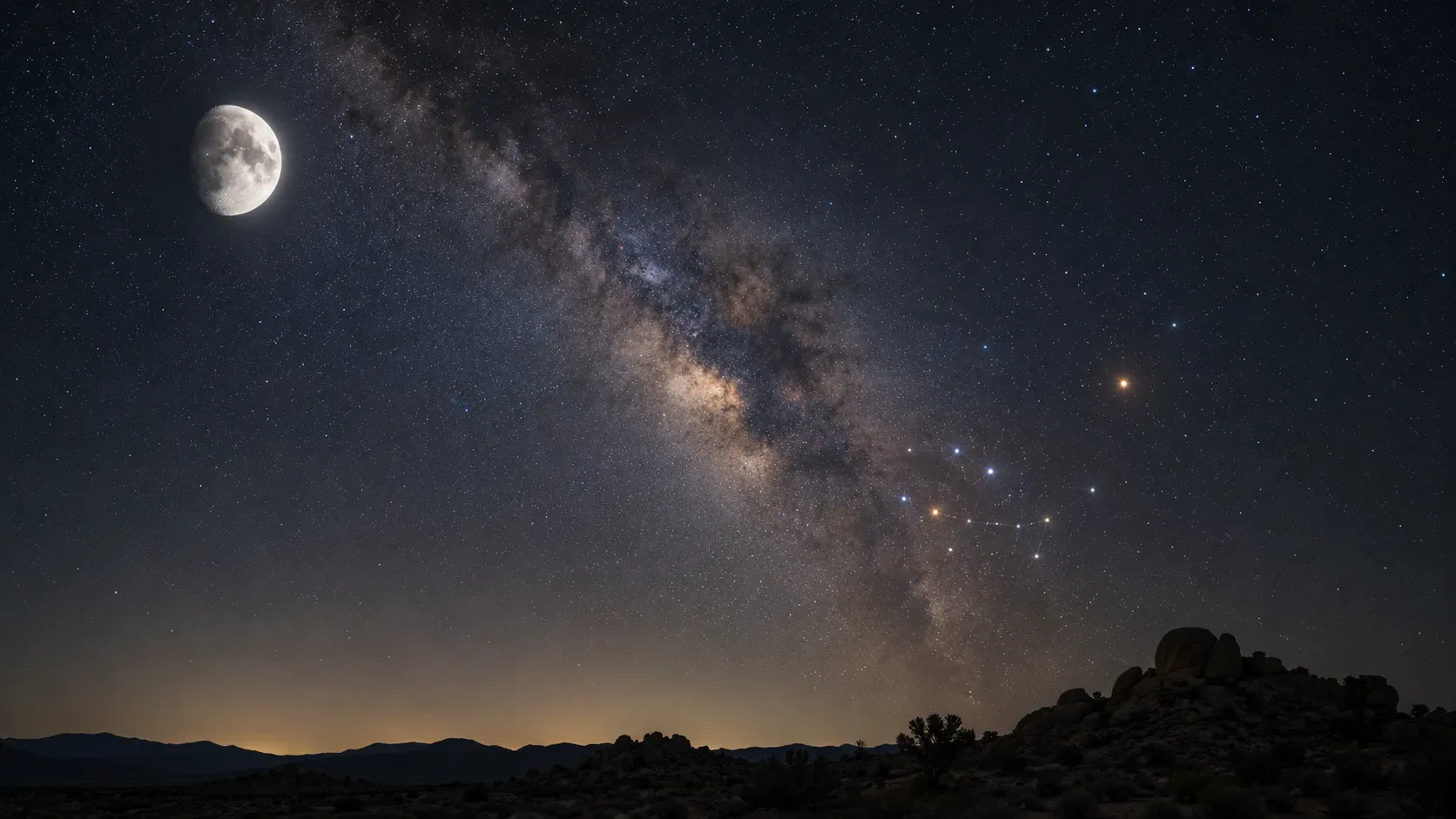
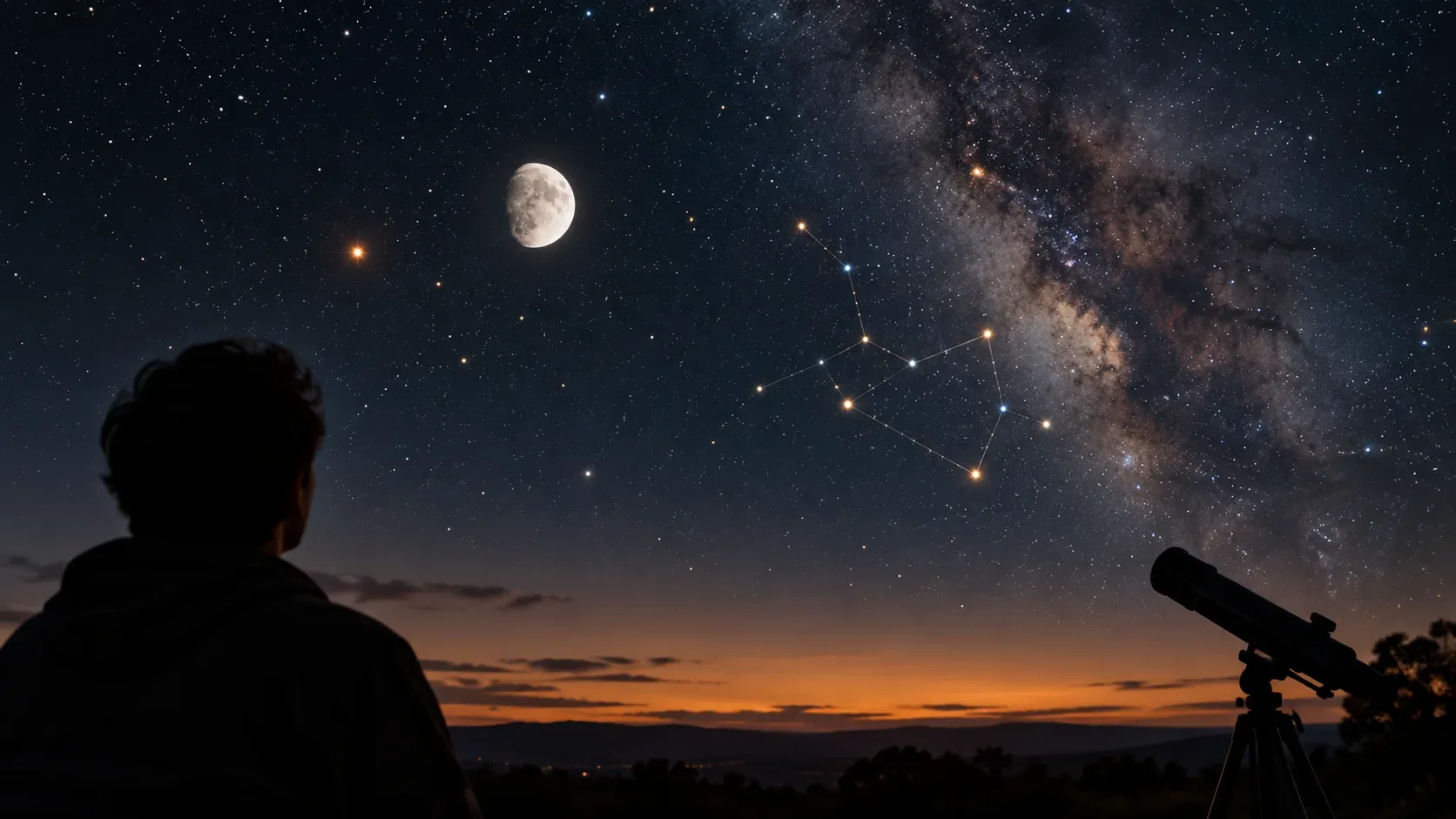
From September 14 to 20, 2026, the Moon works as a moving marker for recognizing two memorable landmarks in the sky: Antares, the reddish star that marks the heart of Scorpius, and the “Teapot,” an asterism within Sagittarius. NASA recommends starting about an hour after sunset and following how the Moon changes position night by night. For observers in Brazil, the exact altitude and horizon direction vary by city, so the most useful approach is to follow the relative positions of the Moon and the stars rather than copy the orientation of a chart made for another latitude.
What you are trying to find
Antares is a bright, reddish star in Scorpius. It works as the first landmark because it stands out to the unaided eye and helps you recognize that part of the constellation.
The “Teapot” of Sagittarius is not a separate constellation but an asterism: an informal star pattern inside Sagittarius. The pattern resembles a teapot with a handle, lid and spout. Under a truly dark sky, the Milky Way may look like steam rising from the spout; following that band toward its thickest area points your gaze toward the center of our galaxy, not toward a single point-like object visible to the unaided eye.
Night-by-night guide: September 14 to 20
| Date | How to use the Moon | What to look for |
|---|---|---|
| Sep. 14 | Use the Moon as your starting point and inspect the surrounding sky about an hour after sunset. | Begin learning the star field and look for Antares farther along the path the Moon will follow over the next nights. |
| Sep. 15 | Compare its position with the previous night: the Moon will already have moved against the background stars. | Antares should become easier to identify by its reddish color and its contrast with nearby stars. |
| Sep. 16 | This is one of the best nights in the sequence for directly relating the Moon to Antares; the pair appears notably close in the sky for much of the Americas. | Fix Antares’ position relative to the Scorpius pattern. After the Moon moves on, you can return to the star without relying on it. |
| Sep. 17 | The Moon will have passed the Antares region and will continue toward Sagittarius. | Use the shift to transfer your attention from Scorpius to the star field containing the Teapot. |
| Sep. 18 | The Moon reaches first quarter and sits near the Teapot’s spout region and the direction of the Milky Way’s center. | Try to recognize the Teapot’s brighter stars first. Moonlight may wash out part of the fainter Milky Way band. |
| Sep. 19 | The waxing Moon appears among or very near the Teapot stars, making the asterism easy to locate even though lunar glare can make its details harder to see. | Use the Moon to memorize the overall shape. The date also coincides with the 2026 International Observe the Moon Night. |
| Sep. 20 | The Moon will have moved beyond the main part of the pattern. | Repeat the Teapot search without using the Moon as a direct bridge; the previous nights should have given you a mental reference for the area. |
How to recognize Antares without mistaking it for a planet
Look for a bright point with an orange or reddish tint. Antares sits at the heart of Scorpius and keeps its position relative to the constellation’s other stars from one night to the next. The Moon, by contrast, changes position noticeably against the stellar background. That movement is exactly what makes a multi-day sequence useful: the Moon passes through the area, while Antares remains as a fixed landmark.
How to build the Teapot pattern in the sky
After locating the Sagittarius region, look for a group of stars you can mentally divide into three parts: a handle, a body with a lid, and a spout. Do not expect drawn lines in the sky; the shape emerges when you visually connect the more prominent stars.
- First recognize the Teapot outline without trying to see the Milky Way.
- Then, if the site is dark and the sky is transparent, look for a pale band extending from the spout region.
- If moonlight is washing out the fainter stars, memorize the location and return on another night with less lunar glare.
What you can see with the unaided eye
The Moon, Antares and the main stars forming the Teapot can be observed without a telescope under reasonable conditions. The limiting factor is often the sky itself: clouds, urban lighting and nearby obstructions reduce the number of visible stars. NASA notes that no special equipment is required to begin skywatching, although getting away from heavily developed areas reveals more stars.
The Milky Way band requires better conditions. Near first quarter, moonlight can reduce the contrast of the hazy band. In that case, the September 14–20 sequence is still useful for learning where to look; a clearer view of the Milky Way can wait for a darker night.
An important rule for observers in Brazil
The charts in NASA’s monthly guide are produced mainly for observers at mid-northern latitudes. The geometry among the Moon, Antares and Sagittarius remains a useful reference, but altitude, pattern tilt and horizon direction can change with latitude and time. NASA recommends using a sky app configured for the observer’s location when you need to confirm whether an object is visible and where to look.
In short: the Moon is a bridge, not the destination
The best way to use this sequence is progressively: on September 14 and 15, become familiar with the Moon and the star field; on the 16th, lock in Antares; on the 17th, follow the passage toward Sagittarius; on the 18th and 19th, use the Moon to recognize the Teapot; and on the 20th, try to find the pattern again with less dependence on the lunar marker. In this way, the Moon’s motion turns a crowded star field into a map you learn step by step.
Sources: NASA — What’s Up: September 2026 Skywatching Tips; NASA — Skywatching FAQ; EarthSky — September 2026 sky guide.