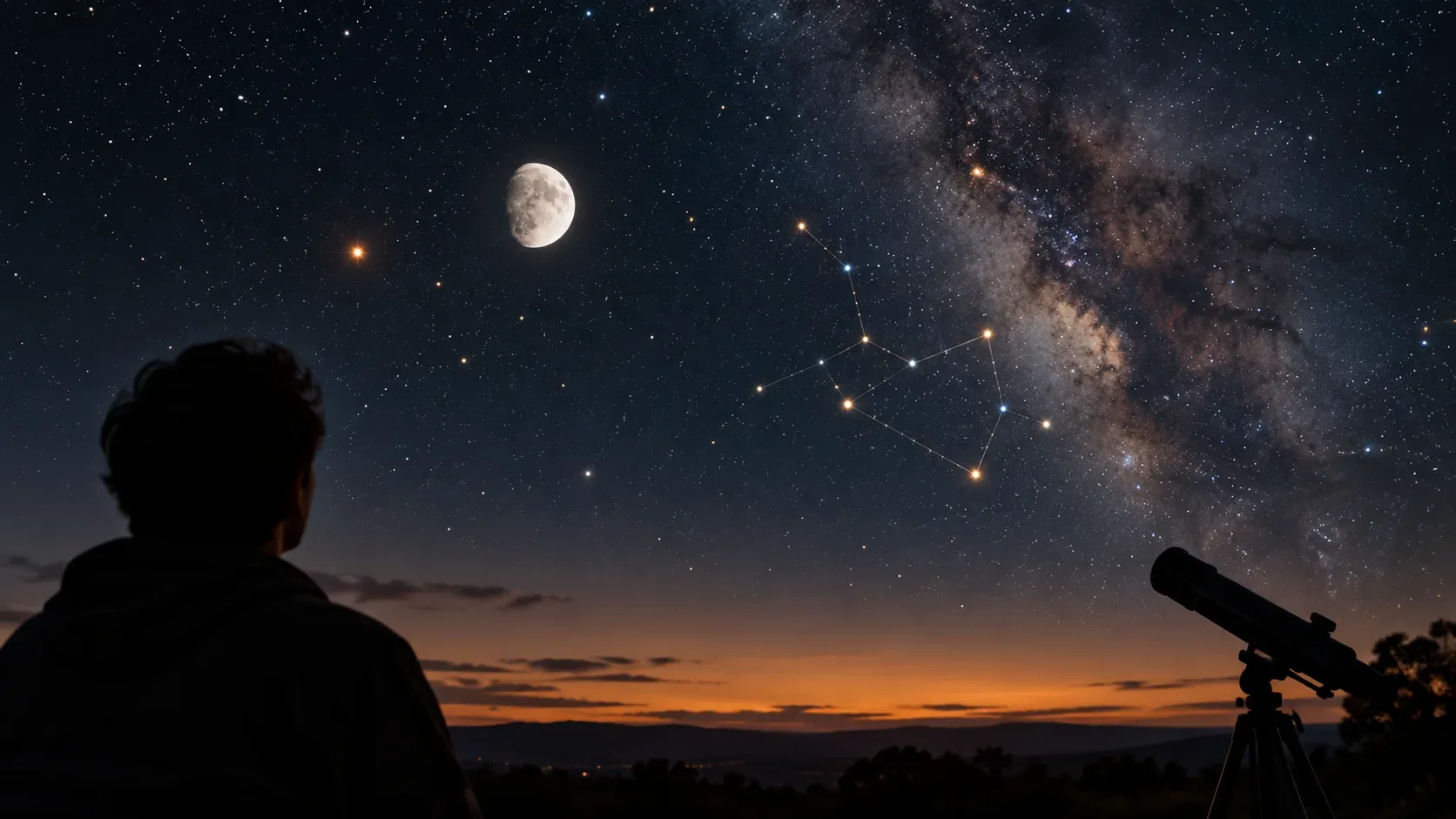

From September 14 through 20, 2026, the Moon can act as a moving marker for three useful sky landmarks: Antares, the Sagittarius Teapot, and the direction of the Milky Way’s center. NASA’s basic observing advice is simple: about an hour after sunset, find the Moon in the evening sky and notice how its position shifts against the background stars from one night to the next. It first moves through the region of Antares, the reddish star that marks the heart of Scorpius, then advances into Sagittarius, home of the Teapot asterism.
The important trade-off is that the Moon becomes brighter through the week. That makes it easier to navigate by the Moon while also making the faint Milky Way harder to see. Antares and the Teapot’s main stars can remain accessible from light-polluted areas, while the galactic center region requires a much darker sky.
How to use the Moon as a pointer
Start without trying to memorize entire constellations. Find the Moon and use three steps:
- Look for Antares. It is a bright orange-red star marking the heart of Scorpius. From September 14 to 17, the Moon progressively closes in on this part of the sky.
- Move on to the Teapot. In Sagittarius, several stars form a pattern that looks like a teapot with a handle, lid, and spout. From September 17 to 20, the Moon moves into this area and narrows your search field.
- Use the Teapot’s spout as a Milky Way reference. Under a truly dark sky, the Milky Way can look like hazy “steam” rising from the spout. Follow that band to its thickest part and you are looking toward the center of our galaxy.
NASA highlights this exact September 14–20 sequence and recommends starting about an hour after sunset.
Night-by-night guide, September 14–20
| Date | Moon and reference position | Main target | Useful observing time | Horizon and urban light |
|---|---|---|---|---|
| Sept. 14 | A relatively thin waxing crescent, still west of the Scorpius region against the background stars. | Begin recognizing Antares and the overall shape of Scorpius. | About 1 hour after sunset and during the next couple of hours, while the region remains well above the horizon. | The Moon creates less glare than it will later in the week. Antares is usually easier than the Milky Way under light pollution. |
| Sept. 15 | The waxing Moon moves closer to Antares from one night to the next. | Antares: look for the warm-colored star near the Moon’s apparent path. | Start roughly 1 hour after sunset. | An open horizon keeps Scorpius visible longer. In a city, focus on the reddish star first rather than the Milky Way band. |
| Sept. 16 | The Moon is closer still to the Antares region. | Use the proximity to lock in Antares before moving on toward Sagittarius. | Early evening. | This is a good night to learn the difference between a point-like stellar target and diffuse sky glow. Buildings and trees can shorten the observing window. |
| Sept. 17 | The Moon passes through the Antares region and begins to move visually into the Sagittarius sector. | Make the transition from Antares to the Teapot. | From about 1 hour after sunset. | The brighter Moon starts reducing background contrast. The Teapot’s stars remain fairly accessible, but the Milky Way “steam” needs a dark sky. |
| Sept. 18 | The Moon reaches first quarter and is in Sagittarius. | Find the Teapot: its handle, lid, and spout make a compact and practical pattern. | Early evening, when the Moon is well placed to serve as a reference. | Moonlight is now significant. Move away from streetlights and lit façades, and block direct light with a wall, tree, or your own body. |
| Sept. 19 | Just after first quarter, the Moon keeps moving eastward relative to the stars of Sagittarius. | Confirm the Teapot and identify the direction of its spout before searching for the Milky Way band. | Begin after twilight, once the sky has become fully dark. | A rural or very dark site makes a major difference for the Milky Way. The brighter Moon further lowers contrast. |
| Sept. 20 | The Moon is now east of the Teapot against the background stars, acting as an outer marker from which to look back toward Sagittarius. | The Teapot and the direction of the Milky Way’s center. | About 1 hour after sunset; observe before Sagittarius sinks too low. | This is the most demanding night of the sequence for seeing the galactic band because the Moon is brighter. Prioritize a dark site and unobstructed horizon. |
The phase sequence explains the increasing glare: New Moon falls on September 11 and first quarter on September 18. The first-quarter date can be checked in a local lunar calendar such as Timeanddate’s 2026 Moon phases for Brasília. The phase instant is global, although the displayed clock time depends on time zone.
How to recognize Antares without confusing it with another star
Antares stands out because of its color. To the unaided eye, it often looks more orange or red than most bright stars around it. NASA describes it as the bright reddish star marking the heart of Scorpius. You do not need a telescope to identify it.
Under urban skies, the full constellation may lose some of its fainter stars, but Antares usually survives light pollution better. If Scorpius looks incomplete, use the Moon first, then Antares’ color, and only afterward try to reconstruct the surrounding star pattern.
The Teapot is not a separate constellation
The Teapot is an asterism: an easy-to-recognize pattern made of stars that belong to Sagittarius. It is useful because it turns a rich, complicated region of sky into a simple visual shape. Instead of trying to find “all of Sagittarius,” look for a small teapot-like figure with a body, handle, and spout.
During this week, the Moon helps because it moves from the Scorpius region toward Sagittarius. Once you have identified Antares, follow the Moon on subsequent evenings and look for the Teapot in the same broad corridor of sky.
Where the Milky Way’s center is
We do not see the galactic center as one isolated bright point. Under a sufficiently dark sky, what we see is a thicker, more structured part of the Milky Way in the direction of Sagittarius. NASA’s metaphor is practical: imagine “steam” coming from the Teapot’s spout and follow it to the densest-looking part. That is the direction of the center of the galaxy.
This also explains why dark skies matter so much. Antares and the Teapot stars are point sources; the Milky Way is diffuse light spread across a large area of sky. Urban lighting, haze, humidity, and moonlight can quickly erase that contrast.
What changes from one Brazilian city to another
The pattern among the Moon, Antares, Sagittarius, and the Milky Way is the same, but the altitude above the horizon, apparent rotation of the pattern, and sunset time vary with latitude, longitude, and date. That is why “about an hour after sunset” is more useful for a nationwide guide than one fixed clock time.
- Horizon: choose an open area without buildings, hills, or trees blocking the sector where Scorpius and Sagittarius appear in the early evening.
- Urban light: Antares and the Teapot’s brighter stars tolerate brighter skies better; the Milky Way may disappear completely from city centers.
- Dark adaptation: spend several minutes away from bright screens and lights. Avoid checking your phone repeatedly.
- Binoculars: they can enrich the Sagittarius star fields, but they cannot replace a dark sky for seeing the Milky Way’s broad structure.
Which night to choose if you can observe only once
If your goal is to learn Antares, prioritize September 16 or 17, when the Moon is very close to that part of the sky. If you want to recognize the Teapot, September 18 or 19 makes the connection with Sagittarius more direct. If your top priority is to see the Milky Way band, the logic changes: less moonlight and less light pollution are better. Within the September 14–20 window, the earlier nights have less lunar glare, but the Moon gives you less direct help with the Teapot.
In other words, there is no single “best night” for all three targets. The sequence works like a practical lesson: the Moon first helps you lock in Antares, then carries you toward Sagittarius, and finally gives you a reference for the Teapot and the direction of the galactic center. The cost of that help is increasing moonlight through the week.
Quick observing checklist
- Go outside about an hour after sunset.
- Find the Moon before searching for any constellation.
- From September 14 to 17, use the Moon to lock in Antares.
- From September 17 to 20, move from the Moon to the Sagittarius Teapot.
- From the Teapot’s spout, look for the thickest part of the Milky Way band.
- For the Milky Way, choose the darkest site you can and shield your eyes from direct light.
- If the horizon is blocked or the sky is bright, focus on Antares and the Teapot; they are the more robust targets.
Sources: NASA — What’s Up: September 2026 Skywatching Tips; Timeanddate — 2026 Moon phases for Brasília.