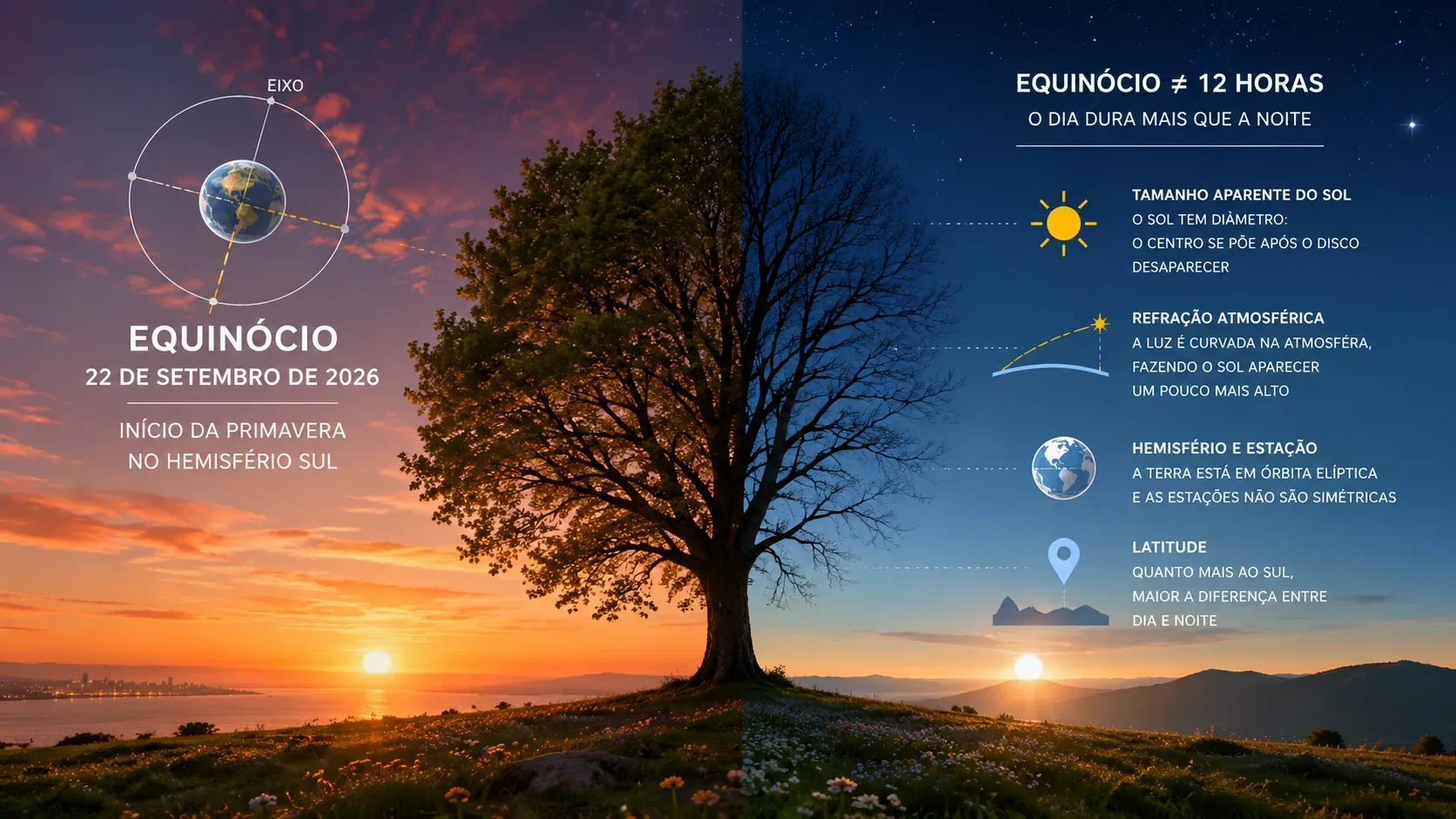
In 2026, astronomical spring in the Southern Hemisphere begins at the September equinox. NASA highlights the event on September 22 for time zones in the Americas; the calculated instant is September 23 at 00:05 UTC, which corresponds to September 22 at 9:05 p.m. Brasília time (UTC−3). That is why there is no contradiction if an international calendar shows September 23 while a Brazilian astronomy calendar shows September 22: both can refer to the same instant in different time zones.
The equinox, however, does not mean that every place on Earth gets exactly 12 hours of daylight and 12 hours of darkness. That is a useful approximation, but observed day length is affected by the Sun’s apparent size, atmospheric refraction, and the observer’s latitude. The date when day and night are closest to 12 hours each — often called the equilux — can fall a few days before or after the equinox depending on location.
What happens at the September 2026 equinox
An equinox is an astronomical instant, not a whole day. It occurs when the center of the Sun crosses the plane of Earth’s equator. In observational astronomy terms, the Sun’s center passes through 0° declination as it crosses the celestial equator. NASA gives the September 2026 equinox as 00:05 UTC on September 23.
In the Southern Hemisphere, that crossing conventionally marks the start of astronomical spring; in the Northern Hemisphere, it marks the start of astronomical autumn. After the September equinox, daylight generally keeps increasing in the South and decreasing in the North as the December solstice approaches. NASA’s September 2026 skywatching guide summarizes the event as the moment when spring begins in the Southern Hemisphere.
Why “equinox” does not produce exactly 12 hours of day and 12 of night
If the Sun were a geometric point and Earth had no atmosphere, the intuitive picture would be very close: at the equinox, the Sun’s center would be geometrically above the horizon for about 12 hours. The complication is that sunrise and sunset are not defined by the center of the solar disk.
1. The Sun is an apparent disk, not a point
Sunrise is counted when the upper edge of the Sun’s disk begins to appear above the horizon; sunset is when that upper edge disappears. The U.S. Naval Observatory (USNO) uses about 16 arcminutes for the Sun’s apparent semidiameter. That alone makes the interval from sunrise to sunset slightly longer than the time during which the Sun’s center is geometrically above the horizon.
2. The atmosphere lifts the Sun’s apparent position
Near the horizon, sunlight bends as it passes through layers of air with different densities. This effect, called atmospheric refraction, makes the Sun appear slightly higher than its geometric position. For tabulated sunrise and sunset times, the USNO uses a mean refraction of about 34 arcminutes.
Adding the roughly 16 arcminutes of the Sun’s apparent radius to 34 arcminutes of refraction means the Sun’s geometric center is about 50 arcminutes below the horizon at the conventional instants of sunrise and sunset. In practice, the “day” measured between those two times gains several minutes.
Equinox and equilux are different things
| Term | What it means | Is it the same everywhere? |
|---|---|---|
| Equinox | The instant when the Sun’s center crosses the plane of Earth’s equator/celestial equator. | Yes. It is one physical instant, although the civil date and clock time depend on the time zone. |
| Day length | The conventional interval between sunrise and sunset. | No. It depends on latitude, date, and local conditions. |
| Equilux | The date when daylight is closest to 12 hours and night is closest to 12 hours. | No. The date varies with latitude and can differ from place to place. |
The Met Office uses the term equilux specifically to separate the idea of “equal day and night” from the astronomical instant of the equinox. The USNO notes that in the Southern Hemisphere, dates with equal day and night tend to occur before the September equinox and after the March equinox.
Why latitude matters
Latitude changes the angle at which the Sun’s apparent path crosses the horizon. Near the equator, that path is steeper, so the Sun gains or loses altitude more quickly. At higher latitudes, the path meets the horizon at a shallower angle, so the Sun’s apparent radius and refraction translate into a longer time interval.
That is why there is no single “12-hour date” for all of Brazil. The country spans many latitudes, and different cities can reach their closest-to-12-hours day on different dates. The USNO also notes that on the equinox itself, daylight commonly exceeds nighttime by several minutes, with the difference increasing at higher latitudes.
The hemisphere changes the season, not the instant
The equinox happens simultaneously for the whole Earth. What changes between hemispheres is the seasonal interpretation. In September, the Sun crosses the celestial equator southward: astronomical spring begins in the Southern Hemisphere and autumn in the Northern Hemisphere. In March, the pattern is reversed.
This is also why saying “spring starts on September 22 in Brazil” refers to the astronomical start of the season. Weather does not change instantly at 9:05 p.m.; temperature, rainfall, and air masses respond to atmospheric and oceanic processes that do not switch at the exact minute of the equinox.
Why some sites show September 22 and others September 23
The exact 2026 time makes the difference easy to see. NASA lists the event as September 23 at 00:05 UTC. In Brasília time, three hours behind UTC, it is still September 22 at 9:05 p.m. A source can therefore use September 23 in UTC while a publication aimed at Brazil uses September 22.
When checking an astronomy calendar, look for whether the time is shown in UTC, in the observatory’s local zone, or already converted for your city. Physically, there are not two equinoxes: there is one instant expressed by different clocks.
How to read day length correctly for your city
- Use local sunrise and sunset data. They depend on latitude, longitude, and time zone.
- Do not expect exactly 12:00 on the equinox date. Several extra minutes of daylight are normal.
- Treat the equilux as a local event. The closest-to-12-hours date may not be the same in two Brazilian cities.
- Remember that the real atmosphere varies. Refraction, terrain, and an obstructed horizon can make actual observations differ from times calculated for an ideal horizon.
In short
In 2026, the September equinox occurs at 00:05 UTC on September 23, equivalent to 9:05 p.m. on September 22 in Brasília time, and it marks the beginning of astronomical spring in the Southern Hemisphere. Day and night are close to 12 hours but not exactly equal because sunrise and sunset use the edge of the solar disk and because atmospheric refraction extends the Sun’s visibility. Latitude determines how strongly those effects translate into minutes and on which date the local equilux occurs.
Sources: NASA — What’s Up: September 2026; NASA — Embracing the Equinox; U.S. Naval Observatory — Length of Day and Night at the Equinoxes; Met Office — Understanding equinoxes and solstices.