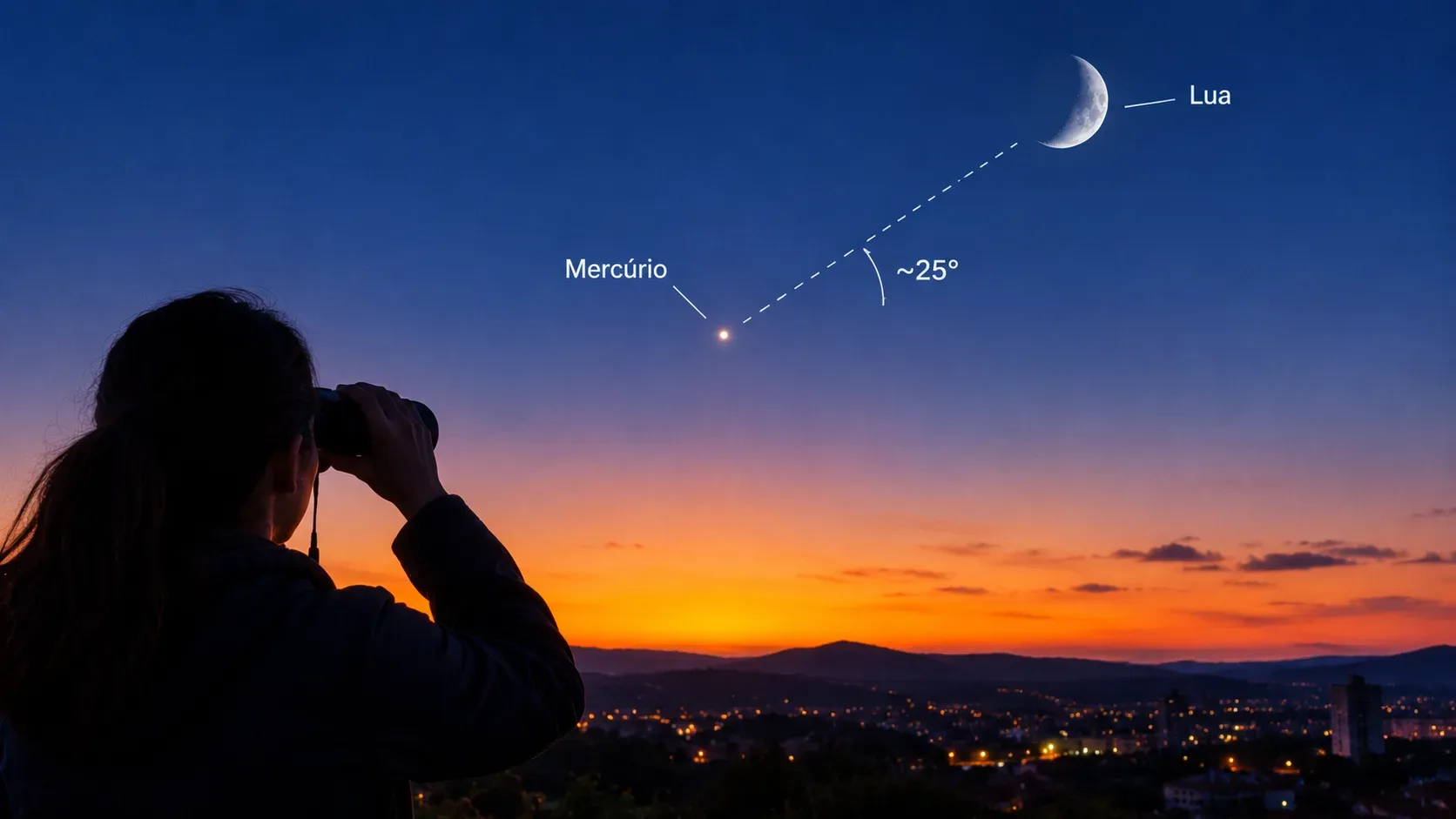
Quick answer: to see Mercury from Brazil in October 2026, use October 12 as the central date of the evening apparition. Around then, the planet reaches greatest eastern elongation, with an angular separation of about 25° from the Sun. In practice, it is worth trying on several evenings around the maximum — especially from October 10 to 14 — looking west, toward the sunset direction, once the Sun’s disk is completely below the horizon.
Greatest elongation improves the chance of finding Mercury because the planet appears farther from the Sun’s glare in the sky. It does not mean, however, that Mercury will be 25° above the horizon: elongation is the apparent separation between Mercury and the Sun, while the planet’s altitude depends on latitude, season, and the angle of the ecliptic to the horizon.
When to look for Mercury in October 2026
Astronomical sources agree that Mercury reaches greatest elongation east of the Sun on October 12, 2026, at roughly 25° of separation. The event is called “eastern elongation” because Mercury lies east of the Sun on the celestial sphere; as a result, it rises and sets after the Sun and is observed in the evening twilight.
| Period | What to expect | How to observe |
|---|---|---|
| October 8–10 | The separation is already close to maximum and Mercury appears bright in the evening sky. | Start looking west shortly after sunset, with a clear horizon. |
| October 11–14 | Priority window; greatest elongation occurs on October 12, near 25°. | Use the early twilight and compare the position with a sky map set for your city. |
| October 15–18 | It may still be visible, but it tends to lose altitude and later brightness as it moves back toward the Sun. | Look earlier in twilight and avoid horizons blocked by buildings, hills, or haze. |
This range is a practical guide, not an “official window” that is identical everywhere in the country. The best local evening depends on clouds, atmospheric transparency, horizon obstructions, and sky geometry at the observer’s latitude. A useful general rule is to try within roughly a week of greatest elongation.
Which direction to look from Brazil
Mercury will be in the western sky after sunset. Instead of relying on one nationwide clock time, first locate the part of the horizon where the Sun went down and let the twilight fade. The planet should look like a bright point relatively low in the sky, and around greatest elongation its magnitude is estimated at about -0.1.
The exact azimuth — west, west-southwest, or a nearby direction — changes with city, date, and time. The most reliable instruction is therefore: look toward the sunset sector of the horizon and follow Mercury during the first part of the evening. A planetarium app or sky map with the correct location and time will confirm the precise position.
What an elongation of about 25° means
Elongation is an angle measured in the sky. Imagine two lines extending from your eyes: one points to the Sun and the other to Mercury. The angle between them is the elongation. Because Mercury orbits closer to the Sun than Earth does, it never reaches opposition and never strays very far from the Sun’s glare. Its greatest elongations generally range from about 18° to 28°.
In October 2026, about 25° is a large separation for Mercury. That gives the sky more time to darken after sunset before the planet itself sets. This is why greatest elongation is usually the main reference point for observers who want to see Mercury without advanced equipment.
Important: a 25° elongation does not mean 25° of altitude. Mercury may be much lower above the horizon. Its altitude depends on how the ecliptic — the band of sky along which the Sun, Moon, and planets appear to move — intersects the horizon at that location and season.
Why October is favorable for much of Brazil
Around spring in the Southern Hemisphere, the ecliptic tends to meet the horizon at a more favorable angle during evening apparitions of Mercury. That can place the planet higher in the sky for the same separation from the Sun. EarthSky describes the October elongation as the best evening apparition of Mercury in 2026 for the Southern Hemisphere.
This benefits much of Brazil, especially central and southern latitudes. In the far north of the country, the geometry can differ, so planning should always be refined with the observer’s actual location.
How to adapt the timing to your city
- Check your local sunset time for the chosen date. Do not use the time for another capital as if it applied to all of Brazil.
- Wait until the Sun has completely disappeared. Mercury is a twilight target, but safety comes first.
- Begin searching shortly after sunset, while the planet is still above the horizon. In many places the useful window falls within the first hour of evening, but the exact interval should be checked in an ephemeris or sky map.
- Set your city and date in a sky map. Timeanddate’s Mercury page provides an interactive map; planetarium software can also be adjusted for location and time.
- Choose an unobstructed western horizon. Buildings, ridges, trees, and low haze can hide Mercury even when the astronomical geometry is favorable.
The mathematical instant of greatest elongation can occur when Mercury is not visible from your city. That is not a problem: the event is a geometric reference. For actual observing, use the local twilight on nearby evenings, not the exact clock time of the maximum.
Naked eye, binoculars, or telescope?
Mercury can be visible to the naked eye when the sky is clear and the horizon is favorable. Binoculars can make it easier to locate in twilight, but they require an absolute safety rule: never point binoculars or a telescope toward the Sun’s region while any part of the solar disk is still above the horizon. Accidental solar viewing through optical equipment can cause permanent eye injury.
If you plan to use binoculars, wait until sunset is completely over before searching. Once you identify Mercury with optical help, try to find it again with the unaided eye.
What to remember from this apparition
- Central date: October 12, 2026.
- Practical window: prioritize October 10–14 and consider attempts a few days before and after.
- Direction: west, near the sunset region, during evening twilight.
- Greatest elongation: about 25° east of the Sun.
- Meaning: greater apparent separation from the Sun’s glare, not necessarily greater altitude above the horizon.
- Best strategy: combine a date near elongation with a clear horizon, transparent skies, and timing calculated for your own city.
To check the geometry and refine your observing plan, see In-The-Sky.org, Timeanddate’s explanation of greatest elongation, its Mercury visibility page, and EarthSky’s guide to the October 2026 apparition.