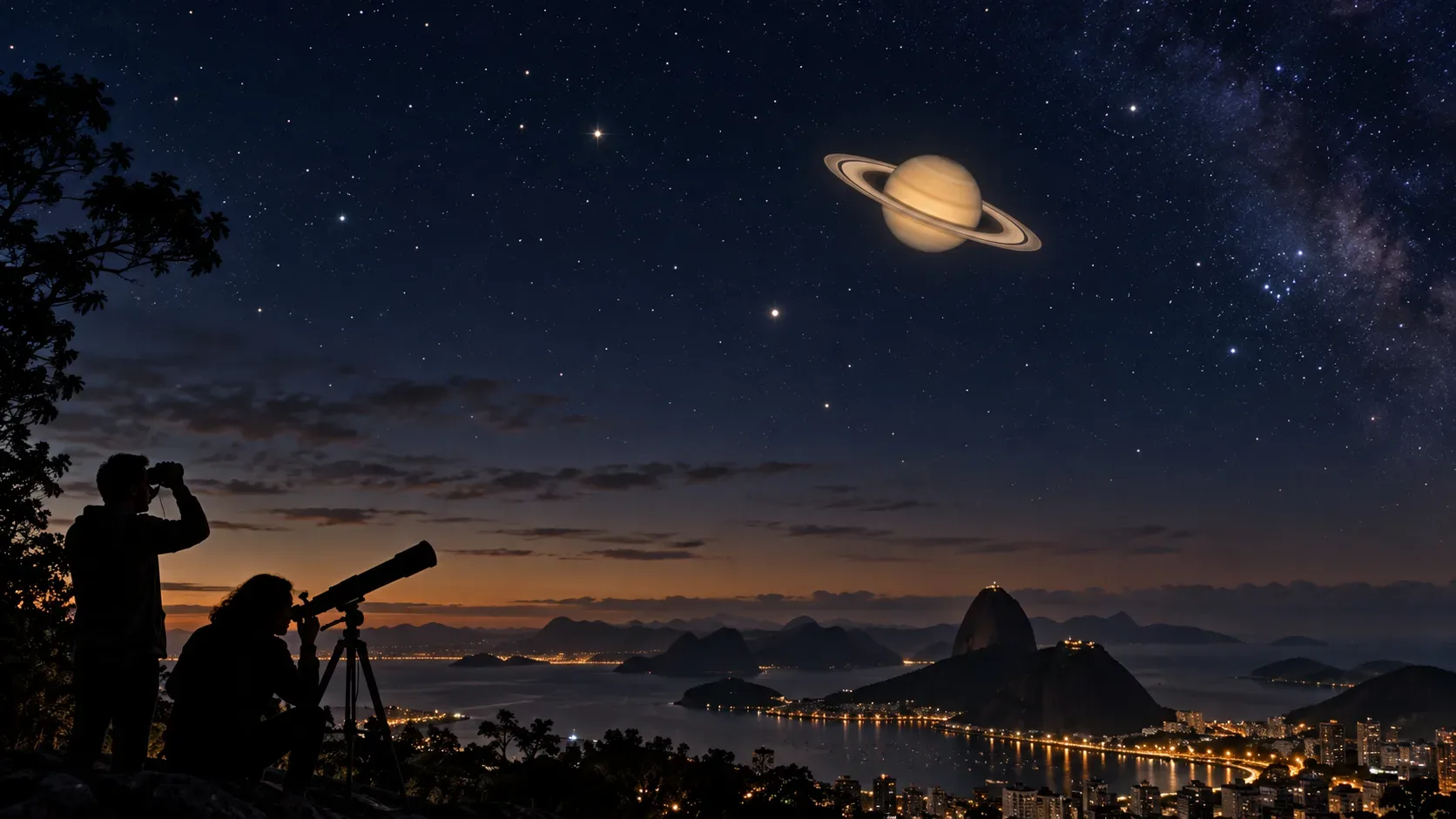
Saturn's opposition on October 4, 2026 marks the center of the best observing season of the year for the planet. Opposition geometry places Earth between the Sun and Saturn: the planet appears opposite the Sun in the sky, rises roughly as the Sun sets, remains visible for nearly the entire night, and comes close to its minimum distance from Earth for the year. For observers in Brazil, that means a long, practical viewing window without the need to hit one exact minute.
Ephemerides from the IMCCE place opposition at about 12:28 UTC on October 4, or roughly 09:28 Brasília time. Different ephemerides can vary by a few minutes because of the models and criteria used. Because the exact instant occurs during daylight in Brasília time, the nights of October 3–4 and October 4–5 offer practically equivalent conditions for observers. The Night Sky Network/JPL calendar also lists October 4 as the opposition date.
When to observe Saturn from Brazil
The most useful rule is not a single nationwide clock time, because rising, culmination, and setting times change with longitude, time zone, and the observer's position. Around opposition, however, the general pattern is simple: Saturn appears near the eastern horizon around nightfall, climbs higher through the night, is highest around the middle of the local night, and moves toward the west before dawn.
| Time of night | Where to look | What to expect |
|---|---|---|
| Shortly after dark | Near the east | Saturn is still low; good for locating it, less favorable for telescopic detail. |
| Middle of the local night | High in the sky | Usually the best interval for a telescope because there is less atmosphere along the line of sight. |
| Before dawn | Toward the west | The planet remains visible but gradually loses altitude. |
Across much of Brazil, Saturn reaches a high altitude in the sky at this opposition, which is especially helpful for seeing ring detail. To plan a clock time, check an ephemeris configured for your city on the day itself: do not use the rise or culmination time for another location as if it applied to the entire country.
What opposition changes in brightness and apparent size
At opposition, Saturn is approximately aligned with Earth and the Sun and is near its minimum Earth distance for that observing season. A table of opposition circumstances from INAF gives, for October 4, 2026, a distance of about 8.43 astronomical units, a planetary disk about 19.7 arcseconds across, a ring system about 44.6 arcseconds across, and an apparent magnitude around +0.5.
Those numbers help explain the visual experience. Saturn is already visible to the unaided eye as a bright point, and at opposition it reaches the year's best combination of proximity, brightness, and apparent size. That does not mean a dramatic change from one night to the next: the improvement is gradual, and several weeks around opposition remain excellent for observing.
What you can see with the unaided eye, binoculars, and a telescope
| Equipment | What you can expect |
|---|---|
| Unaided eye | A bright, yellowish point. The rings are not resolved. |
| Regular binoculars | Useful for finding the planet and steadying your view, but they normally do not separate the rings. NASA notes that common binoculars will probably not show Saturn's rings. |
| Small telescope | The rings become the main attraction. NASA educational material on Saturn indicates that magnification of about 30× can already reveal the ring system under suitable conditions. |
| Telescope with good optics and steady air | You can look for clearer separation between the globe and rings, brightness differences across the system, and, depending on aperture and conditions, moons such as Titan. |
For detail, do not start with the highest magnification available. Use a lower-power eyepiece to locate and focus Saturn, then increase magnification gradually while the image remains sharp. On nights with strong atmospheric turbulence, lower magnification can show more useful detail than a large but shaky image.
Why the rings look different in 2026
Saturn's rings change their apparent tilt over the years because the planet's axis is tilted and Saturn takes about 29.5 years to orbit the Sun. After the nearly edge-on geometry seen in 2025, the rings are opening again. For the 2026 opposition, the INAF table gives an inclination of about 7.4 degrees to our line of sight, with the southern face of the ring system turned toward Earth.
That is still much less open than in seasons when the rings approach their maximum tilt, but it already produces an appearance clearly more separated from the planet's disk than during the ring-plane crossing. NASA explains that when we see the rings nearly edge-on, their apparent thickness becomes so small that they can seem to disappear in modest telescopes.
Can the rings brighten near opposition?
Yes. There is a physical phenomenon known as the opposition effect or Seeliger effect. When the Sun, Earth, and Saturn are nearly aligned, shadows between ring particles are less visible from the observer's direction and backscattered light can increase. NASA describes this brightness enhancement in the rings and notes that it can be seen from Earth when conditions are favorable.
In practice, do not expect a dramatic naked-eye flash. The effect is more interesting for careful observers, telescopic comparisons, and planetary imaging. The more reliable advantage of opposition is different: Saturn is available for many hours, bright, relatively close, and well placed for observing.
How to find Saturn without turning the date into a minute-by-minute chase
On your observing night, start with an unobstructed eastern horizon shortly after dark. Saturn should appear as a bright, relatively steady point. A planetarium app or sky chart configured for your city can confirm the position; on October 4, 2026 the planet is in the region of the constellation Cetus. If your goal is telescopic detail, it is worth waiting for the planet to climb higher instead of insisting on observing while it is still close to the horizon.
The difference between October 3, 4, or 5 is small for the visual experience. Clouds, transparency, and atmospheric steadiness can matter more than being exactly on the mathematical date of opposition. If weather closes in on the 4th, observe on nearby nights: the favorable geometry does not vanish from one hour to the next.
Quick checklist for a good observing session
- Check the cloud forecast for your city and choose a site with an open horizon.
- Use an ephemeris or app configured for your location to get local rise, culmination, and setting times.
- If using a telescope, start at low magnification, focus carefully, and increase power gradually.
- Avoid looking over roofs, heated concrete, or other sources of turbulent air when you want ring detail.
- Do not dismiss urban observing: Saturn is bright; for planetary detail, atmospheric steadiness and altitude in the sky are especially important.
- If October 4 is cloudy, try again on the nights immediately before or after.
In summary
Saturn reaches opposition on October 4, 2026, with the calculated instant around 09:28 Brasília time. For observers in Brazil, the most useful way to plan is to think in terms of the whole night: look for the planet near the east after dark, wait for it to climb, and, for telescopic viewing, favor the period when it is highest from your city. To the unaided eye it is a bright point; binoculars help locate it but usually do not resolve the rings; a small telescope transforms the experience by revealing the ring system.
The rings will be reopening after the nearly edge-on phase of 2025, with a tilt near 7.4 degrees at opposition. That angle, combined with the year's close approach and long nighttime visibility, makes the weeks around October 4 one of the best opportunities of 2026 to observe Saturn.