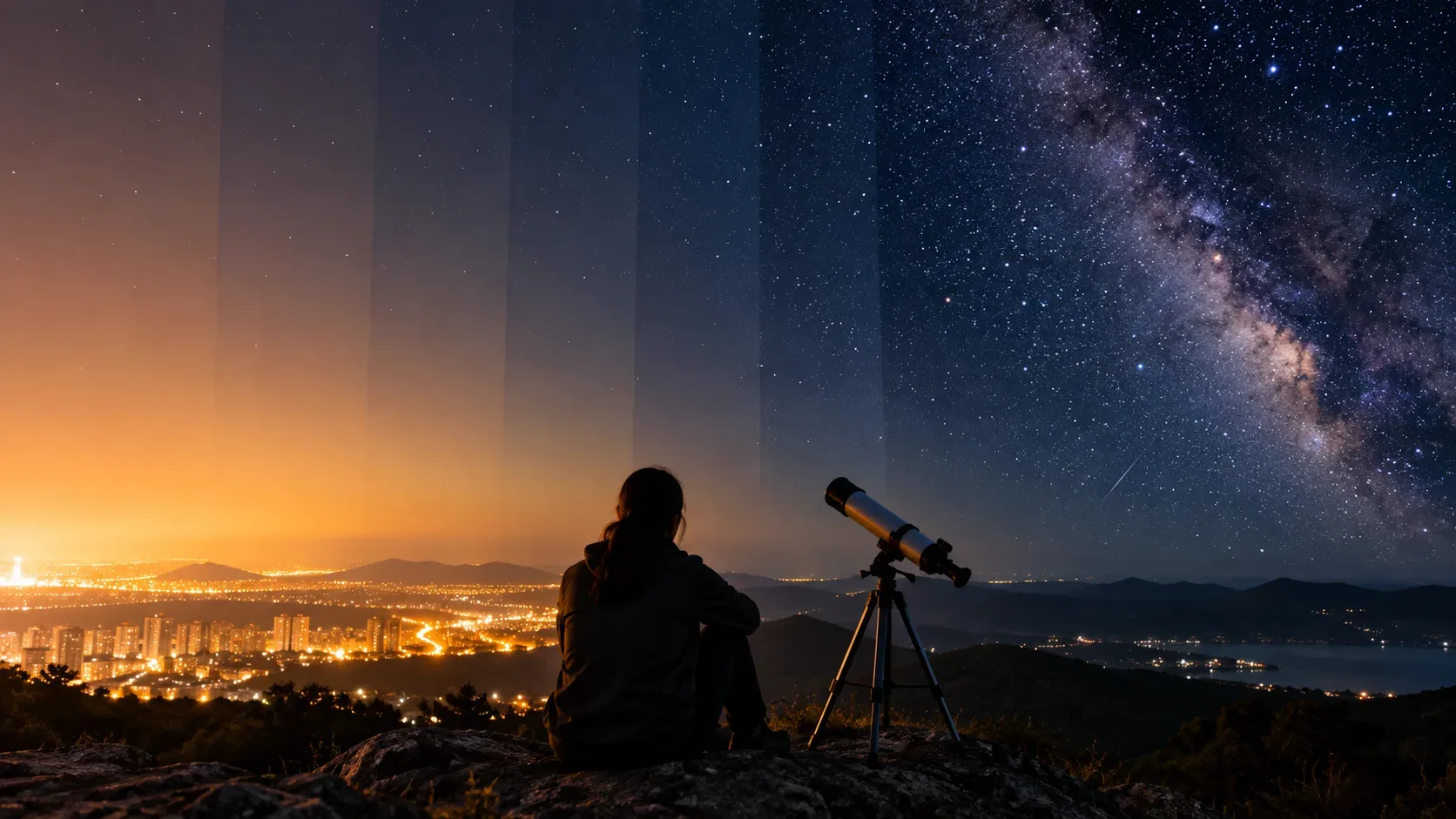
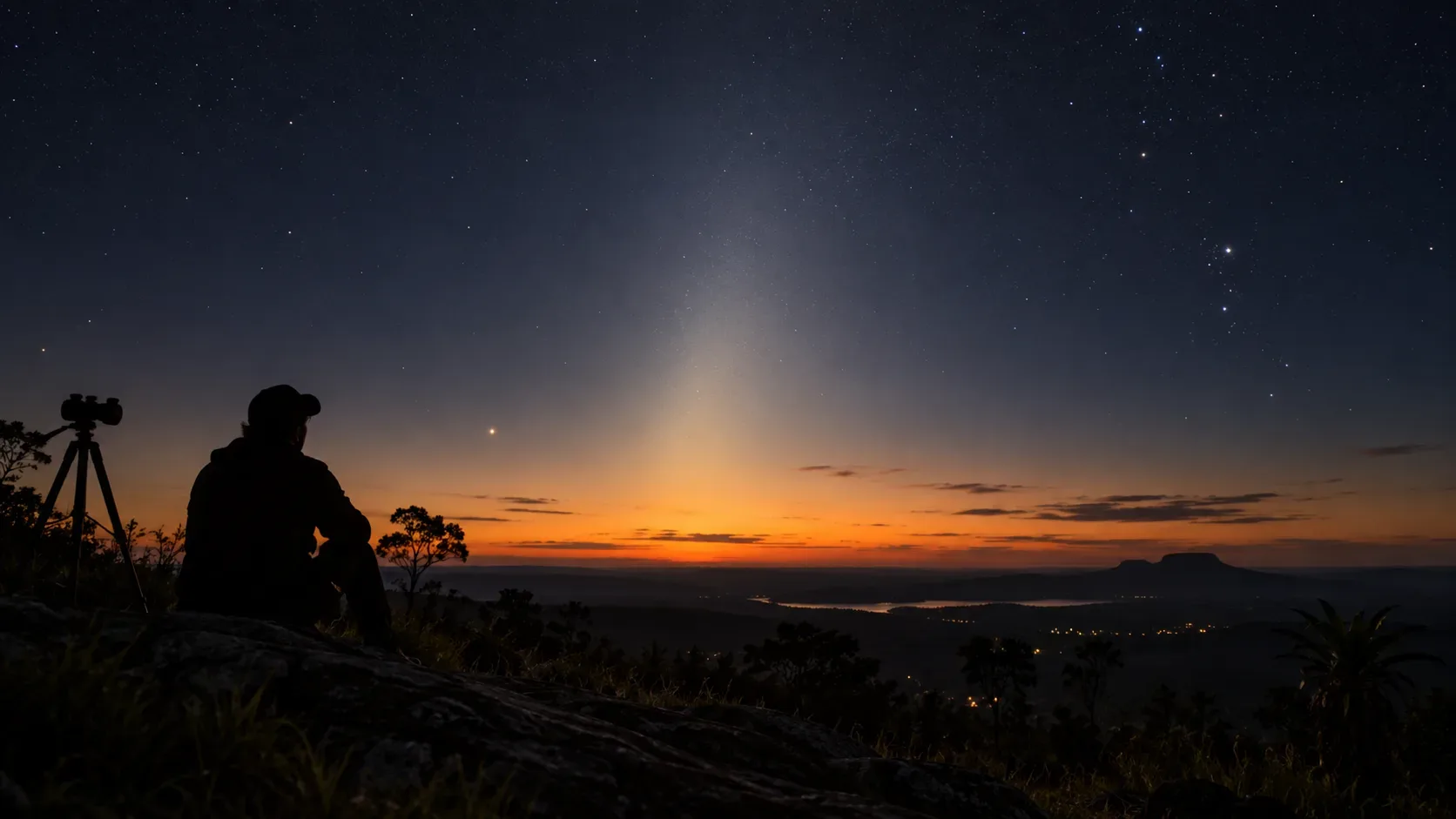
In September 2026, the most useful rule for most of Brazil is simple: look for zodiacal light in the west, after sunset and after evening twilight. That is the reverse of the often-repeated advice to look for a “false dawn” before sunrise, because that advice usually reflects the seasonal geometry of the Northern Hemisphere. NASA summarizes the difference clearly: in September, Southern Hemisphere observers should look west after evening twilight, while the Northern Hemisphere has the more favorable pre-dawn window.
Why the observing time changes between hemispheres
Zodiacal light is a diffuse glow produced when sunlight is scattered by interplanetary dust concentrated near the plane of the ecliptic — the same apparent plane along which we see the Sun, Moon, and planets. It becomes easier to notice when the ecliptic meets the horizon at a steeper angle, allowing the luminous cone to rise into a darker part of the sky instead of lying inside the brighter band close to the horizon.
Near the September equinox, that geometry favors the early evening in the Southern Hemisphere. NASA describes zodiacal light as a faint triangular pillar or cone and advises observers south of the equator in September to look west in the hour following evening twilight. NASA's broader observing guidance also notes that around the local spring equinox, zodiacal light is generally most favorable after sunset.
This is why the nickname false dawn can be misleading. The phenomenon does not belong exclusively to the morning: it can appear before dawn or after dusk depending on season and latitude. In most of Brazil, September is the beginning of spring, so the evening window is the main reference.
When to try in September 2026
There is no single clock time that works for the entire country because the end of twilight depends on location, date, and latitude. Instead of memorizing a time, use a practical sequence: choose a dark site with an open western horizon, arrive while twilight is still fading, and start searching once the sky is dark enough to reveal many stars. The zodiacal cone should rise from the part of the horizon where the Sun set and extend upward along the ecliptic.
| September 2026 milestone | What it means for observing |
|---|---|
| September 11, 03:27 UTC: New Moon | Nights near New Moon offer the month's best protection from moonlight. In Brasília time, the phase occurs at 00:27 on September 11. |
| September 18: Venus reaches peak brightness in this evening apparition | Venus will be an extremely bright point low in the west after sunset. It can help you orient yourself, but it should not be confused with the diffuse zodiacal glow. |
| September 23, 00:05 UTC: September equinox | This is when the seasonal geometry is especially favorable for evening zodiacal light in the Southern Hemisphere. In Brasília, the instant occurs at 21:05 on September 22. |
| September 26, 16:49 UTC: Full Moon | The sky becomes much brighter; because zodiacal light is faint and diffuse, strong moonlight tends to wash it out. |
In practice, the nights around the September 11 New Moon are the friendliest for observing. As the waxing Moon becomes brighter in the evening, the advantage decreases. Near the September 26 Full Moon, the attempt becomes much harder. Sky transparency and distance from city lights, however, can matter more than a difference of a few days in the lunar calendar.
Where to look and what to expect
Face the western horizon. Zodiacal light does not look like a spotlight and it has no sharp edges. Expect a broad, pale, very soft cone with its base near the horizon and a glow that tapers upward. It follows the ecliptic, so it often appears tilted rather than perfectly vertical; the exact tilt changes with latitude and date.
In September 2026, Venus will be exceptionally bright in the evening sky and may appear low in the west. Use it only as an orientation marker. The planet is a concentrated point of light; zodiacal light is a diffuse feature spread over a large area. If you see only Venus above a bright orange twilight band, the sky is probably not dark enough yet.
How to tell zodiacal light from urban skyglow
Light pollution creates skyglow, the artificial brightening of the night sky over inhabited areas. It often forms an irregular dome or band above cities and roads and can remain strongest exactly where ground lighting is concentrated. Zodiacal light, by contrast, tends to show a triangular shape that narrows upward and follows the direction of the ecliptic.
- Shape: zodiacal light usually has a broad base and a narrowing top; urban glow is often flatter or centered over a cluster of artificial lights.
- Direction: the zodiacal cone rises from the direction of the recently set Sun and follows the apparent path of the planets.
- Behavior with clouds: low clouds often brighten when artificial lighting is beneath them; clouds, haze, and humidity usually obscure or blur zodiacal light.
- Color: do not rely on color as the main test. Human color perception is limited at low light levels, and both natural horizon glow and artificial skyglow can take on different hues.
If your western horizon points directly toward a large city, move to another site or choose a location where the main light dome is behind you. DarkSky International notes that urban skyglow reduces the visibility of stars and faint night-sky features; this is especially important for zodiacal light because the signal is already low contrast.
A simple observing routine
- Choose a safe, dark site with an unobstructed view to the west.
- Avoid nights near Full Moon and favor the period around New Moon.
- Arrive before the sky is fully dark so you can identify west and move safely.
- After twilight, reduce phone use and give your eyes a few minutes to adapt.
- Scan a broad area rather than a single point. Peripheral vision can help reveal very faint structures.
- If you take a photo, use it as confirmation rather than as the visual standard: a longer camera exposure can record a cone that looks much subtler to the naked eye.
The caveat for far northern Brazil
The phrase “in Brazil, look after sunset” works as a practical rule for most of the country, which lies in the Southern Hemisphere, but it is not a law for every Brazilian location. Brazil crosses the Equator. Very close to the equator, the ecliptic can be favorably steep in both morning and evening during several parts of the year; north of the equator, the seasonal preference can increasingly resemble Northern Hemisphere guidance. For Roraima, Amapá, and other far-northern areas, it is therefore worth checking local geometry before ruling out a pre-dawn attempt.
What matters most
For most of Brazil in September 2026, the practical formula is west + dark sky + after evening twilight + little moonlight. The September equinox improves the geometry, and the September 11 New Moon provides an especially useful window against lunar glare. Most importantly, do not expect a bright “second Milky Way”: zodiacal light is subtle, broad, and soft, and truly dark skies matter more than any special equipment.
Sources: NASA — What's Up: September 2023; NASA — What's Up: September 2026; NASA — Embracing the Equinox; timeanddate.com — Moon in September 2026; DarkSky International — What is light pollution?.