Short answer: the full Moon on September 26, 2026 is the same lunar phase seen across the planet, but the name Harvest Moon is a seasonal convention tied to autumn in the Northern Hemisphere. In Brazil, the September equinox marks the start of spring, not a harvest season. The astronomical event is real and fully observable from Brazil, but the agricultural meaning of the name should not be transferred literally to the Brazilian calendar.
What “Harvest Moon” actually means
Harvest Moon is the traditional name for the full Moon closest to the autumn equinox in the Northern Hemisphere. The definition does not create a special lunar phase: physically, it is still an ordinary full Moon. In 2026, the September 26 full Moon is the one closest to that equinox, which is why international skywatching guides call it the Harvest Moon. NASA highlights the date in its September 2026 skywatching guide, and the Royal Observatory Greenwich also identifies it as the 2026 Harvest Moon.
The key is to separate two things: the astronomical phase, which does not depend on culture, and the traditional name, which grew out of a particular seasonal relationship. NASA itself defines a Harvest Moon as the full Moon nearest the start of fall.
Why the name made sense to Northern Hemisphere farmers
Before electric lighting, the full Moon near the autumn equinox had practical value at Northern Hemisphere latitudes. At that time of year, the geometry between the Moon’s apparent path and the horizon means that for several nights the moonrise time advances by less than the usual average. Instead of rising about 50 minutes later from one night to the next, the Moon can rise with much smaller delays at mid and high northern latitudes. That preserved useful moonlight in the early evening during the traditional harvest season.
This combination — a full Moon near autumn and small night-to-night changes in moonrise time — is what gave the name its force. The U.S. Naval Observatory explains that the tradition is strongly associated with Northern Hemisphere sky lore.
Why September does not mark a Brazilian “Harvest Moon” season
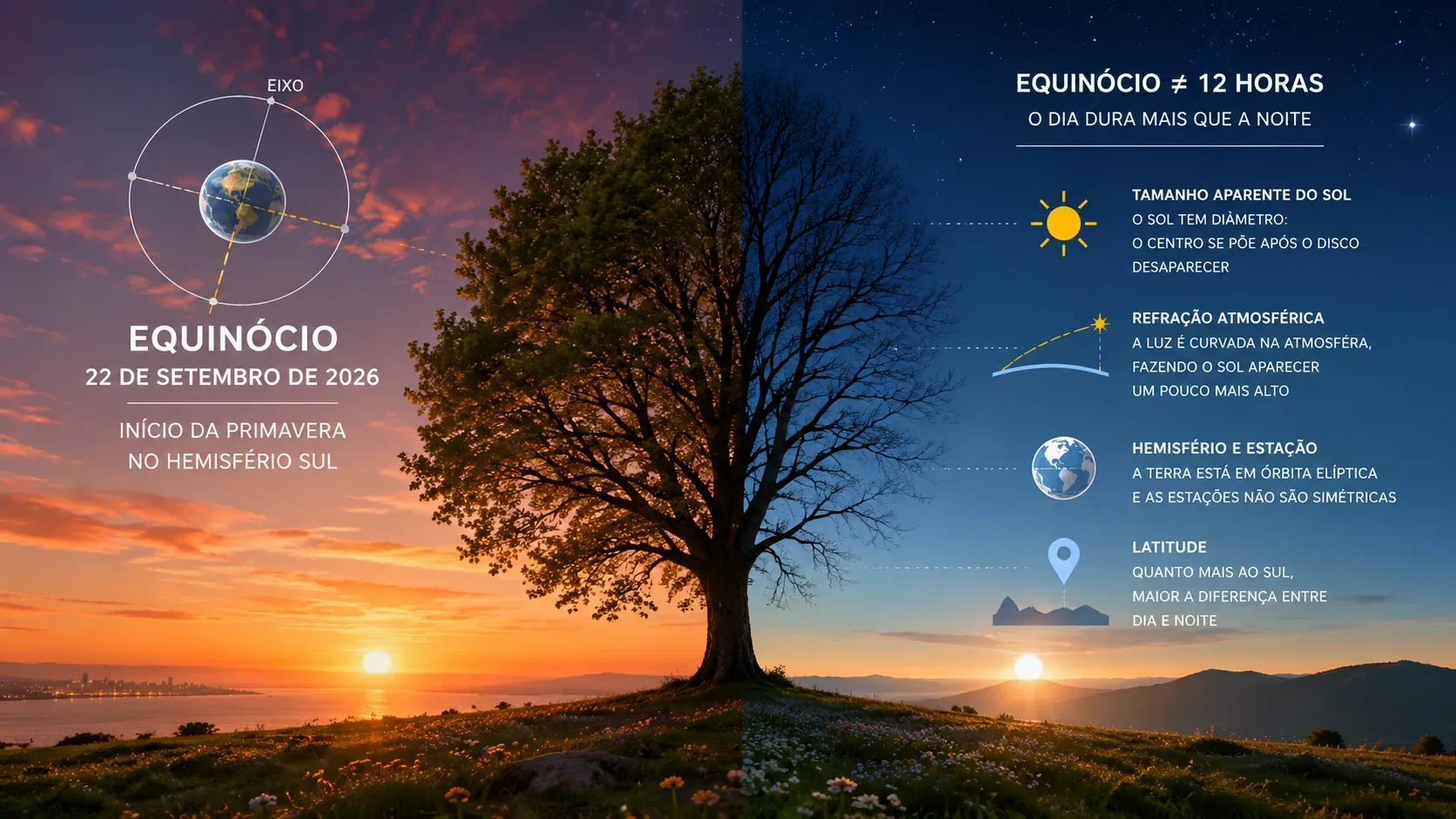
Seasons are reversed in the Southern Hemisphere. According to Brazil’s INMET, spring in 2026 begins in Brazil on September 22 at 9:05 p.m. Brasília time. So when the full Moon arrives four days later, Brazil is entering spring while the Northern Hemisphere is entering autumn.
The moonrise geometry also reverses seasonally. The U.S. Naval Observatory notes that in September the intervals between successive moonrises in the Southern Hemisphere tend to be longer; the classic Harvest Moon effect occurs in the south near the March equinox, when autumn begins there. In other words, if the seasonal phenomenon is adapted to the Southern Hemisphere, its physical counterpart belongs around March, not September.
That does not make it “wrong” for a Brazilian news story to use the label Harvest Moon in September. International media, apps, and calendars often retain the Northern Hemisphere traditional name. The editorial caution is to explain that the label is imported and does not indicate a Brazilian national harvest. Crop and harvest calendars in Brazil vary by crop and region, so the name does not function as a nationwide agricultural marker.
The 2026 Harvest Moon: when to see it from Brazil
| Event | Reference date and time | What it means for observers in Brazil |
|---|---|---|
| September equinox | Sep. 22, 2026, 9:05 p.m. (Brasília) | Start of spring in the Southern Hemisphere. |
| Exact full Moon | Sep. 26, 2026, 1:49 p.m. (Brasília) | Maximum phase occurs in the afternoon; by nightfall the Moon will still look essentially full. |
| Moonrise in Brasília | Sep. 26, 2026, around 6:12 p.m. | The Moon rises in the east shortly after sunset. The exact time changes by city. |
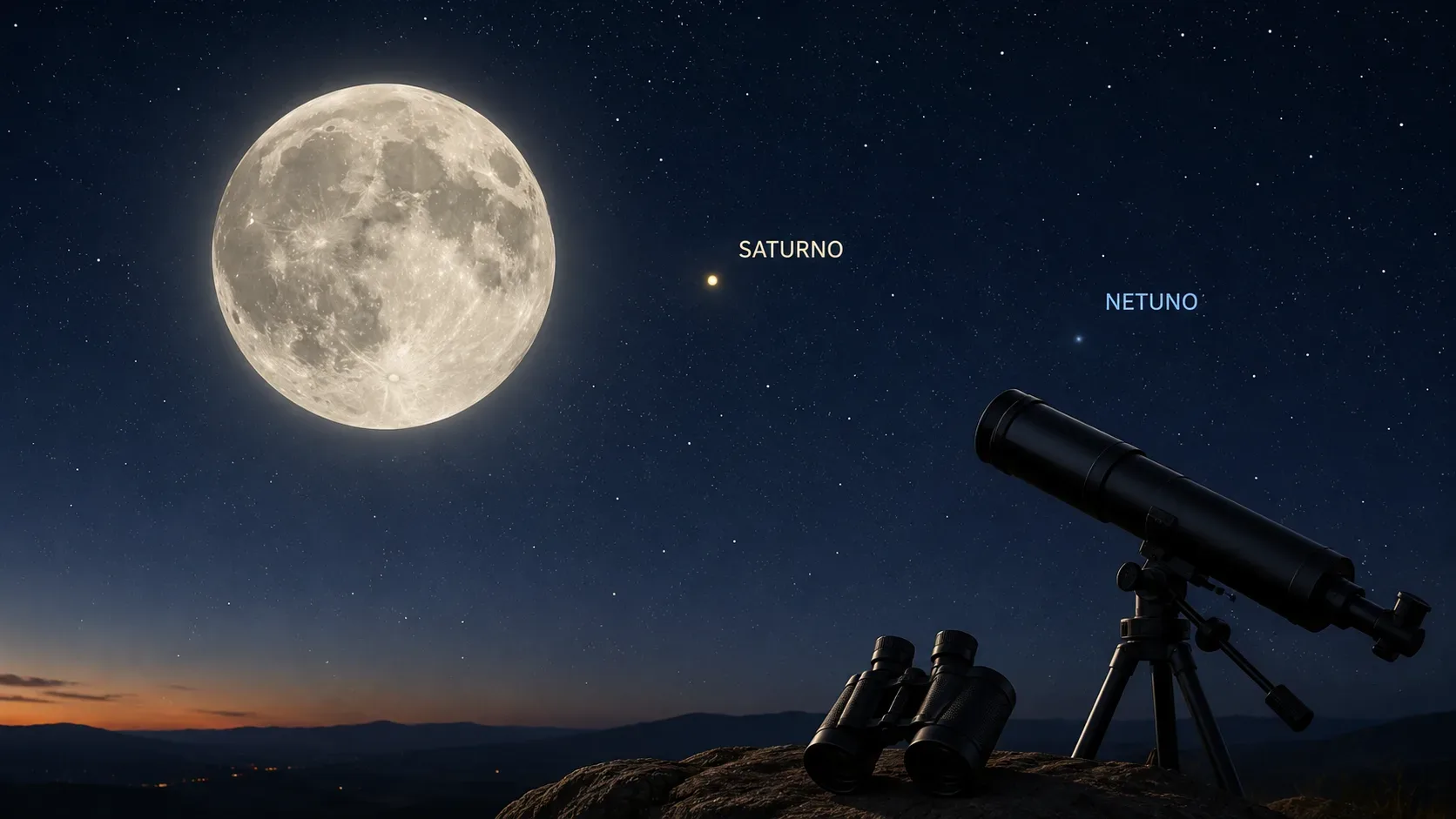
| Nearby objects | Night of Sep. 26 | Saturn appears near the Moon; Neptune is in the same area but is too faint for unaided viewing. |
The phase and moonrise times for Brasília can be checked in the 2026 lunar phase calendar and the monthly moonrise and moonset table. For other cities, use local times: latitude, longitude, and the local horizon change the exact moment the Moon becomes visible.
How to observe it
- Find a location with an unobstructed eastern horizon at the beginning of the evening on September 26.
- You do not need a telescope to enjoy the full Moon or see Saturn if the sky is clear.
- To try to locate Neptune, use binoculars or a telescope plus an up-to-date sky chart; NASA puts it at around magnitude 8, below the naked-eye limit.
- If clouds spoil the night of September 26, the Moon will still look very full on nearby nights, even though the exact astronomical instant has passed.
Does the Moon become larger, more golden, or brighter because it is a Harvest Moon?
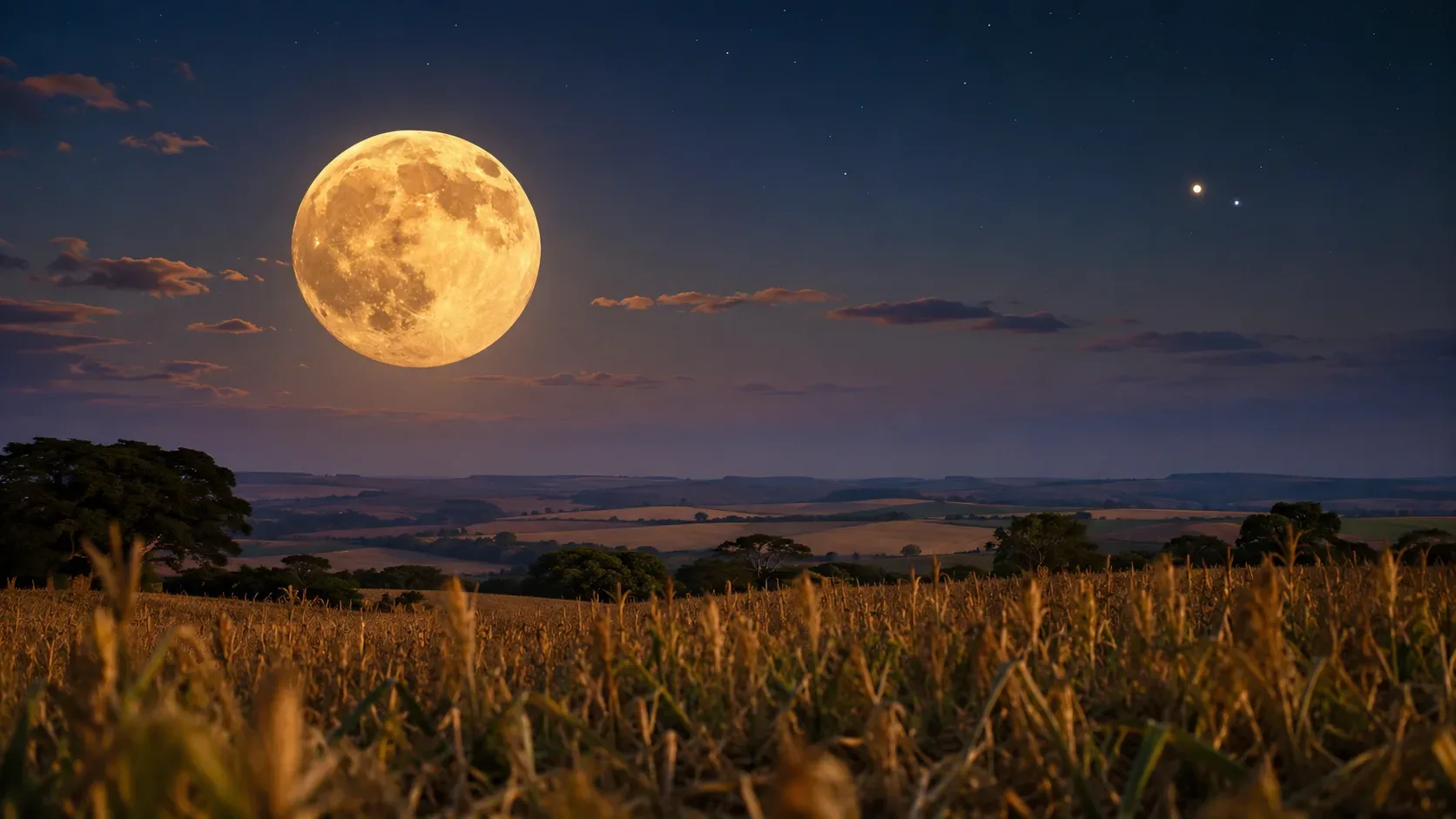
Not because of the name. A Harvest Moon can look golden or orange when it is low because moonlight travels through more of Earth’s atmosphere. NASA explains that the Moon tends to look more yellow or orange near the horizon. It can also look enormous at moonrise, but that is the Moon illusion: the lunar disk does not physically grow near the horizon.
So photographs showing a gigantic Moon above trees, buildings, or fields do not demonstrate a special property of the Harvest Moon. Color, apparent size, and photographic framing can be dramatic, but they come from atmosphere, perception, and imaging choices — not from the seasonal name.
So what should the September 26 full Moon be called in Brazil?
There are two clear approaches. In an international context, “the September 26 Harvest Moon” is valid as long as it is explained as the traditional name tied to Northern Hemisphere autumn. In a strictly Brazilian context, “September full Moon” is more neutral and avoids implying a connection with Brazil’s harvest calendar.
The most accurate reading is therefore this: on September 26, 2026, Brazil will see the same full Moon that many Northern Hemisphere calendars call the Harvest Moon. What does not automatically cross the equator is the seasonal meaning of the name.