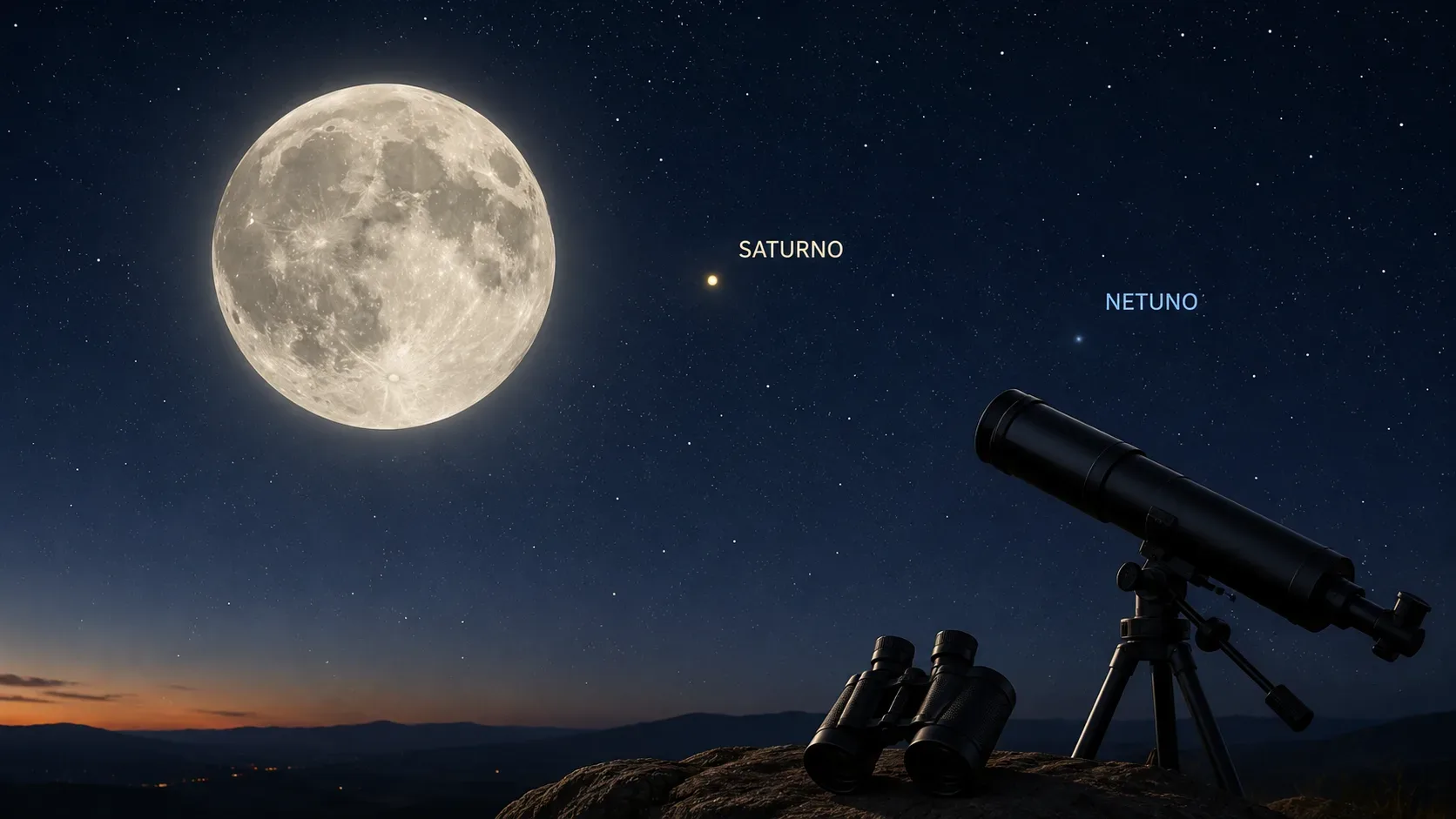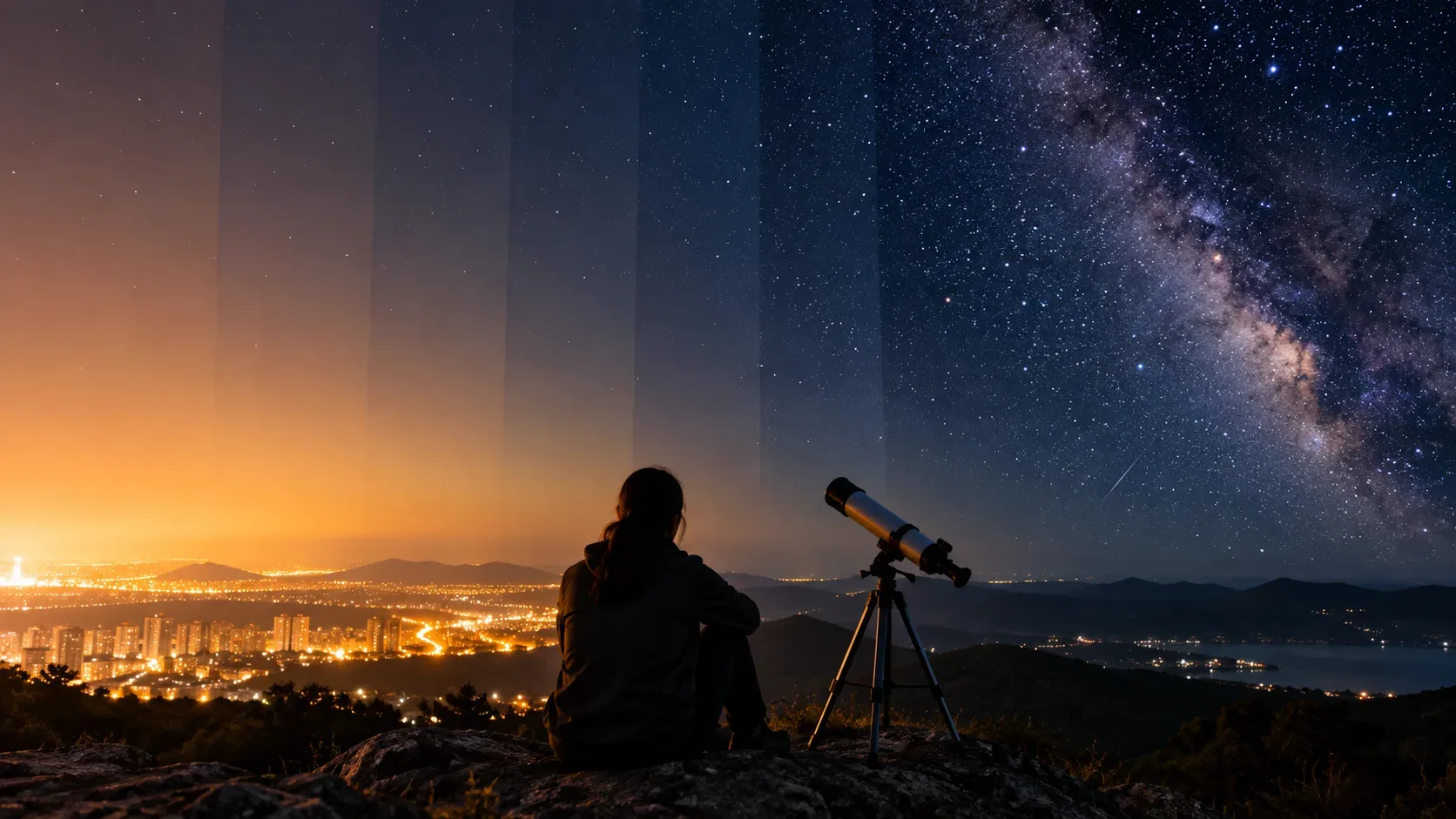
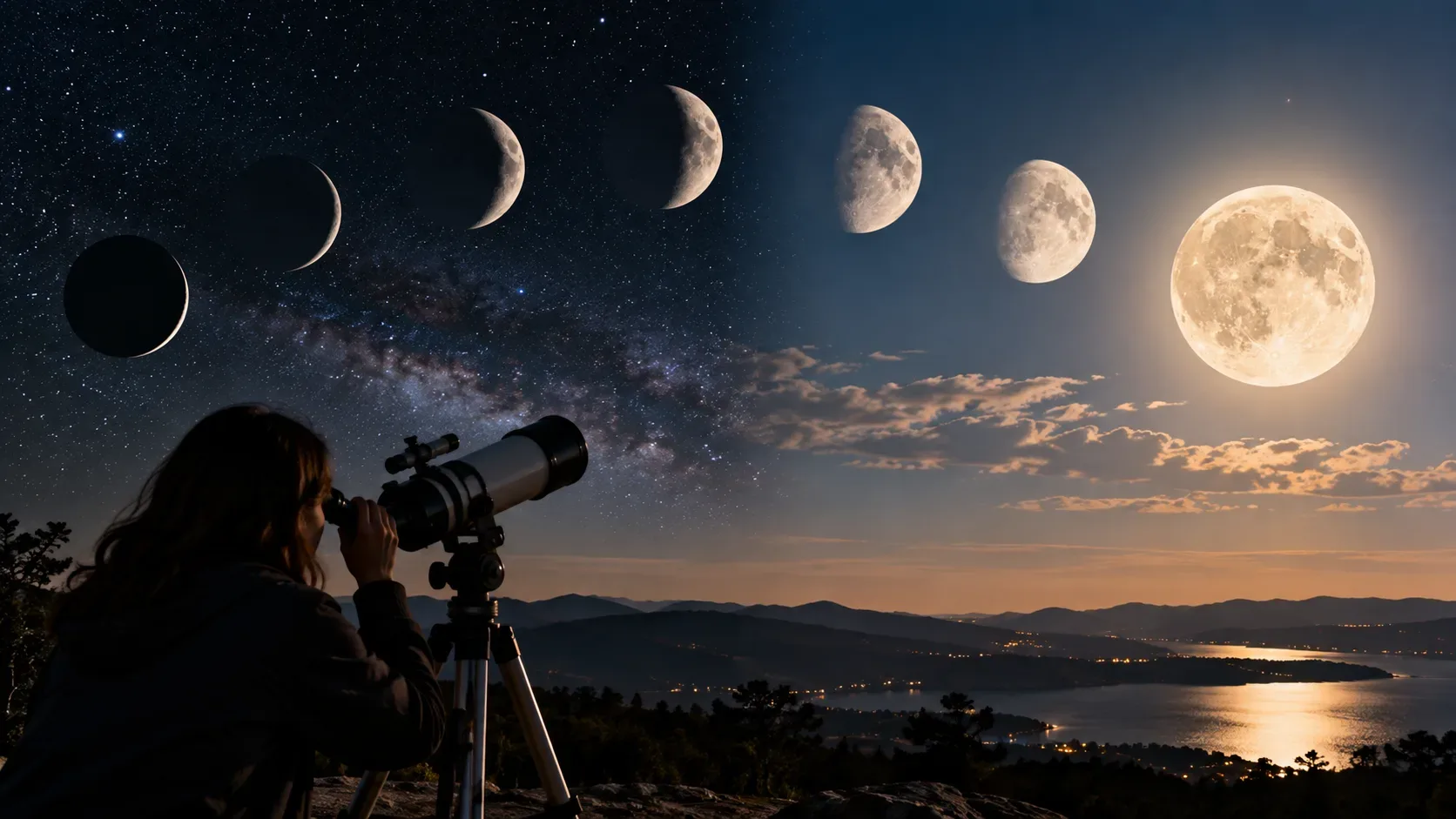
To observe faint stars, the Milky Way, and other deep-sky objects, favor nights near the new Moon, when there is less moonlight. To explore craters and mountains on the lunar surface, choose phases near first or last quarter: low-angle sunlight casts shadows that reveal the terrain. The full Moon is excellent for viewing the entire disk and its broad dark markings, but it is not necessarily the phase that reveals the most topographic detail.
Why does the phase change what you can see?
The Moon produces no light of its own: we see the portion of its face illuminated by the Sun. As it moves along its orbit, the illuminated fraction visible from Earth changes. According to NASA, the cycle between successive new Moons lasts about 29.5 days. At new Moon, the face toward us is dark and the Moon is near the Sun in the sky; at full Moon, the visible face is almost entirely illuminated and the Moon appears opposite the Sun.
The choice depends on your target; there is no single best phase for everything. The moonlight that helps reveal the lunar surface also brightens the sky background and reduces the contrast of faint stars and objects. On the Moon itself, the boundary between the illuminated and dark portions, called the terminator, creates shadows that are particularly helpful for seeing the terrain.
Table: phase, target, and observing window
The windows below are approximate and describe the typical geometry of each phase. Actual moonrise and moonset times vary with date and location; check a forecast for your observing site before heading out.
| Phase | Illumination and effect on the sky | Suitable target | Typical window |
|---|---|---|---|
| New Moon | Visible face dark; little or no moonlight at night. | Faint stars, Milky Way, and dim objects; not a phase for viewing the lunar disk. | At night, provided the sky is dark and clear. |
| Waxing crescent | Small illuminated portion; limited moonlight while it is above the horizon. | Terrain near the terminator and earthshine; stars after moonset. | Early evening in the west; the sky tends to darken after it sets. |
| First quarter | About half the apparent disk illuminated; strong shadows near the terminator. | Craters, mountains, and valleys through binoculars or a telescope. | Late afternoon and evening; sets around midnight. |
| Waxing or waning gibbous | More than half illuminated; strong moonlight, but the terminator remains visible. | Lunar detail along the terminator; lower contrast for faint objects. | Waxing: evening and night; waning: later at night and before dawn. |
| Full Moon | Almost the entire disk illuminated; brighter night sky. | Overall disk, lunar maria, and brightness differences; fewer terrain shadows across the central disk. | Rises near sunset and sets near sunrise. |
| Last quarter | About half the apparent disk illuminated, with shadows over a different region. | Craters and terrain under lighting different from first quarter. | Rises around midnight; late night and morning. |
| Waning crescent | Small illuminated sliver; little moonlight for part of the night. | Stars before moonrise; the Moon and earthshine before dawn. | Last hours before dawn in the east. |
For stars, choose a night with little moonlight
Near new Moon, the Moon generally follows the Sun across the sky and does not significantly illuminate the night. This favors faint stars, the Milky Way, star clusters, and nebulae. Near full Moon, moonlight brightens the sky background and can wash out dim targets even away from cities, as NASA explains in its guide to finding stargazing locations.
You do not have to observe at the exact astronomical instant of new Moon. A thin waxing crescent that has already set, or a thin waning crescent that has not yet risen, can also leave hours of darkness. Alongside the illuminated percentage, check whether the Moon will be above the horizon during your session. Brighter stars and planets remain visible on many full-Moon nights; the main loss is in low-contrast targets.
A moonless sky does not automatically overcome light pollution, clouds, or haze. For faint targets, choose a safe place with an unobstructed view away from direct lights; give your eyes time to adapt to the dark and avoid bright screens while observing.
For craters, look along the terminator
At first and last quarter, the boundary between lunar day and night crosses much of the visible disk. The Sun is low in the local sky along that boundary, so crater rims, mountains, and scarps cast long shadows. The result is a sense of depth even through modest equipment. NASA recommends observing different phases, especially along the terminator, rather than limiting lunar exploration to full Moon.
If you observe early in the evening, first quarter is convenient because the Moon is usually already high in the sky. Last quarter shows terrain lit from a different direction but calls for observing after midnight or in the morning. Returning to the same lunar feature on different nights helps reveal how changing shadows alter its appearance.
Full Moon is still worth observing: it makes the broad lunar maria and brightness patterns across almost the entire disk easy to recognize. But with sunlight falling more directly on central regions, craters and mountains there cast fewer visible shadows. At new Moon, by contrast, the face toward Earth is dark, so there is no illuminated disk to inspect at night. A thin crescent may also reveal earthshine, a faint glow on its dark portion caused by sunlight reflected from Earth.
How to combine dark-sky and Moon observing
If you want both in one outing, try a waxing crescent in the days after new Moon: study the lunar surface early in the evening and switch to faint stars after moonset. Another option is deep-sky observing early in the night before a waning Moon rises, then turning to the Moon later. These strategies depend on local moonrise and moonset times, the length of the night, and sky conditions.
Before setting up, check a phase calendar, local Sun and Moon rise and set times, and the cloud forecast. Phase alone does not tell you when the Moon will be visible: a full Moon spans nearly the entire night, first quarter favors the early evening, and last quarter favors the hours after midnight. Approximate times also shift with season and latitude.
What to use and what precautions to take
With the naked eye, you can distinguish the phase and broad light and dark areas. Steady binoculars add texture and let you inspect the terminator; a telescope reveals smaller craters and features, depending on aperture, optical quality, and atmospheric steadiness. Start at low magnification to find your target and increase it only while the view stays sharp. The Moon can also be observed from urban locations, although faint stars are more affected by artificial lighting.
Never point binoculars or a telescope at the Sun or near it without appropriate solar equipment and expert guidance. When viewing a crescent low on the horizon, wait until the Sun is fully below the horizon and ensure a safe pointing direction. Do not confuse new Moon with an eclipse: the alignment required for an eclipse does not occur every lunar cycle.
Checklist before heading out
- Choose the target: deep sky and faint stars call for little moonlight; lunar terrain calls for a well-defined terminator.
- Check the phase, illuminated fraction, and local moonrise and moonset times. Plan the part of the night when the Moon will be present or absent.
- Check clouds, sky transparency, an open horizon, and nearby artificial lights.
- Bring suitable clothing, subdued lighting, and a steady instrument if available; observe safely and never point optics at the Sun.