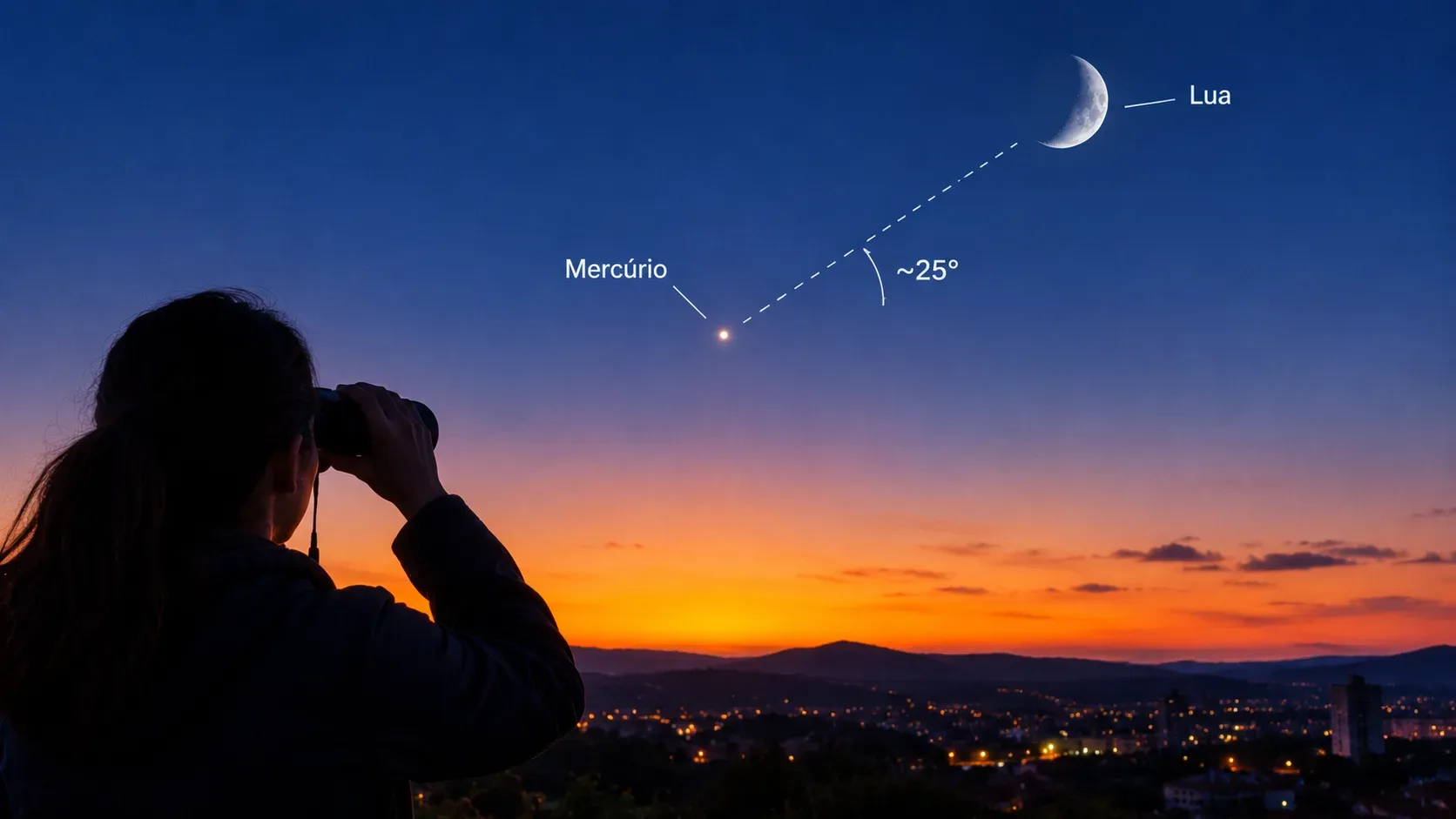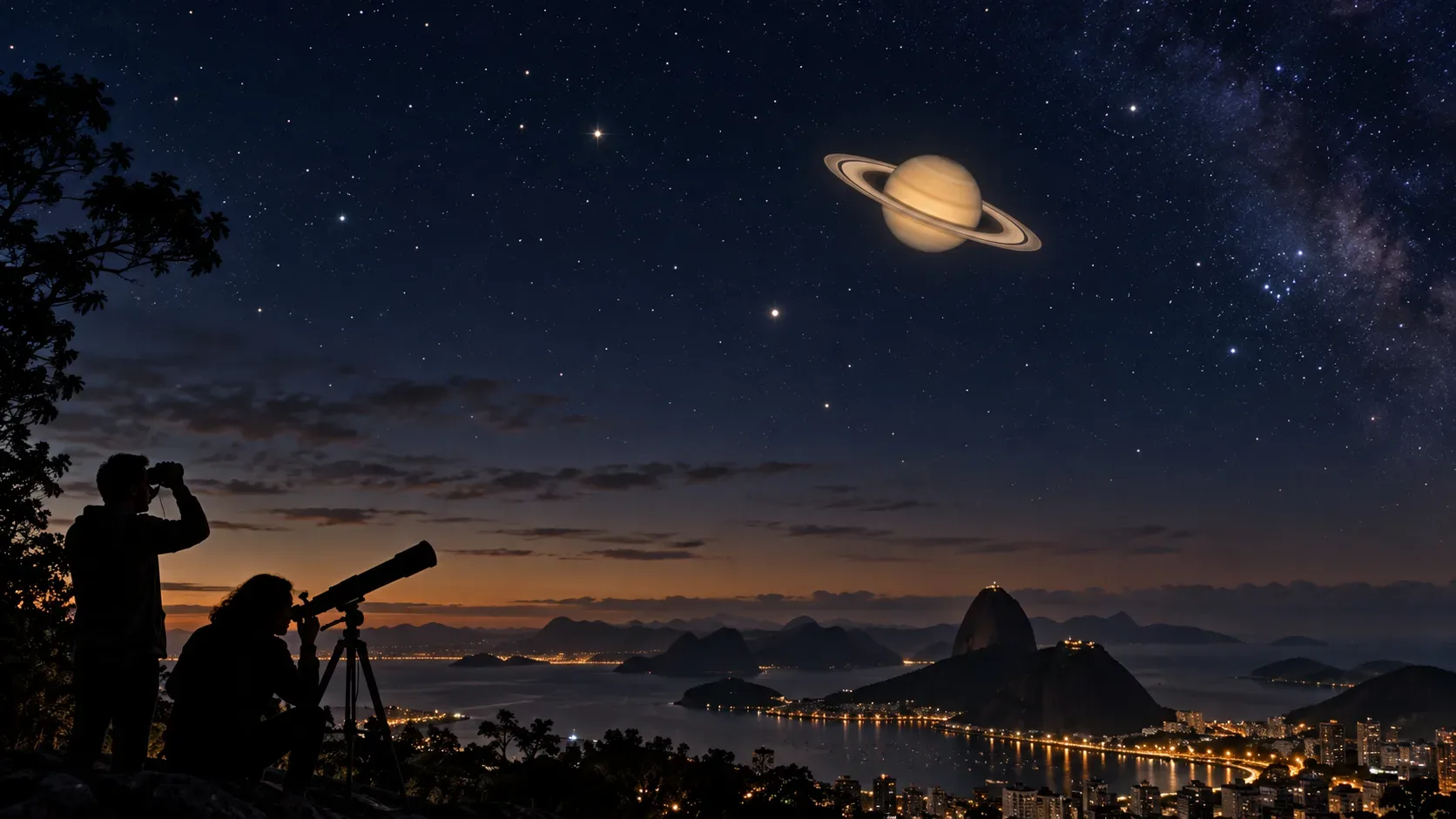
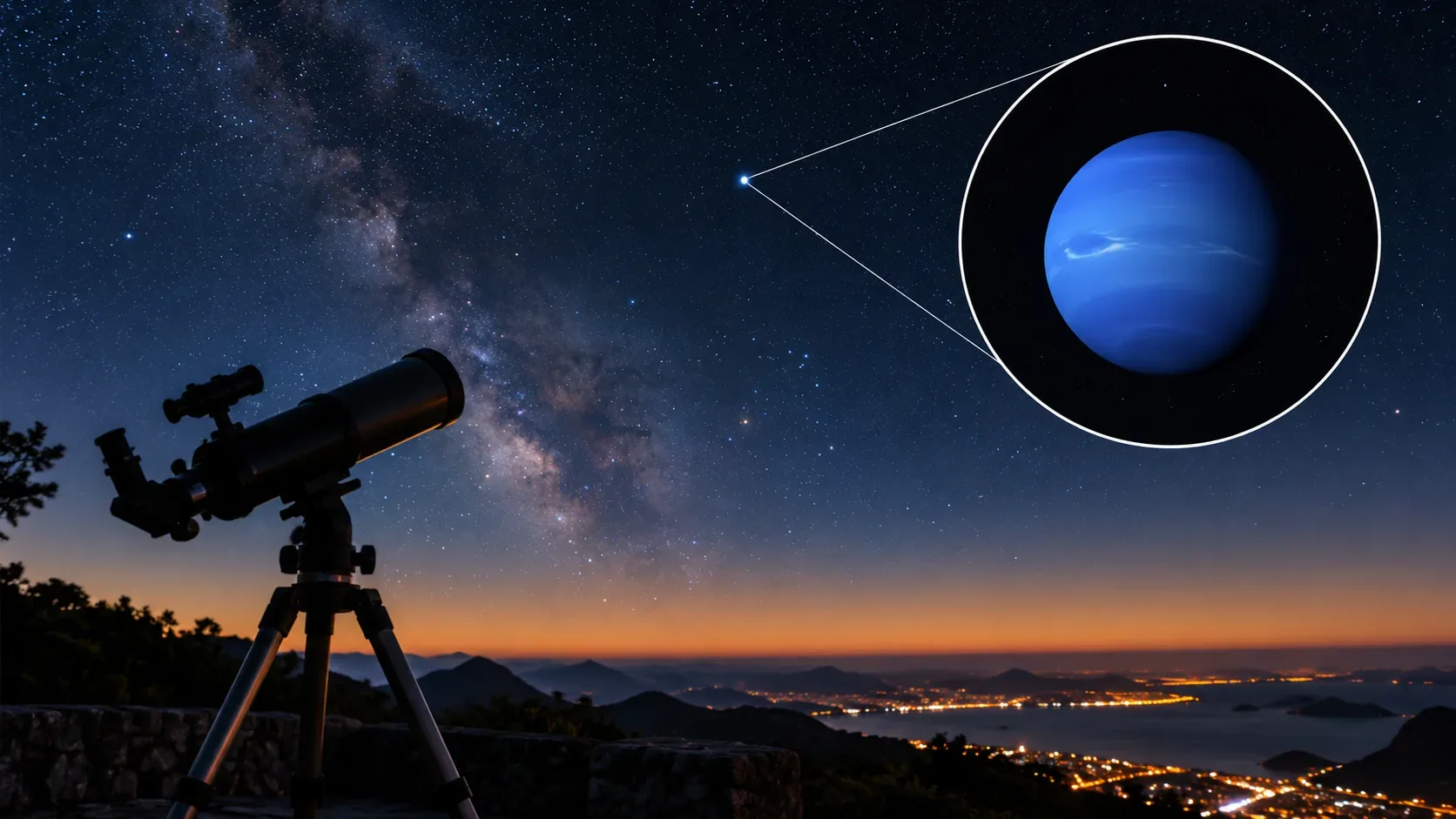
On the night of September 25, 2026, Neptune reaches opposition for observers in Brazil. It is the best annual window to look for the planet because Neptune lies approximately opposite the Sun in the sky, rises near sunset, remains observable for much of the night, and is close to its smallest Earth distance of the year. That does not, however, make Neptune a naked-eye object.
The key is to set realistic expectations: near opposition, Neptune shines at about magnitude 7.8 and measures only around 2.4 arcseconds across. Even under a very dark sky, human vision normally reaches stars around magnitude 6 to 6.5. Neptune therefore still requires binoculars or, preferably, a telescope for a reliable identification.
What it means for Neptune to be at opposition
In astronomy, an outer planet is at opposition when, as seen from Earth, it appears roughly 180 degrees from the Sun in the sky. Earth lies between the Sun and the planet. Brazil’s National Observatory explains that this geometry makes opposition the most favorable time of year to observe outer planets: they are illuminated face-on from our perspective, remain in the sky for almost the entire night, and are near their closest annual approach.
NASA’s 2026 events list marks Neptune’s opposition on September 25. Ephemerides that record the instant in UTC may show September 26; converted to Brazilian time zones, the event falls on the night of September 25–26. For practical observing, the calendar difference does not change the strategy: the hours around local midnight are the most convenient because Neptune will be high in the sky.
Why opposition does not make Neptune visible to the naked eye
The word “opposition” can suggest that the planet becomes dramatically brighter. The effect varies from planet to planet, but for Neptune it is limited by the enormous distance. According to the 2026 ephemeris from In-The-Sky.org, near opposition Neptune will be about 28.9 astronomical units from Earth, at roughly magnitude 7.8, with a disk only 2.4 arcseconds wide.
The magnitude scale works in the opposite direction from what the numbers might suggest: lower values mean brighter objects. Sky & Telescope uses roughly magnitude 6 to 6.5 as a reference for the naked-eye limit under good to exceptional skies. At magnitude 7.8, Neptune is fainter than that threshold. Light pollution, humidity, haze, and moonlight make the challenge even greater.
Opposition also changes Neptune’s apparent distance relatively little over several weeks. Because the planet is so far away, a change of a few tenths of an astronomical unit does not produce a visual change comparable with what observers see for Mars. In practice, opposition means “best opportunity of the year,” not “easy planet.”
What to expect through binoculars or a telescope
With good-aperture binoculars such as 10x50s, under a dark sky and with a precise chart, Neptune can be detected as a faint star-like point. The main problem is not only seeing it, but being certain which point in the field is the planet. That is why a star chart or astronomy app is essential.
A telescope makes confirmation more reliable. At low power, Neptune still looks nearly stellar. With sharp focus, steady atmospheric conditions, and higher magnification, its tiny blue-gray disk may begin to separate from a point-like star. NASA Science recommends a telescope or high-powered binoculars and notes that Neptune often appears as little more than a dot in many amateur telescopes.
Do not expect to see the clouds, storms, or fine details shown in spacecraft images or processed astrophotography. Those views are produced with instruments and techniques very different from ordinary visual observing.
How to locate Neptune from Brazil on September 25
At the 2026 opposition, Neptune will be in the constellation Pisces, very close to the celestial equator. That favors Brazil: from much of the country, the planet climbs well above the horizon and passes relatively high in the sky during the central hours of the night.
- Set the correct location. Open a star chart or astronomy app and enter your city, September 25, 2026, and a nighttime hour. The exact position in the field depends on location and time.
- Find the Pisces region first. Saturn will be much brighter in the same broad area of sky and can serve as a general reference, but pointing at Saturn is not enough: Neptune is far fainter and requires a more detailed field map.
- Use low power to find the field. With a telescope, begin with an eyepiece that shows a wider area of sky. Compare the star pattern in the eyepiece with the chart.
- Confirm with the star pattern. Neptune moves slowly against the background stars. Repeating the observation on another night and comparing the field helps confirm which point is the planet.
- Increase magnification only after locating it. High power reduces the field of view and makes the initial search harder. It is more useful when trying to perceive the tiny disk.
The nearly full Moon will be an obstacle in 2026
There is a specific complication for this opposition. NASA’s astronomical calendar places the full Moon on September 26, 2026, only hours after Neptune’s opposition. In practice, the night of September 25–26 will have strong moonlight. NASA’s September 2026 “What’s Up” guide also notes that Neptune is around magnitude 8 and that darker skies and good observing conditions help bring it into view.
This means the exact opposition date is not necessarily the easiest visual night for a beginner using binoculars. Neptune changes very little in brightness from one night to the next. If the Moon, clouds, or humidity interfere, it is worth trying again a few days later, while the planet remains almost equally bright and the geometry is still favorable.
Conditions that improve your chances
- Clear, transparent sky: high clouds, haze, and humidity scatter light and erase faint targets.
- Less light pollution: with binoculars, moving away from urban lighting makes a major difference.
- Good dark adaptation: avoid bright white screens; if you need an app, lower the display brightness and use night mode.
- Stable optical equipment: mount binoculars on a tripod or steady support when possible. With a telescope, a stable mount makes it easier to compare field stars.
- An up-to-date chart: a rough constellation position is not enough for a magnitude 7.8 object. Use a chart that shows faint nearby stars.
Binoculars or telescope: what makes more sense
| Tool | Realistic expectation | Best use |
|---|---|---|
| Naked eye | Neptune will not be visible | Recognizing constellations and bright reference objects |
| 10x50 binoculars | Possible detection as a faint point under dark skies | Locating the field with a precise chart |
| Telescope at low power | More reliable identification among field stars | Finding and confirming the target |
| Telescope at higher power | Possible perception of a tiny disk and bluish tint | Distinguishing Neptune from a point-like star |
What opposition really changes for the observer
Opposition combines three advantages: Neptune is available for almost the entire night, reaches its brightest part of the year, and is high in the sky near the middle of the night. None of these removes the main limitation: the planet remains extremely distant and faint.
For observers in Brazil, the most effective strategy is to treat opposition as a window of several nights rather than an event lasting a few minutes. Use an app or star chart configured for your city, begin with a wide field, confirm the star pattern, and only then increase magnification. If the nearly full Moon on September 25–26 interferes, try again on following nights: you lose very little brightness and may gain substantially in contrast.
In short, opposition does not make Neptune “appear” to the naked eye. It simply places a difficult target under the best annual geometry. With transparent skies, an accurate chart, and optical aid, however, it is an excellent opportunity to find the most distant planet in the Solar System with your own eyes.