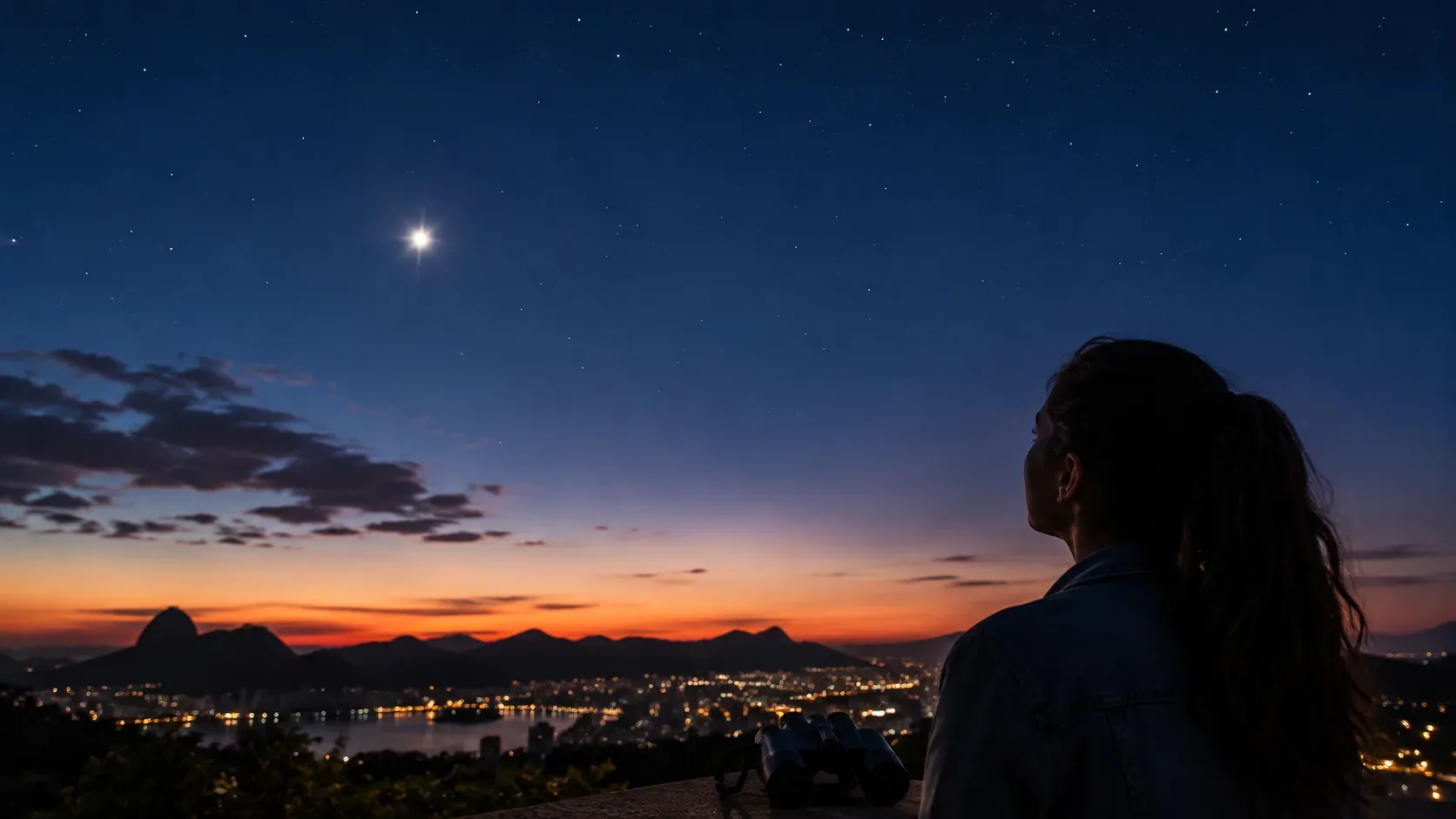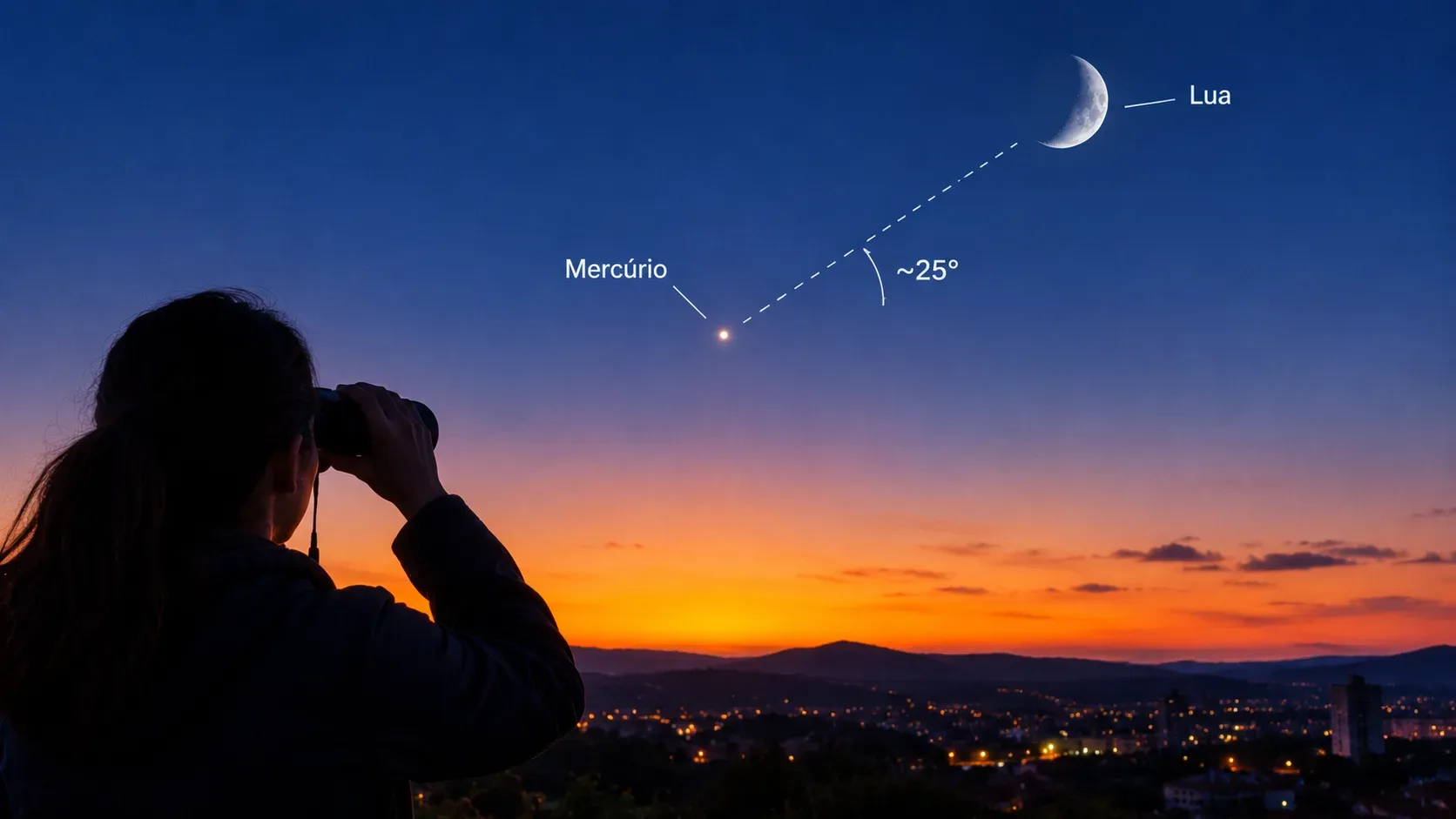
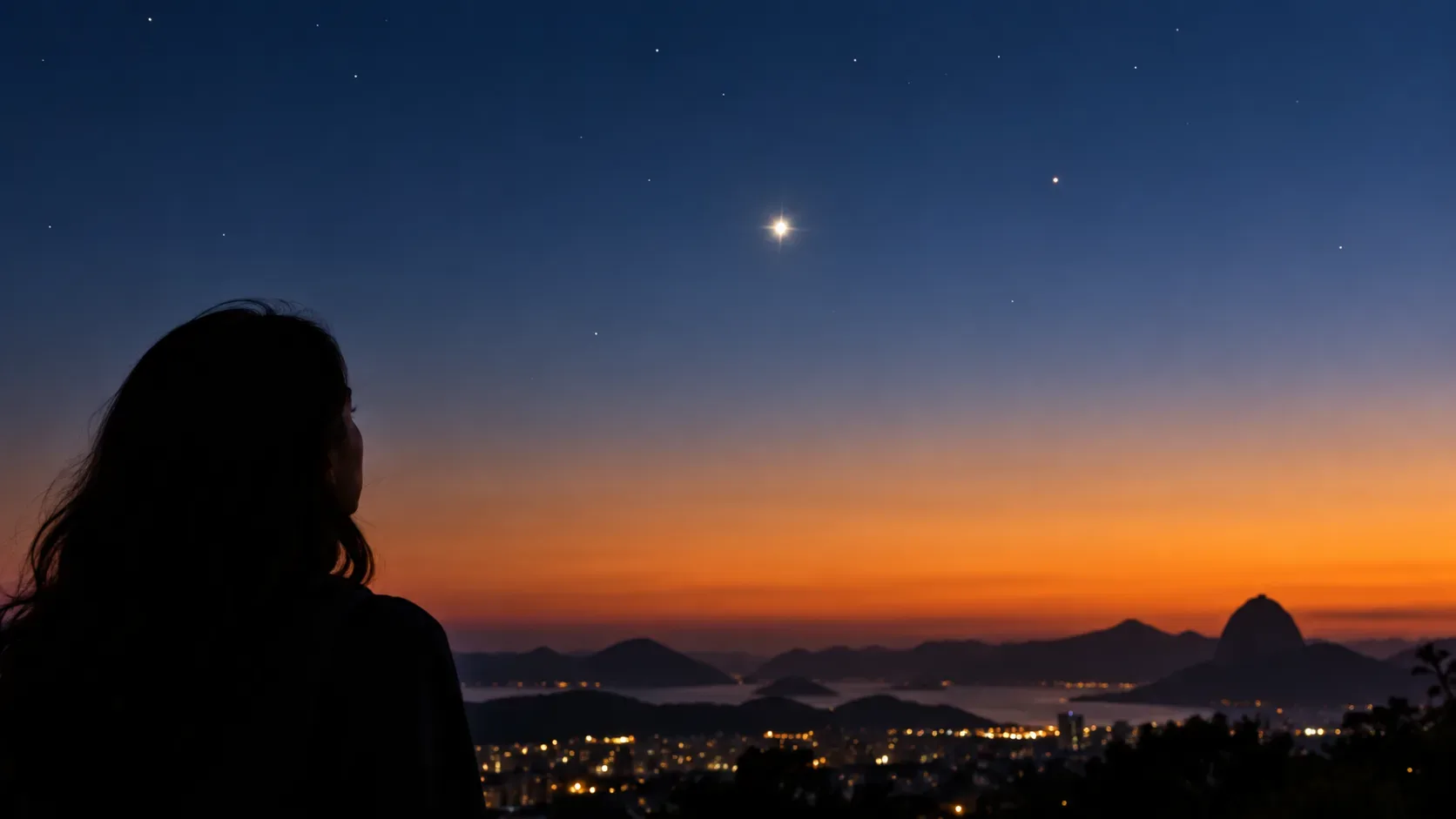
On September 18, 2026, Venus reaches the peak brightness of this evening apparition, according to NASA. For observers in Brazil, the simplest rule is to look toward the western sky shortly after local sunset. No telescope is required; to the unaided eye, Venus should stand out as an exceptionally bright point in the twilight.
Quick answer: where and when to look for Venus
- Date: September 18, 2026.
- Direction: west, on the same side of the horizon where the Sun has just set.
- Best starting time: about 20 minutes after local sunset.
- Practical window: roughly 20 to 90 minutes after sunset; after that, Venus remains visible while it is above the horizon, but it gets progressively lower.
- Equipment: none. Binoculars and telescopes are optional and should only be used after the Sun is completely below the horizon.
NASA highlights September 18 as the peak-brightness date for this evening apparition. EarthSky estimates a magnitude of about -4.8 and places the maximum near 23:00 UTC, equivalent to 8:00 p.m. in Brasília time and 7:00 p.m. in Manaus. This is not a sudden flash: the brightness changes gradually, so a difference of a few minutes, or even a nearby night, is small visually.
What time to observe from Brazil on September 18
There is no single clock time that works for the entire country because sunset and time zones vary by location. The most reliable method is to use local sunset as your reference and begin searching about 20 minutes later. The examples below combine sunset data from Timeanddate, Timeanddate for Rio de Janeiro and Timeanddate for Manaus with Venus ephemerides from Céu do Sul, Céu do Sul for Rio and Céu do Sul for Manaus.
| City | Sunset | Venus sets | Suggested practical window |
|---|---|---|---|
| Brasília | 18:07 | 20:46 | 18:25–19:40 |
| Rio de Janeiro | 17:47 | 20:38 | 18:05–19:20 |
| Manaus | 17:57 | 20:17 | 18:15–19:15 |
The suggested windows are practical guidance, not official astronomical observing times. Clouds, buildings, hills, trees and atmospheric transparency can shorten the view. In other Brazilian cities, use the same rule: check local sunset, wait for the solar disk to disappear, then begin looking for Venus in the west.
Where to look in the sky
After sunset, face west. Venus will be in the evening sky and will descend toward the horizon as the evening progresses. A location with an unobstructed view toward the sunset side is especially helpful once the planet is lower.
You do not need to know the constellations to find it. Use the area of the horizon where the Sun disappeared as your reference and scan the sky above it with your eyes. As twilight darkens, Venus tends to appear before many stars because of its exceptional brightness.
How to tell Venus from a star
- Brightness: Venus should be the brightest star-like point in that part of the sky.
- Color: it usually looks white or yellowish-white to the unaided eye.
- Twinkling: planets generally twinkle less than stars, although atmospheric turbulence near the horizon can make even Venus flicker or change color briefly.
- Apparent motion: over the evening, it follows the sky's rotation and sinks toward the western horizon.
If several bright points are visible, the combination of west + shortly after sunset + extremely high brightness is the most useful clue for identifying Venus on the 18th.
Why Venus can be brightest without being “full”
Venus's brightness as seen from Earth depends on a balance between two factors: how much of its illuminated side faces us and how large the planet appears in the sky. As Venus moves closer to Earth in its orbit, its apparent disk grows while its phase becomes thinner. Greatest brilliancy occurs near the point where this combination produces the greatest apparent amount of light, not when the planet has the largest illuminated fraction.
That is why a small telescope can show Venus as a crescent around this time even though it still looks like a single bright point to the naked eye.
Do you need a telescope or binoculars?
For the main goal — finding Venus and seeing it near peak brightness — no. Naked-eye observing is enough and is the simplest option for beginners.
Binoculars or a telescope can reveal the phase more clearly, but there is an important safety rule: never sweep the sky near the Sun with optical instruments while the Sun is above the horizon. Wait until sunset is complete before aiming binoculars or a telescope toward Venus.
What if it is cloudy on September 18?
Peak brightness is not a seconds-long event. Venus will already be extremely bright on nearby evenings, and the change is gradual. If clouds block the view on the 18th, try the night before or after; for casual viewing, the brightness difference will be hard to detect with the unaided eye.
Observation checklist
- Check the cloud forecast near the western horizon.
- Choose a location without buildings, hills or trees blocking the view.
- Check local sunset time.
- Begin looking about 20 minutes later.
- Find the brightest point in the western sky.
- Use optical instruments only after the Sun has fully set.