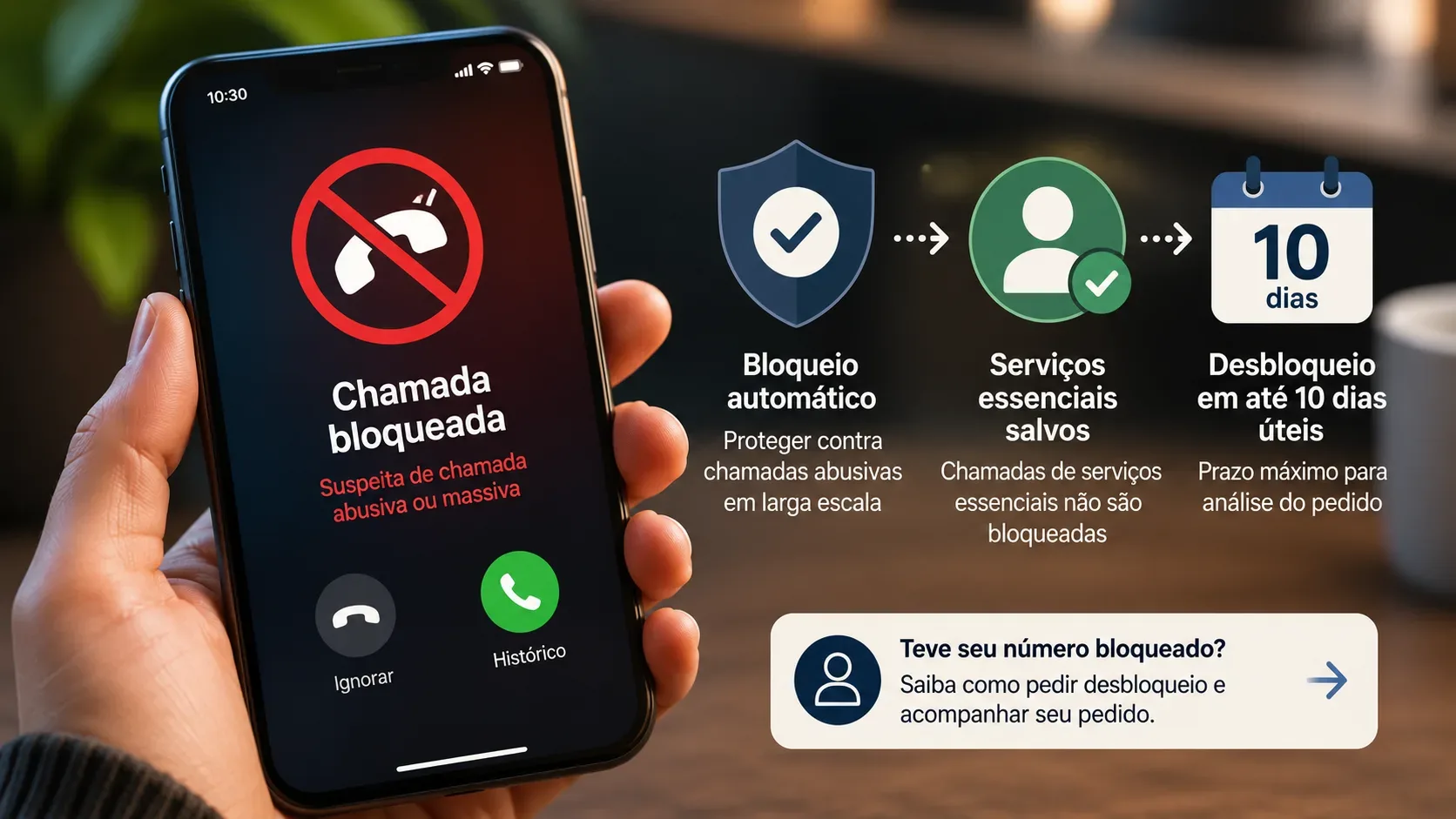
On August 17, 2026, Anatel published a rule establishing common parameters for carriers’ own filtering and blocking mechanisms for mass calls. The most important point for people receiving calls is that, when a carrier adopts this kind of solution, it must activate it by default for its customer base, at no extra charge, give prior notice, and offer a simple way to disable it. For people or organizations originating calls whose number is blocked, the carrier responsible must provide a specific channel or procedure for information and a possible unblocking request, with 10 calendar days to respond or unblock the number when the case does not fit the criteria or warrants differentiated treatment.
The measure is contained in Decision Order No. 82/2026/RCTS/SRC. It does not create a nationwide blocking app, does not prescribe a single technology, and does not establish one universal number of calls that automatically makes any line abusive. Its purpose is to guide how carriers may operate their own antispam systems with proportionality, good faith, transparency, and safeguards against improper blocking.
What Anatel’s new rule requires
| Situation | What the rule provides |
|---|---|
| A carrier decides to use its own antispam filter | The solution must follow the principles and criteria established by Anatel. |
| Carrier customer | Activation must be the default for the customer base, with no additional charge and with prior notice. |
| Customer does not want to use the filter | The carrier must offer an opt-out through a simple and accessible method. |
| An originating number is blocked | The responsible party may request information and possible unblocking through the channel or procedure of the carrier that applied the block. |
| Unblocking request | The carrier has 10 calendar days to respond or unblock when it finds that the traffic does not meet the blocking criteria or merits differentiated treatment. |
| Essential and public-utility services | Safeguards must prevent the blocking of numbers used, among others, by public security, fire departments, civil defense, and health services. |
Will automatic blocking be mandatory at every carrier?
Not exactly. Anatel’s official communication says that carriers’ own filtering and blocking mechanisms are adopted at the carriers’ discretion. The rule standardizes the conditions that must be observed when a company uses such a solution. It should therefore not be read as the creation of one mandatory, identical national filter across all networks.
There is, however, an important obligation once a carrier decides to implement the mechanism: the solution must be activated by default for its customer base, without an additional charge. Before activation, the company must communicate the change and its effects. Its customer-service channels and website must also clearly explain the existence and general operation of the filter.
How a carrier decides that a call may be mass or abusive traffic
The order uses contextual criteria. Among them is the compatibility between call volume and duration and the purpose and characteristics of proper use of voice service. This means the mechanism should not look only at an isolated call count without considering the pattern and purpose of the traffic.
The new rule also requires proportionality, good faith, and non-discrimination. In practice, these principles serve as limits intended to prevent automated systems from treating every high-volume traffic pattern as necessarily abusive.
This rule should be distinguished from Anatel’s other measures against abusive calls. The agency maintains specific actions involving large callers, call authentication, improper network use, and other mechanisms. Decision Order No. 82/2026, however, does not establish a specific technology or a universal numerical threshold for each carrier’s own filter.
Which calls need safeguards against improper blocking
Anatel required mechanisms to include protections for numbers used by essential and public-utility services. The official communication mentions public security, fire departments, civil defense, and health services.
This safeguard matters because an overly aggressive filter can create a problem greater than the one it is meant to solve. An antispam system should reduce unwanted mass calls without preventing legitimate and socially essential communications.
How to disable automatic blocking if you do not want the filter
Customers must be able to choose not to use the mechanism. This right appears as an opt-out: the carrier has to provide a simple and accessible way to turn off the filter.
The order does not create one national button or an identical path for all carriers. Because each carrier may choose its own technology, the opt-out path may also vary. A practical approach is to:
- check the notice sent by your carrier about activation of the filter;
- look in the carrier’s app, website, or customer-service channel for an antispam, call-filtering, or call-blocking option;
- if the option is not clear, ask customer service for the specific instructions to exercise the opt-out;
- keep the service protocol number, especially if deactivation is not completed.
The opt-out concerns the carrier’s own antispam mechanism. It should not be confused with Brazil’s Não Me Perturbe telemarketing suppression service, manual number blocking on a phone, or other regulatory measures against improper network use.
Your number was blocked when making calls: how to request unblocking
The rule also creates a process for the other side of the call: an originating user whose number was blocked by a given carrier’s mechanism. In this case, the company that applied the block must provide a specific channel or procedure for information and a possible unblocking request.
Because the order does not establish a single national form, the request must be directed to the carrier responsible for the block. To reduce back-and-forth, it is useful to gather information that can demonstrate the legitimate purpose of the calls, such as the line holder’s identification, the affected number, approximate dates of the block, the nature of the service provided, and relevant traffic characteristics. The exact documentation may vary depending on the carrier’s process.
The deadline is 10 calendar days
The carrier has 10 calendar days to provide a response or carry out the unblocking when it finds that the call does not meet the criteria in the order or has characteristics that justify differentiated treatment.
This means calendar days, not business days. It is also important that the rule says response or unblocking depending on the analysis; it does not mean every request will automatically result in release of the number.
What to do if the carrier does not explain the filter or solve the problem
For telecommunications consumers, Anatel’s general guidance is to start with the carrier and keep the protocol number. If regular customer service does not resolve the issue, the next step is the carrier’s ombudsman. If the problem persists, a complaint can be filed through Anatel Consumidor.
This general complaint flow has its own deadline: once a complaint is filed with Anatel, the carrier has 10 calendar days to respond in the system. This is a complaint-handling deadline in Anatel Consumidor and should not be confused with the separate 10-day deadline in Decision Order No. 82/2026 for a response or possible unblocking of an originating number.
What changes for someone who simply wants unwanted calls to stop
The new mechanism can add an automatic layer of protection within the carrier’s network, but it does not replace every existing tool. Anatel maintains a page on abusive calls with guidance including the Não Me Perturbe service, the Qual Empresa Me Ligou lookup service, and blocking tools available on phones themselves.
These tools have different purposes. Não Me Perturbe is aimed at certain telemarketing calls covered by the service. Manual phone blocking acts on numbers or categories selected by the user. The mechanism covered by Decision Order No. 82/2026, in turn, is filtering performed by the carrier itself, based on traffic criteria and subject to opt-out.
What the rule does not guarantee
- It does not guarantee the end of all spam: filters can reduce mass calls but cannot eliminate every source of unwanted or fraudulent calls.
- It does not create one nationwide list of blocked numbers: the order deals with carriers’ own mechanisms.
- It does not prescribe a single algorithm: companies may choose the technology as long as they follow the criteria and safeguards.
- It does not make every high volume automatically improper: purpose, duration, and usage characteristics must be considered.
- It does not remove customer choice: customers must have access to a simple and accessible opt-out.
Practical summary
For people receiving calls, the most concrete change is the possibility of having the carrier’s filter enabled by default, free of charge, with prior notice and an option to disable it. For people or organizations originating calls, the key change is a formal route to challenge a block and obtain a response or possible unblocking within 10 calendar days. In both cases, the rule seeks to balance the reduction of abusive calls with transparency, customer choice, and protection against improper blocking.
Main source: Anatel — rules expanding automatic blocking mechanisms for abusive calls.