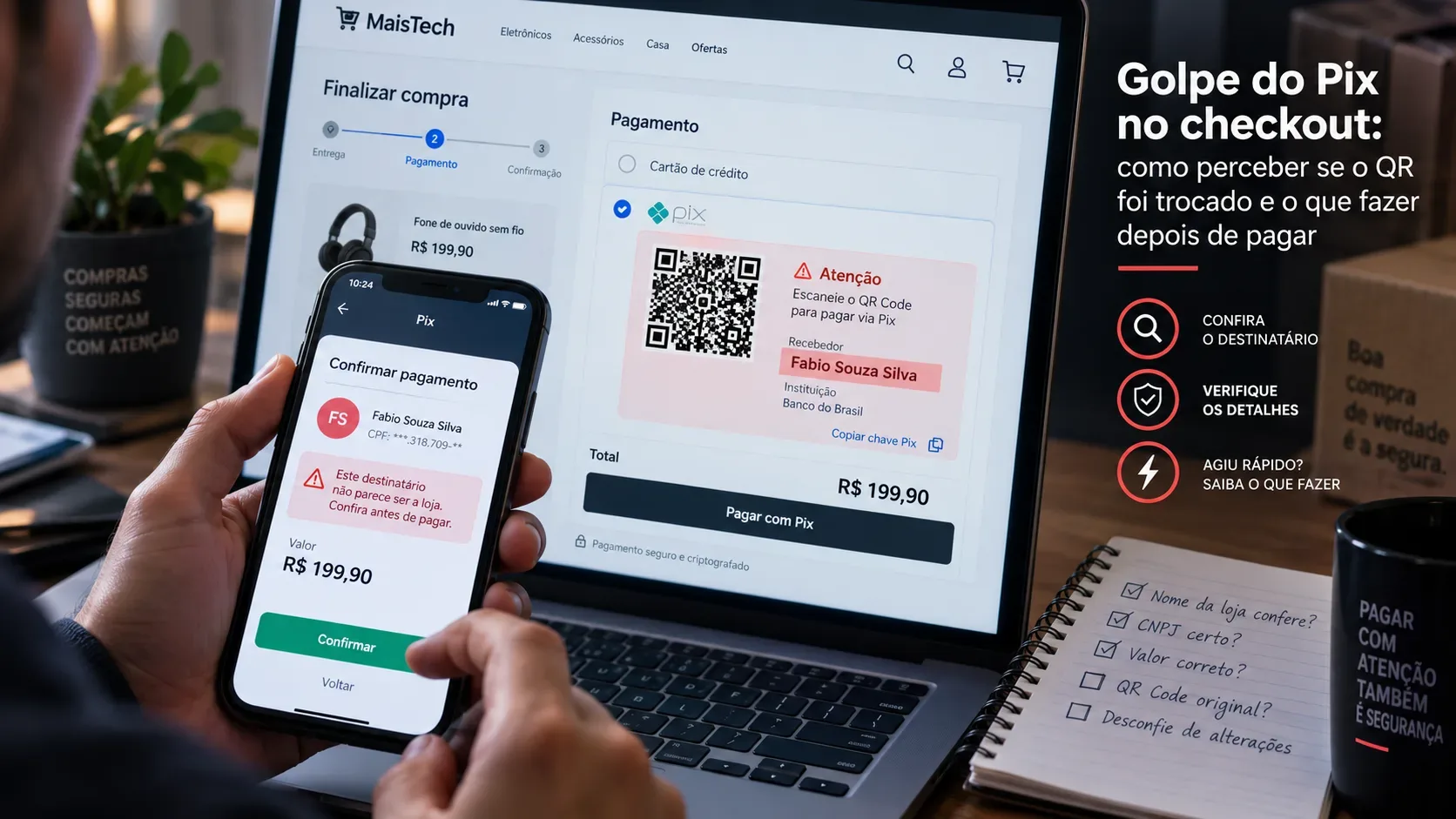
If you made a Pix because you were deceived by a scammer, the Central Bank's guidance is to activate the Special Return Mechanism (MED) through your institution's application as quickly as possible. The request can be made within 80 days of the transaction, but waiting reduces the chance that there are still resources that can be blocked and recovered. All participating institutions must make the service available through the app.
The most important point is to understand what MED is not: it does not work as an automatic chargeback or as a card chargeback. The action opens a dispute and recovery process. There is an analysis of suspected fraud and the refund depends, among other factors, on funds being found in the accounts involved. Therefore, even when there has been a scam, the money may be returned in full, only in part, or not recovered at all.
When should MED be triggered
MED was created for specific situations. In the most relevant case for those who have suffered a scam, it applies when there is a well-founded suspicion that Pix was used in a fraud, scam or crime.
This includes situations where the victim made the transfer themselves after being deceived. The Central Bank's current guide includes, for example, scams in which the criminal induces the victim to make Pix, hacking or fraudulent access to the account, coercion and certain fraud in purchases.
There are also cases of refunds related to operational failures of institutions, such as the system sending duplicates of a single correctly initiated transaction. This is different from the customer making two transfers by mistake: the BC guide makes it clear that a repeated order by the user or the choice of an incorrect destination key or account does not constitute an operational failure for this purpose.
Fraud, commercial disagreement and wrong Pix are not the same thing
The difference between these situations defines whether MED is the appropriate path.
| Situation | MED? | Example |
|---|---|---|
| Fraud or scam | Yes, it can be triggered | The victim is deceived by a scammer and makes the Pix; or a purchase is part of a fraud in which the supposed seller does not send the product |
| Commercial disagreement | No, when there is no seller fraud | Good faith seller's product arrives late, does not meet expectations, or there is another dispute about the purchase |
| Pix sent by mistake | No | The payer himself chooses the wrong key or recipient |
The Central Bank's own guide makes this separation. A commercial dispute does not turn into fraud just because the payment was made by Pix. At the same time, the appearance of a purchase does not prevent MED when there is actually fraud — for example, in certain scams in which the false seller does not even deliver the product. The framework depends on the circumstances analyzed by the institutions.
There is yet another important exclusion: regulation protects third parties in good faith. If funds related to a scam were used to legitimately pay a person or company that did not participate in the fraud, the existence of the MED does not authorize simply debiting that third party as if they were the scammer.
What to do right after you notice the scam
Speed matters because the money received in a fraud can be moved to other accounts. Although the current system has mechanisms to track subsequent transactions and attempt to block funds in involved accounts, this does not mean that there will always be a balance available for refund.
- Open the application of the institution through which the Pix was sent. Enter the Pix area, locate the transaction and look for the dispute or MED option. If you cannot locate the functionality or are unable to use it, immediately contact the institution's official customer service channel.
- Inform that it is a scam, fraud or crime and describe what happened precisely. Keep the protocol number. In self-service, the institution must register the demand and initiate the corresponding procedure for an eligible transaction.
- Preserve the evidence. Proof of Pix, conversations, advertisements, data presented by the scammer and other records can be useful in the analysis. The Central Bank also recommends filing a police report in parallel when the person has been a victim of a scam.
- Do not delay the MED to gather all the documentation. The Central Bank's guide instructs the institution to initiate the Recovery of Values immediately after receiving the complaint, without previously requiring documents such as a police report. Documentation can be requested later for merit analysis.
The regulatory limit of 80 days should not be interpreted as a period to wait. The sooner the dispute enters the system, the less opportunity there is for resources to be dispersed and the greater the possibility of finding amounts to block.
Why activating the MED does not mean getting your money back
After the complaint, the process does not simply undo the Pix.
In the current model, Value Recovery allows you to track movements linked to fraud and reach suspicious resources not only in the first account that received Pix, but also in subsequent transactions. The institutions that receive the notifications analyze whether there are grounds for suspicion; the guide establishes a deadline of up to seven calendar days for this analysis stage.
Even with this structure, there are two basic barriers: fraud needs to be recognized in the process and recoverable resources need to exist. If the money has already been withdrawn or there is not enough value in the accounts that can be reached by the mechanism, the refund may be partial or non-existent. The Central Bank is explicit in informing that the MED does not guarantee a refund.
This limitation also explains why MED should not be presented as insurance against scams. It is a specific mechanism for contesting, blocking and attempting to recover resources within Pix.
What if the Pix was sent to the wrong person?
If there was no scam and you simply entered the wrong key, chose the wrong recipient or confirmed a transfer you did not intend to make, MED is not the intended tool to resolve the problem.
The Central Bank advises anyone who sent a Pix by mistake to try to contact them to obtain a refund and, if they do not know the recipient, contact their institution to seek a solution. For those who received money improperly, the safest procedure is to use the Return function linked to the original transaction itself, instead of making a new Pix for a key indicated by the person who contacted you. This even reduces the risk of falling for the so-called wrong Pix scam.
Trigger first, discuss recovery later
Whoever has just noticed a scam does not need to decide alone whether the case will be definitively accepted by the MED. The immediate step is to register the dispute through the institution's own app, correctly explain what happened and save the protocol.
The bank and other institutions involved will carry out the analysis provided for in the mechanism. If there is fraud and recoverable resources, full or partial refunds may occur. If it is just a commercial disagreement or a Pix sent to the wrong recipient due to the payer's own error, the MED is not the path envisaged by the Central Bank.
If the scam has just happened, don't wait to get close to 80 days: dispute the transaction now through your institution's official channel.