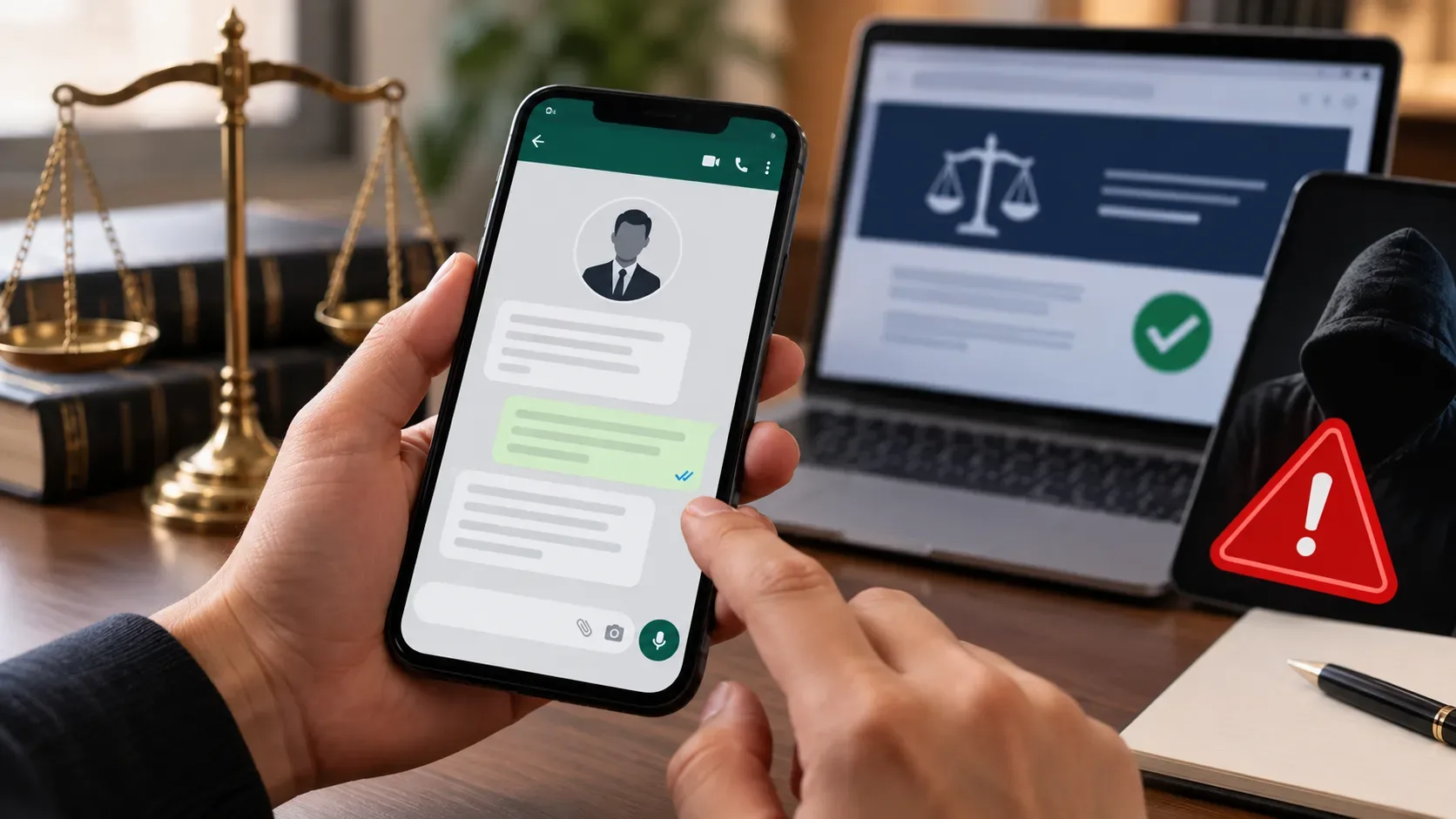
The fake-lawyer scam exploits a dangerous advantage: the criminal may know names, case numbers, approximate amounts and even details from the real law firm. Using that information, the scammer builds a convincing WhatsApp conversation and asks for a Pix payment under pretexts such as “releasing a court order,” “paying a fee” or “unlocking the proceeds of the case.” Correct information in the message, however, does not prove that the sender is the lawyer.
Before transferring any money, the practical rule is to separate three checks: does the professional exist and have a valid bar registration?; is the person speaking to you really that professional?; and does the requested payment make sense in the case and for the named beneficiary?. ConfirmADV mainly helps with the second step, but it should be combined with independent checks.
How the fake-lawyer scam usually works
According to an alert from the Federal District and Territories Court of Justice (TJDFT), criminals may use real case information and pose as the victim’s lawyer or as someone from the law firm. The approach often comes through WhatsApp or email and may reproduce a real name, photograph, logo and details from the lawsuit.
The financial request usually appears tied to a promise of receiving money: the victim is told that a fee, cost or advance payment is required to release funds from the case. Urgency is part of the method. The less time the victim has to check the story with another source, the greater the chance of sending the Pix before noticing inconsistencies.
For that reason, accurate case information should not be treated as proof of identity. The TJDFT itself warns that the court does not charge people for registration or for releasing money from court cases.
What ConfirmADV confirms — and what it does not
ConfirmADV, created by the Federal Council of the Brazilian Bar Association (OAB), is integrated with the National Registry of Lawyers (CNA). The platform lets a member of the public try to confirm the identity of someone presenting themselves as a lawyer by using professional-registration data and an electronic confirmation sent to the email address registered in the CNA.
In practice, this is different from merely searching for a name in the registry. A search in the CNA helps verify that the professional and registration exist and their status; ConfirmADV adds a validation step linked to the electronic contact information on file with the OAB.
The OAB itself stresses that ConfirmADV is an auxiliary public-consultation mechanism. A positive confirmation is therefore an important security layer, but it does not automatically make every Pix request legitimate. You still need to verify the reason for the charge, the case, the communication channel and the recipient of the money.
How to use ConfirmADV before paying
- Open confirmadv.oab.org.br directly instead of using a link sent in the suspicious conversation.
- Enter the OAB registration number, the state of registration and the professional email address that was provided to you, along with the other information requested by the platform.
- Wait for the confirmation attempt through the channel registered in the CNA. OAB guidance describes a short window for the professional to respond to the request.
- If the identity is confirmed, perform a second check anyway: contact the firm through a phone number or address you already knew, that appears in your engagement agreement, or that you obtained independently.
- If there is no confirmation, do not send the Pix. Stop the transaction and investigate the discrepancy through another channel.
Does “not confirmed” mean it is a scam?
Not necessarily. In a report published on April 29, 2026, the OAB said ConfirmADV had received 32,318 verification requests in its first year: 22,685 were confirmed and 9,633 were not confirmed. The organization explained that the non-confirmed group also includes attempts that were not completed and records containing incorrect data.
That changes how the result should be read: a failed confirmation is a reason to stop the payment, not automatic proof of fraud. The next step is to reach the lawyer or firm through an independent contact and verify the information before any transfer.
Checklist before sending a Pix to someone claiming to be your lawyer
- Check the OAB registration. Search the CNA by name and/or registration number and confirm that the data matches the professional you know.
- Use ConfirmADV. Run the validation from the official website instead of relying on links received through WhatsApp.
- Compare the phone number. If the contact number changed, do not accept the change merely because the person knows details of the case. Call the firm using a number you already had or one obtained independently.
- Confirm the charge. Ask the lawyer or firm, through another channel, what the payment is for and why it is required at that moment.
- Check the case. If the story involves the release of funds, a court order, a settlement or a recent ruling, verify the case movement on the court’s official portal or with the responsible court office.
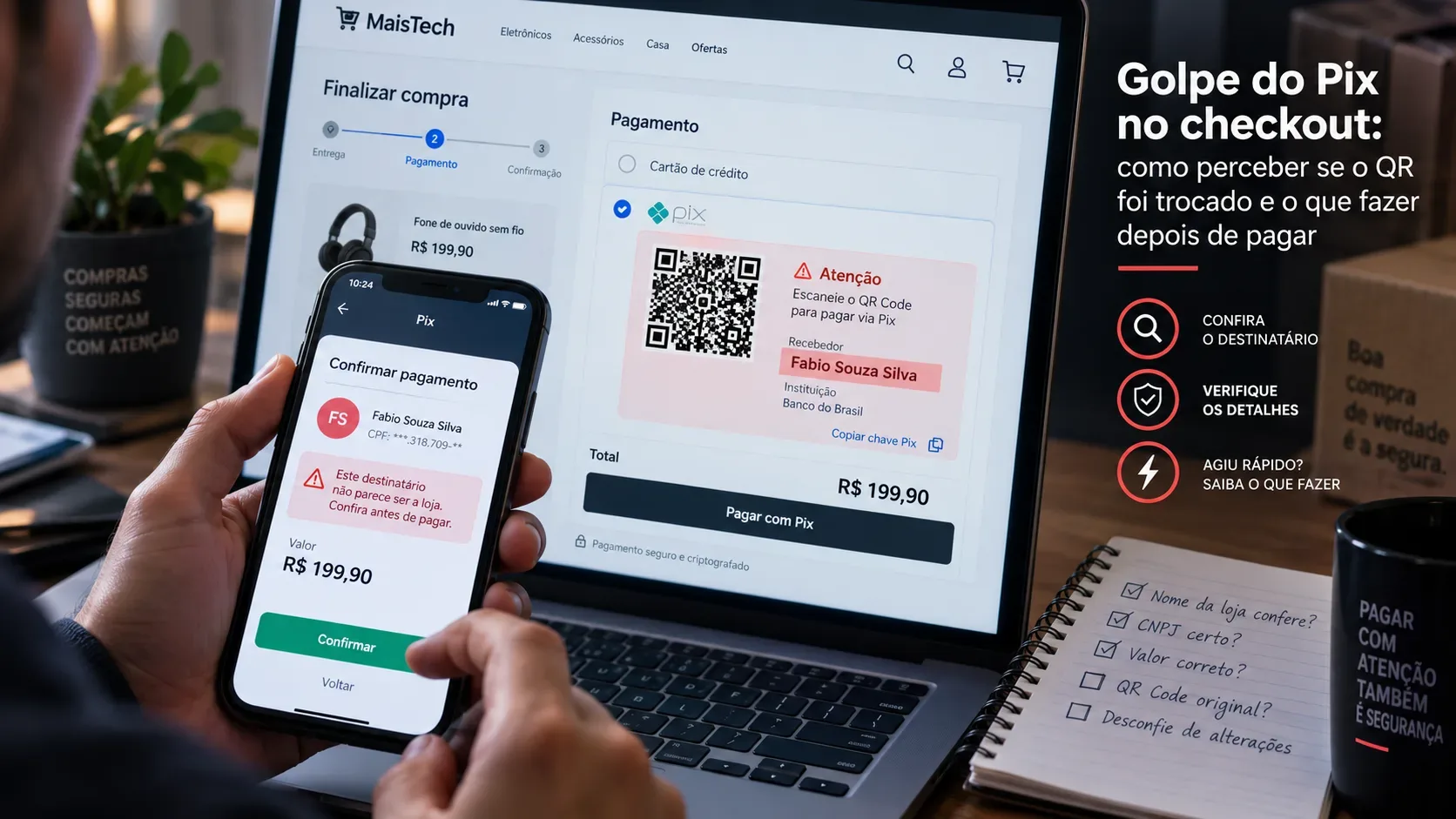
- Check the Pix beneficiary. The name and CPF/CNPJ shown by the bank should make sense in relation to the confirmed professional or firm. A third-party account, unknown name or mismatch requires another check before payment.
- Be wary of urgency. Pressure to pay “right now,” threats that you will lose money, or insistence that you not call the firm are classic social-engineering warning signs.
Warning signs that matter more when they appear together
One element may have a legitimate explanation; several in combination justify ending the conversation. Recurring signs include an unknown WhatsApp number, a sudden contact change, a request to send Pix to someone with no clear connection to the case, a message saying the money must be sent immediately, a shortened or unusual link, an official-looking document sent only as an image, and resistance when you suggest calling the law firm.
Another important sign is an attempt to turn true information into authority: “I know your case number, so I must be your lawyer.” That reasoning is unsafe because some court information may be available in public sources or may have been exposed in other ways. The check must confirm the person, not only the information that person knows.
How to preserve evidence without continuing to engage the scammer
If you suspect fraud, do not delete the conversation immediately. The TJDFT advises keeping messages, phone numbers, emails and receipts. Take screenshots that show the context, the number or profile used, dates, times, Pix key, beneficiary name, amount requested and any documents that were sent.
Also save the receipt for any transfer already made and note the channel through which you later confirmed that the approach was fake. This evidence may be useful for the police report, the communication with your bank and a report to the OAB.
Preserving evidence does not mean continuing to converse with the suspect. Once you have recorded what is necessary, stop the contact and use official or previously known channels for any further checks.
If you already sent the Pix, act quickly
The Central Bank of Brazil advises scam victims to contact their financial institution as soon as possible, report the fraud and request a refund through the Special Refund Mechanism (MED). It also recommends filing a police report in parallel.
Under the process described by the Central Bank, the victim’s bank files an infringement notice and opens the MED; the recipient’s institution blocks available funds; the institutions analyze the case; and, if fraud is confirmed, funds may be returned. The MED does not guarantee a full recovery, because the outcome depends on the review and on funds being available for blocking or return.
A MED request may be filed up to 80 days after the transaction, but the Central Bank emphasizes that acting quickly increases the chances of recovery. If you realize the scam after paying, do not wait to finish every other step before contacting the bank.
A two-minute verification routine
- Stop the payment and do not click links in the conversation.
- Check the lawyer in the CNA.
- Try to validate the identity through ConfirmADV.
- Call the law firm using an independent contact and confirm the charge.
- Check the case with the court if the explanation involves court funds.
- Compare the Pix beneficiary’s name with the confirmed professional or law firm.
- If anything does not match, do not pay and preserve the evidence.
- If you already paid, contact your bank to request the MED and file a police report.
The safest logic is simple: do not use a single piece of information as proof of identity. A correct name, a lawyer’s photo, a case number and even knowledge of case details can be reproduced by a scammer. Before sending a Pix, combine professional-registration checks, ConfirmADV, confirmation through an independent channel and consistency of the requested payment. That sequence reduces the chance that a convincing message becomes a hard-to-reverse transfer.