An internet or cell phone bill exceeding the agreed amount does not need to be treated as a choice between paying everything first or running the risk of having the service suspended. Under Anatel's current rules, the consumer can dispute the charge they consider undue, leave that portion under analysis and receive a new billing document only with the amounts that are not being discussed.
The mechanism is important because billing was the subject with the highest number of complaints registered with Anatel in 2025: there were 435,809 occurrences, 13.6% more than in 2024. Within this universe, the agency again highlighted billing in disagreement with the contractor as the most prominent problem.
The rules below are based on the General Regulation on Consumer Rights for Telecommunications Services, approved by Anatel Resolution No. 765/2023. The billing dispute provisions have been in force since September 1, 2025 and cover, among others, mobile telephony and fixed broadband.
The central rule: the disputed party does not need to be paid while it is analyzed
Article 60 of the regulation allows you to dispute a charge with the provider within a period of three years, counting from the date of the charge considered undue. If the disputed amount has not yet been paid, the collection of that installment will be suspended.
At the same time, the operator must issue, free of charge, a new billing document for the amounts that have not been disputed. This new document must have an additional deadline and respect the rule of making the invoice available at least five days before the due date.
In practice, this means that an invoice can be separated into two parts: the portion that you recognize and must pay normally, and the portion whose legitimacy is being discussed. The goal is to prevent a specific charge from automatically turning the entire account into delinquency.
How to dispute without letting the rest of the invoice become a delay
Check exactly which release is wrong
Before opening the dispute, compare the invoice with the contract, the contracted offer and details of consumption or additional services. Identify the specific release, amount, and reason for the divergence. It could be a monthly fee different from that contracted, an additional service not recognized, a charge after cancellation or another amount that does not correspond to what was agreed.
The more limited the charge discussed is, the less chance of the dispute turning into a generic complaint. Instead of just saying that the account is wrong, state which item is being questioned, how much it represents and which document shows the difference.
Register the dispute on the operator's own channel
The dispute must be presented to the provider. The regulation determines that every service receives a protocol, informed to the consumer at the beginning of the contact and sent electronically within one day. Keep this number, the date of service and, when possible, screenshots or proof of the order.
The protocol is important because it marks the beginning of the specific dispute period and allows you to track what was requested. The operator must also keep the history of demands for at least three years after completion and, if you request this history, send it within five calendar days.
Request a new invoice only with the undisputed amount
If the discussed charge has not yet been paid, expressly request the issuance of a new billing document without the disputed portion. This is not just a courtesy from the company: article 60 provides for issuance at no cost to the consumer.
When the new invoice arrives, check whether the disputed amount has been withdrawn and pay the part you recognize by the new due date. The dispute protects the disputed portion, but should not be used as a reason to stop paying amounts that are not under discussion or other overdue bills.
What happens when the service is suspended during the dispute
Article 61 establishes that contesting a debt suspends the validity of deadlines that could lead to suspension of service and termination of the contract. This suspension of deadlines lasts until the consumer is notified of the provider's response.
It is a relevant protection: while the disputed charge is formally under analysis, the regulatory clock linked to that debt remains stopped. This does not mean, however, that the customer is protected against any suspension for any reason. Another invoice that is actually due and undisputed, for example, remains subject to normal default rules.
It is also important not to confuse suspension of the deadline with definitive cancellation of the charge. During the analysis, the value remains discussed. The outcome depends on the operator's response or the end of the response deadline.
The operator has up to 30 days to respond
The provider must analyze the dispute and notify the consumer of its response within a maximum of 30 days, counting from the date of the dispute. This deadline is specific to the discussion of the debt.
During this period, follow the protocol and check whether the new invoice for the undisputed amounts has been made available. If the operator tries to charge the discussed portion again before completing the analysis, record the fact in the same service or in a new complaint and preserve the receipts.
If the charge is considered inappropriate or the operator does not respond
If the dispute is considered valid, the solution depends on whether the installment has been paid or not. When the amount has not yet been paid, the charge must be cancelled. When the consumer has already paid the undue amount, the provider must make the automatic refund in accordance with the regulation's reimbursement rules.
The same effect occurs when the 30 days end without a response from the operator: if the amount has not been paid, the charge must be cancelled; If it was paid, there should be an automatic refund.
In cases of undue payment, article 64 provides for a refund of double what was paid in excess, plus monetary correction and interest of 1% per month, proportional to the day. For postpaid customers, one of the forms of refund is a reduction on the next invoice. The consumer can also choose to pay via the banking system, with a maximum period of 30 days. For prepaid payments, the rule provides for credits with a minimum validity of 90 days, with refunds within 10 days.
If the operator says the charge is correct
The provider may charge the disputed amount again if it concludes, within 30 days, that the dispute is unfounded. Before that, you must notify the consumer and explain the reasons for the decision.
With notification of the response, the suspension of regulatory deadlines ends. Therefore, it is not safe to ignore the negative response hoping that the simple fact of having objected will prevent any future action. Read the justification, check the date you were notified and quickly decide whether to pay, file a new complaint through the company's review channels or escalate the case.
The general default rule allows the provider to suspend the service after 15 days have passed since notification of an overdue debt. As the challenge only suspends the deadlines, and does not necessarily restart them from scratch, the concrete situation must be monitored by the history of the protocol and the notifications received.
When to use the ombudsman and when to take the case to Anatel
If standard assistance does not resolve the charge or if the response does not address what was disputed, check whether the provider offers an ombudsman. For providers subject to this obligation, the regulation provides a specific channel for demands already analyzed previously and establishes a period of 10 calendar days for processing by the ombudsman.
When there is an ombudsman, Anatel's current guidance is to use this channel after regular service and, if the problem continues, register the complaint with Anatel Consumidor. In the case of a complaint forwarded by the agency, the operator has 10 calendar days to respond. In small providers, the ombudsman structure may not follow the same obligations as those provided for
Furthermore, that's why it's worth checking the channels provided by the company itself and by Anatel.
When escalating the case, bring the protocols, the original invoice, the new invoice without the disputed portion, the contract or offer that supports your position, and the company's response. This helps to show that the issue is not a simple disagreement over the total, but a specific charge that has already been identified and formally discussed.
What if you have already paid the entire invoice so as not to run the risk of being cut?
Paying the bill does not eliminate the right to contest. The regulatory period for questioning the charge is three years. If the charge paid is recognized as undue, the rule of refunding double the amount paid in excess applies, with correction and interest in accordance with the regulations.
The practical difference is that, after payment, there is no longer an outstanding installment whose collection needs to be suspended. The discussion turns to the refund of the amount. Still, maintain protocol and ask that the dispute be registered clearly, as the 30-day deadline for responding remains relevant to the outcome.
Example: invoice of R$256.40 with R$94.00 disputed
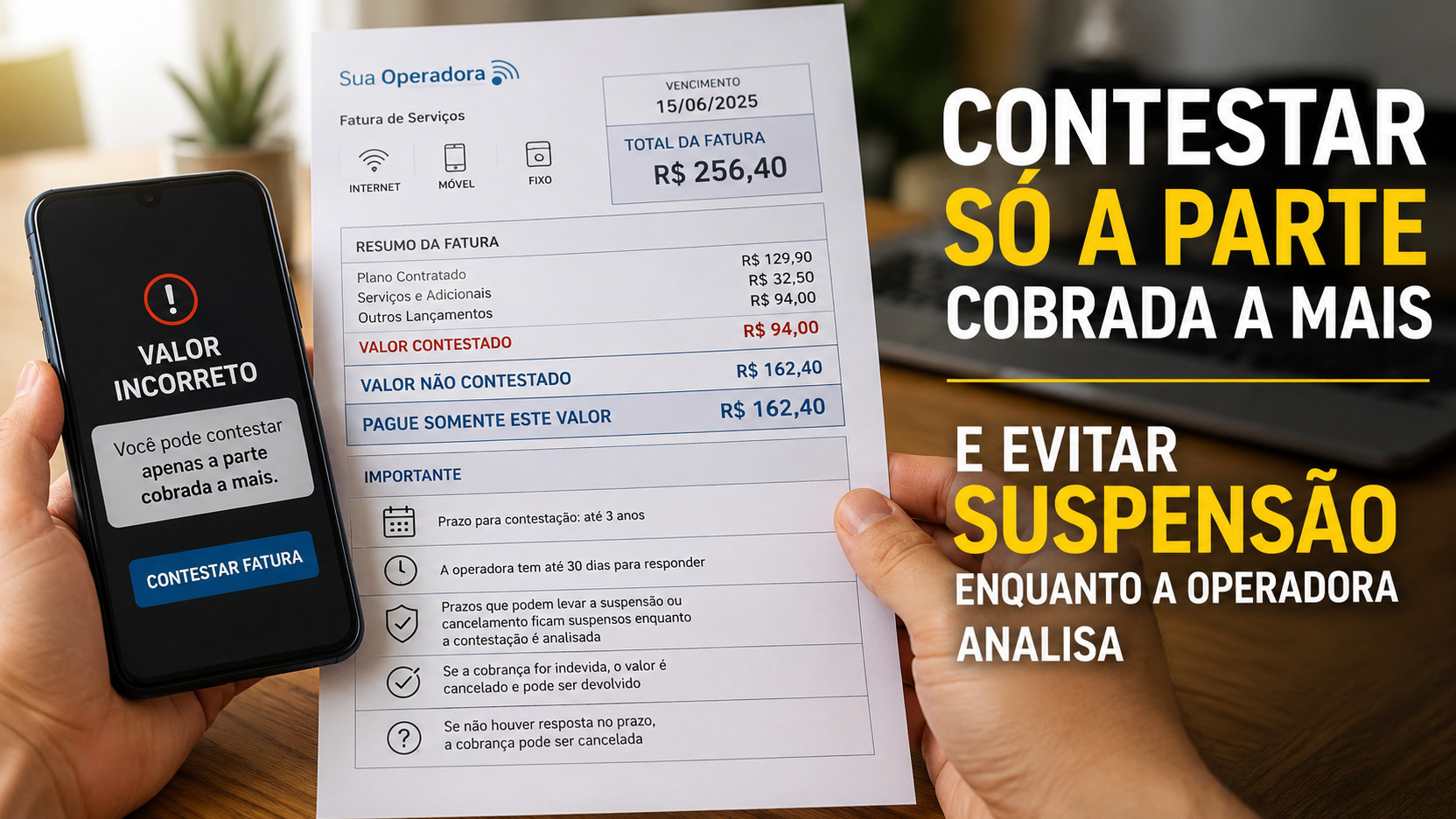
Imagine a bill of R$256.40 in which you recognize R$162.40, but identify R$94.00 relating to a service you did not contract. The safest way to act is to specifically dispute the R$94.00 and ask for a new invoice for R$162.40 to be issued, with a new due date.
You pay the R$ 162.40 within the new billing period and keep the R$ 94.00 under analysis. While the dispute is pending, the deadlines linked to suspension and termination due to this disputed debt are suspended. The operator has up to 30 days to respond.
If the company recognizes the error or allows the deadline to end without a response, the unpaid R$94.00 must be canceled. If you deny the dispute within the deadline, you may charge the installment again after providing the reasons for the decision. From this notification, you need to closely monitor the deadlines and, if you disagree, use the ombudsman and Anatel without letting the situation go silently.
What to keep to prove that the dispute was made
The most useful set of documents is usually the original invoice, the current contract or offer, the details of the disputed entry, the dispute protocol, the electronic confirmation sent by the operator, the new invoice with the undisputed part, proof of payment for this new invoice and the company's final response.
If contact occurs by telephone, ask for the recording when it is necessary to reconstruct the service. In the digital environment, save relevant documents and screens before they are replaced by newer versions.
The most important point to avoid being stuck between paying everything and being without service
When the internet or cell phone bill is wrong, the regulatory path is to separate what is under discussion from what is not. Dispute the specific installment, keep the protocol, demand a new invoice with only the undisputed amounts and pay that part within the new deadline.
The disputed and unpaid charge is suspended, as well as the deadlines that could lead to suspension and termination due to that debt, until notification of the response. A
operator has 30 days to decide. If you recognize the error or do not respond within this period, the charge must be canceled when it has not been paid or returned when payment has already been made.
If the answer is negative, the analysis phase protection ends and the charge may resume. It is at this moment that protocols and documents make a difference when deciding between paying, appealing to the ombudsman or taking the complaint to Anatel.