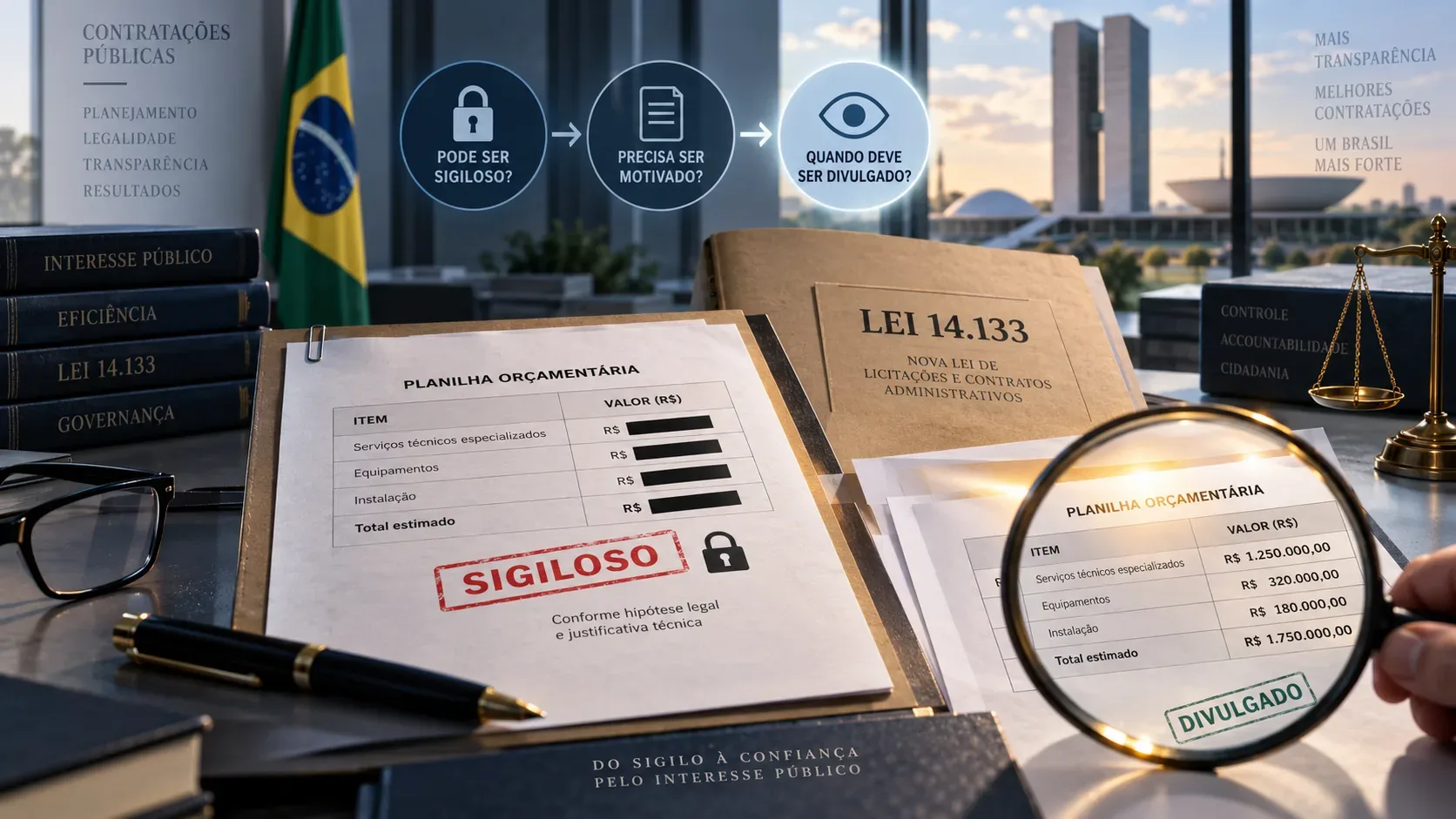
The short answer is: Law 14,133/2021 does not require the Preliminary Technical Study to be attached to the notice nor does it establish its publication on the internet before the notice as a requirement for the validity of the bidding.
This was one of the understandings established by the Plenary of the Federal Court of Auditors in Ruling 1,532/2026, judged on June 17, 2026. The Court also made it clear that nothing prevents the Administration from disclosing the ETP in advance for reasons of transparency and governance, as long as legally admitted secrecy is respected.
The most relevant point for those working in the preparatory phase is another: the ruling does not make non-disclosure a rule. It shifts the question from “am I obliged to publish the ETP with the notice?” to “is there a legal and administrative reason to disclose this ETP before approval?”.
Law 14,133 did not include the ETP among the mandatory annexes to the notice
The ETP is a structuring contract document. Law 14,133 itself defines it as the first stage of planning, designed to characterize the public interest, identify the best solution and serve as the basis for the term of reference, draft or basic project. The preparatory phase also requires that the need for hiring be based on the study.
This, however, does not mean that the ETP must necessarily follow the notice.
Art. 54 of Law 14,133 determines the disclosure of the entire content of the notice and its annexes on the National Public Procurement Portal. § 3 establishes that, after approval, documents produced in the preparatory phase that have not been included in the notice and its annexes must be made available in the PNCP.
This legal construction was central to the TCU's understanding: if the law itself regulates the subsequent disclosure of preparatory documents that were left out of the notice, a general obligation to transform the ETP into an annex to the convening instrument cannot be derived from it.
Judgment 1,532/2026 also did not come from scratch at this point. In 2024, in Ruling 2,273/2024-Plenary, the Court had already decided that Law 14,133 does not require the inclusion of the ETP as an annex. At the time, it admitted its disclosure when useful to bidders, as long as the risk of conflict between the ETP and the terms of reference was previously mitigated.
What Judgment 1,532/2026 added
The advancement of 2026 is mainly in the discussion about the timing of advertising.
In the monitoring process that led to the ruling, the TCU examined information technology hiring and faced regulations that provide specific commands on the disclosure of the ETP.
Art. 34 of IN SGD/ME 94/2022, applicable to the contracting of ICT solutions from bodies and entities that are part of the SISP of the federal Executive Branch, continues to present on its official page the determination to publish the ETP and the term of reference on an easily accessible website until the date of publication of the notice.
In the Judiciary, art. 28 of Resolution CNJ 468/2022 also provides for the publication of the STIC ETP on an easily accessible website and on Connect-Jus until the date of the notice, with specific rules for hypotheses such as confidentiality of the estimated value. The text currently made available by the CNJ maintains this prediction.
In view of this apparent tension with art. 54, § 3, of Law 14,133, the TCU informed the CNJ and the Ministry of Management and Innovation in Public Services that these provisions must be interpreted in accordance with the law. In the Court's formulation, making the ETP available on a widely accessible website is not to be confused with making it a mandatory part of the notice.
The vote went further: the rapporteur failed to accept proposals that would point to non-compliance with these provisions as an irregularity and noted that, in the adopted understanding, it is not mandatory to make the ETP available at the opening of the contest.
Does this mean that agencies can stop publishing the ETP before the notice?
Not a safe conclusion for all cases.
Ruling 1,532/2026 did not change the text of Law 14,133 nor formally repeal IN SGD/ME 94/2022 or Resolution CNJ 468/2022. The deliberation informed the CNJ and MGI of the interpretation adopted by the TCU and formulated recommendations related to improving governance and contracting systems.
In the consultation of the official pages carried out on August 8, 2026, both art. 34 of IN SGD/ME 94/2022 as well as art. 28 of Resolution CNJ 468/2022 still appear with the disclosure deadlines mentioned above.
Therefore, for units subject to these or other specific regulations, the ruling recommends a more careful review of the flow, and not simply automatic exclusion from the publication stage. It is necessary to check the applicable regulations, any subsequent guidelines from the central body and the legal position adopted internally.
For contracts that are not subject to a specific advance disclosure rule, the reading of Law 14,133 adopted by the TCU is more direct: there is no general legal obligation to attach the ETP to the notice or to publish it on the internet before the notice as a requirement to launch the bid.
Publishing can still be a good decision
The absence of mandatory disclosure does not make advance disclosure inappropriate.
The TCU itself acknowledged that the Administration can make the document available for reasons of transparency and governance. Care must be taken not to automatically publish an artifact that was created to support internal decisions and that may undergo adjustments during the preparatory phase.
The Court drew attention precisely to this dynamic nature of the study. In the same Ruling 1,532/2026, it was established that the ETP must be completed and approved before the preparation of the terms of reference or basic project, but can be revised during the internal phase due to the maturity of the solution, market research or changes in modeling. When this occurs, the changes need to be reflected in other planning artifacts.
This characteristic helps to explain one of the risks of publishing the ETP as an annex to the notice: incompatible versions of the study and the term of reference may raise doubts about which document effectively governs the dispute.
And the requirement that influences the proposal should not be hidden only in the ETP. Law 14,133 establishes that the term of reference must contain the basis for the contract with reference to the corresponding preliminary technical studies or, when these studies cannot be disclosed, an extract from the non-confidential parts.
How to decide on disclosure after Ruling 1,532/2026
The decision can be organized into five practical checks:
- Identify the standard applicable to hiring. Before using only art. 54 of Law 14,133, check sectoral regulations, entity acts, internal rules and guidance from the central body.
- Separate publication of the ETP from attachment to the notice. These are different decisions. A document may be available for transparency without formally forming part of the convening instrument.
- Evaluate whether publicity helps the market. If information from the study is relevant to understanding the solution and preparing proposals, advance publicity may be useful. The bidders' obligations, however, need to be clearly reflected in the notice and in the documents that effectively govern the dispute.
- Review confidential and sensitive information. IN Seges 58/2022 itself determines, at the end of the preparation of the ETP, the evaluation of possible classification according to the Access to Information Law. Estimates and other elements may also require specific treatment.
- If you decide to publish, carry out a consistency check. ETP, terms of reference, basic project and notice must not present incompatible premises. If the study was revised during planning, the remaining artifacts also need to reflect the consolidated version.
This reasoning turns advertising into a documented governance choice rather than an automatic procedure.
The most useful effect of the ruling is in the design of the process
Ruling 1,532/2026 does not diminish the importance of the ETP. In the same decision in which it removed its mandatory annexation to the notice, the TCU reinforced that the study must precede the term of reference or basic project and that the conclusion on the viability of the contract must exist before detailing the solution.
The Court also recommended that the CNJ and MGI evaluate the adoption, as a good governance practice, of progressive validations of the preparatory phase, with a statement from the competent authority at the end of the demand formalization document, the ETP and the term of reference or basic project, especially in complex or higher risk contracts.
The practical consequence is relevant: the discussion stops being just about “when to upload a PDF” and returns to the purpose of planning.
The ETP needs to be well prepared, approved at the right time, consistent with subsequent documents and subject to a conscious publicity decision. Publishing it together with the notice may be appropriate; treating it as a mandatory annex under Law 14,133, according to the TCU, is not.
For bodies that maintain checklists with the automatic publication of the ETP along with the notice, Ruling 1,532/2026 is a good reason to review the flow and expressly record which standard requires disclosure, what the purpose of the publication is and how secrecy, versions and possible divergences between the artifacts will be handled.