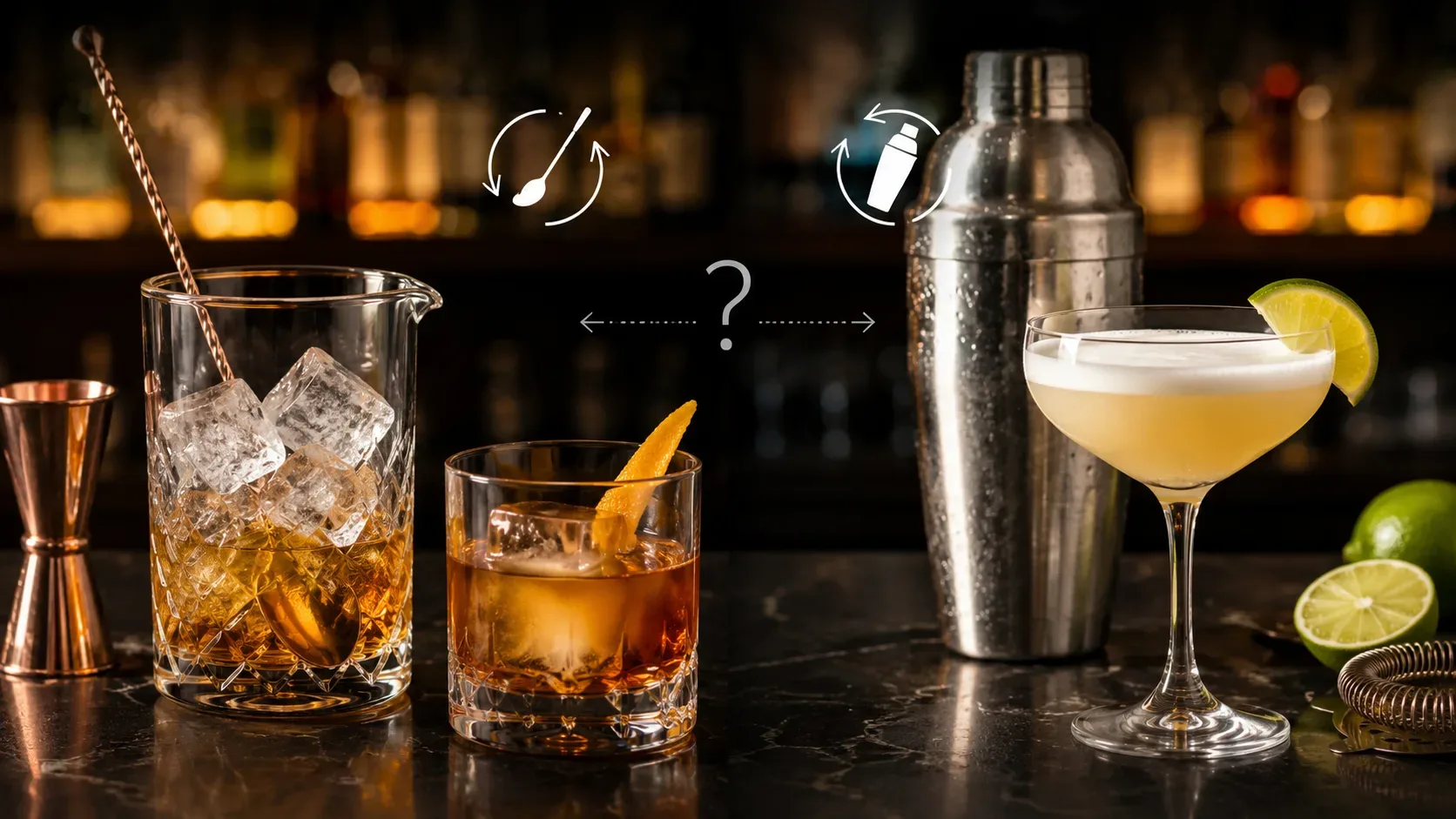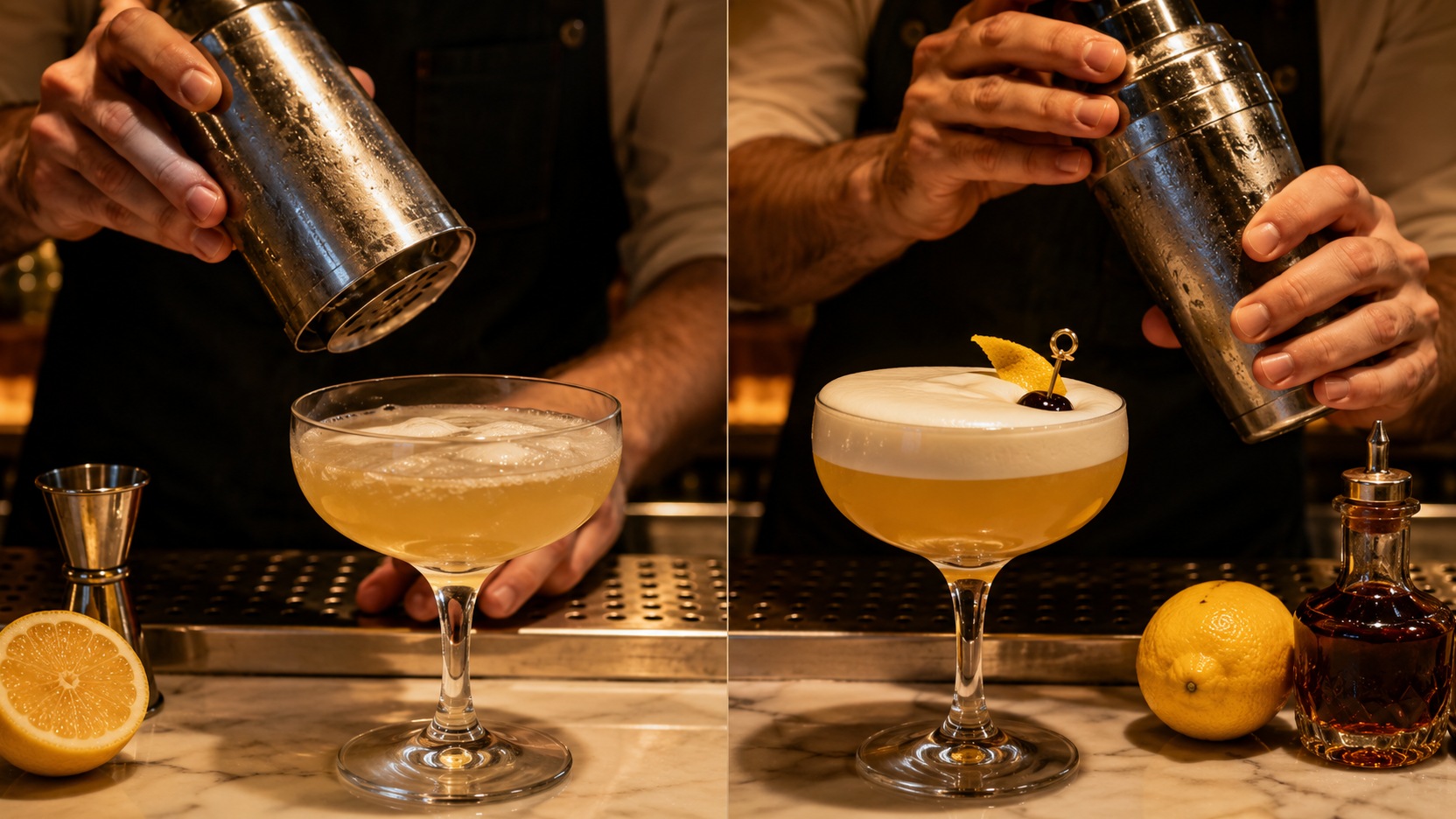
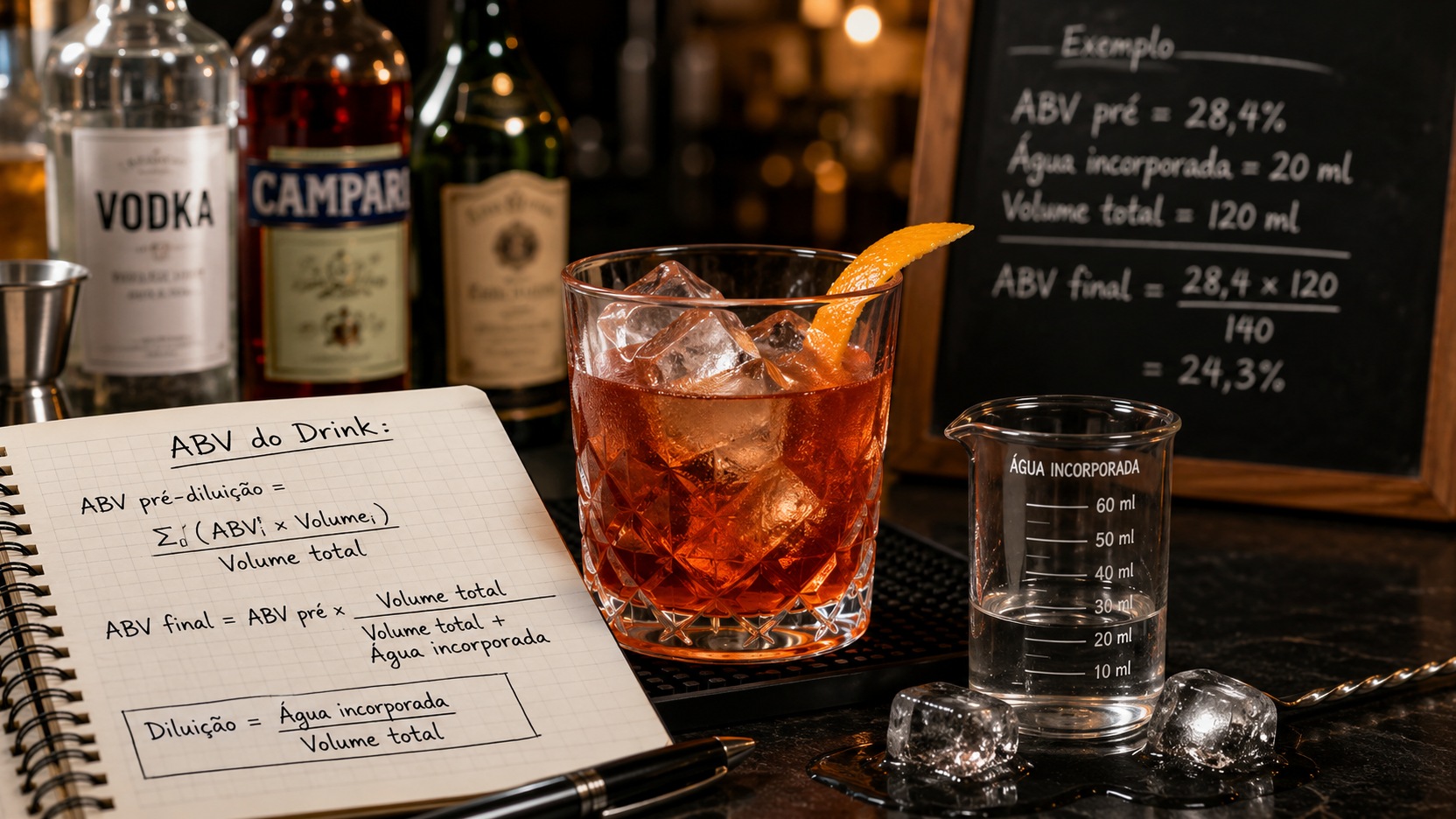
A practical ABV calculation for a drink starts with a simple idea: add up the equivalent volume of pure alcohol from all alcoholic ingredients and divide that total by the volume of the cocktail. Before the ice, the denominator is the volume of the mixture; after preparation, the denominator should reflect the final volume, already including the water actually incorporated. That second measurement is what keeps you from relying on a generic dilution estimate.
What ABV represents
ABV stands for alcohol by volume. In Brazil, as in many other markets, alcoholic strength is expressed as the percentage by volume of ethyl alcohol at 20 °C. The same logic appears in international alcoholometric tables: the strength by volume relates the equivalent amount of ethanol to the total volume of the mixture at a reference temperature.
For a cocktail spec sheet, however, the number obtained from the ingredient quantities is an operational estimate. It is very useful for comparing recipes, standardizing service, and tracking the effect of dilution, but it should not be mistaken for a laboratory or regulatory determination.
How to calculate ABV before the ice
Start with the ingredients in the recipe before any water from the ice is added. For each alcoholic ingredient, multiply the volume used by the ABV shown on the label, converted to decimal form. Non-alcoholic ingredients enter the total volume but contribute zero to the equivalent alcohol.
Equivalent alcohol from the ingredient = ingredient volume x ingredient ABV / 100.
Then add up the equivalent alcohol from all alcoholic ingredients.
Total equivalent alcohol = the sum of volume x ABV / 100 for each alcoholic ingredient.
The estimated ABV before dilution is:
ABV before the ice = total equivalent alcohol / volume of the mixture before the ice x 100.
The key point is not to divide only by the volume of the spirits. Juice, syrup, soda, water previously added, and any other non-alcoholic liquid reduce the concentration and need to be part of the denominator.
How to use the dilution measured in the recipe itself
Fixed dilution percentages can serve as a starting approximation, but there is no single correct value for every cocktail. Technical mixology tests show that stirred and shaken drinks can end in different temperature and dilution ranges, and that the ideal amount of water also depends on the recipe itself.
For a spec sheet, the most direct route is to prepare the recipe exactly as it will be served and measure the final liquid volume after straining. Measure it with a graduated container and keep the procedure constant: same recipe, same ice, same amount of ice, same tool, same stirring or shaking time, and the same moment of reading.
If the nominal mixture before the ice had 100 mL and, after preparation and straining, the liquid occupies 122 mL, the apparent difference is 22 mL. That value represents an operational measurement of the water incorporated into the final result. Repeating the test a few times helps reveal the real variation in your process, instead of treating a single run as the standard.
Weighing before and after preparation is also used to calibrate batches. It is practical, but it requires care with liquid that stays trapped in the ice, in the shaker, or in the mixing glass. That retention can distort the reading if it is interpreted as the exact amount of melted water.
How to calculate ABV after dilution
If you measured the final volume of the cocktail, the cleanest calculation is to use that volume directly in the denominator:
ABV after the ice = total equivalent alcohol / measured final volume x 100.
This approach is preferable to simply adding a presumed volume of water, because the volume of ethanol and water mixtures is not perfectly additive. The United States Pharmacopeia notes that mixing alcohol and water leads to volume contraction, and temperature also changes the observed volume.
If you only have an operational measurement of added water and you accept the approximation of additive volumes, you can use:
Estimated ABV after the ice = ABV before the ice x volume before the ice / (volume before the ice + incorporated water).
This formula is useful for spreadsheets and quick tests. For better consistency, prefer the actual measured final volume.
Example with four ingredients
Consider a recipe with 45 mL of gin at 42% ABV, 25 mL of vermouth at 16%, 20 mL of an aperitif at 25%, and 10 mL of non-alcoholic syrup. The nominal volume before the ice is 100 mL.
The gin provides 18.9 mL of equivalent alcohol. The vermouth provides 4.0 mL. The aperitif provides 5.0 mL. The syrup provides zero. The total is 27.9 mL of equivalent alcohol.
Before the ice, the calculation is 27.9 divided by 100, multiplied by 100. The result is an estimated 27.9% ABV.
Now prepare the drink with the ice and technique defined for the spec sheet. Suppose the measured final volume, after straining, is 122 mL. The post-dilution ABV is 27.9 divided by 122, multiplied by 100. The result is approximately 22.9% ABV.
The volume difference is 22 mL. If you define dilution as added water relative to the initial mixture, the dilution was 22%. If you prefer to report the fraction of added water within the final volume, those 22 mL represent about 18% of the 122 mL. The two percentages describe different things, so the spec sheet should say which definition it is using.
Why a generic dilution estimate can mislead
Imagine the same recipe were calculated with an automatic assumption of 20% added water. The final volume would be estimated at 120 mL and the calculated ABV would be 23.3%. In the measured test, with 122 mL, the result was 22.9%.
The difference in this example is small, but it grows when the real water content departs further from the assumed percentage. That can happen when the ice changes, the starting temperature of the ingredients changes, the vessel changes, the preparation time changes, the way the drink is stirred or shaken changes, or the recipe volume changes.
The gain from measuring your own recipe is not to find a universal constant. It is to discover what dilution your process produces when it is repeated the way the bar actually works.
Drinks served over ice need a reference moment
In a drink served up, without ice in the glass, the post-dilution value can be defined at the moment the drink is strained. In a drink served over ice, the scenario changes: the drink keeps taking on water while it remains in the glass.
In that case, there is no single final ABV for the entire experience unless you define a moment. The spec sheet can record, for example, the estimated ABV immediately after preparation. If the goal is to study what happens after a few minutes, treat that as another measurement, with time and conditions recorded.
In highballs and other drinks topped with soda, tonic, soft drink, juice, or another mixer, the volume of that component normally enters the denominator. If the drink also stays over ice, the water melting after service continues to change the concentration.
Batches become more predictable when water becomes an ingredient
For a pre-diluted batch, water can stop being a consequence of ice and become an explicit part of the recipe. First, calibrate a single serve until you reach the dilution that delivers the desired flavor, temperature, and texture. Then carry that amount of water over to the batch scale.
In this scenario, the batch ABV is calculated with the same principle: total equivalent alcohol divided by the final volume of the mixture. If the batch is chilled without contact with ice before service, the value remains more stable because it does not depend on new meltwater for each serve.
If the batch serve is still stirred, shaken, or served over ice, there will be a second dilution stage. It needs to be included if the goal is to estimate the ABV in the served glass.
Where the precision limit lies
There are several sources of uncertainty. The ABV printed on the label is a declared value, and the measure poured with a jigger also has practical tolerance. Small residues stay in tools and in the ice. Volume changes with temperature. Mixtures of ethanol and water show volume contraction, so 50 mL of one liquid plus 50 mL of another do not guarantee exactly 100 mL after mixing.
Ingredients with sugar, acids, and other solids also make analytical measurements based on density more difficult. Official methods for beverages may require specific sample preparation, including distillation before reading alcoholic strength when there are components that interfere.
For that reason, the spec-sheet calculation should be presented as estimated ABV. For labeling, legal compliance, a report, or any situation that requires an analytical result, use a validated method and an appropriate laboratory or technical procedure.
Pocket formula for the spec sheet
Total equivalent alcohol = sum of ingredient volume x ingredient ABV / 100.
ABV before the ice = total equivalent alcohol / volume before the ice x 100.
ABV after the ice = total equivalent alcohol / measured final volume x 100.
Apparent incorporated water = measured final volume - volume before the ice.
Dilution relative to the initial mixture = apparent incorporated water / volume before the ice x 100.
If you record those five values together with the preparation technique, the spec sheet stops depending on a generic percentage and starts reflecting the behavior of the recipe itself.
What is worth recording alongside the number
ABV alone does not explain how the result was obtained. To make the calculation repeatable, record the brands or ABVs of the ingredients, the volumes, the preparation technique, the type and amount of ice, the stirring or shaking time, and the observed final volume.
If any of those elements changes in a relevant way, take a new measurement. The usefulness of the calculation lies precisely in linking alcoholic strength to the real preparation process, rather than turning an estimate into a number that only appears exact.