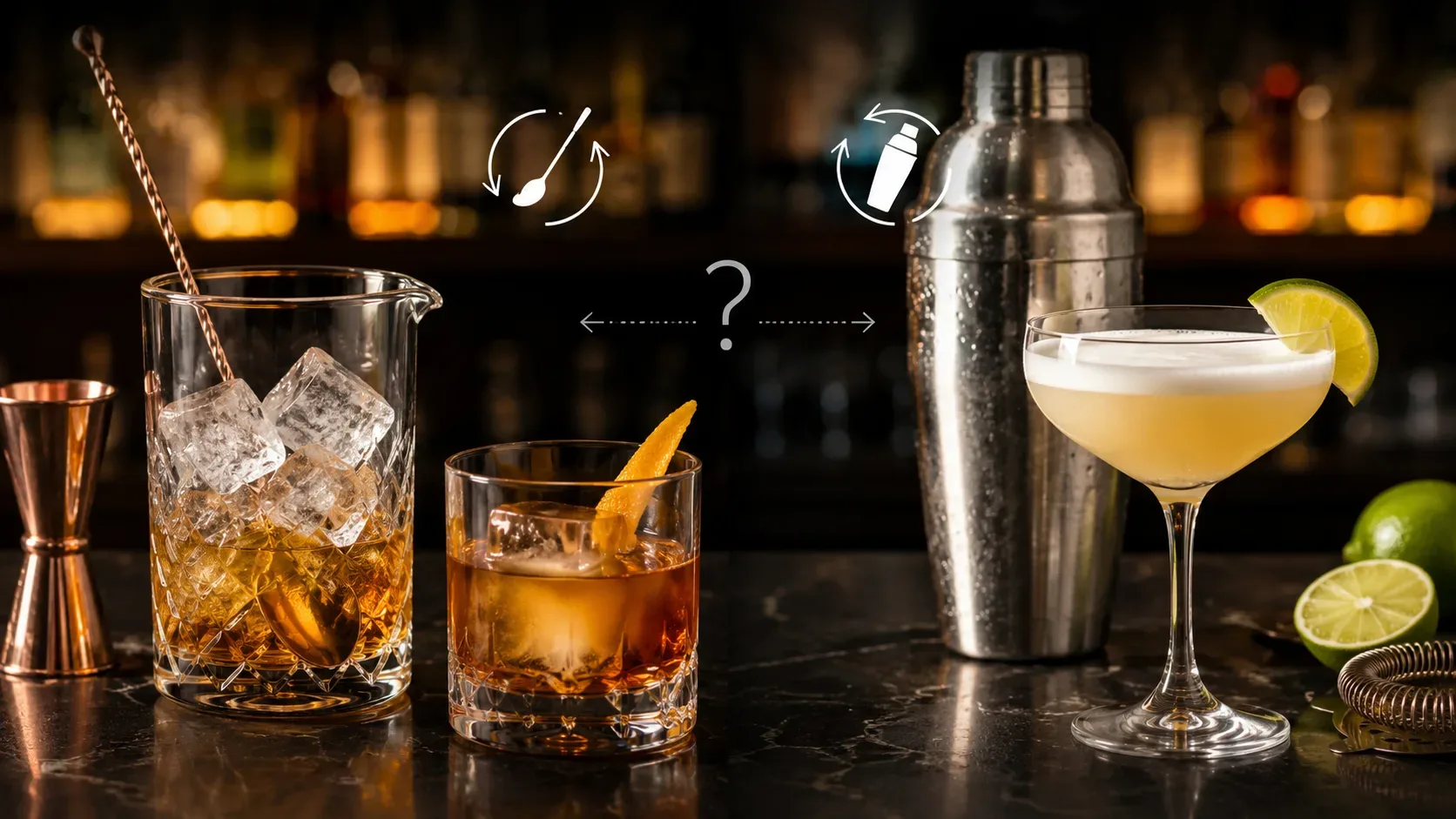
If the question is “should I stir or shake the drink?”, the best answer is not determined by the base spirit alone, but by the effect the recipe needs in the glass. Both methods mix, chill, and dilute a cocktail as ice melts. Shaking, however, does so more turbulently and incorporates air, changing texture, appearance, and foam. Stirring is gentler and tends to preserve a clearer, denser, silkier profile.
In practice, the most useful rule is: cocktails made mainly with spirits, liqueurs, vermouths, and bitters are usually stirred; recipes with citrus, other juices, purées, cream, milk, egg white, or aquafaba are usually shaken. This is a decision rule, not a law: the desired texture and the specific recipe can justify exceptions.
What actually changes when you stir or shake
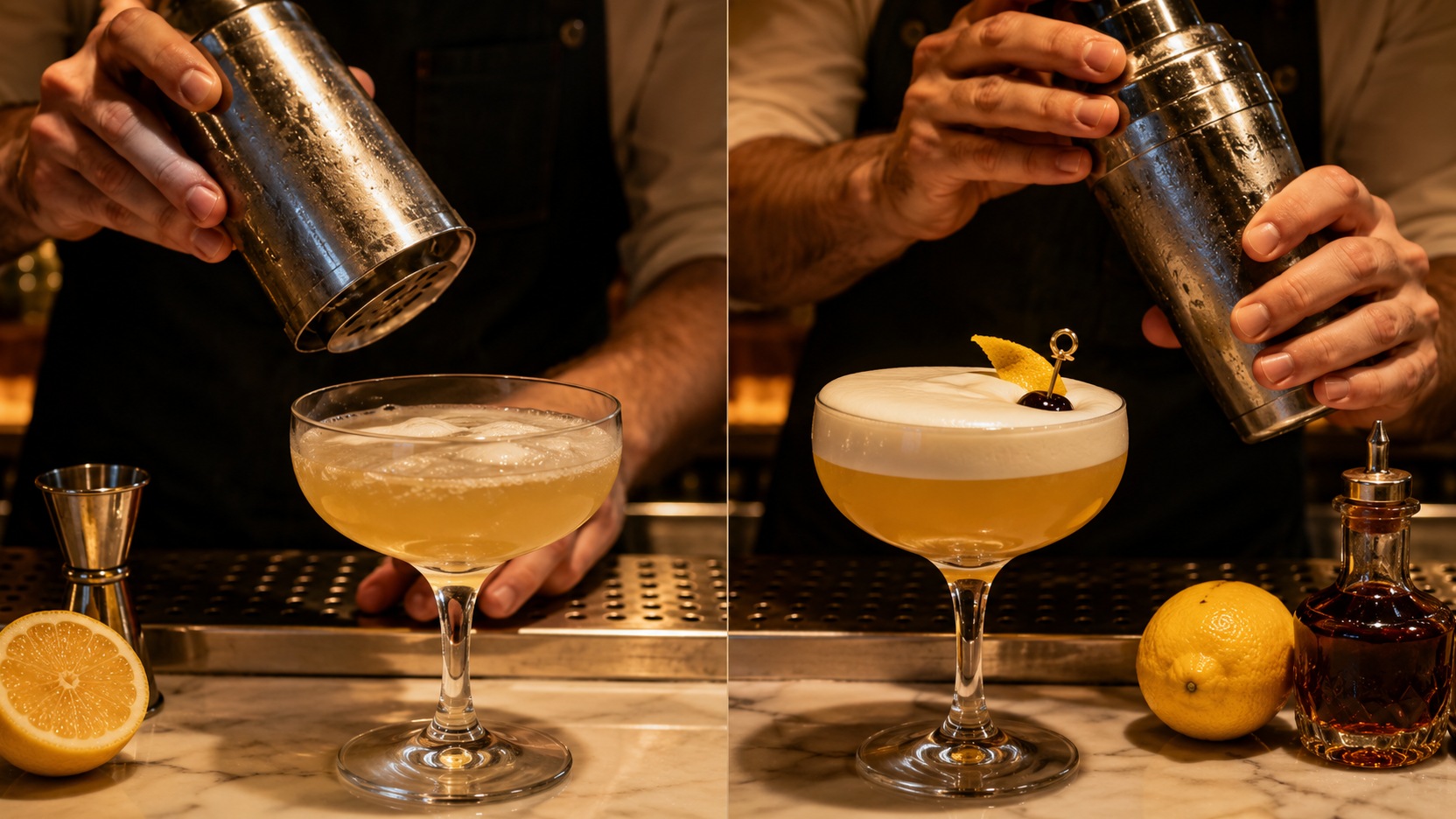
According to Difford's Guide, both methods chill and dilute, but shaking reaches those effects faster and also introduces tiny air bubbles. Liquor.com highlights three recurring aims of shaking: mixing, aerating, and diluting while the drink chills.
- Aeration: this is the clearest difference. Vigorous movement in a shaker incorporates air and can create foam, lightness, and a softer mouthfeel.
- Texture: a shaken sour can feel livelier and silkier; a stirred Manhattan tends to retain a smoother, more compact texture.
- Clarity: stirring usually keeps the liquid more visually transparent. Shaking can make it temporarily cloudy because of microbubbles and particles from the ingredients.
- Temperature and dilution: both depend on contact with ice. Shaking usually reaches serving condition faster; stirring gives a more gradual sense of control. Ice size, temperature, and quantity also affect the result.
Quick table: which method fits each ingredient?
| Composition or goal | Most common method | Why | Examples |
|---|---|---|---|
| Spirits + vermouth/liqueur + bitters, no juice | Stir | Preserves clarity and a silky texture with little aeration | Martini, Manhattan, Negroni |
| Spirit + citrus + sweetener | Shake | Integrates different phases and creates the aeration expected in a sour | Daiquiri, Margarita, Whiskey Sour |
| Fruit juice or purée | Shake | Helps homogenize less-transparent ingredients and adds lightness | Mai Tai, passion fruit or pineapple cocktails |
| Cream or milk | Shake | The force helps integrate fat and liquid and develop texture | creamy cocktails |
| Egg white or aquafaba | Shake | Aeration is essential for building foam and body | foamy sours |
| Syrup in a clear, spirit-forward recipe | It depends | Syrup alone does not require shaking; texture remains the deciding factor | Old Fashioned is usually stirred |
| Carbonated ingredient | Do not shake sealed | Pressure can build inside the shaker; carbonated ingredients are generally added afterward | soda, tonic, sparkling wine |
1. If the recipe is essentially spirit-forward, start by thinking stir
Martinis, Manhattans, and Negronis are useful references because they combine ingredients that already mix easily and do not need foam to fulfill the drink’s intended style. Stirring with ice lowers temperature and adds water progressively without the turbulence of a shaker. The expected result is a cold, clear cocktail with a more polished mouthfeel.
That does not mean a shaken Martini is “forbidden.” Shaking changes the profile: it adds more aeration, can create tiny ice fragments, and alters texture. If that is the desired effect, it is a stylistic choice. The better question becomes not “which method is allowed?” but “which texture is this recipe trying to create?”
2. Citrus, juices, and purées are strong signals to shake
Lemon, lime, grapefruit, and other fresh juices bring water, acids, sugars, pulp, and compounds that behave differently from spirits. Shaking helps integrate these components quickly and adds the aeration typical of Daiquiris, Margaritas, and other sours. The Serious Eats guide also treats juices, dairy, and eggs as classic signs that the shaker is the appropriate tool.
Purées and denser juices strengthen the same logic. The goal is not merely to “mix better,” but to build a coherent texture. Pineapple, for example, holds foam easily; citrus can also retain some aeration for a while.
3. Egg white, aquafaba, and cream make texture the priority
When egg white, aquafaba, or cream is present, the decision becomes less about transparency and more about structure. Egg white needs agitation to incorporate air and form the protein network that supports foam. Liquor.com explains that a dry shake — shaking without ice — can be used to encourage emulsification before or after the iced stage, depending on the chosen technique.
With cream and milk, shaking also helps create an integrated texture. Recipe and proportion still matter: dairy can curdle when it meets highly acidic ingredients, so it is not enough to apply the rule “it has cream, therefore shake” without checking whether the formula was designed for that combination.
4. Dilution does not mean “shaking makes it watery”
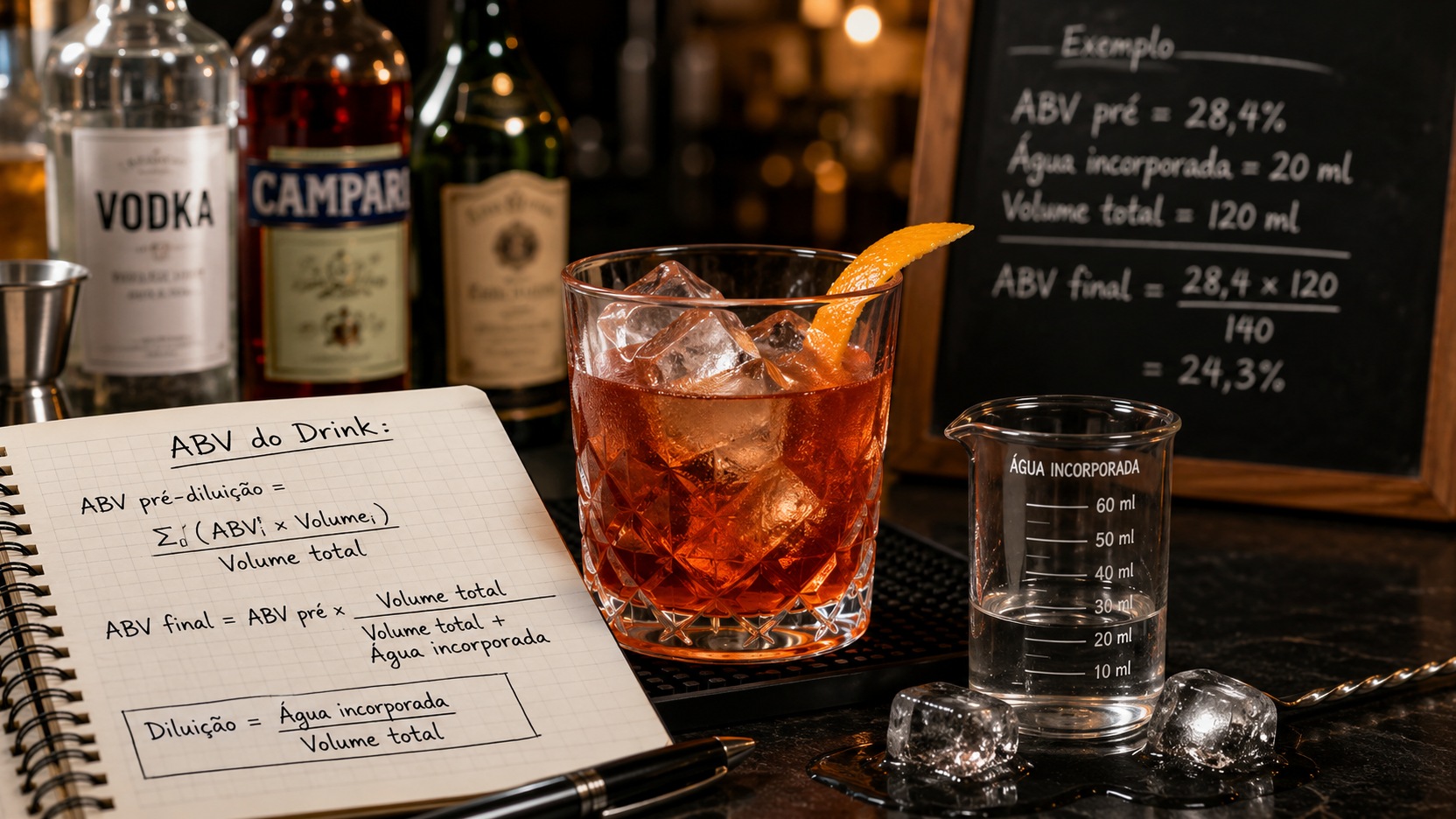
It is common to imagine that shaking always over-dilutes and stirring barely adds water. The comparison is subtler. Every cocktail stirred or shaken with ice receives some dilution, because chilling happens together with the melting of part of the ice. Shaking increases heat exchange and normally reaches serving condition faster; a longer stir can reach similar levels of chilling and dilution.
That is why time is not a universal magic number. Small, already-wet ice behaves differently from large, very cold cubes. Recipe volume, ingredient temperature, vessel shape, and technique intensity also matter. At home, following a tested recipe and adjusting from the result in the glass is more reliable than chasing one fixed number of seconds.
5. Use this four-question decision tree
- Does it contain citrus, another juice, purée, egg white, aquafaba, or dairy? Start with shaking.
- Is it essentially spirits, liqueurs, vermouths, and bitters? Start with stirring.
- Does the desired texture call for foam, lightness, or stronger integration? Shaking becomes the stronger choice.
- Is the priority clarity, density, and a smooth texture? Stirring is usually the better choice.
If the answers are split, compare the recipe with the closest classic. A drink built like a sour tends to be shaken; one built like a Manhattan tends to be stirred. That comparison is usually more useful than classifying the technique by the color of the base spirit.
Common mistakes when choosing between stirring and shaking
- “Clear spirits should be shaken.” No. Gin and vodka can appear in stirred Martinis; “clear” describes appearance, not technique.
- “Any syrup requires a shaker.” No. An Old Fashioned contains sugar or syrup and is normally stirred.
- “Shaking always makes a drink colder.” Shaking chills quickly, but final temperature also depends on ice, time, vessel, and ingredients.
- “The longer you shake, the better.” Once the intended balance of chill, dilution, and texture is reached, continuing can simply shift the recipe out of balance.
- “You can put soda or sparkling wine in the shaker.” Avoid sealing and shaking carbonated ingredients. VinePair recommends adding bubbly components after the shaking or stirring step.
In short: choose by the result in the glass
Stirring versus shaking is not a contest between one “right” technique and one “wrong” technique. It is a choice about texture engineering. Stir when you want to chill, dilute, and integrate without introducing much air; shake when the recipe needs vigorous incorporation, foam, or a lighter texture. Ingredients provide the first clue, but the sensory goal makes the final decision.