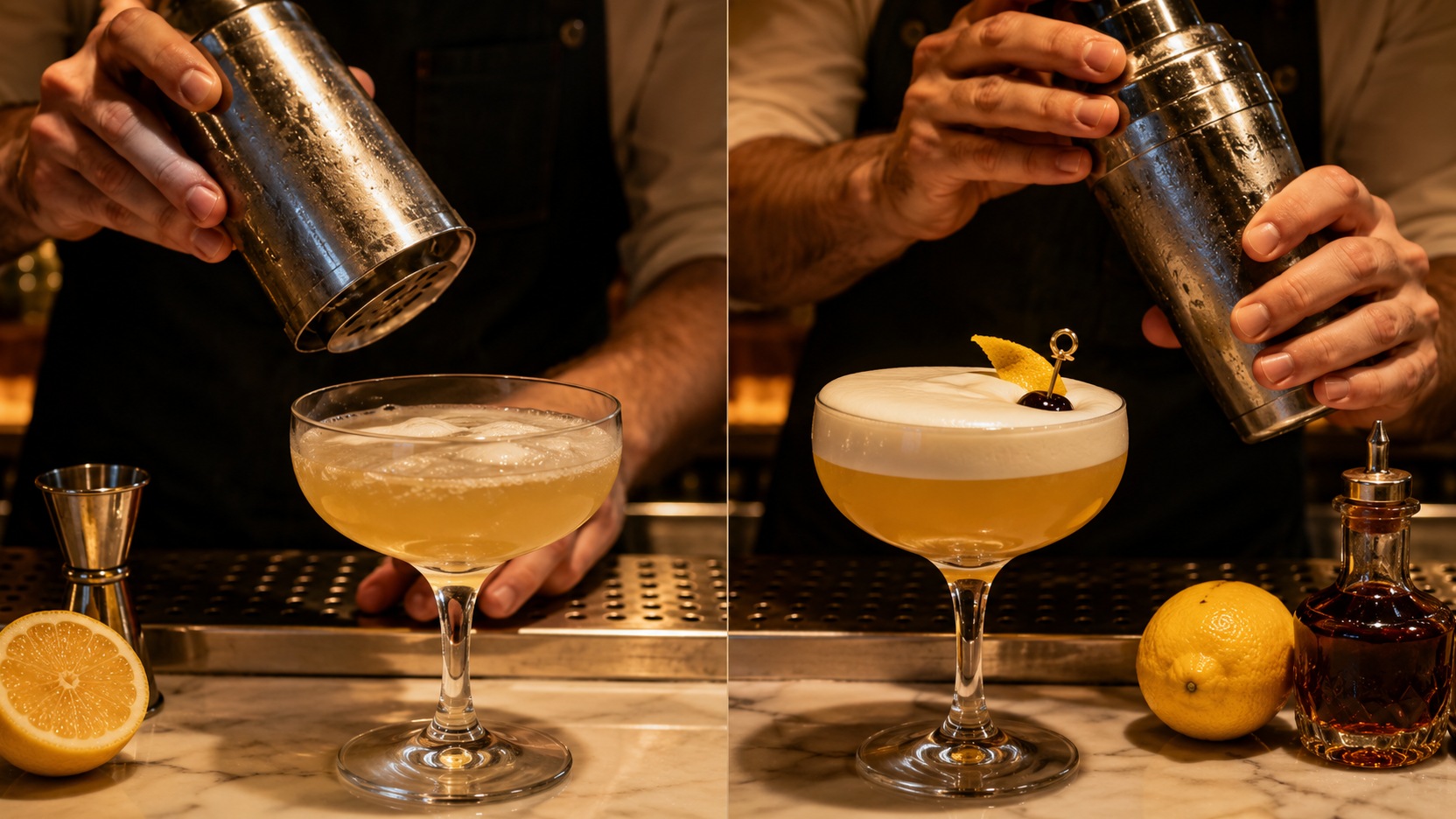
Reverse dry shake usually has an advantage when the goal is a tall, even, visually distinct layer of foam on a Whiskey Sour. Conventional dry shake remains a valid technique and, when well executed, provides good aeration and texture. If the drink forms almost no foam with either method, however, changing only the order of the shakes is unlikely to solve it: fat contamination, the amount or behavior of the egg white, insufficient aeration, and recipe variations may matter more than the sequence.
In 2026, the International Bartenders Association still treats egg white as optional in its Whiskey Sour specification. The official guidance is simple: if egg white is used, the drink should be shaken more vigorously to incorporate the foam. The IBA does not prescribe dry shake or reverse dry shake as a mandatory method. The debate between the two techniques belongs more to bar practice than to a universal rule for the cocktail.
What dry shake and reverse dry shake actually change
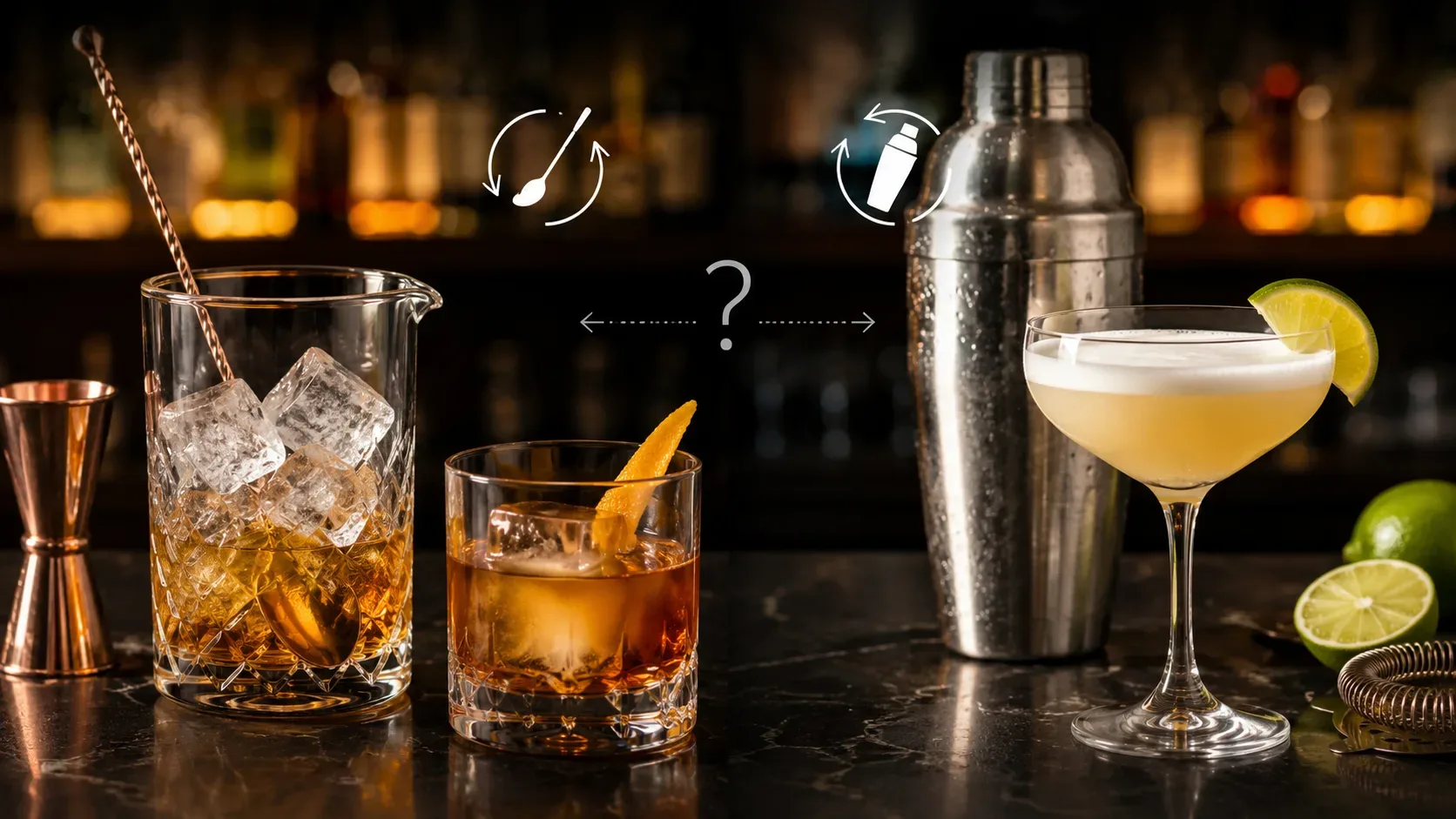
In a conventional dry shake, the ingredients are shaken first without ice. Ice is added only for the second stage, which chills and dilutes the cocktail. The idea is to give the egg white an initial aeration phase without the physical interference of ice cubes and at a higher temperature, a condition that favors foam formation in egg whites.
In a reverse dry shake, the order is reversed. The cocktail is shaken with ice first; then the ice is removed and a second shake is performed without ice. Some versions keep the egg white in from the first shake. Others add the egg white only after straining out the ice. Those two variants are not exactly the same test, because the second one also changes how long the egg white is in contact with alcohol, acid, sugar, and ice.
The most important practical difference is where the process ends. In the conventional method, foam created at the beginning is still shaken together with ice. In the reverse method, final aeration happens after the ice has already been removed. This helps explain why bartenders and practical comparisons often report a larger foam head with reverse dry shake: the final foam does not face another round of impact from the cubes before reaching the glass.
Foam is a protein structure, not just air trapped in the drink
Egg white contains proteins that can reorganize at the interface between air and liquid. Shaking incorporates bubbles and forces those proteins to distribute around them, forming a film that slows the collapse of the foam. It is the same general principle that lets egg white aerate in other preparations, although a cocktail is a very different environment from a meringue because of alcohol, acid, sugar, dilution, and low temperature.
Food science helps explain why technique does not act alone. Fat strongly interferes with the formation of egg-white foam. Acids can contribute to the stability of the protein structure. Sugar can improve stability at certain concentrations, but it can also make initial foam formation slower. Temperature and mixture composition affect the rate of aeration and the resilience of the bubbles. In other words, two Whiskey Sours using the same shaking sequence can behave differently if the rest of the system is not truly identical.
Is reverse dry shake better?
If the question is only which method tends to produce the tallest, most defined layer, reverse dry shake has a plausible practical advantage and is widely adopted. Difford's Guide, for example, describes dry shake as effective for increasing foam but says it gets even more volume with the reverse method. The operational explanation is consistent: the final stage is aeration without ice, followed directly by straining and service.
That does not make reverse dry shake the absolute winner. Conventional dry shake requires less transfer between vessels, is simpler during service, and can give a more integrated sensation between liquid and foam because the entire mixture still passes through a second stage with ice. Foam height is not the only measure of quality, either. A huge layer with large bubbles and rapid drainage can be less pleasant than a slightly smaller foam that is fine and stable.
For home preparation, the practical decision is simple. If the main goal is a taller, more photogenic top, it makes sense to start with reverse dry shake. If dry shake already produces consistent foam and the texture is pleasing, there is no technical reason to abandon it merely because some bartenders consider another sequence more efficient.
How to run a comparison that actually isolates the technique
A useful test needs to change one variable at a time. Use the same recipe, the same whiskey, the same amount of egg white or other foaming agent, the same shaker, the same type and mass of ice, the same shaking time, and glasses in the same condition. Prepare one drink with a dry shake followed by a shake with ice, and another with a shake with ice followed by a dry shake.
If the egg white is added only after the ice is removed in the reverse dry shake, note that this introduces another variable. That version may work very well in practice, but it does not allow you to conclude that the entire difference came only from the order. For the cleanest technique-to-technique comparison, keep the egg white present in both stages of both methods and change only the sequence. Then a second round can test the variant in which the egg white enters only in the final shake.
The evaluation should not stop at a photograph taken immediately after serving. Observe foam height after a few seconds, the apparent size of the bubbles, liquid drainage after a few minutes, separation between foam and cocktail, perceived temperature, and texture on the first sip. Together, these reveal more than measuring
only centimeters of foam.
If the Whiskey Sour still has no foam, look for these signs
Fat on the egg white, glass, or equipment
Traces of yolk, oil, or other fat can sharply reduce egg-white performance. This is one of the classic problems with protein foams. If the technique used to work and stopped working without any other obvious change, review the glass, shaker, strainer, and egg-separation process before endlessly increasing shaking time.
The amount or type of egg white changed
Fresh egg white, pasteurized liquid egg white, and commercial foaming products do not behave interchangeably. Pasteurization and formulation can alter functional properties, and some products contain stabilizers. Repeating the same volume with different brands or types can therefore produce a different texture. The correct diagnosis is to treat an ingredient change as a real variable, not as a neutral detail.
There is too little aeration energy
Dry shake does not simply mean shaking without ice. The stage must actually incorporate air. A poorly sealed shaker, timid movement, or a mixture that occupies too much of the vessel reduces efficiency. When discussing a Whiskey Sour with egg white, the IBA emphasizes exactly the need for more vigorous shaking.
Ice is interfering with the final result
In the classic dry shake, the second shake with ice is necessary for chilling and dilution, but it also happens after foam has already begun to form. Some of that structure can remain on the ice, in the strainer, or be changed by the second stage. If foam appears in the shaker but reaches the glass in a small amount, reverse dry shake is a logical change to test.
Sugar and acidity moved away from the usual balance
Lemon does more than add tartness to the flavor; the acidic environment also affects the protein. Sugar, in turn, can contribute to stability, although higher concentrations may slow foam formation. This does not mean the drink should be sweetened or acidified solely to create volume. It means that recipe changes can change the foam and need to be considered in the diagnosis.
The foam became large but coarse and unstable
More volume is not automatically better. Very large bubbles tend to create a less smooth surface and foam that loses liquid more quickly. When the result looks like a very airy cloud but collapses soon afterward, focusing less on volume and more on smaller bubbles and a more uniform texture can improve the drink. Fine straining can help remove solids and leave a cleaner surface, although it may also retain some foam depending on the strainer and technique.
What the IBA specification helps put into perspective
The current IBA recipe uses bourbon, fresh lemon juice, sugar syrup, and a few drops of egg white as an option. The official method calls for shaking the ingredients with ice and notes that, if egg white is included, the drink should be shaken a little harder to release and incorporate the foam. This matters because it shows that a recognizable Whiskey Sour does not depend on a single dry-shake ritual.
Dry shake and reverse dry shake are optimization techniques. They exist to better control emulsification, aeration, texture, and presentation. When they are treated as if they were mandatory conditions for the cocktail to work, diagnosis becomes worse: the person making the drink may repeat an increasingly long technique while ignoring the real cause of weak foam.
Raw egg white requires a safety decision
If a Whiskey Sour is served with uncooked egg white, the food-safety issue does not disappear because there is alcohol in the glass. The FDA recommends using eggs treated to eliminate Salmonella or pasteurized egg products in recipes served raw or undercooked. For home or professional use, pasteurized egg white is a safer choice when it is available and suitable for the desired result.
That precaution also avoids a common reasoning error: increasing the alcohol content of the drink should not be treated as a method for sanitizing egg white. Food safety and foam formation are different problems and need to be addressed separately.
Which technique to choose for the next Whiskey Sour
To maximize the chance of a tall, clearly separated foam layer, reverse dry shake is the most logical starting point. Chill and dilute the cocktail with ice, remove the ice, and perform the final aeration without cubes before serving. If the recipe already works well with the classic dry shake, however, switching is optional: the visual gain may not justify an extra step in the workflow.
If neither sequence produces foam, stop comparing the order and investigate the foundation of the process. Cleanliness and the absence of fat, egg-white behavior, recipe proportion, shaking vigor, and ice consistency are more useful candidates than simply shaking for longer.
The conclusion is less dramatic than the debate suggests. Reverse dry shake tends to favor visible foam; dry shake remains fully functional; and foam that will not hold may be telling you that the problem is not the shake order. The best test is one in which only one variable changes and the result is evaluated by volume, stability, texture, and temperature, not just by a photo of the glass.